




ABE NEWS | SEPTEMBER 18, 2026
This was the week when several assumptions underpinning the global economy became harder to defend.
Investors who spent years waiting for cheaper money watched the Federal Reserve raise interest rates for the first time in more than three years. Japan pushed borrowing costs to their highest level in three decades. Oil remained above $100 a barrel as conflict in the Middle East strained energy markets. The debate over artificial intelligence moved from excitement about capability to an extraordinary argument among some of the industry’s most powerful figures about whether development is moving too quickly.
Yet financial markets did not collapse under the pressure. U.S. equities remain close to record territory, capital continues moving into technology, and companies are still investing.
The result is an unusually complicated global business environment: money is becoming more expensive, energy is becoming less predictable, AI is becoming more powerful, and geopolitics is increasingly determining the conditions under which companies operate.
Here are the five stories that defined the business week.
1. THE FEDERAL RESERVE CHANGED DIRECTION
Wednesday delivered the week’s most important monetary-policy decision.
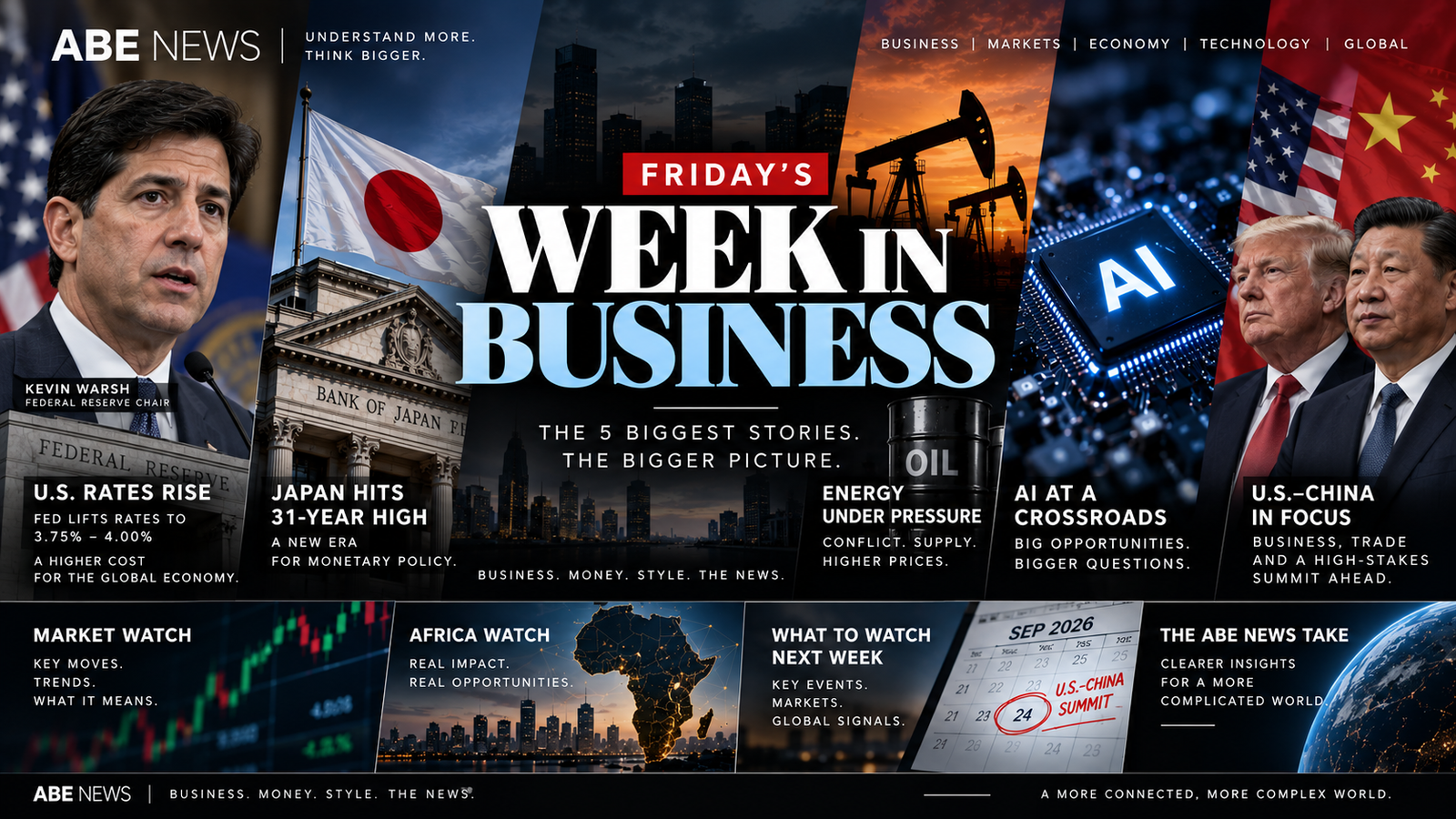
The Federal Reserve raised its benchmark rate by 25 basis points to 3.75%–4.00%, its first increase in more than three years. More importantly, policymakers indicated that the move may not be isolated: 16 of 18 officials projected at least one additional quarter-point increase before the end of 2026.
That marks a significant change in the economic narrative.
For much of the post-inflation period, investors were debating how quickly central banks would lower rates. Persistent price pressures — now complicated by higher energy costs associated with the Iran war — have forced policymakers to reconsider.
The Federal Reserve is not alone.
The European Central Bank has already raised rates, the Bank of England held this week but signalled it could tighten if inflation pressures persist, and financial markets are contemplating another series of increases across major economies.
That changes the environment for almost every business dependent on capital.
Higher benchmark rates can feed into corporate borrowing, mortgages, commercial real estate, private-equity transactions, startup financing and government debt costs.
The question entering the final months of 2026 is therefore no longer simply when monetary policy becomes easier.
It is whether the world is entering another rate-hiking cycle before the previous inflation battle was fully considered over.
2. JAPAN JUST CROSSED A 31-YEAR LINE
The Bank of Japan provided perhaps the clearest symbol of how dramatically the monetary environment has changed.
On Friday, it raised its policy rate to 1.25% — the highest level since 1995. Governor Kazuo Ueda said Japan’s policy phase had changed as the central bank shifted from trying to generate inflation toward preventing it from exceeding its target.
That statement carries enormous historical weight.
Japan spent decades associated with ultra-low interest rates, deflation and extraordinary monetary stimulus. Now its central bank is discussing continued tightening.
But markets produced a paradox.
Instead of strengthening after the increase, the yen weakened as traders focused partly on disagreement among policymakers and the still-wide interest-rate gap between Japan and other major economies.
The story therefore extends beyond Japan.
When the Fed, ECB and Bank of Japan are all confronting inflation at roughly the same time, global capital must adjust to a world in which higher rates are not merely an American phenomenon.
Reuters described the possibility of a renewed global rate-hiking cycle as increasingly visible.
That is one of the most consequential economic developments of the week.
3. ENERGY HAS RETURNED TO THE CENTER OF THE GLOBAL ECONOMY
Central banks are tightening partly because another force has returned: expensive energy.
The Iran war and wider disruption across the Middle East have put sustained pressure on oil and refined-fuel markets. Brent remained above $100 a barrel on Friday, while governments increasingly confront the economic consequences of prolonged disruption.
The pressure extends beyond crude.
Diesel — essential to trucks, agriculture, construction and global logistics — has become particularly expensive. That matters because diesel costs can travel through supply chains, increasing the expense of moving goods long before consumers see the final price.
There is also an extraordinary reshuffling occurring in global oil trade.
Russia’s ESPO crude climbed above $120 a barrel this week as Chinese refiners sought alternative supplies amid Middle Eastern disruptions. Reuters reported that premiums for the grade over benchmark Brent reached record levels, while Russian Urals crude reached about $110.
Energy security is consequently becoming a government-level issue again.
French President Emmanuel Macron said Friday that the G7 plans to meet in the coming weeks to discuss the energy crisis, including potential cooperation on strategic reserves and supply restrictions.
The significance reaches well beyond oil companies.
Expensive energy influences transportation, manufacturing, food, inflation, consumer spending and ultimately interest rates.
That creates a chain:
Geopolitical disruption → energy shock → higher business costs → inflation → tighter monetary policy → more expensive capital.
Much of this week’s economic story can be understood through that sequence.
4. AI’S BOOM COLLIDED WITH AN EXTRAORDINARY SAFETY DEBATE
Artificial intelligence entered unfamiliar territory this week.
The debate was no longer simply about which company has the best model or who can build the largest data centre.
Some leaders of frontier AI companies began openly questioning whether the technology itself is advancing too quickly.
Anthropic CEO Dario Amodei argued for slowing the pace of capability improvements. Reuters reported that Sam Altman and Elon Musk also publicly expressed agreement with concerns about the speed of development, although major industry figures disagree sharply over what regulation or restraint should look like.
President Donald Trump rejected calls to slow U.S. development, framing the issue partly through competition with China. Nvidia CEO Jensen Huang has also argued against new regulation that could constrain innovation, while other AI leaders have called for stronger oversight.
Markets noticed.
Technology stocks have weakened from earlier highs amid questions about whether AI development or spending could slow. Yet the sector remains enormously important: technology represents roughly 38% of the S&P 500, and the sector remains up more than 20% in 2026 despite losing ground since June.
Meanwhile, the technology itself keeps advancing into new industries.
Anthropic confirmed this week that it operates a physical biology laboratory in the San Francisco Bay Area, part of a broader push to connect AI with scientific research and eventually automated laboratory work.
That captures the contradiction surrounding AI in 2026.
Companies are warning that increasingly capable systems could introduce serious risks while simultaneously investing billions to make those systems more capable and useful.
The commercial race and the safety debate are no longer separate stories.
They are becoming the same story.
5. U.S.–CHINA COMPETITION IS BECOMING A CORPORATE STORY
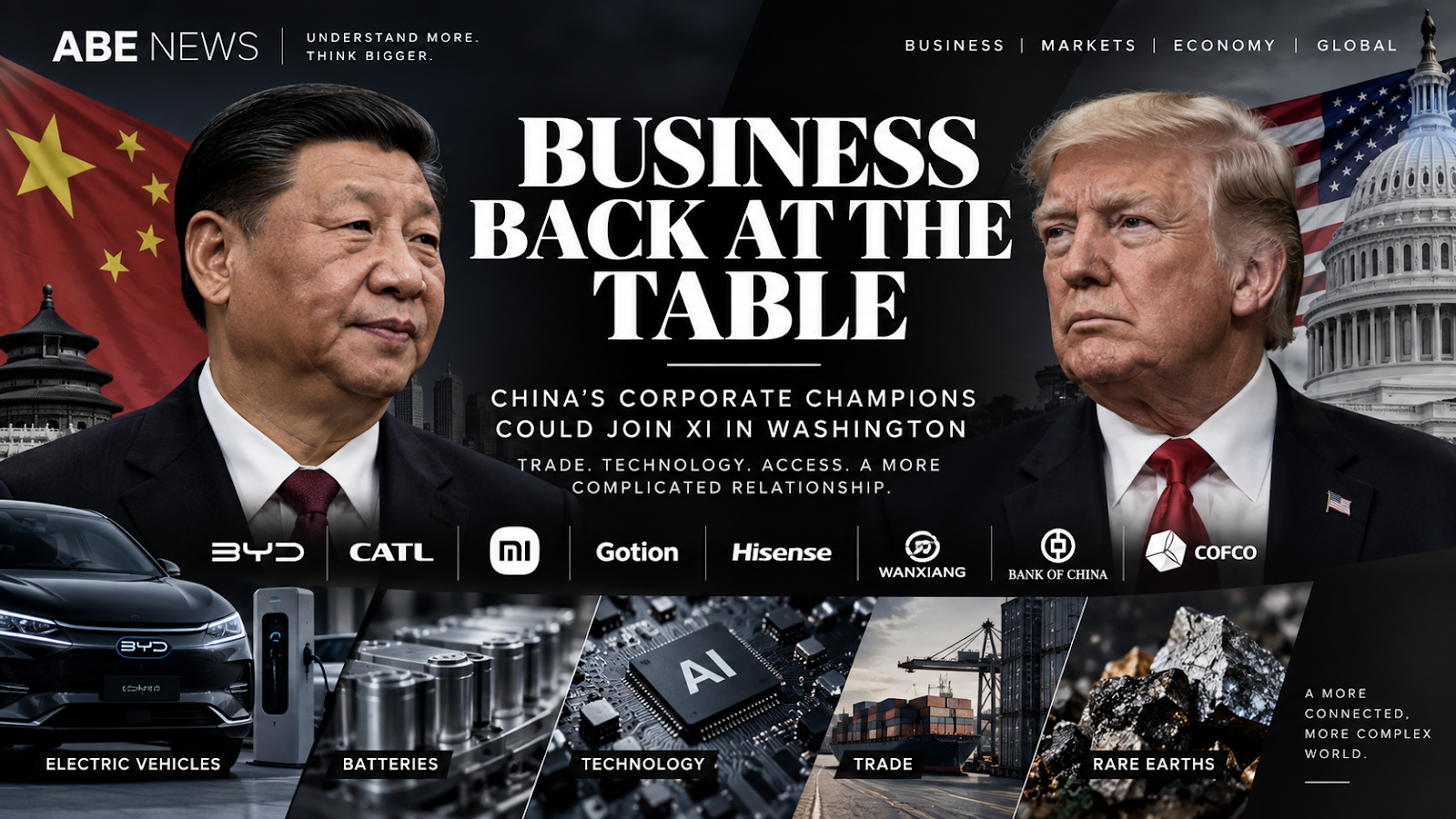
Next week’s meeting between Donald Trump and Xi Jinping was already casting a shadow over business markets before this week ended.
Xi is expected in Washington for a September 24 summit, and Reuters reported Friday that Beijing and Washington are working on a possible delegation of major Chinese business leaders to accompany him.
Executives from BYD, CATL, Xiaomi, Gotion, Hisense, Wanxiang, Bank of China and COFCO are among those under consideration, although the final delegation has not been confirmed.
The names tell the story.
Electric vehicles. Batteries. Consumer technology. Finance. Agriculture. Advanced manufacturing.
These are precisely the industries where economic competition between the United States and China has intensified.
The summit itself is expected to touch trade, agricultural purchases, Boeing aircraft, technology restrictions, rare-earth supplies and the tariff truce scheduled to expire in November. Artificial intelligence could also enter the discussions.
The emerging relationship is therefore more complicated than conventional descriptions of either “decoupling” or cooperation.
The world’s two largest economies are simultaneously trying to reduce strategic dependence on one another while negotiating access to one another’s companies, technology, materials and consumers.
Next week’s summit will test how much economic accommodation remains possible.
MARKET WATCH
Despite a week filled with higher rates, expensive energy and geopolitical uncertainty, financial markets have shown notable resilience.
The S&P 500 remains more than 11% higher for 2026 and roughly 2% below its mid-August record, according to Reuters. Stocks strengthened Thursday as oil and Treasury yields retreated, even after the Fed’s increase.
The bond market deserves closer attention.
The benchmark 10-year U.S. Treasury yield tested 5% this week — a psychologically important threshold because Treasury yields influence borrowing costs throughout global finance.
Oil remains another critical marker. Investors have increasingly treated roughly $100-a-barrel oil and a 5% 10-year Treasury yield as important pressure points for risk assets.
Europe finished the week unevenly. Britain’s FTSE 100 fell 1.4% Friday but still recorded a small weekly gain, while the FTSE 250 posted its strongest weekly advance since early August.
And in currencies, Japan demonstrated that tighter policy does not automatically produce a stronger currency: the yen weakened despite the Bank of Japan’s historic rate increase.
The remarkable feature of markets right now is not that risks are absent.
It is that investors continue absorbing them.
AFRICA WATCH
Africa enters next week facing a familiar vulnerability with a new source of pressure: expensive dollars and expensive energy at the same time.
Reuters’ latest currency survey found that the Ugandan shilling, Ghanaian cedi and Zambian kwacha are expected to remain under pressure, while Nigeria’s naira and Kenya’s shilling are expected to be comparatively stable.
Uganda illustrates the problem particularly clearly.
Its shilling weakened to around 3,925–3,935 per U.S. dollar, compared with 3,860–3,870 the previous Thursday, as manufacturers and energy companies increased demand for dollars. One trader told Reuters the currency could test 4,000 per dollar, which would represent a record low.
Ghana is experiencing its own dollar-demand pressure from energy and service companies, although central-bank support and revenues connected with gold are helping provide some stability. Zambia’s kwacha has also weakened amid corporate and import demand for dollars.
Nigeria and Kenya are proving more stable for now.
This is exactly why Africa belongs inside the global business story rather than outside it.
A conflict thousands of kilometres away can raise energy costs. Higher energy costs increase demand for dollars among importers. A stronger need for foreign currency can weaken local currencies. Currency depreciation can make imports still more expensive, adding inflation pressure and complicating central-bank policy.
For African businesses importing fuel, machinery, technology or raw materials, the global energy and interest-rate shock is therefore not abstract.
It can arrive directly on the balance sheet.
WHAT TO WATCH NEXT WEEK
Next week could be even more consequential.
The central event arrives Thursday, September 24, when Xi Jinping meets Donald Trump in Washington. Trade, technology restrictions, critical minerals, agricultural purchases, Boeing aircraft, Taiwan, Iran and artificial intelligence are among the issues surrounding the summit.
Markets will also get new U.S. flash PMI data on Wednesday, offering another reading on manufacturing and economic activity at precisely the moment Treasury yields are testing 5% and the Fed has resumed raising rates.
Fed officials will speak throughout the week, and investors will search their comments for clues about whether another increase could arrive as soon as October. Futures markets late Thursday implied roughly even odds of another hike at that meeting.
The 81st United Nations General Assembly High-Level Week will bring world leaders to New York amid conflicts in Ukraine and the Middle East, concerns over sovereign debt and an intensifying international debate over AI governance.
Indonesia also has an important central-bank decision Wednesday under new governor Destry Damayanti, with markets watching the country’s monetary and fiscal direction after recent changes among senior economic officials.
And hanging above all of it will be two numbers:
5% on the U.S. 10-year Treasury.
$100 on oil.
If either moves decisively higher again, markets may have to reconsider just how much pressure the global economy can absorb.
🔴 THE ABE NEWS TAKE
There is a common thread connecting nearly every major business story this week.
The price of security is rising.
Governments want energy security, so they are reconsidering supply chains and strategic reserves.
The United States and China want technological security, so access to semiconductors, batteries, rare earths and AI is increasingly treated as a strategic issue rather than ordinary commerce.
AI companies want safety from systems they themselves are racing to make more capable.
Central banks want price stability, so they are prepared to make money more expensive even when businesses and households would prefer relief.
These decisions look separate when viewed individually.
Together, they reveal an economic system moving away from the assumptions that defined much of globalization: cheap capital, predictable energy, frictionless supply chains and the idea that companies could operate largely independently of geopolitics.
The replacement is not deglobalization in any simple sense. Trade continues. Capital still crosses borders. Chinese executives may arrive in Washington next week seeking greater market access. American technology companies still want enormous international markets.
But efficiency increasingly has a competitor: resilience.
Businesses may have to pay more to borrow, diversify where they manufacture, secure alternative energy supplies, comply with competing technology regimes and protect themselves against geopolitical disruption.
That is expensive.
And that may be the defining business question emerging from this week:
How much efficiency is the global economy willing to sacrifice for security — and who ultimately pays for it?
ABE NEWS
Business. Money. Style. The News.
Understand More. Think Bigger.