






ABE NEWS | SEPTEMBER 18, 2026
For much of the past two years, investors, companies and households had been waiting for the next great turn in monetary policy: the point at which inflation would retreat far enough for central banks to make money steadily cheaper again.
This week delivered something very different.
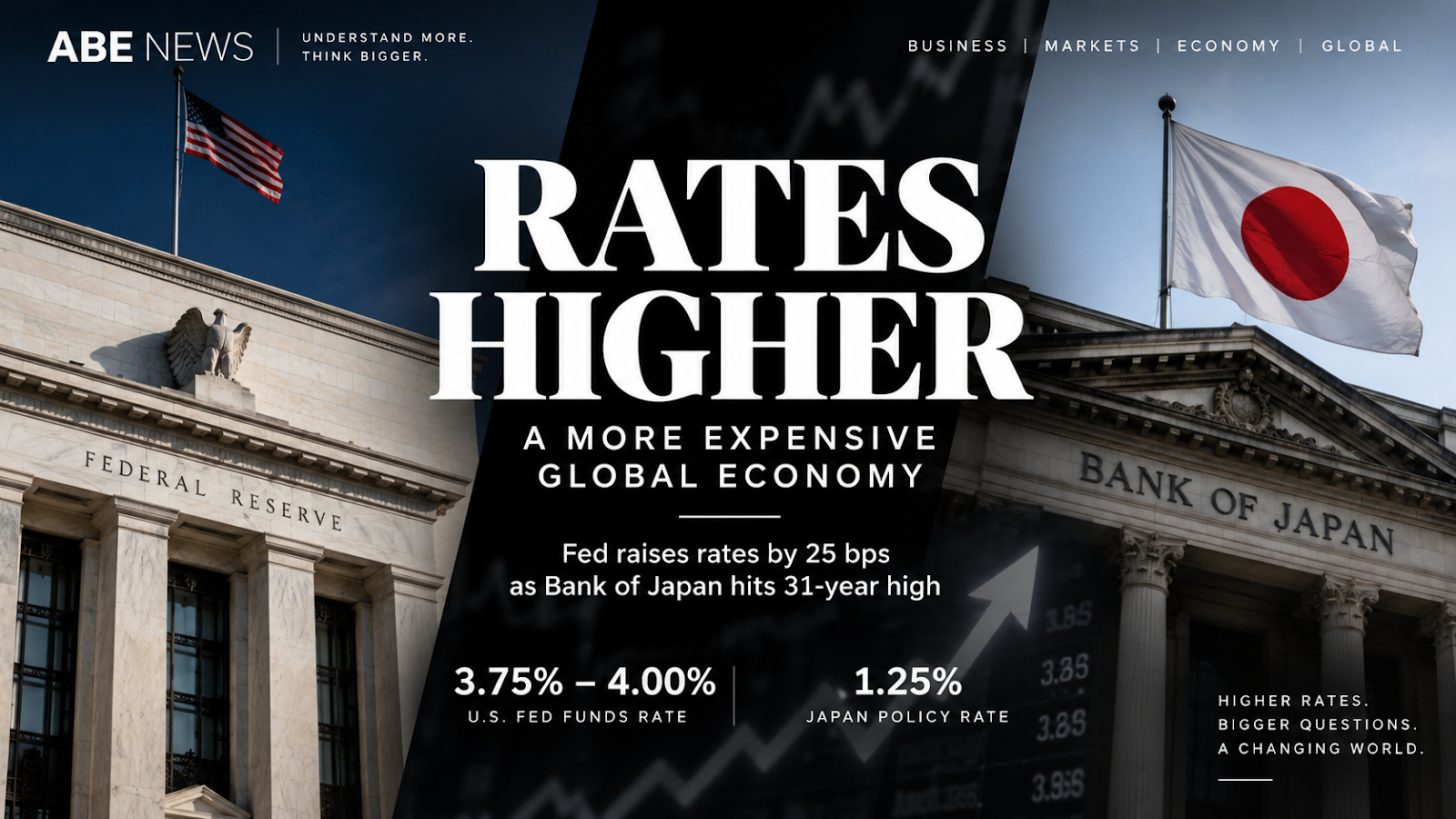
The U.S. Federal Reserve raised its benchmark interest rate by a quarter percentage point on Wednesday, taking its target range to 3.75%–4.00%. It was the Fed’s first rate increase in three years and its first policy change under Chair Kevin Warsh. On Friday, the Bank of Japan followed with another increase of its own, lifting its policy rate from 1% to 1.25% — its highest level in 31 years.
These are decisions from two very different economies, but together they tell a larger story. Inflation has again become difficult enough that some of the world’s most important central banks are moving toward tighter monetary policy, even as businesses and financial markets are already confronting elevated borrowing costs, geopolitical uncertainty and energy prices above $100 a barrel.
THE FED HAS CHANGED DIRECTION
The Federal Reserve’s decision was unanimous.
The Federal Open Market Committee voted 12–0 to increase rates by 25 basis points. In its statement, the Fed said economic activity continued to expand at a solid pace, domestic spending remained resilient, productivity growth was strong and capital investment was robust. But the central problem was inflation, which the central bank said remained elevated.
That matters because the increase represents more than another adjustment to the cost of money. It marks a reversal in the direction investors had spent years anticipating.
Fed officials are increasingly concerned that inflationary pressure is no longer confined to temporary disruptions. Energy costs associated with the Middle East conflict, U.S. tariffs and strong investment — including spending associated with the artificial-intelligence boom — have contributed to the inflation environment confronting policymakers.
The Fed’s latest projections also suggest Wednesday’s increase may not be the end of the tightening cycle. Sixteen of the 18 policymakers who submitted interest-rate projections expected at least one additional quarter-point increase before the end of 2026.
For businesses, that changes the calculation. Companies that had been planning around progressively cheaper financing may instead have to operate in an environment where capital remains expensive for longer — or becomes more expensive still.
JAPAN’S 31-YEAR HIGH SHOWS HOW MUCH THE WORLD HAS CHANGED
Japan’s decision carries a different historical significance.
For decades, the country was associated with extraordinarily low interest rates, weak inflation and aggressive monetary stimulus. The Bank of Japan’s latest increase pushes its policy rate to 1.25%, the highest since 1995. The decision passed by a 7–2 vote.
The central bank is attempting to prevent inflation from moving persistently beyond its 2% target as Japan continues its retreat from the ultra-loose monetary policies that defined much of its modern economic era.
Yet markets produced an important reminder that central-bank policy does not operate in isolation.
Despite the rate increase, the yen weakened sharply on Friday. Reuters reported the dollar was up about 1.2% against the Japanese currency at one point, while the yen was heading toward its worst weekly performance against the dollar in two years.
Part of the explanation lies outside Japan: U.S. interest rates are moving higher too.
When both countries are tightening, investors must compare not simply whether rates are rising, but the relative attractiveness of assets across markets. The Fed’s renewed tightening therefore complicates Japan’s attempt to strengthen its currency through higher domestic rates.
THE REAL STORY IS BECOMING GLOBAL
The Fed and Bank of Japan are not isolated cases.
September has produced the largest increase in average interest rates across the Group of Ten economies since July 2023, according to Reuters, with four central banks raising rates and others signalling that further tightening may become necessary. The European Central Bank has also indicated additional tightening could be required, while the Bank of England held rates this week but warned that prolonged geopolitical disruption could force another increase.
One of the forces connecting these decisions is energy.
Oil remains above $100 a barrel as the Middle East conflict continues to disrupt expectations for global energy supplies. Brent crude eased on Friday, but strains remain visible in physical oil markets.
That creates an uncomfortable problem for central banks.
Higher energy prices can increase transportation, manufacturing and operating costs throughout an economy. Businesses may pass some of those costs to consumers, workers can demand compensation for higher living expenses, and inflation that initially originated from an external shock can spread more broadly.
Central banks then face a difficult choice: tolerate inflation for longer or increase borrowing costs and risk slowing economic activity.
Increasingly, they are signalling that persistent inflation is the greater danger.
THE BOND MARKET IS SENDING ITS OWN WARNING
The consequences are already appearing in global bond markets.
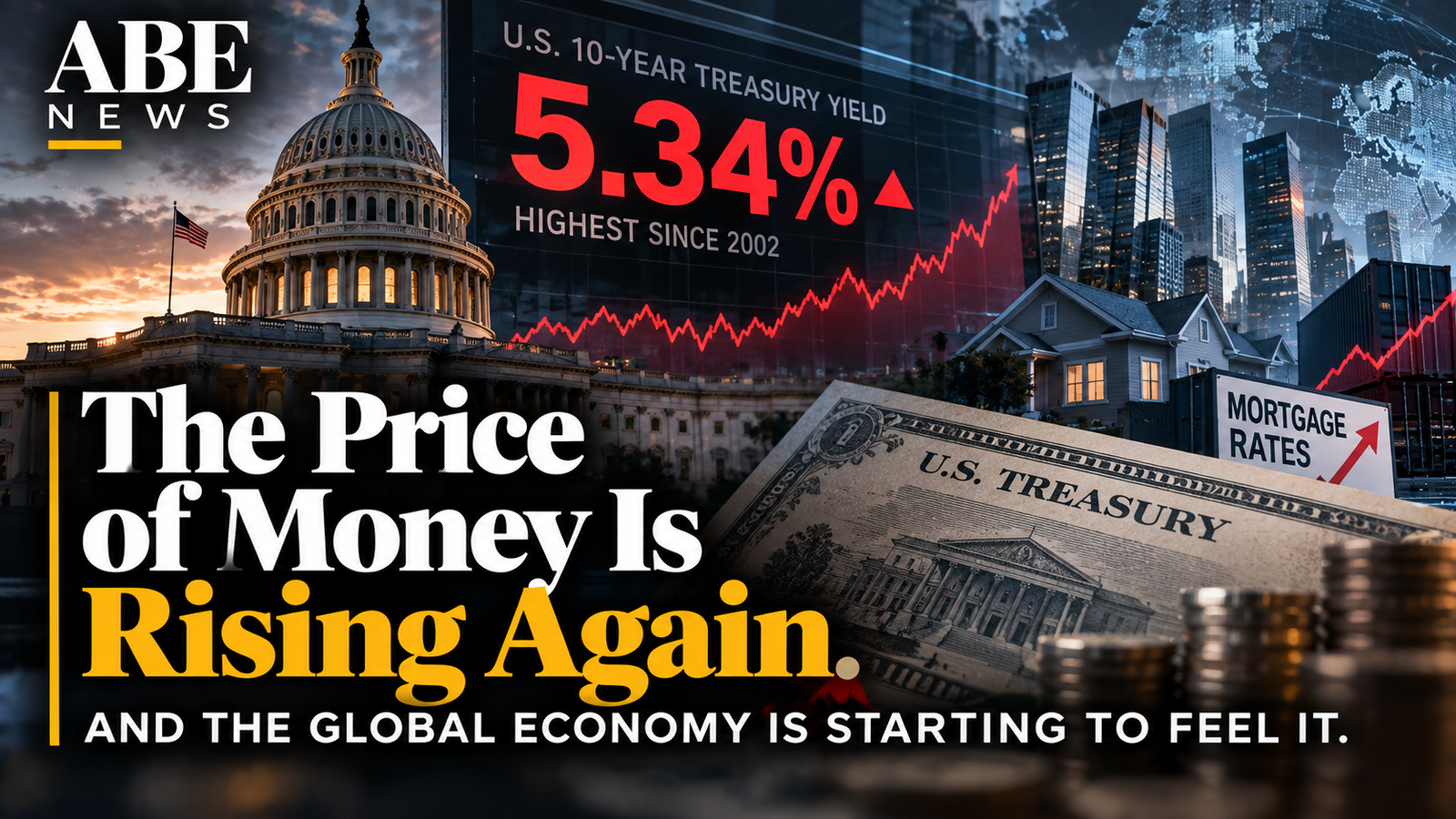
The yield on the benchmark 10-year U.S. Treasury briefly moved above 5% this week, reaching its highest level since 2007, before easing to around 4.96% on Friday. Bond yields in Britain and across the euro area have also reached multi-year highs.
That number extends far beyond Wall Street.
Government bond yields help establish the price of money throughout an economy. When benchmark yields remain elevated, financing can become more expensive for governments, corporations, property developers and households.
The implications therefore move from trading screens into real economic decisions: whether a company finances an acquisition, whether a developer proceeds with a project, whether a startup raises another round of capital, or whether a household can afford a mortgage.
And yet investors have not abandoned equities.
Bank of America Global Research reported Friday that investors poured money into U.S. stocks at the fastest pace in three months during the latest week, even while pulling money from corporate bonds.
That divergence is worth watching. Investors are simultaneously confronting tighter monetary policy and continuing to place substantial capital into American equities.
THE ERA OF CHEAP MONEY MAY BE FURTHER AWAY THAN MARKETS EXPECTED
The larger shift is psychological as much as financial.
Companies and investors spent years adjusting to a world in which inflation was expected to fall and central banks would eventually have room to reduce borrowing costs. The events of this week challenge that assumption.
The Federal Reserve now says inflation remains elevated. Japan is raising rates to levels unseen in three decades. Major government-bond yields are testing levels associated with the period before the global financial crisis. Energy prices are once again feeding inflation concerns across multiple economies.
None of this means the world is returning permanently to the interest-rate environment of previous decades. Inflation, economic growth and geopolitical conditions can change.
But it does mean businesses can no longer build strategies around the assumption that cheaper money is inevitably just around the corner.
🔴 THE ABE NEWS TAKE
The most important development this week is not simply that the Federal Reserve raised rates or that Japan reached a 31-year high. It is that the global economy is being forced to reconsider one of its most comfortable assumptions: that inflation had largely been defeated and monetary policy would gradually become easier.
The new environment is more complicated.
Geopolitical conflict can move energy prices. Tariffs can affect import costs. An investment boom in artificial intelligence can strengthen capital spending and demand. Central banks can respond by tightening policy — and higher rates can then change valuations, borrowing decisions and the economics of investment across the world.
That creates a particularly important test for businesses built during the expectation of progressively cheaper capital. Companies with strong cash generation and productive investment opportunities may continue to expand. Businesses dependent on refinancing, inexpensive debt or distant future profits face a more demanding environment.
And the next question is already forming.
The Fed’s projections indicate additional tightening may come. The Bank of Japan says its policy remains accommodative even after Friday’s increase. Meanwhile, the U.S. 10-year Treasury yield has already tested 5%.
The defining financial question may therefore be shifting from “When will rates come down?” to something much more consequential:
What happens if higher rates are not temporary at all?
ABE NEWS
Business. Money. Style. The News.
Understand More. Think Bigger.