





ABE NEWS | September 15, 2026
For much of the past few years, the global economy has been waiting for relief.
Inflation had retreated from its worst levels, businesses had adjusted to a world of higher interest rates, and investors were increasingly looking toward the moment when borrowing costs could finally begin moving lower. The expectation was not necessarily that cheap money would return, but that the extraordinary pressures created by the inflation shock would gradually become easier to manage.
Instead, two of the most important prices in the global economy are moving in the wrong direction at exactly the same time.
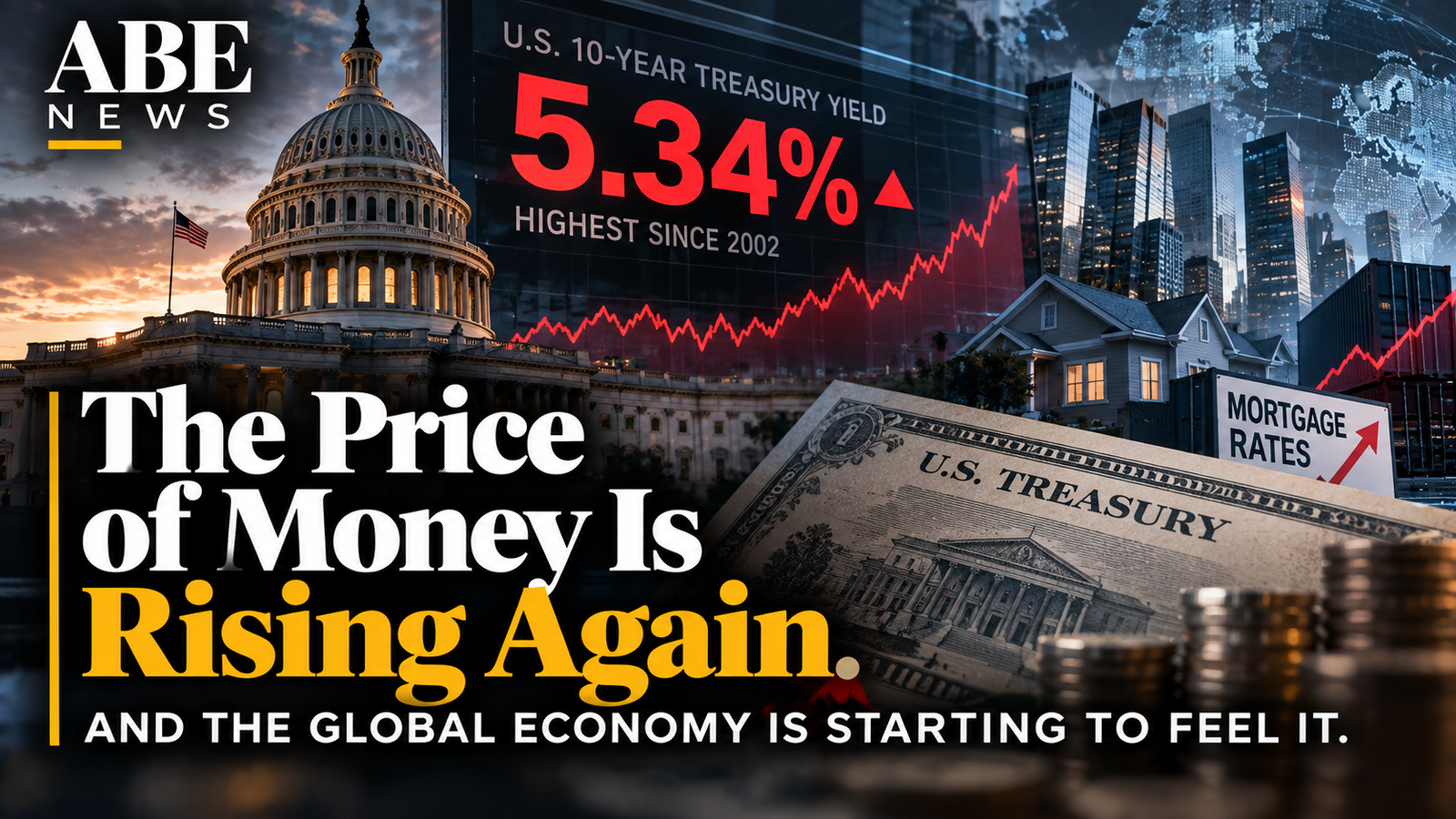
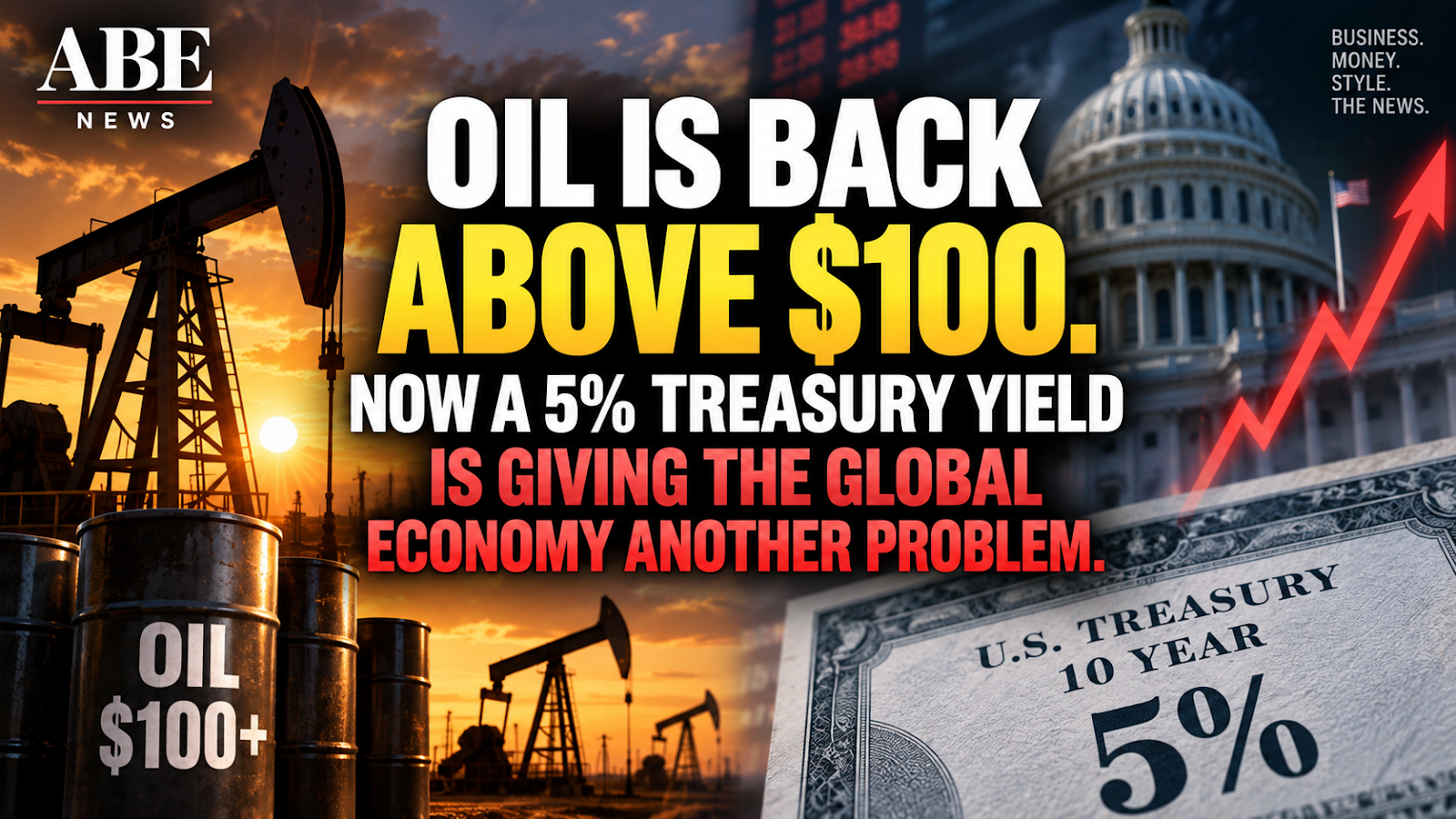
Oil is back above $100 a barrel, with Brent crude trading around $108 on Tuesday as renewed disruptions to global energy supplies pushed prices higher. At the same time, the yield on the benchmark 10-year U.S. Treasury has crossed 5%, taking one of the world’s most important borrowing benchmarks to levels not seen since before the global financial crisis.
Those numbers belong to very different markets, but together they create a problem that reaches far beyond traders on Wall Street. Oil influences the cost of transportation, manufacturing, agriculture and global supply chains, while Treasury yields help determine what households, companies and governments pay to borrow.
The world is therefore confronting something considerably more uncomfortable than another volatile day in financial markets: energy is becoming more expensive at the same time that money is becoming more expensive.
And if both remain that way, the consequences could eventually reach almost every major part of the economy.
THIS ISN’T REALLY JUST AN OIL STORY
The immediate reason oil has moved higher is supply.
Brent crude rose nearly $3 to about $108.49 a barrel on Tuesday, while West Texas Intermediate climbed to roughly $104.68, after a new series of disruptions raised concerns about how reliably crude can continue reaching the global market.
Oil loadings were halted at Saudi Arabia’s Red Sea port of Yanbu following Houthi attacks, while operations at three Libyan oil fields were suspended amid protests affecting a key pipeline. The disruptions arrive as attacks involving energy infrastructure elsewhere have already made global supply increasingly difficult to predict.
Saudi Arabia matters particularly because it is not simply another oil producer. The kingdom is one of the world’s most important exporters and has historically possessed something extremely valuable in energy markets: the ability to increase production when other suppliers run into trouble.
That makes disruption to Saudi infrastructure particularly sensitive for traders.
But the larger economic problem begins after the oil leaves the ground.
Modern economies still depend heavily on petroleum. Airlines need jet fuel, trucks need diesel, ships carry products across oceans using fuel, manufacturers consume enormous amounts of energy, and petroleum-derived materials appear throughout industrial supply chains. Agriculture also depends on energy for machinery, fertilizers, processing and transportation.
A sustained increase in crude prices therefore does not remain confined to the petrol station. It gradually becomes a cost faced by businesses throughout the economy.
Companies can absorb some of that increase through lower margins. Eventually, however, many will attempt to pass at least part of it to customers.
That is where an energy problem can become an inflation problem.
THE WORLD THOUGHT THE INFLATION FIGHT WAS GETTING EASIER
Central banks spent years trying to repair the damage caused by the inflation surge that followed the pandemic and subsequent supply shocks.
Interest rates rose sharply. Mortgage payments increased. Corporate borrowing became more expensive. Housing markets slowed. Investors had to reconsider what companies were worth when capital was no longer almost free.
The pain had a purpose.
Higher rates were supposed to reduce demand sufficiently to bring inflation under control, allowing monetary policy eventually to become less restrictive.
Expensive oil threatens to complicate that process.
Central banks cannot produce more crude, repair pipelines or end geopolitical conflicts by changing interest rates. But policymakers do care enormously about what happens after an energy shock reaches the wider economy.
If businesses begin raising prices to compensate for higher transportation and production costs, and workers begin demanding higher wages to compensate for more expensive living costs, an initially temporary increase in oil can become more persistent inflation.
That creates a difficult choice.
Cut interest rates too quickly and policymakers risk allowing inflation to accelerate again. Keep rates high for too long and they risk unnecessarily weakening households, businesses and economic growth.
The bond market is already forcing investors to confront that possibility.
5% MAY BE THE MORE IMPORTANT NUMBER
Oil above $100 attracts attention because everyone understands what expensive energy feels like.
A 5% 10-year Treasury yield sounds considerably more technical.
It may ultimately matter just as much.
The U.S. Treasury market sits near the centre of the global financial system. Treasury securities are treated as a benchmark against which countless other investments and borrowing decisions are evaluated. When their yields rise, the consequences spread into mortgages, corporate debt, government financing and asset valuations.
The 10-year yield moving above 5% therefore represents something much larger than investors selling government bonds.
It represents a higher price for capital.
For a household trying to purchase a home, that can mean a more expensive mortgage. U.S. 30-year mortgage rates have recently been around 6.85%, keeping affordability under pressure and making it harder for the housing market to regain momentum.
For a corporation, the calculation can involve hundreds of millions or billions of dollars.
Suppose a company wants to build a factory, purchase a competitor, construct a data centre or expand into another country. Management has to compare the expected return from that investment with the cost of obtaining the capital required to finance it.
When capital becomes more expensive, some projects stop making financial sense.
That is one of the quiet ways higher interest rates slow an economy. Companies do not necessarily announce that a 5% Treasury yield forced them to abandon growth. They simply decide that fewer investments produce returns high enough to justify the risk.
Multiply that calculation across thousands of businesses and the economic consequences become significant.
THE AI BOOM NOW HAS AN INTEREST-RATE PROBLEM TOO
There is another reason the bond market matters particularly now.
The artificial-intelligence boom is becoming one of the largest capital-investment cycles in modern technology.
AI requires semiconductor factories, servers, data centres, networking equipment, electricity generation, transmission infrastructure and enormous amounts of land and construction. Technology companies and their partners are committing extraordinary amounts of money to build that infrastructure.
That spending has helped support economic growth and contributed to investor enthusiasm around some of the world’s largest companies.
But AI infrastructure does not exist outside the financial system.
A data centre costing billions of dollars still has to produce an acceptable return. Energy projects built to power those facilities still need financing. Semiconductor manufacturers still have to decide whether the expected demand justifies constructing new production capacity.
Higher bond yields raise the hurdle those investments have to clear.
That does not mean the AI boom suddenly stops because the 10-year Treasury crosses 5%. Companies with enormous cash reserves can continue investing aggressively, and demand for computing infrastructure remains substantial.
But expensive capital changes the economics.
Projects that looked attractive when financing was cheaper may look less compelling when investors can earn around 5% simply by holding U.S. government debt.
That comparison matters because investors do not evaluate stocks in isolation. They constantly compare the potential return from taking risk with the return available from safer assets.
The higher the risk-free alternative becomes, the more companies have to prove that their future profits justify today’s valuations.
OIL AND BONDS ARE STARTING TO REINFORCE EACH OTHER
This is what makes the current situation particularly difficult.
The energy market and the bond market are not two unrelated problems occurring at the same time. One can make the other worse.
If oil remains expensive, inflationary pressure can increase. If inflation remains elevated, the Federal Reserve and other central banks have less room to lower interest rates. If investors believe rates will remain higher for longer — or potentially rise further — they may demand higher yields from government bonds.
Higher yields then increase borrowing costs across the economy, reducing investment and putting additional pressure on households.
That creates a chain running from an oil facility thousands of kilometres away to a mortgage application, corporate investment decision or government budget.
The connection helps explain why markets are paying such close attention to the Federal Reserve.
The question is no longer simply whether policymakers believe inflation has improved enough to begin easing monetary policy. They now have to determine how much of the latest energy shock could eventually appear in consumer prices and whether the economy can tolerate another period of restrictive financial conditions.
That is a much more uncomfortable conversation than investors expected to be having at this stage of the cycle.
WALL STREET ISN’T PANICKING — AND THAT MATTERS
Despite everything happening in oil and bonds, financial markets have not collapsed.
The S&P 500 remains relatively close to its August record, with strong corporate earnings and continued optimism surrounding artificial intelligence helping support equities even as government borrowing costs rise.
That resilience matters because it tells us investors are not currently treating $100 oil and a 5% Treasury yield as evidence that a recession or financial crisis is inevitable.
There are legitimate reasons for that confidence.
Corporate America remains profitable. Consumers have repeatedly proved more resilient than economists expected. Major technology companies continue investing. Banks are considerably better capitalized than they were heading into the 2008 financial crisis. And businesses have had years to adjust to an environment where interest rates are much higher than they were during the decade after that crisis.
But there is an important distinction between an economy being capable of absorbing a shock and an economy being unaffected by one.
Duration changes everything.
A logistics company can absorb unusually expensive diesel for several weeks. An airline can hedge part of its fuel exposure. A homeowner can delay purchasing a property. A corporation can postpone refinancing debt. A government can temporarily accept higher interest payments.
Those adjustments become progressively more difficult if the conditions last for months or years.
That is why the next question is not simply whether markets fall tomorrow.
It is whether $100 oil and 5% borrowing benchmarks become temporary spikes or a new economic reality.
THIS PROBLEM DOESN’T STOP AT THE U.S. BORDER
The global nature of both markets makes the situation particularly important outside the United States.
Oil is traded internationally, and the U.S. Treasury market influences financial conditions around the world.
Countries that import large quantities of energy can therefore be hit from several directions at once. They pay more for crude, their currencies may weaken against the dollar, and governments or businesses seeking financing may encounter higher borrowing costs.
India is already experiencing some of that pressure, with expensive oil weighing on the rupee and bond market as investors simultaneously reassess the outlook for U.S. monetary policy.
Emerging economies can be particularly vulnerable because many commodities are priced in dollars. When oil rises while the dollar strengthens, the local-currency cost of importing energy can increase even more dramatically.
Governments carrying large debt burdens face another problem.
Debt does not remain at its original interest rate forever. Bonds mature and governments issue new ones. If debt that was previously financed at very low rates has to be replaced with borrowing carrying substantially higher yields, interest payments begin consuming more of the government budget.
Companies face the same refinancing cycle.
A business that borrowed cheaply several years ago may discover that replacing that debt today is considerably more expensive. The company then has less money available for hiring, investment, research, expansion or shareholder returns.
This is how higher rates gradually move from financial markets into the real economy.
THERE IS ALSO A WINNER ON THE OTHER SIDE OF $100 OIL
Higher oil prices are not universally negative.
For major oil-producing countries and energy companies, $100 crude can generate enormous additional revenue.
Canada is an obvious example.
As one of the world’s largest oil producers, Canada can benefit from higher energy prices through stronger producer revenues, increased royalties and potentially improved export earnings. Provinces with substantial energy industries can see government finances strengthen when crude prices rise.
Saudi Arabia, the United Arab Emirates and other major exporters can also benefit enormously when they are able to maintain production.
Large energy companies may generate stronger cash flows, allowing them to increase investment, reduce debt or return more capital to shareholders.
That creates one of the unusual features of an oil shock: money does not simply disappear.
It moves.
Consumers and oil-importing economies pay more, while producers and exporters receive more.
The economic question is what each side does with that transfer.
A household paying more for gasoline may reduce spending at restaurants or retailers. An oil producer receiving billions in additional revenue may increase investment or distribute cash to shareholders. An exporting government may use the money for infrastructure, public spending or sovereign investment.
The global effect therefore depends not only on how expensive oil becomes, but on how the resulting transfer of wealth moves through the economy.
$120 OIL WOULD CHANGE THE CONVERSATION AGAIN
Markets are currently trying to determine whether the latest disruptions will be resolved quickly enough to prevent another major move higher.
That matters because the difference between $100 and $120 oil is not merely twenty dollars.
At higher levels, pressure on transportation, airlines, manufacturing and household budgets becomes more difficult to absorb. Inflation forecasts would have to be reconsidered, corporate profit expectations could change, and central banks would face even less room to ease monetary policy.
Analysts cited by Reuters have warned that prolonged supply disruptions could push crude beyond $120 a barrel, with more severe scenarios producing even higher prices.
Those forecasts are scenarios, not certainties.
Energy markets can reverse extremely quickly. Infrastructure can return to operation. Supply can be redirected. Producers can increase output. Geopolitical risk premiums can disappear almost as rapidly as they emerge.
But businesses cannot simply assume the optimistic scenario.
Airlines have to plan fuel purchases. Manufacturers have to negotiate contracts. Logistics companies have to price deliveries. Governments have to prepare budgets. Investors have to decide what companies are worth.
The uncertainty itself therefore has an economic cost.
THE BIGGEST RISK MAY BE HOW LONG THIS LASTS
There is a temptation to treat certain numbers as automatic economic breaking points.
$100 oil.
5% Treasury yields.
7% mortgages.
But economies do not operate according to neat numerical barriers.
There is nothing magical about oil crossing from $99.99 to $100.01, and there is nothing about a 5% Treasury yield that automatically causes companies to stop investing.
What matters is how those prices interact with everything else — and how long they remain elevated.
If oil falls rapidly and bond yields retreat, September’s market anxiety may eventually look like another temporary shock.
If both remain elevated into the coming months, however, businesses and households will increasingly have to make decisions around them.
Companies may reduce investment. Consumers may become more cautious. Governments may spend more servicing debt. Housing affordability could remain constrained. Central banks may keep monetary policy tighter than previously expected.
None of those changes necessarily produces an immediate crisis.
Together, they can gradually reduce economic momentum.
That is why the most important question facing markets may not be how high oil or Treasury yields go this week.
It may be how long they stay there.
🔴 THE ABE NEWS TAKE
The global economy has spent the past several years learning how to live without the cheap energy and almost-free money that defined much of the previous decade.
It may now have to learn something harder: how to grow when both energy and capital are expensive at the same time.
Oil above $100 will dominate headlines because consumers can immediately understand what expensive fuel means. The 10-year Treasury crossing 5% is less visible, but its influence may eventually be just as significant because it changes the price attached to almost every major investment decision.
A family considering a mortgage feels it through monthly payments. A startup feels it through the price of capital. A multinational feels it when deciding whether a new factory produces an acceptable return. A government feels it when billions of dollars of debt have to be refinanced. An investor feels it when a safe government bond suddenly offers a return high enough to compete with riskier assets.
The oil market adds another layer because it threatens to keep inflation alive just when businesses and households were expecting relief.
That creates the real danger.
The Federal Reserve can raise or lower interest rates, but it cannot repair Saudi energy infrastructure, reopen Libyan oil fields or eliminate geopolitical risk. Oil producers can increase supply, but they cannot determine how bond investors price inflation. Governments can provide temporary relief to consumers, but doing so can create additional fiscal costs when their own borrowing is becoming more expensive.
There is no single lever capable of solving both problems.
And yet this should not automatically be interpreted as the beginning of another global economic crisis.
The world is wealthier, more adaptable and more technologically capable than it was during previous energy shocks. Companies have become better at managing supply chains. Energy production is more geographically diverse. Renewable power is larger. Some businesses carry substantial cash reserves, and many consumers and corporations locked in lower borrowing rates before rates rose.
The global economy has buffers.
What it does not have is unlimited tolerance.
If $100 oil becomes $120 oil, if 5% Treasury yields remain elevated, and if central banks conclude that inflation requires another prolonged period of tight monetary policy, those buffers begin to erode.
That is when investment decisions start changing. Expansion plans get delayed. Hiring becomes more cautious. Refinancing becomes painful. Consumers become more selective. Governments discover that servicing yesterday’s debt leaves less money for tomorrow’s priorities.
The biggest story, therefore, is not that two famous market benchmarks crossed psychologically important numbers on the same week.
It is what those numbers represent.
Oil tells us what the world is paying for energy. Treasury yields tell us what the world is paying for money.
When one becomes expensive, economies adjust.
When both become expensive, the adjustment becomes considerably harder.
For now, Wall Street appears to believe the global economy can handle it.
The next several months may determine whether that confidence was justified.
ABE NEWS
Business. Money. Style. The News.
Understand More. Think Bigger.