









ABE NEWS | September 15, 2026
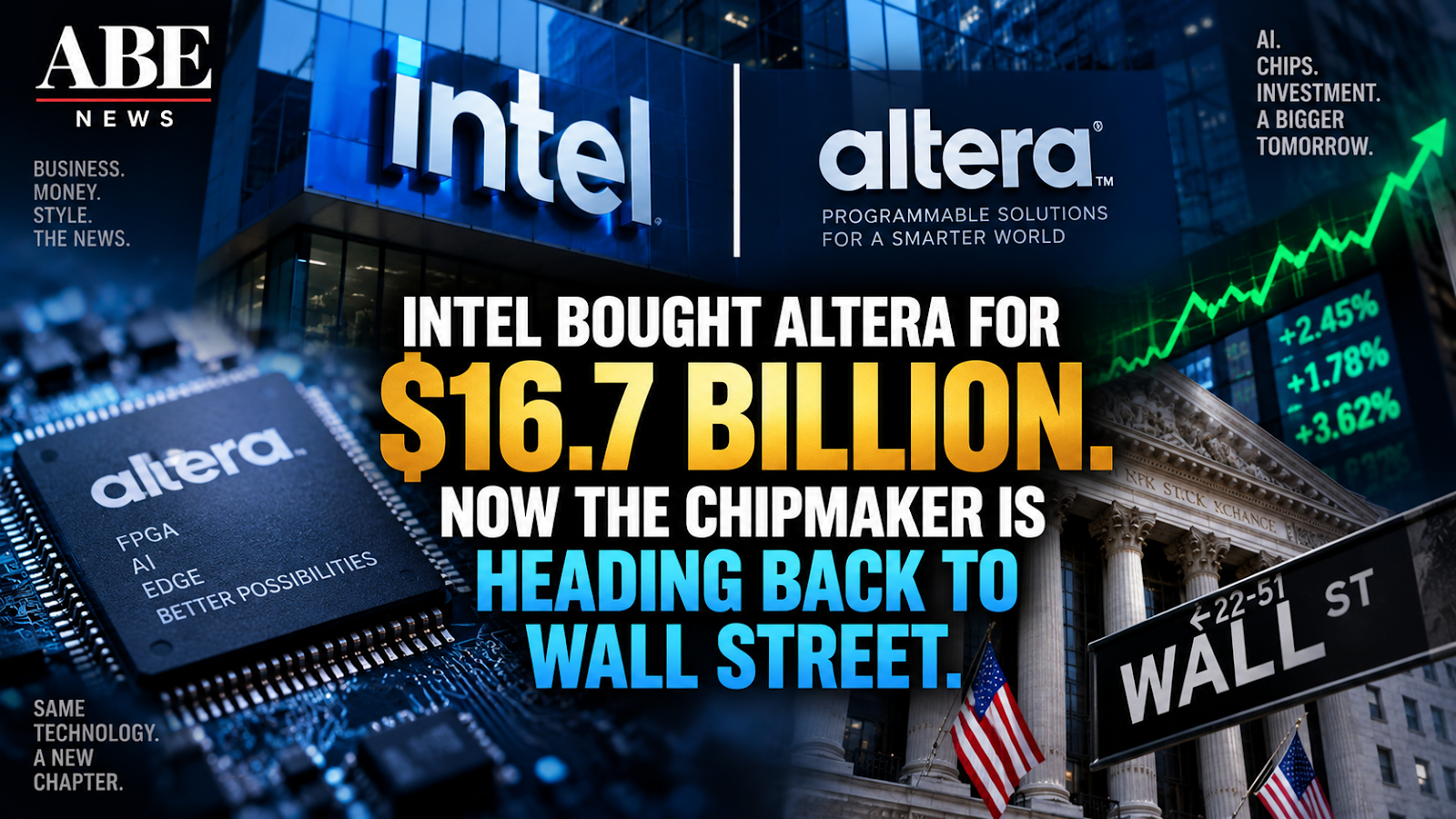
Eleven years ago, Intel spent approximately $16.7 billion buying Altera in one of the biggest semiconductor acquisitions of its era. The deal was supposed to give Intel a stronger position in programmable chips and bring another major technology business inside a company that was still one of the most powerful names in the global semiconductor industry.
A decade later, the story looks very different.
Intel no longer controls Altera. Private-equity giant Silver Lake owns the majority of the company, Intel’s remaining stake is now a minority position, and Altera has officially taken the first major step toward returning to the public markets.
On Tuesday, the San Jose-based chipmaker said it had confidentially filed for a U.S. initial public offering, making it the latest semiconductor company attempting to capitalize on enormous investor interest surrounding artificial intelligence and the infrastructure required to support it. Altera has not yet disclosed how many shares it intends to sell or what valuation it will seek, but Reuters reported last week that the offering could raise more than $2 billion and potentially take place before the end of 2026.
If that happens, Altera’s IPO would become one of the largest semiconductor listings in recent years.
But the amount it raises may not be the most interesting number.
Altera was worth $16.7 billion when Intel bought it. Last year, the transaction that handed Silver Lake control valued the entire company at just $8.75 billion.
Now Wall Street is about to decide what it is worth in the AI era.
INTEL ONCE BELIEVED ALTERA WAS WORTH $16.7 BILLION
To understand why Altera’s return to Wall Street matters, it helps to go back to 2015.
Intel was still trying to extend its dominance beyond the traditional computer processor market. Altera specialized in field-programmable gate arrays, or FPGAs — chips that can be reconfigured after they are manufactured rather than permanently designed for one specific task.
That flexibility makes them useful in industries where computing requirements change or highly specialized performance is necessary. Altera’s chips are used in data centres, telecommunications networks, industrial equipment, aerospace and defence systems, and increasingly in artificial-intelligence applications.
Intel saw an opportunity to combine those products with its enormous semiconductor business and announced the $16.7 billion acquisition.
At the time, the transaction represented a major strategic bet.
But the Intel that bought Altera in 2015 would eventually find itself confronting challenges far larger than Altera itself.
The company lost ground in advanced semiconductor manufacturing, faced increasingly aggressive competition and watched Nvidia become the defining chip company of the artificial-intelligence boom. Intel eventually entered a prolonged restructuring as management tried to reduce costs, strengthen the balance sheet and decide which businesses still belonged inside the company.
Altera became one of the assets caught in that transformation.
THEN INTEL SOLD CONTROL AT AN $8.75 BILLION VALUATION
Last year, Intel agreed to sell 51% of Altera to Silver Lake for $4.46 billion, valuing the entire company at approximately $8.75 billion.
Intel retained the other 49%.
The comparison with 2015 is difficult to miss.
Intel had paid about $16.7 billion to acquire Altera. Roughly a decade later, the transaction transferring control to Silver Lake valued the business at barely more than half that amount.
That does not mean Intel simply lost the difference between the two numbers. Corporate acquisitions are more complicated than comparing purchase price with a later valuation, and Intel benefited from owning and operating Altera during the intervening years.
But the numbers still illustrate how dramatically the strategic value attached to the business changed.
For Intel, selling control also represented something broader.
Under CEO Lip-Bu Tan, the chipmaker has been restructuring aggressively in an attempt to restore growth and rebuild investor confidence. Asset sales, cost reductions and new sources of capital have become part of that effort as Intel concentrates resources on its manufacturing ambitions and its position in an industry increasingly shaped by AI.
Separating Altera allowed Intel to unlock capital while preserving a large minority stake.
That 49% position is important now.
If Altera returns to the public market at a significantly higher valuation, Intel still participates in that upside.
SILVER LAKE IS BETTING WALL STREET WILL VALUE ALTERA DIFFERENTLY
Silver Lake entered the picture at a very different moment for the semiconductor industry.
The private-equity firm committed roughly $3.3 billion of equity to the Altera transaction alongside Abu Dhabi-backed investment firm MGX. Now, only about a year after taking control, Altera is preparing to test the public markets.
That timing is significant.
An IPO above last year’s $8.75 billion valuation could produce a rapid increase in the value of Silver Lake’s investment. The exact outcome will depend on the valuation Altera ultimately seeks, the amount of stock sold and how public investors respond once the company’s detailed financial information becomes available.
For now, much of that information remains private.
That is one reason companies use confidential IPO filings. They can begin the regulatory process without immediately revealing detailed financial statements and other information to competitors and the public. Those disclosures generally arrive closer to the actual listing.
What investors already know, however, is that Altera is trying to position itself inside one of the most valuable investment themes in the world.
Artificial intelligence.
ALTERA IS NOT NVIDIA — AND THAT MAY BE PART OF THE OPPORTUNITY
When investors hear “AI chips,” Nvidia is usually the first company that comes to mind.
Altera operates in a different part of the semiconductor market.
Its FPGAs are programmable, allowing customers to configure hardware for particular workloads and later modify it as requirements change. That can make the chips valuable where flexibility, specialized processing and low latency matter.
Altera’s products therefore reach well beyond generative AI. They are used in telecommunications, industrial systems, aerospace and defence, data centres and other specialized computing environments.
But AI has created another potential growth engine.
As artificial intelligence moves from enormous centralized training clusters into factories, telecommunications systems, robotics, defence equipment and other physical infrastructure, demand for specialized computing may expand alongside it.
Altera CEO Raghib Hussain has been explicit about the opportunity. In a July interview with Reuters, Hussain said the company was preparing for an eventual public listing while pursuing growth in artificial intelligence and robotics, and Altera expects revenue growth in the mid-20% range this year.
That growth expectation gives Altera something particularly valuable as it approaches Wall Street: a story about where the company could go next, rather than merely where it has been.
And in today’s market, AI can make that story substantially more attractive.
WALL STREET HAS DEVELOPED A HUGE APPETITE FOR CHIP COMPANIES
Altera is not entering a quiet IPO market.
It is arriving during an extraordinary period for public listings.
U.S. IPO proceeds have already surpassed $145 billion in 2026, according to Renaissance Capital data cited by Reuters, as companies return to public markets after the traditionally slower summer period.
Semiconductors have been an important part of that enthusiasm.
Arm Holdings raised roughly $5 billion when it returned to the public markets in 2023. Cerebras raised $5.55 billion earlier this year, while South Korean memory-chip giant SK Hynix received more than $26 billion from its U.S. listing in July.
Altera’s potential $2 billion-plus offering would be smaller than those blockbuster deals, but it would still rank among the largest semiconductor IPOs of recent years.
The broader IPO environment matters because investors have demonstrated a willingness to put enormous amounts of money behind companies positioned around AI, semiconductors, data centres and the infrastructure surrounding them.
Altera now has an opportunity to enter that market while enthusiasm remains strong.
But AI alone will not determine whether the IPO succeeds.
PUBLIC INVESTORS WILL FINALLY GET TO SEE THE NUMBERS
The confidential filing means one of the most important parts of the Altera story is still missing.
Its detailed finances.
Investors will eventually want to know how quickly revenue is growing, how profitable the business is, what its margins look like, how much cash it generates, how much it spends on research and development, and how exposed it remains to cyclical parts of the semiconductor industry.
They will also want to understand how much of Altera’s growth genuinely comes from artificial intelligence.
That distinction matters.
The phrase “AI” has become enormously valuable in capital markets, but investors are increasingly separating companies that merely benefit from the enthusiasm surrounding the technology from businesses producing measurable revenue because of it.
Altera will have to demonstrate that its programmable-chip strategy gives it a defensible position in the next generation of computing.
Its competitors will not stand still.
AMD owns Xilinx, another major FPGA business, following its $35 billion acquisition completed in 2022. Other semiconductor companies are developing specialized processors for data centres, industrial computing, automotive systems and edge AI.
Altera therefore returns to independence in a market with enormous opportunity but equally serious competition.
Wall Street will have to decide whether the company’s growth prospects justify a valuation substantially above the $8.75 billion attached to Silver Lake’s investment last year.
THIS IPO IS ALSO PART OF INTEL’S REINVENTION
There is another company whose shareholders should be paying attention.
Intel.
Because Intel still owns 49% of Altera, a successful public listing could make that remaining stake considerably more valuable.
That would matter to a company still trying to finance one of the most difficult transformations in the semiconductor industry’s history.
Intel is attempting to rebuild its manufacturing capabilities, compete for advanced chip-production contracts, strengthen its position in artificial intelligence and restore investor confidence after years of strategic setbacks.
Those ambitions require enormous amounts of capital.
Intel has already turned repeatedly to outside sources of money. Last year, the U.S. government agreed to acquire a 9.9% stake in Intel through an $8.9 billion investment connected to previously awarded semiconductor and defence funding. In August, Intel raised roughly $20 billion through a follow-on stock offering, with proceeds intended for capital expenditure and working capital.
Against that backdrop, Altera’s IPO becomes more than a liquidity event for Silver Lake.
It is another piece of Intel’s effort to extract value from assets while concentrating resources on the parts of the business management believes matter most.
And there is an interesting possibility.
Intel may ultimately benefit from a company becoming more valuable after Intel gave up control of it.
SILVER LAKE NOW HAS TO PROVE THE $8.75 BILLION DEAL WAS ONLY THE BEGINNING
Private equity often revolves around a relatively straightforward idea: buy an asset, improve its operations or strategic position, and eventually sell some or all of it at a higher valuation.
Altera could become an unusually visible example of that model.
Silver Lake acquired control at an $8.75 billion valuation. If Altera enters the stock market at a significantly higher value, the firm could establish a substantial paper gain in a remarkably short period.
But that outcome is not guaranteed.
IPO investors are not simply buying the history of the company or the prestige of its owners. They are buying expectations about future cash flows.
A weak valuation would raise a different question: whether Intel’s original $16.7 billion purchase price reflected a strategic value that Altera has never managed to recover.
A strong valuation would suggest something else entirely.
It could indicate that separating the business from Intel, combining it with private-equity ownership and repositioning it around AI, robotics and specialized computing allowed investors to see value that had been obscured inside a much larger semiconductor company.
That is precisely why the eventual IPO price will be so interesting.
It will provide the first major public-market verdict on Altera as an independent company in more than a decade.
THE IPO BOOM IS CREATING A WINDOW — BUT WINDOWS CLOSE
There is also a timing question.
2026 has become an exceptional year for U.S. listings, with several enormous technology offerings helping bring investors back into IPOs. The fall calendar is filling with additional deals, and companies are taking advantage of the market while demand remains strong.
That environment gives Altera an opportunity.
But IPO markets are notoriously cyclical.
A major market correction, deterioration in the economic outlook, higher interest rates or a reversal in enthusiasm surrounding AI could make investors substantially less willing to pay aggressive valuations.
Altera’s confidential filing allows the company to prepare without committing immediately to a listing date. Reuters has reported that an offering could happen as early as this year, but the timing and size can still change.
That flexibility matters.
If conditions remain favourable, Altera can move forward.
If they deteriorate, it can wait.
For Silver Lake and Intel, however, the current environment may be difficult to ignore. Investors are actively seeking semiconductor exposure, AI infrastructure remains one of the dominant themes in global markets, and IPO demand is unusually strong.
There may not be a better window.
🔴 THE ABE NEWS TAKE
Altera’s IPO is easy to describe as another semiconductor company trying to capitalize on artificial intelligence.
But that misses the more interesting story.
This is a company that Wall Street has effectively been asked to value three different times under three very different circumstances.
In 2015, Intel decided Altera was worth $16.7 billion.
In 2025, Silver Lake’s acquisition of control valued it at $8.75 billion.
Now, in 2026, public investors are about to get their turn.
Those three numbers will tell a larger story about corporate strategy, private equity and the extraordinary redistribution of value taking place across the semiconductor industry.
Intel’s original acquisition came from an era when the company was powerful enough to spend nearly $17 billion expanding its semiconductor empire. The later Silver Lake transaction came from an era in which Intel was restructuring that empire, raising capital and deciding which businesses it could no longer afford to control.
The IPO arrives in an entirely different era again.
Artificial intelligence has transformed semiconductors from an industry most consumers rarely thought about into one of the central battlegrounds of the global economy. Governments are spending billions to secure chip supply chains. Technology companies are committing extraordinary sums to AI infrastructure. Investors have rewarded companies positioned anywhere near the most valuable parts of that expansion.
Altera now has to prove it belongs in that story.
Its advantage is that programmable chips occupy a genuinely important position in computing. As AI moves beyond chatbots and data centres into telecommunications networks, industrial systems, robotics, aerospace and defence, adaptable hardware could become increasingly valuable.
Its challenge is that Wall Street has heard hundreds of versions of the AI story.
Investors will eventually demand numbers.
Revenue growth. Margins. Cash generation. Market share. Customer concentration. Research spending. Competitive position.
That is when the real Altera IPO begins.
And perhaps the most fascinating outcome would be if Wall Street eventually values the company near — or above — the $16.7 billion Intel paid eleven years ago.
That would mean Altera had travelled from the public markets into Intel, from Intel into private-equity control, and then back to Wall Street only to recover the value it once commanded.
If it exceeds that level, Silver Lake will have an extraordinary investment story.
If it falls well short, Intel’s 2015 acquisition will look even more expensive in hindsight.
Either way, this IPO will do something that hasn’t happened since Altera disappeared from the stock market more than a decade ago.
It will finally give investors a price.
And that price may tell us as much about Intel’s past and Silver Lake’s bet as it does about Altera’s future.
ABE NEWS
Business. Money. Style. The News.
Understand More. Think Bigger.