






ABE NEWS | September 6, 2026
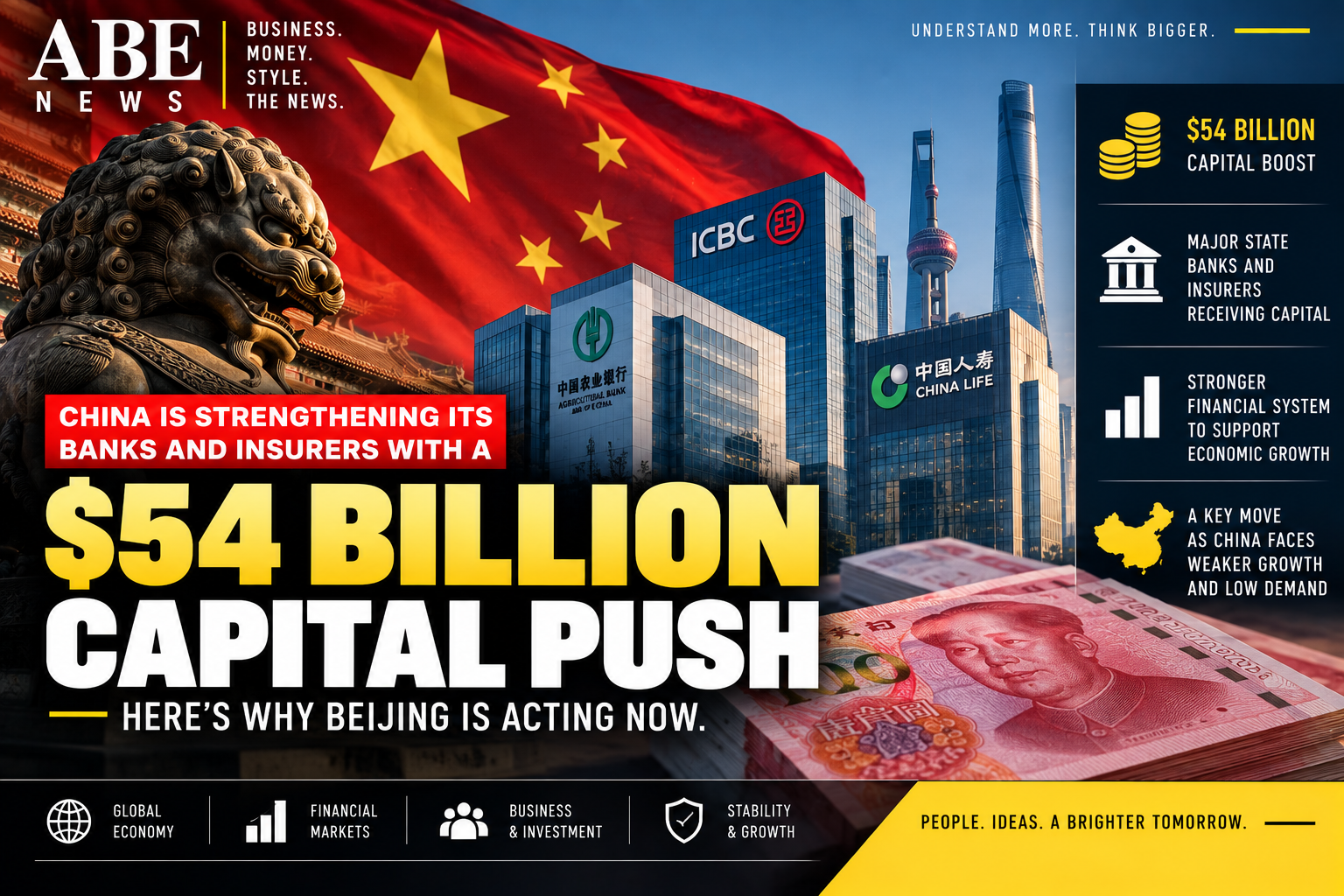
China is moving to strengthen some of the most important institutions in its financial system through a coordinated $54 billion capital-raising programme, giving major state-owned banks and insurers additional financial firepower as Beijing tries to support an economy facing weaker investment, subdued borrowing demand and pressure on financial-sector profitability.
The measures announced Sunday involve three state lenders and several large insurance groups. Agricultural Bank of China plans to raise as much as 160 billion yuan, or roughly $24 billion, while Industrial and Commercial Bank of China plans to raise another 100 billion yuan, or about $15 billion. The Export-Import Bank of China will receive a further 30 billion yuan.
On the insurance side, China Life Insurance Group will receive 35 billion yuan, China Taiping Insurance Group will receive 7 billion yuan, and other state-controlled insurers are also receiving or raising additional capital.
Taken together, the moves represent one of Beijing’s latest efforts to reinforce the institutions it relies upon to channel money through the world’s second-largest economy.
This is not a conventional bank bailout triggered by an immediate financial crisis. Instead, China is strengthening financial institutions that are increasingly being asked to support economic growth while operating in a difficult environment of low interest rates, weak credit demand and pressure on profitability.
Understanding why Beijing is putting more capital behind its banks and insurers therefore tells us something important about the broader condition of the Chinese economy.
WHY BANK CAPITAL MATTERS
Banks operate differently from ordinary businesses.
When a bank receives a deposit, it doesn’t simply place all of that money inside a vault. Banks use deposits and other funding to make loans, purchase assets and provide financing throughout the economy.
But regulators require them to maintain sufficient capital to absorb potential losses.
The stronger a bank’s capital position, the greater its ability to withstand bad loans and financial shocks while continuing to lend.
That becomes particularly important when governments want banks to support economic growth.
China’s state-owned lenders occupy an unusually important position because Beijing frequently relies on them to provide financing to businesses, infrastructure projects and strategically important industries.
Agricultural Bank of China and ICBC said the money being raised would be used to replenish their core Tier 1 capital, one of the most important measures of a bank’s financial strength.
By reinforcing that capital, Beijing is effectively increasing the capacity of these institutions to continue extending credit without allowing their financial buffers to become too thin.
THE ECONOMY NEEDS SUPPORT
The timing is significant.
China’s economy expanded 4.3% in the second quarter of 2026, its weakest quarterly growth rate in more than three years and a slowdown from 5% in the first quarter.
Investment has been one of the areas under pressure.
Beijing has already responded with other measures. China launched an 800 billion yuan policy-based financing programme this year designed to provide capital for major projects and encourage additional private and bank financing.
China Development Bank recently began deploying the first portion of those funds into projects involving battery manufacturing, advanced materials and transport infrastructure.
The objective is familiar: encourage investment and prevent weaker demand from producing an even sharper economic slowdown.
But governments cannot simply announce investment programmes and assume money will automatically flow through the economy.
Banks are the transmission system.
If Beijing wants companies, infrastructure projects and strategic industries to receive more financing, it needs financial institutions strong enough to provide it.
That helps explain Sunday’s recapitalisation.
CHINA HAS A CREDIT-DEMAND PROBLEM
The unusual part of China’s situation is that strengthening banks does not necessarily mean companies and households will suddenly want to borrow.
Reuters reports that weak loan demand remains a persistent drag on the Chinese economy.
That distinction matters.
A government can increase the amount of money banks are capable of lending, but it cannot easily force profitable businesses to borrow if executives lack confidence about future demand.
Nor can it make households take out mortgages or consumer loans simply because financing is available.
This is one of the fundamental challenges confronting Chinese policymakers.
China has spent decades relying heavily on investment to drive economic expansion. Property development, infrastructure and industrial capacity helped transform the country into a manufacturing superpower.
But the property downturn weakened one of the economy’s traditional engines, while businesses have become more cautious about investment.
That means Beijing increasingly needs to stimulate demand while simultaneously ensuring the financial system remains strong enough to support a recovery.
The $54 billion capital programme addresses the second problem.
It does not automatically solve the first.
LOW INTEREST RATES ARE HURTING BANK PROFITS
Another pressure comes from interest rates.
Banks generally make money from the difference between what they pay depositors and what they earn from loans and other assets.
When interest rates remain very low and competition pushes lending rates downward, that spread can narrow.
Chinese lenders have faced exactly that pressure.
Beijing wants banks to provide affordable credit because cheaper financing can support businesses and economic activity.
But pushing lending costs lower can simultaneously weaken bank profitability.
That creates a difficult balancing act.
Policymakers want banks to lend more.
Borrowers want cheaper loans.
The economy needs support.
But banks still need to generate enough profit and maintain enough capital to remain financially healthy.
Adding capital gives state lenders more room to operate inside that tension.
INSURERS ARE UNDER PRESSURE TOO
The inclusion of insurance companies makes the programme particularly interesting.
China’s insurance industry has also been affected by persistently low interest rates.
Insurance companies collect premiums today and invest those funds so they can meet obligations years or decades into the future. Returns on those investments therefore matter enormously.
When interest rates remain low for extended periods, insurers can struggle to earn enough from relatively safe investments.
Reuters reports that numerous smaller and mid-sized Chinese insurers have experienced deteriorating solvency ratios as profitability has come under pressure.
Beijing is now strengthening several large state insurers.
China Life, the country’s largest life insurer, will receive 35 billion yuan.
China Taiping will receive another 7 billion yuan.
China Export and Credit Insurance Corporation is receiving 10 billion yuan, while China Reinsurance Group plans to raise another 3 billion yuan.
People’s Insurance Company of China also plans to raise up to 15 billion yuan through a private placement to the Ministry of Finance.
The objective is not simply to protect these institutions from financial pressure. Stronger state insurers could also play a role in managing weaker parts of the industry if smaller insurance companies encounter greater difficulty.
INSURERS ALSO MATTER TO CHINA’S STOCK MARKET
There is another reason Beijing wants financially strong insurance companies.
Chinese authorities have encouraged major insurers to place more medium- and long-term capital into the country’s stock market.
Insurance companies are particularly useful for this purpose because they manage enormous pools of money with long investment horizons.
Unlike short-term traders, insurers can hold assets for years.
That makes them potential stabilizing forces in financial markets.
A better-capitalized insurance sector can therefore support several policy objectives simultaneously: protect policyholders, strengthen financial stability and provide more long-term domestic investment capital.
This illustrates something important about China’s economic system.
Banks and insurers are commercial institutions, but the largest state-controlled firms also function as instruments of economic policy.
When Beijing wants to stimulate investment, support strategic industries or stabilize markets, these institutions can be mobilized.
THE WORLD’S LARGEST BANK IS INVOLVED
ICBC’s participation gives some sense of the scale involved.
Industrial and Commercial Bank of China is one of the largest banks in the world by assets and sits at the centre of China’s financial system.
It plans to raise 100 billion yuan, approximately $15 billion, to strengthen its capital.
Agricultural Bank of China is seeking even more: 160 billion yuan, approximately $24 billion.
These aren’t distressed regional lenders being rescued after depositors fled.
They are enormous state financial institutions being reinforced so they can continue performing a central role in Beijing’s economic strategy.
That difference is important.
A recapitalisation can sometimes signal panic.
In this case, it appears more accurately understood as preparation.
Beijing is strengthening the machinery it may need to use if economic conditions remain difficult.
CHINA’S BANKS ARE ALSO LOOKING OUTSIDE CHINA
The situation becomes even more interesting when looking at what Chinese banks have been doing with some of their available funds.
Reuters reported this week that Chinese commercial banks have increased purchases of U.S. Treasury securities after attracting more dollar deposits.
Foreign-exchange deposits in China reached approximately $1.18 trillion at the end of July, up nearly 18% from a year earlier.
One reason Treasuries have become attractive is straightforward: yields on Chinese government bonds are extremely low, while U.S. government bonds offer substantially higher returns.
China’s largest state banks have generally capped standard dollar deposit rates at 2.8%, but customers with larger balances have increasingly been able to negotiate rates above 3%, while some smaller and foreign banks have offered rates approaching 4%.
Banks can attract those dollars and invest some of them in higher-yielding U.S. Treasuries.
The situation illustrates the strange realities of the global financial system.
At the same time that economic rivalry between Washington and Beijing remains intense, Chinese banks can still find American government debt financially attractive.
Capital frequently follows returns even when politics moves in the opposite direction.
THIS IS NOT CHINA’S FIRST BANK RECAPITALISATION
Beijing has used similar tools before.
The latest bank measures extend a recapitalisation strategy unveiled earlier through China’s annual parliamentary process.
Large state banks were already strengthened through previous capital measures, and policymakers are now extending that support to additional institutions.
That suggests Beijing views strong bank balance sheets as an important component of its broader economic strategy rather than as a temporary emergency measure.
The logic is relatively simple.
If economic growth remains weak, banks may need to lend more aggressively.
If some borrowers struggle, banks may eventually face higher credit losses.
If interest margins remain compressed, profitability may stay under pressure.
More capital gives institutions greater ability to absorb those stresses.
BUT MORE BANK CAPITAL CANNOT FIX EVERYTHING
This is where the limitations of the programme become important.
A strong banking system is necessary for a healthy economy.
It is not sufficient.
China’s deeper economic challenges include weak domestic demand, a prolonged property-sector adjustment, demographic pressures, high levels of local-government debt and uncertainty among businesses and consumers.
Giving banks additional capital doesn’t directly convince a family to purchase a home.
It doesn’t automatically persuade a company to build another factory.
It doesn’t guarantee consumers will spend more.
And it doesn’t make every infrastructure project economically productive.
That means Beijing’s challenge is ultimately broader than finance.
It needs confidence.
Businesses need reasons to invest.
Consumers need reasons to spend.
Households need confidence in income and employment.
Investors need confidence that capital can generate attractive returns.
Banks can finance economic activity.
They cannot manufacture economic confidence by themselves.
WHY THE NUMBER STILL MATTERS
Fifty-four billion dollars is enormous in absolute terms.
But relative to China’s financial system, it should not be interpreted as evidence that Beijing believes $54 billion alone can transform the economy.
The importance lies in what the programme signals.
China is willing to use the state’s balance sheet to strengthen financial institutions before weaknesses become more dangerous.
It is also preparing banks to continue supporting government economic priorities.
And it is reinforcing insurers at a moment when low rates are placing pressure on their solvency and profitability.
This is financial-system maintenance on a very large scale.
For investors, it provides another indication that Beijing is increasingly concerned with ensuring its financial institutions remain capable of supporting growth even if the broader economic environment remains challenging.
🔴 THE ABE NEWS TAKE
China’s $54 billion capital push should not be read as a dramatic bank rescue.
There are no signs here of China’s largest banks suddenly collapsing or Beijing scrambling to stop depositors from fleeing.
The more interesting interpretation is that China is reinforcing the financial machinery it expects to rely upon.
That distinction matters.
When an economy is expanding rapidly and businesses are eager to invest, banks don’t need much encouragement to lend.
Demand arrives naturally.
China’s current environment is different.
Economic growth slowed to 4.3% in the second quarter. Investment has weakened. Loan demand remains subdued. Low interest rates are squeezing financial-sector profitability.
Beijing therefore finds itself trying to encourage more economic activity while protecting the institutions expected to finance it.
Giving banks more capital helps.
Giving insurers more capital helps.
Deploying hundreds of billions of yuan into policy financing may help.
But eventually the effectiveness of these measures depends on what happens outside the financial sector.
Will companies invest?
Will households spend?
Will the property market stabilize?
Will private businesses regain confidence?
Will infrastructure spending generate sufficient economic returns?
Those questions matter more than the headline size of Sunday’s capital programme.
There is also a larger lesson about China’s economic model.
Western economies often rely heavily on central-bank interest rates and market incentives to influence credit.
China possesses additional levers because many of its largest financial institutions remain state-controlled.
Beijing can recapitalize them.
Direct them toward priority industries.
Encourage them to finance infrastructure.
Use insurers as long-term market investors.
And coordinate financial institutions with broader national economic objectives.
That gives China extraordinary capacity to mobilize capital.
It does not guarantee that capital will always be used efficiently.
That is the trade-off worth watching.
China has spent decades demonstrating how powerful state-directed investment can be when capital flows into productive infrastructure and rapidly expanding industries.
The next phase is more difficult.
The economy is larger.
Debt levels are higher.
Property is weaker.
Demographics are changing.
And simply adding more investment produces diminishing returns if projects do not generate enough economic value.
That is why Sunday’s $54 billion move matters.
It isn’t the solution to China’s economic challenges.
It is Beijing making sure one of its most important tools remains strong enough to keep working.
The banks now have more capital.
The insurers are being strengthened.
The financial system has another layer of protection.
The bigger question is what China can persuade the rest of its economy to do with all that financial capacity.
ABE NEWS
Business. Money. Style. The News.
Understand More. Think Bigger.