




ABE NEWS | September 6, 2026
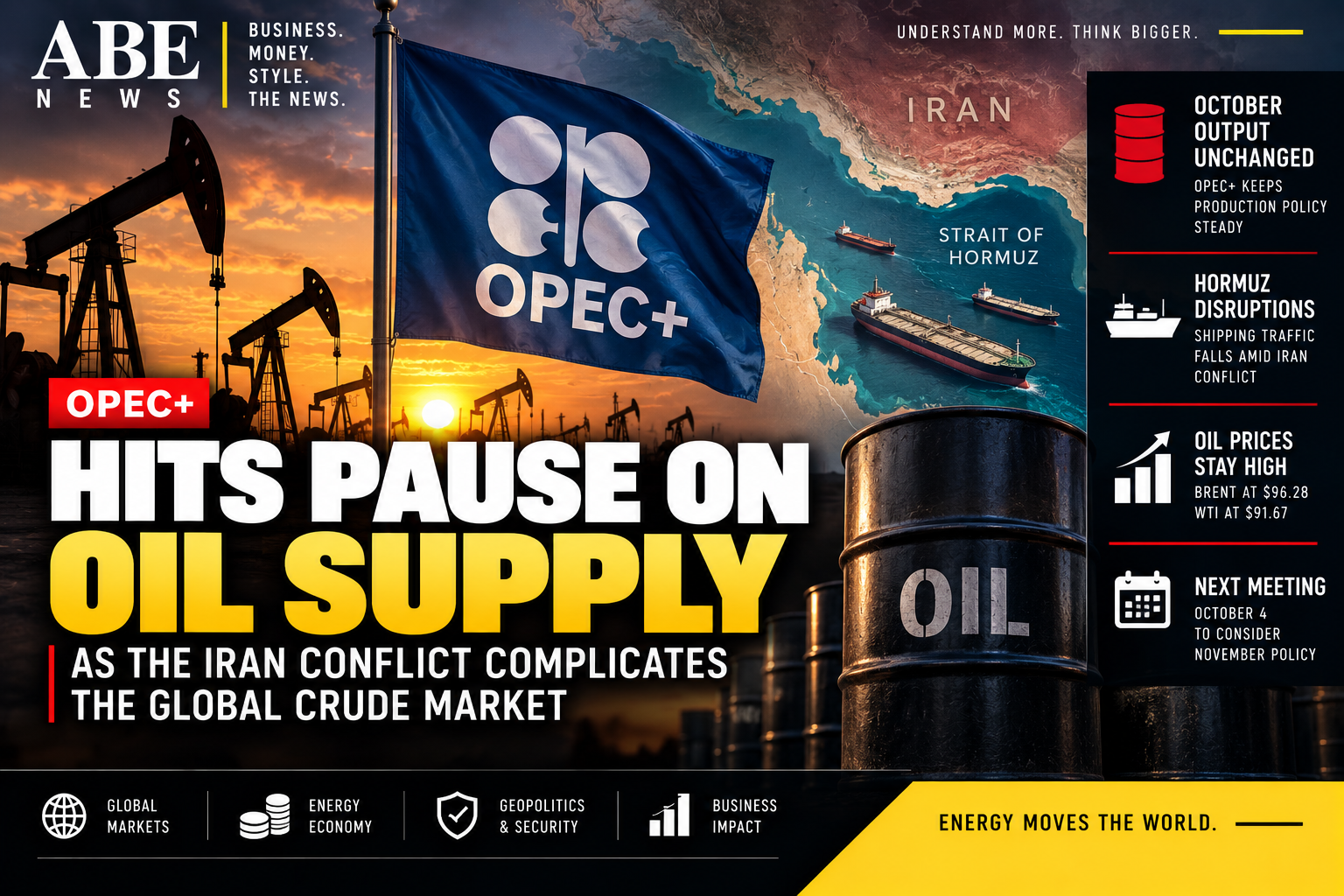
OPEC+ has decided to keep its oil-production policy unchanged for October, pausing further increases after months of gradually restoring supply while escalating tensions involving Iran continue to disrupt one of the world’s most important energy corridors.
The decision was taken Sunday by the group of producers that has been managing voluntary production adjustments, including Saudi Arabia, Russia and Iraq. It comes after OPEC+ spent much of 2026 increasing output targets as it unwound a 1.65-million-barrel-a-day layer of voluntary cuts introduced in 2023.
Under more normal conditions, another OPEC+ meeting might primarily be about how many additional barrels should enter the market and what that could mean for prices. The situation confronting the group today is considerably more complicated.
Oil flows through the Strait of Hormuz remain disrupted by the Iran conflict, shipping traffic has fallen sharply at times, and several OPEC+ members have been unable to produce or export as much crude as their official targets suggest.
That has created an unusual disconnect between OPEC+ production policy on paper and the amount of oil actually reaching customers.
For the global economy, the difference matters far more than the quota itself.
WHY OPEC+ DECIDED TO WAIT
OPEC+ entered 2026 with substantial production restrictions still in place.
Those cuts had originally been designed to support oil prices by limiting the amount of crude available to the market. But the group gradually began reversing part of those reductions as producers sought to regain market share and respond to changing supply conditions.
The latest sequence involved unwinding a voluntary cut of approximately 1.65 million barrels per day.
By September, that process had effectively been completed.
Instead of immediately beginning to reverse another layer of cuts, the participating producers have now chosen to pause for October.
The timing gives OPEC+ an opportunity to evaluate a market transformed by geopolitical disruption.
The group still possesses enormous influence over global oil supply, but announced production targets become less meaningful when conflict prevents producers from physically delivering all of the barrels they are permitted to sell.
That is increasingly the problem around the Persian Gulf.
HORMUZ HAS CHANGED THE CALCULATION
The Strait of Hormuz is one of the most important waterways in the global economy.
It connects the Persian Gulf with the Gulf of Oman and the Arabian Sea, creating the principal maritime route through which major Middle Eastern oil and liquefied-natural-gas exporters reach global customers.
Saudi Arabia, Iraq, Kuwait, Qatar and other producers depend heavily on the wider Gulf export system.
The conflict involving Iran has disrupted that system.
Shipping data reported by Reuters last week showed just four commodity vessels passing through Hormuz on Thursday, compared with a 10-day average of roughly 13 vessels. Similar disruptions have occurred repeatedly as military confrontation increased the risks associated with using the waterway.
Two supertankers carrying Saudi crude were also struck by projectiles near the strait earlier in the week.
The result is a problem that OPEC+ cannot solve simply by changing a spreadsheet in Vienna.
A country may technically be allowed to produce another 100,000 barrels per day.
But if tankers cannot reliably transport that oil through the Gulf, increasing the quota does little to increase global supply.
This is why today’s OPEC+ decision needs to be understood alongside the conflict rather than separately from it.
OIL HAS RESPONDED TO THE RISK
Energy markets have already reacted.
Brent crude ended Friday at $96.28 per barrel, gaining more than 4% over the week as renewed fighting between the United States and Iran increased concerns about supplies.
U.S. West Texas Intermediate crude ended at $91.67.
Those are important levels because expensive oil eventually spreads through the wider economy.
Oil is not simply the raw material used to make gasoline.
It affects aviation.
Shipping.
Trucking.
Agriculture.
Manufacturing.
Petrochemicals.
Plastics.
Construction.
And many of the supply chains responsible for moving goods around the world.
A sustained increase in crude prices can therefore become an inflation problem even for countries located thousands of kilometres from the Middle East.
That is why policymakers and investors watch Hormuz so closely.
A disruption there does not remain a Middle Eastern problem for long.
OPEC+ STILL HAS ENORMOUS POWER
It would be premature to conclude that geopolitical disruption has made OPEC+ irrelevant.
The group collectively accounts for roughly 40% of global oil production, giving it extraordinary influence over the amount of crude available to the world.
Saudi Arabia also possesses something particularly valuable: spare production capacity.
When global supply is unexpectedly disrupted, the ability to increase production relatively quickly can become an important stabilizing force.
Other OPEC+ producers also control enormous reserves.
But there is a difference between controlling oil underground and delivering it to a refinery.
Today’s market is increasingly being shaped by both.
How much can producers pump?
And:
How much can they actually export?
For Gulf producers, the second question has become much more important during the Iran conflict.
IRAQ SHOWS HOW COMPLICATED THE MARKET HAS BECOME
Iraq provides a particularly interesting example.
The country has increased exports as buyers respond to attractive pricing and as some Iraqi tankers have been able to transit Hormuz.
Reuters reported that Iraqi exports reached roughly 2 million barrels per day in August, more than half the level recorded in February, with shipments expected to rise further in September.
Chinese companies and trading houses have been among the buyers lifting crude directly from Iraq’s Basrah terminal.
This demonstrates how quickly trade patterns can adjust during disruption.
If one route becomes more difficult, buyers search for another.
If one crude becomes scarce, refiners consider substitutes.
If discounts become large enough, traders find ways to move barrels.
The oil market is extraordinarily adaptive.
But adaptation has limits.
There is no easy replacement for a prolonged large-scale disruption affecting the Persian Gulf.
THE GULF IS ALREADY RETHINKING ITS INFRASTRUCTURE
The Hormuz crisis is also producing a longer-term strategic response.
Gulf countries are investing more heavily in pipelines, ports and export infrastructure that can reduce their dependence on the strait.
Saudi Arabia already operates the East-West pipeline, which can move crude from fields in the east of the country toward the Red Sea.
The United Arab Emirates has infrastructure capable of moving some oil to Fujairah outside Hormuz.
Other projects are increasingly being discussed or accelerated as governments reconsider the risks of concentrating so much energy trade through one narrow maritime corridor.
That could become one of the most important long-term consequences of the conflict.
For decades, Hormuz’s importance was treated almost as a geographic fact that could not easily be changed.
Now producers have stronger financial and national-security incentives to build alternatives.
Those projects will take years and billions of dollars.
But the strategic logic is becoming clearer.
THE NEXT OPEC+ ARGUMENT IS ABOUT 2027
Sunday’s meeting may have kept October policy unchanged, but a much larger debate is approaching.
OPEC+ is reassessing the maximum sustainable production capacity of individual members.
That sounds technical.
It is also politically sensitive.
Production capacity helps determine how future quotas are distributed among members.
If a country believes it has invested billions of dollars expanding its oil industry, it may argue that it deserves a larger production baseline.
Another country with declining capacity may resist losing influence within the group.
Those disagreements matter because production quotas determine how much oil countries can sell while remaining within OPEC+ agreements.
For oil-producing governments, even relatively small quota differences can represent billions of dollars in annual revenue.
The capacity review will help establish the production baselines expected to apply in 2027.
That means some of the most difficult OPEC+ negotiations may still be ahead.
WHY MARKET SHARE MATTERS
OPEC+ does not operate only to maximize today’s oil price.
Its members also care about market share.
If the group restricts production too aggressively while non-OPEC producers continue increasing supply, customers can purchase more oil elsewhere.
The United States has become one of the world’s largest producers.
Brazil has expanded.
Guyana has emerged as a significant new source of crude.
Canada continues producing large volumes.
Other producers are developing new fields.
That creates a long-term strategic dilemma for OPEC+.
Cut too much supply and prices may rise, but competitors gain customers.
Produce too much and prices can fall, reducing government revenues.
The ideal balance is extremely difficult to find.
The Iran conflict makes it even harder because geopolitical disruption can push prices higher without OPEC+ deliberately restricting additional supply.
That helps explain why maintaining October policy makes sense.
There is little reason to make a dramatic change while the market itself is being dramatically changed by events outside the group’s control.
CONSUMERS SHOULD CARE ABOUT WHAT HAPPENS NEXT
Most people will never read an OPEC+ production statement.
They will notice the consequences.
At the gas station.
On airline tickets.
In shipping costs.
Potentially in grocery prices.
Oil remains deeply embedded in the global economy despite the growth of renewable energy and electric vehicles.
Transportation systems still depend heavily on petroleum.
Aircraft overwhelmingly rely on jet fuel.
Ships consume fuel.
Trucks move enormous quantities of goods.
Petrochemicals are used across manufacturing.
When crude prices remain elevated for long periods, companies eventually try to pass some of those costs to customers.
Central banks pay attention for the same reason.
An energy shock can complicate efforts to control inflation.
Interest rates may need to remain higher than otherwise expected if expensive energy begins spreading into broader prices.
The significance of Hormuz therefore reaches far beyond oil traders.
THERE IS ALSO A QUESTION ABOUT DEMAND
Supply is only half of the equation.
OPEC itself has reduced its forecast for global oil-demand growth in 2026 as the Iran conflict and weaker economic conditions affect consumption.
That creates another unusual tension.
Geopolitical disruption can push prices higher because traders fear supply shortages.
But those same higher prices can eventually weaken demand.
Consumers drive less.
Airlines face higher costs.
Businesses reduce consumption.
Economic growth slows.
Oil markets therefore contain their own balancing mechanism.
Prices that rise too far can eventually contribute to the conditions that bring them back down.
OPEC+ has to consider both sides when setting policy.
WHAT HAPPENS ON OCTOBER 4
The next meeting is scheduled for October 4, when producers will consider their policy for November.
By then, the market could look very different.
The conflict with Iran could intensify.
It could ease.
Hormuz traffic could improve.
Another major shipping incident could reduce it again.
Oil prices could rise above current levels.
Or weaker global demand could push them lower.
That uncertainty is precisely why today’s decision is important.
OPEC+ chose not to make another major adjustment while the geopolitical environment remains exceptionally unstable.
Sometimes the most consequential decision is to wait.
🔴 THE ABE NEWS TAKE
OPEC+ has spent decades influencing oil markets by controlling supply.
The basic mechanism is simple: reduce production and the market becomes tighter; increase production and more barrels become available.
But today’s oil market is demonstrating the limits of thinking about supply purely in terms of production quotas.
A barrel of oil only matters to the global market if it can reach a customer.
Right now, the Strait of Hormuz is making that distinction impossible to ignore.
OPEC+ can authorize additional production.
Saudi Arabia can possess spare capacity.
Iraq can increase exports.
But missiles, tanker attacks, sanctions and disrupted shipping routes can change the effective supply picture faster than ministers can adjust quotas.
That does not mean OPEC+ has lost its influence.
Far from it.
A group controlling roughly 40% of world oil production remains one of the most powerful forces in global energy.
But it means OPEC+ is operating inside a market where geopolitics is temporarily competing with production policy for control of the price signal.
That is why keeping October policy unchanged may be more significant than it initially appears.
The group is effectively waiting for greater clarity before deciding whether another layer of supply should be returned.
And that patience is understandable.
Oil is already trading near levels capable of creating economic consequences.
The Persian Gulf remains unstable.
Physical exports remain constrained.
Future production quotas are being reassessed.
And the next major OPEC+ internal negotiation — the battle over 2027 baselines — is approaching.
For consumers, the immediate question is simpler.
Does oil keep flowing?
Because if the answer becomes increasingly uncertain, the price of crude will not be the only thing that rises.
Transportation costs can rise.
Airfares can rise.
Business costs can rise.
Inflation can rise.
And central banks may face another problem just as many economies are trying to stabilize prices.
OPEC+ has decided to pause.
The oil market has not.
ABE NEWS
Business. Money. Style. The News.
Understand More. Think Bigger.