




ABE NEWS | THE WEEK IN BUSINESS | FRIDAY, AUGUST 21, 2026
Some weeks in business are dominated by one enormous event.
This wasn’t one of them.
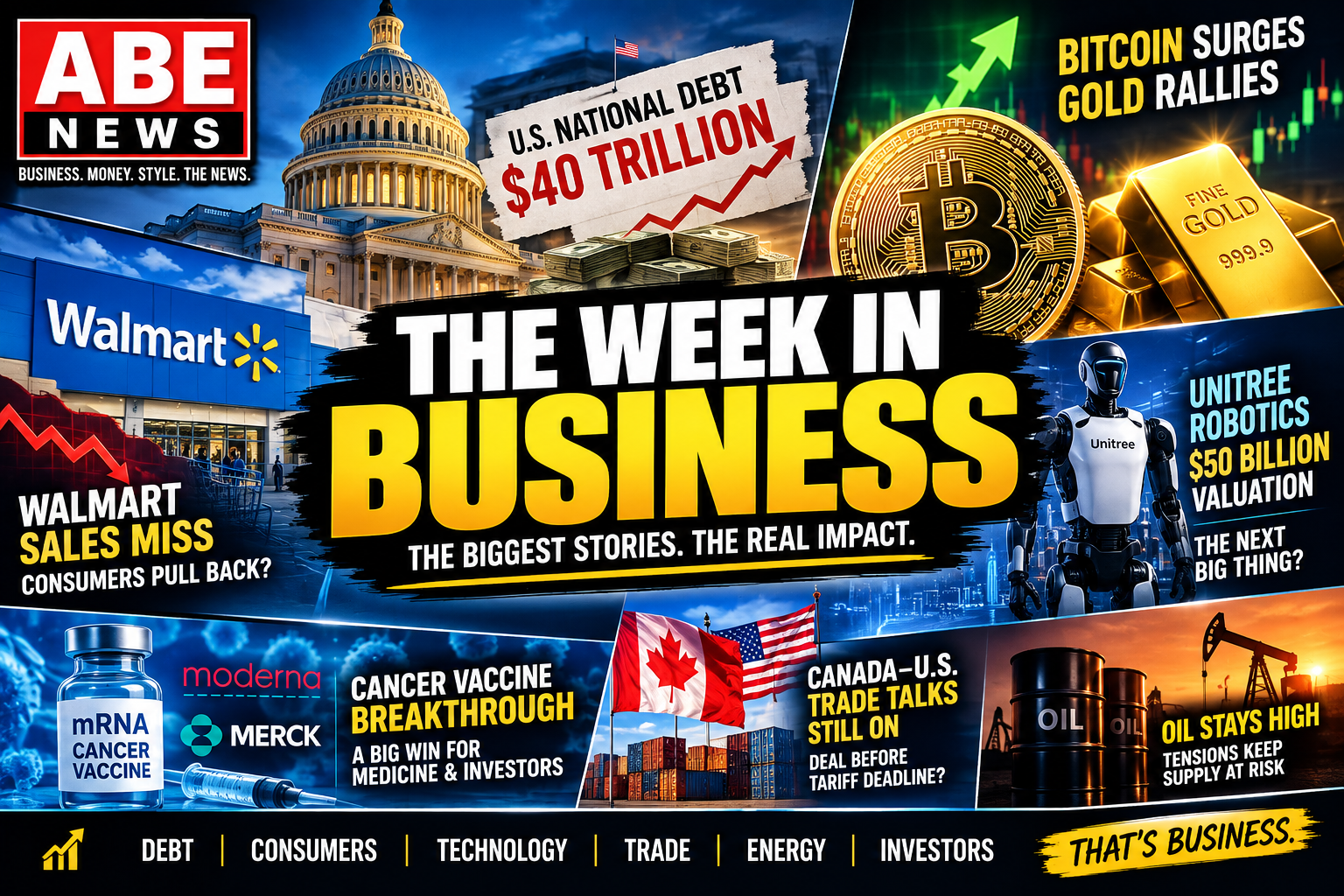
Instead, the global economy spent the week sending signals from almost every direction. The United States crossed $40 trillion in national debt. Long-term government borrowing costs reached levels not seen since 2007. Walmart suffered a rare sales disappointment. Oil remained elevated as the Strait of Hormuz crisis continued. Bitcoin surged. A Chinese robotics company suddenly became a roughly $50 billion market darling, while a personalized cancer vaccine delivered a major scientific and business milestone.
And hanging over Canada throughout it all was a question that still hasn’t been answered:
Can Ottawa and Washington reach a trade agreement before another tariff deadline arrives?
Individually, these look like separate stories. Taken together, they tell us something about the state of business in 2026: money is expensive, governments are under pressure, consumers are becoming more careful, but investors are still willing to make enormous bets on technologies they believe could define the future.
America Crossed $40 Trillion — And the Bond Market Noticed
The week’s biggest number was difficult to comprehend.
U.S. federal debt officially passed $40 trillion, more than double its level when Donald Trump first entered the White House in January 2017. The milestone reflects years of deficits, major crisis spending, tax decisions, rising entitlement costs and increasingly expensive interest payments.
But the debt number wasn’t the only warning.
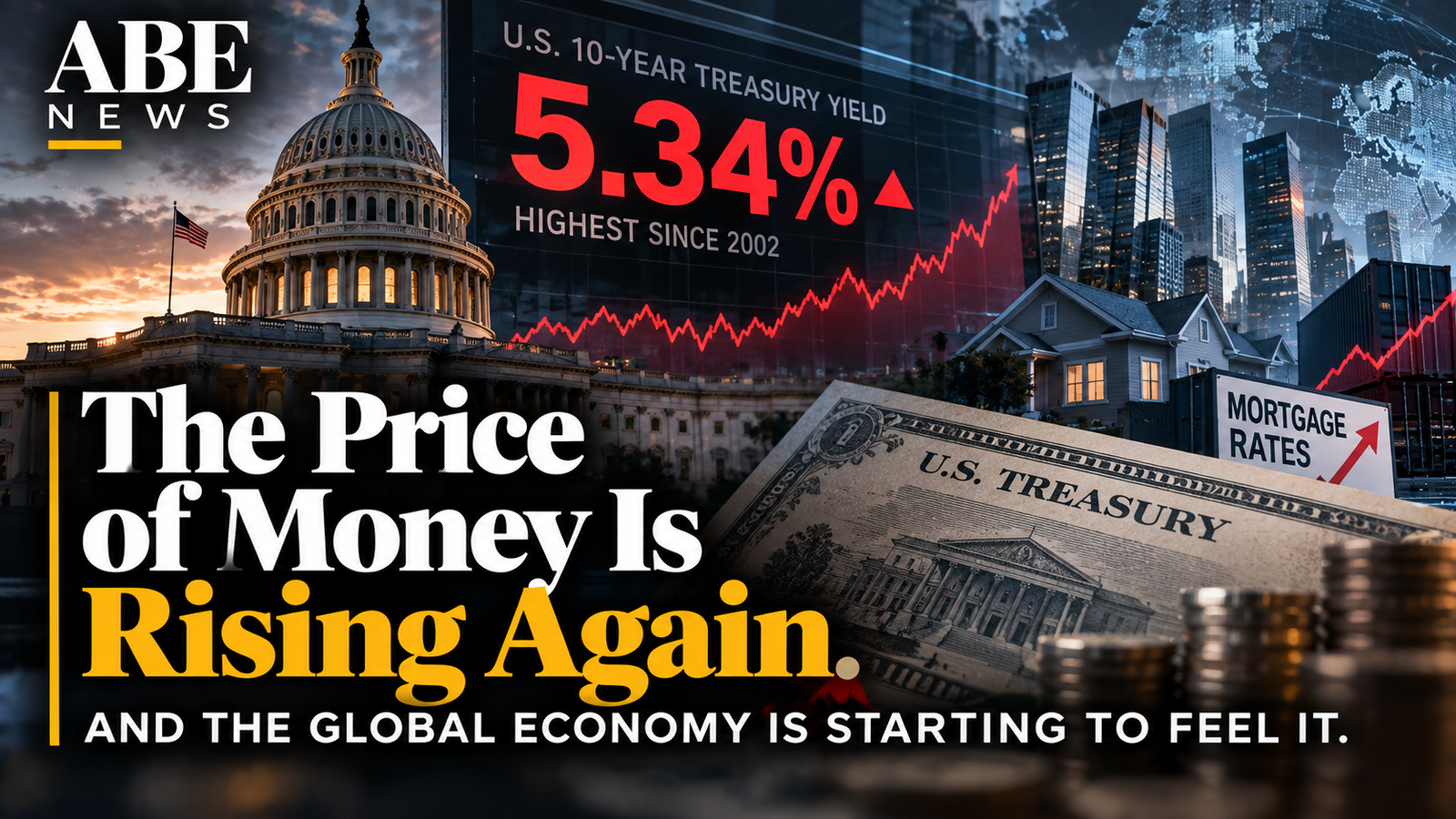
The yield on the 30-year U.S. Treasury briefly reached about 5.34%, its highest level since 2007. The Treasury responded by doubling planned buybacks of some 10-to-30-year securities to at least $4 billion per operation, an effort designed to improve liquidity in the long-term bond market.
Why should anyone outside Wall Street care?
Because government bonds help establish the price of borrowing throughout the economy. Higher Treasury yields can contribute to more expensive mortgages, corporate financing and other loans. And the United States isn’t alone: borrowing costs have risen across several major developed economies as governments confront aging populations, defence spending, climate costs and large debt burdens.
This week’s message from the bond market was therefore bigger than America’s $40 trillion milestone.
Investors are increasingly asking how much they should be paid to finance governments for decades.
And that question could influence everything from housing to business investment.
Then Walmart Gave Us a Warning From the Checkout Line
Wall Street tells us what investors think.
Walmart can tell us something about what households are actually doing.
The world’s largest retailer reported comparable-sales growth of just 2.6%, its slowest pace in roughly six years and below analysts’ expectations. Walmart shares subsequently fell more than 9%, wiping over $80 billion from the company’s market value in one session.
That would be interesting on its own.
But the explanation matters more.
Walmart said consumers appear to be making trade-offs as gasoline prices remain high. Store-traffic growth slowed, while the company expects billions in additional fuel expenses. At the same time, Walmart is cutting prices on thousands of products in an attempt to keep shoppers spending.
This is exactly where the abstract economy becomes the real economy.
Inflation isn’t simply a number released by a statistics agency. When households spend more filling their cars, they have less money available somewhere else. Maybe they postpone buying clothes. Maybe they skip an appliance. Maybe they choose the cheaper brand.
One household making that decision doesn’t change the economy.
Millions doing it simultaneously can.
That’s why Walmart’s rare miss deserves attention. It suggests the pressure we’ve been discussing all week — expensive energy, borrowing costs and persistent living expenses — may increasingly be influencing consumer behaviour.
While Consumers Became Careful, Investors Went Wild for Robots
Then China gave us almost the opposite story.
Investors weren’t cautious when Unitree Robotics came to market.
The Chinese humanoid-robot maker raised about $905 million in an IPO that was more than 8,000 times oversubscribed by retail investors. Unitree had already delivered around 18,000 bipedal humanoid robots by July, and enthusiasm surrounding China’s robotics sector helped turn its listing into one of the week’s defining technology stories.
By the time the market had repriced the company, Unitree was valued at roughly $50 billion.
That tells us something fascinating about today’s investment environment.
Investors can simultaneously worry about government debt, sell consumer stocks and still pour money into a futuristic technology company.
Why?
Because markets don’t only price today’s economy.
They try to price tomorrow’s economy.
Humanoid robotics is ultimately a bet that machines will move beyond demonstrations — running, dancing and performing martial arts — and become economically useful workers in factories, warehouses, logistics and other industries.
Whether Unitree is actually worth $50 billion is a different question.
But the enthusiasm tells us investors increasingly believe robotics could become a major industry rather than simply a technological curiosity.
Medicine Had Its Own Technology Moment
Robotics wasn’t the only futuristic idea that suddenly looked more real this week.
Moderna and Merck announced successful results from a late-stage study of a personalized mRNA cancer vaccine used against melanoma.
Investors responded dramatically: Moderna shares surged roughly 160% during the week, according to Reuters’ weekly market review.
The scientific significance is potentially even larger than the stock move.
Instead of giving every patient exactly the same treatment, personalized cancer vaccines are designed around characteristics of an individual’s tumor. The goal is to teach the immune system to recognize cancer cells carrying specific mutations.
That doesn’t make this a universal cancer cure, and detailed evidence still matters enormously.
But commercially, it represents the possibility of something medicine has pursued for years: treatments increasingly designed around the biology of an individual patient rather than only the name of the disease.
Unitree and Moderna therefore gave us two very different versions of the same business story this week.
Capital is still searching aggressively for breakthroughs.
Robots that might change labour.
Medicine that might change cancer treatment.
Even in a world worried about debt and inflation, investors haven’t stopped betting on transformation.
Canada Spent the Week Waiting
Meanwhile, Canada spent much of the week watching a clock.
The United States has threatened a new 50% tariff on roughly $20 billion of Canadian goods beginning at 12:01 a.m. Saturday unless the two countries reach an agreement.
Negotiators were meeting for a third consecutive day Friday. Canadian Trade Minister Dominic LeBlanc said Thursday that the sides were “very close,” but no final agreement had been announced in the latest reporting.
Possible terms include lowering tariffs on Canadian-built vehicles from 25% to 15% and cutting steel and aluminum tariffs from 50% to 25%. But any agreement could be politically difficult for Prime Minister Mark Carney: a Leger poll found 56% of Canadians opposed making further concessions.
For businesses, however, the biggest enemy isn’t always the tariff itself.
It’s uncertainty.
A manufacturer can calculate a 15% tariff.
It can calculate 25%.
It can calculate 50%.
What is much harder is making investment decisions when you don’t know which number will apply next week.
That is why the eventual agreement — if there is one — matters beyond the headline percentages.
Businesses need rules they can plan around.
And Investors Started Looking for Somewhere Else to Put Their Money
That brings us to one of Friday’s most interesting developments.
Bitcoin surged this week as investors returned aggressively to cryptocurrencies, while gold also benefited from demand for assets viewed by some investors as alternatives to traditional currencies and financial instruments.
It’s tempting to look at Bitcoin, government debt and gold as completely unrelated subjects.
But there is a connection.
When investors become concerned about fiscal deficits, inflation, currencies or government borrowing, they sometimes look for assets whose supply cannot easily be expanded.
Gold has served that purpose for centuries.
Bitcoin is attempting to become a digital version of that idea.
That doesn’t mean Bitcoin is replacing the dollar. It certainly doesn’t mean cryptocurrency suddenly became safe.
It means a week dominated by $40 trillion of U.S. debt and nervous bond markets created an unusually interesting backdrop for investors buying scarce assets.
And that’s one reason Bitcoin’s comeback belongs in the same conversation as America’s debt milestone.
What This Week Actually Told Us
Look beyond the individual headlines and an unusual picture emerges.
The old economy is under pressure.
Governments are borrowing heavily.
Consumers are watching their spending.
Energy remains expensive.
Trade relationships are being renegotiated.
Long-term interest rates are challenging governments and companies accustomed to cheaper financing.
But simultaneously, enormous amounts of capital are chasing the next economy.
Robotics. Personalized medicine. Artificial intelligence. Cryptocurrency. New industrial capacity.
That tension may define business for much of the remainder of 2026.
Companies aren’t operating in an easy-money world anymore.
The winners will increasingly have to prove that their technology can generate real productivity, real revenue and real profits while capital itself becomes more expensive.
And governments face a similar test.
Borrowing can solve today’s problem.
Eventually, somebody has to finance tomorrow’s interest bill.
🔴 THE ABE NEWS TAKE
If there was one lesson from business this week, it was this:
The future is getting more expensive at exactly the moment investors are making bigger bets on it.
America’s $40 trillion debt tells us the cost of yesterday’s decisions is accumulating.
Walmart tells us households are already making choices because their budgets have limits.
The bond market tells us investors increasingly want to be compensated for lending money long-term.
But Unitree tells us people will still pay extraordinary prices for a piece of a future they believe in.
Moderna tells us years of expensive research can suddenly produce a breakthrough that changes how investors see an entire technology.
And Bitcoin tells us that when people begin questioning traditional financial systems, alternatives can quickly attract attention.
That’s not contradiction.
That’s business.
Money constantly moves between fear and opportunity.
Between protecting what exists and financing what comes next.
Between today’s bills and tomorrow’s possibilities.
And as this week ends, one of the biggest unresolved questions sits right here in Canada.
Will Canada and the United States sign their trade agreement before midnight?
Or will Saturday begin with a 50% tariff?
We don’t know yet.
But that’s exactly where next week’s business story begins.
ABE NEWS
Business. Money. Style. The News.
Understand More. Think Bigger.