








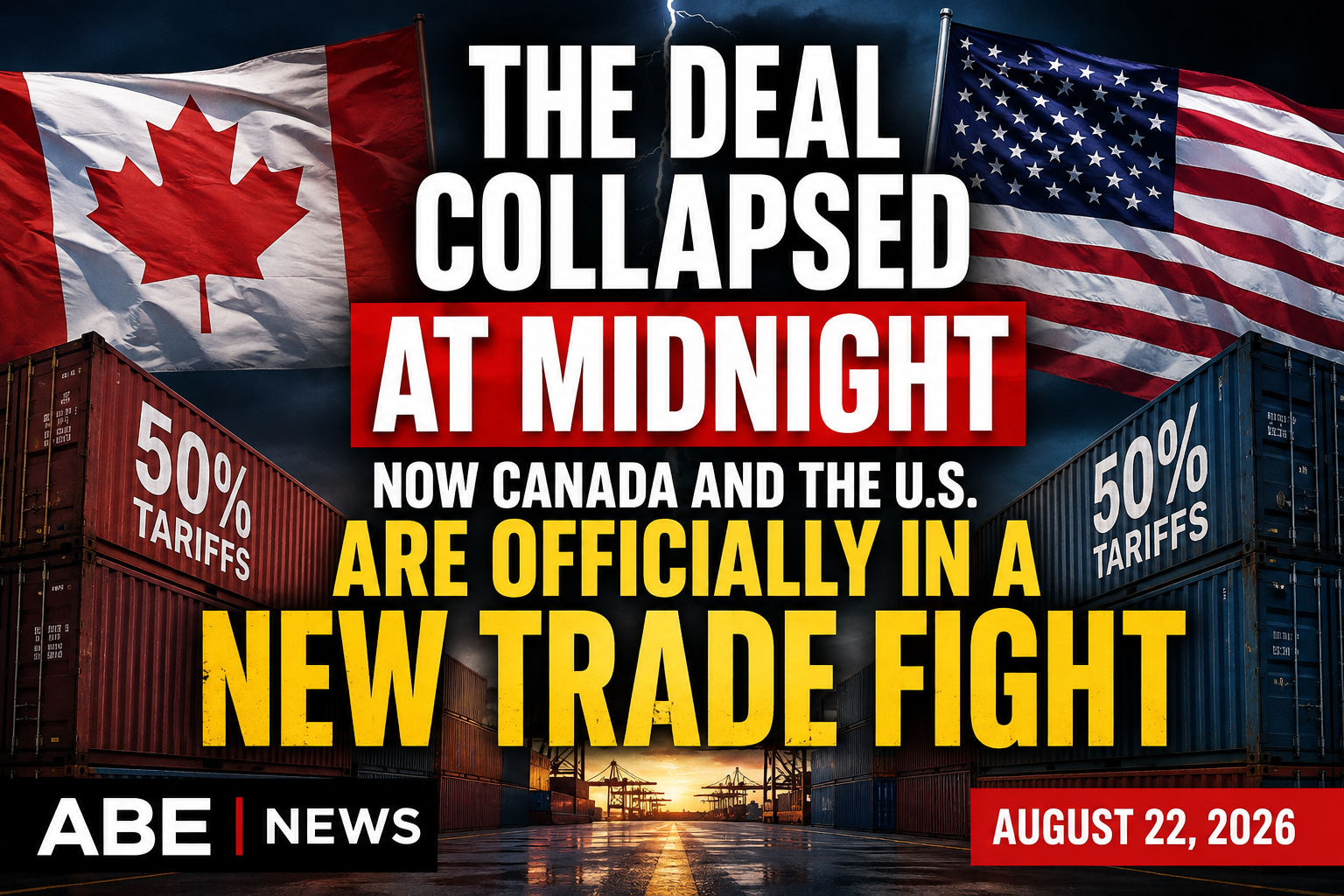
ABE NEWS | SATURDAY, AUGUST 22, 2026
For three days, Canada and the United States appeared to be moving toward a trade agreement.
By midnight, it was gone.
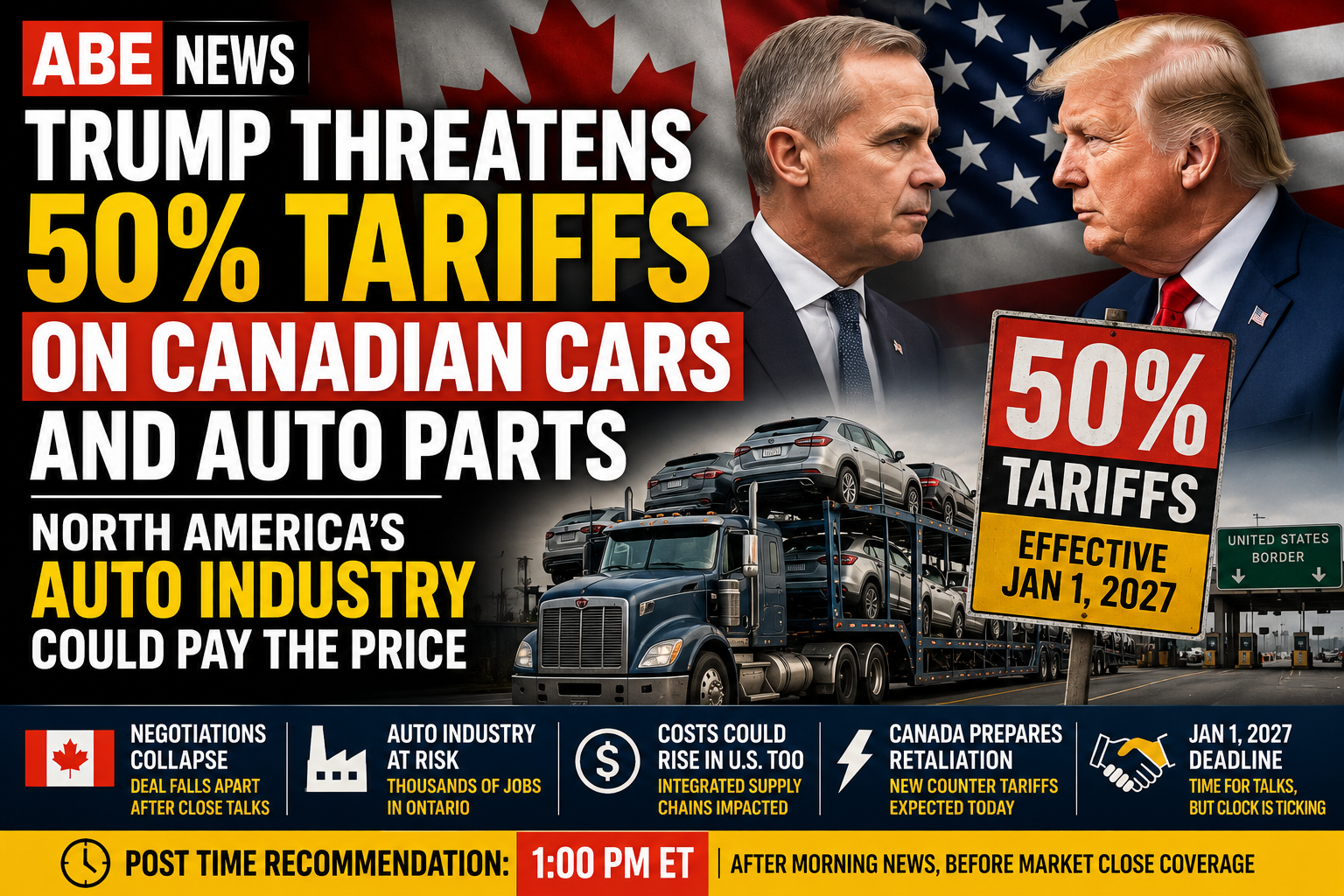
After intense negotiations in Washington, the two countries failed to finalize a deal Friday night. At 12:01 a.m. Saturday, the United States imposed new 50% tariffs on roughly US$20 billion — about C$28 billion — of Canadian goods.
Canada’s response came immediately.
Prime Minister Mark Carney announced that Ottawa would match the American tariffs dollar for dollar, suspended the negotiations and ordered Canada’s negotiating team back to Ottawa.
This isn’t simply another deadline being extended.
The tariffs are now in effect.
The talks have stopped.
And after days of saying they were close to an agreement, Canada and the United States are blaming each other for its collapse.
They Were Supposed to Be Close to a Deal
That’s what makes the breakdown remarkable.
Only days ago, Canadian and American officials were publicly describing significant progress. Negotiators spent three consecutive days in Washington trying to resolve disagreements over some of the most important sectors in the Canadian economy.
A potential agreement could have reduced U.S. tariffs on Canadian steel, aluminum and automobiles. Discussions also touched on softwood lumber, American alcohol in Canadian provincial stores, dairy and a wider economic and national-security partnership.
Instead, negotiations collapsed at the final stage.
And each government tells a very different story about why.
Carney said the United States introduced last-minute changes that Canada considered “unfair” and “uneconomic,” arguing that they called into question whether an agreement could be relied upon.
His message was clear: Canada wanted a deal, but not at any price.
The Trump administration says the opposite happened.
U.S. Trade Representative Jamieson Greer said Canada had declined to finalize terms that had been agreed earlier in the week, accusing Ottawa of introducing new demands and reversing previous commitments. A senior U.S. official said Canada was seeking additional concessions involving steel, aluminum, automobiles and softwood lumber.
So we now have two governments effectively saying:
We had a deal until the other side changed it.
What Actually Gets Hit?
The new 50% duties apply to roughly 5% of Canada’s annual exports to the United States.
That means most Canadian exports are not suddenly facing a 50% tariff.
That distinction matters.
Canada and the United States remain enormously integrated trading partners, and much trade continues under existing arrangements. But the affected products include goods outside preferential treatment under the Canada-U.S.-Mexico trade agreement, and some vulnerable Canadian businesses could face severe consequences.
The economic impact therefore won’t be distributed evenly.
For a company whose products aren’t affected, Saturday morning may look relatively normal.
For a small Canadian exporter suddenly facing a 50% barrier to its biggest market, the calculation can change overnight.
Raise prices?
Absorb the tariff?
Reduce production?
Find customers elsewhere?
Cut workers?
Stop exporting to the United States altogether?
Those are no longer theoretical questions.
Canada Is Fighting Back
Carney didn’t merely criticize Washington.
He announced retaliation.
Canada will impose matching tariffs “dollar for dollar”, while the government says additional measures to support Canadian workers and businesses will be announced in the coming days. Ottawa says it has already provided nearly C$25 billion in support over the past 18 months as trade tensions with the United States have intensified.
Ontario Premier Doug Ford backed the response, saying Canada should respond “tariff for tariff, dollar for dollar.”
But Alberta Premier Danielle Smith struck a more cautious tone, warning that nobody benefits from a trade war and calling for negotiations eventually to resume.
That’s an important tension Canada will have to manage.
Retaliation can demonstrate that the country won’t accept unilateral pressure without responding.
But tariffs also have costs.
American exporters can lose Canadian customers.
Canadian companies importing affected U.S. products can face higher expenses.
Those costs can eventually reach consumers.
A trade war can therefore hurt the country being targeted and the country doing the targeting.
This Is Bigger Than $20 Billion
The immediate tariffs matter.
But the bigger story may be what this breakdown says about the Canada-U.S. economic relationship.
The two countries exchanged about US$880 billion worth of goods and services last year, according to AP. Nearly 72% of Canadian goods exports went to the United States. Approximately US$2 billion in goods cross the border every day.
For generations, geography gave Canada an extraordinary economic advantage.
The world’s largest consumer economy was directly next door.
Factories, supply chains, energy networks and transportation systems grew around that relationship.
But Carney’s statement after the negotiations collapsed contained a sentence that may matter far beyond this weekend:
“America has changed.”
His government argues Canada cannot assume the old economic relationship will simply return. Ottawa is increasingly talking about expanding infrastructure, developing new export markets and reducing Canada’s dependence on a single trading partner.
That may ultimately become the bigger economic transformation.
Not whether tariffs are 25% or 50% this month.
But whether this conflict permanently changes where Canada sells, invests and builds.
And Now CUSMA Gets More Complicated
There’s another problem waiting in the background.
Canada, the United States and Mexico already have the CUSMA/USMCA free-trade agreement.
The three countries need to deal with the future of that agreement, and the latest confrontation makes cooperation considerably more difficult.
Reuters reports that formal U.S.-Mexico discussions have begun, while escalating tensions have created uncertainty around the Canadian side.
That matters because North American manufacturing doesn’t operate neatly inside national borders.
A vehicle can contain components that cross borders multiple times before reaching a dealership.
Energy flows north and south.
Agricultural markets are intertwined.
Manufacturers plan investments years in advance.
The more uncertain the rules become, the harder those businesses find it to decide where to invest their next billion dollars.
The Political Relationship Is Changing Too
This isn’t occurring in an ordinary Canada-U.S. relationship.
President Donald Trump’s tariff policies and repeated rhetoric about Canada becoming America’s “51st state” have produced significant political backlash north of the border.
And something unexpected is happening inside Canada.
Reuters reports Saturday that support for Quebec independence has fallen to roughly 30% — its lowest level in decades. Trump’s trade policies and rhetoric appear to have strengthened Canadian patriotism among some Quebecers who might otherwise have been sympathetic to separation.
That’s extraordinary.
An American trade confrontation isn’t merely affecting factories and prices.
It is beginning to influence debates about Canadian identity itself.
🔴 THE ABE NEWS TAKE
For months, Canada and the United States have argued about tariffs.
But Saturday morning feels different.
The most important development isn’t simply that another tariff took effect.
It’s that Canada walked away from the negotiating table rather than accept the final terms being offered by its largest trading partner.
That carries risk.
Canada cannot quickly replace the enormous American market. Businesses built around cross-border trade cannot simply redirect decades-old supply chains to Europe, Asia or Africa overnight.
But the United States also cannot pretend Canada doesn’t matter.
The two economies are deeply connected. American manufacturers depend on Canadian energy, materials, components and customers. Tariffs imposed at the border don’t magically erase those relationships.
They make them more expensive.
And now both governments have publicly committed themselves to confrontation.
Yesterday, the question was:
What will the Canada-U.S. deal look like?
Today, that question is gone.
The question now is:
How far will this trade fight go before somebody decides the cost is too high?
For the first time in several days, we aren’t waiting for the deadline anymore.
The deadline passed.
And the tariffs are here.
ABE NEWS
Business. Money. Style. The News.
Understand More. Think Bigger.