






ABE NEWS | August 31, 2026
Canada’s escalating trade confrontation with the United States is threatening to hit two companies that are not Canadian and not American particularly hard.
They are Japanese.
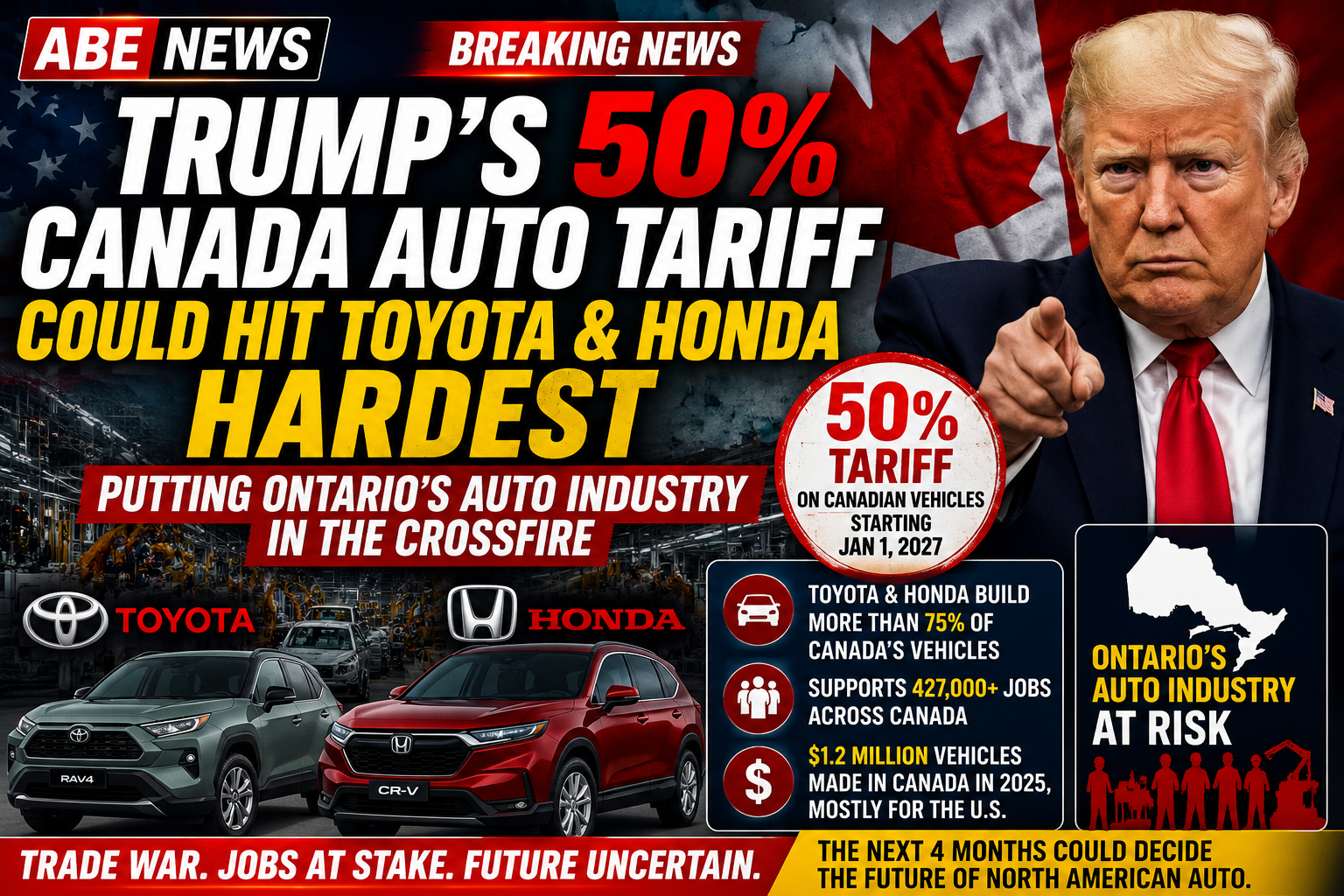
Toyota and Honda have spent decades building enormous manufacturing operations in Ontario, turning Canada into an important production base for some of the most popular vehicles sold across North America. But that strategy is suddenly becoming a major vulnerability as U.S. President Donald Trump threatens to raise tariffs on Canadian-made cars, trucks and automotive parts to 50% beginning January 1, 2027.
The numbers show why the stakes are so high.
Toyota and Honda together account for more than three-quarters of all vehicles manufactured in Canada. Canadian factories produced roughly 1.2 million vehicles last year, with the overwhelming majority destined for the United States.
Toyota ships Canadian-built RAV4s south of the border.
Honda ships Canadian-built CR-Vs.
Both are among America’s most popular SUVs.
Canadian-built vehicles represented approximately 17% of Toyota’s U.S. sales last year and nearly one-quarter of Honda’s U.S. sales, according to Barclays analysts cited by Reuters.
That means a tariff intended to pressure Ottawa could force two of Japan’s largest corporations to make extraordinarily difficult decisions about their Canadian factories.
And behind those decisions are hundreds of thousands of Canadian jobs connected directly and indirectly to one of the country’s most important manufacturing industries.
THE TARIFF COULD DOUBLE
Canadian-made vehicles entering the United States are already confronting a 25% tariff.
Trump has threatened to double that rate to 50% on January 1 following the collapse of trade negotiations between Washington and Ottawa.
A previous deal under discussion would have reduced the top-line tariff on Canadian cars and light-duty trucks from 25% to 15%.
That agreement never happened.
Negotiations broke down amid disagreements that included the treatment of medium- and heavy-duty vehicles, which are particularly important to Canadian manufacturing.
The result is extraordinary uncertainty.
Automakers spent decades designing North America as one integrated production system.
A component might cross the Canadian-U.S. border several times before a finished vehicle reaches a dealership.
Engines, transmissions, steel, electronics and other components move between factories based on efficiency rather than nationality.
The Canada-U.S.-Mexico trade framework encouraged companies to think about North America as a production region.
A 50% tariff on Canadian vehicles threatens to tear directly through that model.
TOYOTA AND HONDA ARE ESPECIALLY EXPOSED
Toyota and Honda’s vulnerability comes from decisions that once looked extremely sensible.
Both companies built large Canadian manufacturing operations precisely because Canada provided access to the enormous American automobile market.
Toyota manufactures vehicles in Ontario at its facilities in Cambridge and Woodstock.
Honda operates its major Canadian manufacturing complex in Alliston.
Those plants are deeply integrated into the companies’ North American operations.
But the same integration that made Canadian production efficient during decades of relatively open trade could become a liability if Washington erects a 50% tariff wall at the border.
Analysts warn that the economics could become extremely difficult.
Manufacturing a vehicle in Ontario, paying the costs of production and transportation, and then adding a 50% tariff when that vehicle enters the United States could make some Canadian production lines commercially unsustainable.
One possible consequence is particularly serious:
production could move.
Industry analysts told Reuters that Toyota and Honda could eventually be forced to shut some Canadian assembly lines if the 50% tariff actually takes effect.
Neither company has announced such closures.
And there are still four months before the proposed increase, leaving time for Canada and the United States to negotiate.
But companies operating factories worth billions of dollars cannot simply wait until December to start thinking about January.
Planning is already happening.
THE RAV4 AND CR-V SHOW WHAT IS AT STAKE
Two vehicles explain the problem better than almost anything else.
The Toyota RAV4 and Honda CR-V are enormously important products in the North American market.
Both companies manufacture versions of these vehicles in Canada and export them into the United States.
Under the old North American model, that made perfect sense.
Build the vehicle where the company has efficient manufacturing capacity.
Move it across the border.
Sell it wherever demand exists.
A 50% tariff changes the calculation.
Toyota and Honda would face several options.
They could absorb some of the tariff themselves, reducing profits.
They could increase American prices, risking lower sales.
They could redirect Canadian production toward other international markets.
They could increase output from U.S. factories.
Or, eventually, they could shift more manufacturing capacity out of Canada.
None of those options is easy.
And several would be painful for Ontario.
ONTARIO HAS A LOT TO LOSE
Canada’s auto industry is not a small niche sector.
It is one of the country’s most important manufacturing ecosystems.
The industry indirectly supports approximately 427,000 Canadian jobs, according to figures cited by Reuters.
Those jobs extend far beyond the people assembling vehicles inside Toyota, Honda, General Motors, Ford and Stellantis plants.
There are parts manufacturers.
Steel producers.
Tool-and-die companies.
Transportation firms.
Warehouses.
Engineering businesses.
Technology suppliers.
Dealerships.
Construction companies.
And thousands of smaller businesses that depend on the enormous automotive supply chain.
Much of that ecosystem is concentrated in Ontario.
That means a major reduction in Canadian vehicle production would spread far beyond a handful of assembly plants.
If an assembly line slows, suppliers receive fewer orders.
If suppliers receive fewer orders, shifts disappear.
If factories close, nearby communities lose high-paying industrial jobs and tax revenue.
That is why Canada’s ambassador to Washington, Mark Wiseman, has said Ottawa cannot accept a trade agreement that fails to preserve a robust Canadian vehicle-assembly and parts industry.
For Canada, autos have become a red line.
THE STRANGE PART: JAPAN COULD PAY FOR A U.S.–CANADA FIGHT
One of the most remarkable aspects of the dispute is who could suffer.
The political confrontation is between Washington and Ottawa.
But Toyota and Honda are headquartered in Japan.
Their Canadian factories were built under a trade system that encouraged foreign manufacturers to invest in North America and then sell vehicles throughout the region.
Now those companies could become collateral damage in a dispute they did not create.
Toyota and Honda also face another challenge.
The United States is one of their most important and profitable markets.
At the same time, Japanese automakers are under increasing pressure from lower-cost Chinese electric-vehicle manufacturers in markets including Southeast Asia, Europe and Latin America.
Chinese automakers such as BYD have expanded rapidly around the world.
The United States remains different because major Chinese EV manufacturers are effectively shut out of the American market by trade barriers.
That makes America’s enormous vehicle market even more strategically valuable to Japanese companies.
Toyota and Honda cannot simply walk away.
They need access to American consumers.
And that gives Washington enormous leverage over where their vehicles are manufactured.
TRUMP WANTS MORE MANUFACTURING INSIDE AMERICA
The broader objective of Trump’s tariff strategy is clear.
The administration wants companies that sell enormous numbers of products to Americans to manufacture more of those products inside the United States.
For automakers, the message is particularly powerful:
If you build outside America and sell into America, tariffs may make that strategy increasingly expensive.
Toyota is already expanding its American footprint.
The company has pledged up to $10 billion over five years to expand U.S. operations, including a new $3.6 billion plant in Texas.
For Canada, that creates an uncomfortable question.
If Toyota must decide where its next billion dollars of North American manufacturing investment goes, does a Canadian factory facing a potential 50% U.S. tariff still compete effectively against a factory located inside the United States?
That is precisely the kind of long-term investment calculation Ottawa has to worry about.
The biggest danger may not be a plant closing tomorrow.
It may be the next plant never being built in Canada.
HONDA HAS ALREADY SENT A WARNING
Honda’s situation demonstrates how trade uncertainty can influence investment even before tariffs take full effect.
The company has warned that it may reconsider plans for another North American assembly plant if the United States-Mexico-Canada Agreement does not provide sufficient long-term certainty.
Honda needs additional North American manufacturing capacity around the end of the decade.
But executives want to know what the continental trade system will look like before committing billions of dollars.
The company has already suspended its approximately $11 billion Canadian electric-vehicle project amid shifting market and trade conditions.
That is exactly why the present confrontation matters beyond January’s tariff deadline.
Factories operate for decades.
Companies make investment decisions years before those factories open.
If executives no longer believe vehicles can move predictably across the Canada-U.S. border, investment decisions could begin moving with them.
BUT CANADA’S AUTO INDUSTRY IS NOT SURRENDERING
There is another development this weekend that complicates the picture.
General Motors workers in Canada have approved a new labour agreement that will bring production of a next-generation heavy-duty GMC Sierra to GM’s Oshawa, Ontario plant.
GM plans to invest C$144 million to add the truck there.
The company has also pledged not to immediately sell or close its assembly facility in Ingersoll.
Overall, GM has committed more than C$1 billion in Canadian plant investment, including previously announced spending supporting new V8-engine production in Ontario.
That is significant.
While Toyota and Honda are evaluating enormous tariff risks, GM is simultaneously committing new manufacturing work to Ontario.
The contrasting developments show how uncertain the industry’s future has become.
Companies are still investing.
Workers are still building vehicles.
New products are still being assigned to Canadian factories.
But every major decision is increasingly being made under the shadow of Washington’s tariff policy.
CANADA IS FIGHTING BACK
Ottawa has not accepted the latest American measures quietly.
Canada announced retaliatory tariffs covering approximately $20 billion worth of annual U.S. imports after the latest round of U.S. tariffs.
Those Canadian counter-tariffs are scheduled to take effect September 8.
The government has also introduced assistance for affected businesses and workers.
But retaliation cannot fully solve Canada’s automotive problem.
Canada can make American exports more expensive.
It can provide financial support to Canadian companies.
It can encourage businesses to find new markets.
What it cannot easily replace is the American consumer.
The United States is simply too large, too close and too deeply integrated into Canada’s industrial economy.
That is especially true for vehicles.
Building an SUV in Ontario and selling it in Michigan is fundamentally easier than building that same SUV in Ontario and trying to replace the American customer with one thousands of kilometres away.
Geography is part of Canada’s economic advantage.
It is also part of Canada’s vulnerability.
COULD CANADA FIND OTHER MARKETS?
Diversification is becoming one of the central themes of Canada’s economic strategy.
Ottawa increasingly wants Canadian companies to trade more with Europe and Asia and reduce their dependence on the United States.
That makes strategic sense.
But automobiles demonstrate how difficult diversification can be in practice.
Different markets have different regulations.
Different consumer preferences.
Different emissions standards.
Different vehicle sizes.
Different distribution systems.
And enormous transportation costs.
A Canadian-built SUV designed primarily for North American consumers cannot necessarily be redirected overnight to Europe or Asia in enormous volumes.
Toyota and Honda are global companies, which gives them more flexibility than many Canadian manufacturers.
But even they cannot effortlessly redesign global production networks around a sudden tariff wall.
THE USMCA QUESTION IS GETTING BIGGER
Behind the immediate tariff battle is an even larger issue:
What happens to the North American trade system itself?
The United States-Mexico-Canada Agreement was designed to provide businesses with predictable rules governing trade across the continent.
Automakers made investment decisions based on those rules.
Suppliers built factories based on those rules.
Communities built economic strategies around those rules.
Now companies are questioning how durable that system really is.
If USMCA no longer guarantees relatively predictable access to the U.S. market, the consequences could extend far beyond vehicles.
Companies in numerous industries would have to reconsider where factories should be located.
Canada’s challenge is therefore not simply persuading Trump to reduce one tariff.
It is restoring enough certainty that companies continue believing Canada is a viable base for serving the entire North American economy.
WHAT HAPPENS BETWEEN NOW AND JANUARY
The 50% auto tariff is not scheduled to take effect until January 1.
That creates a negotiating window.
And industry officials believe the deadline itself could be intended partly to increase pressure on Ottawa.
A deal remains possible.
For Toyota, Honda and hundreds of Canadian suppliers, the next several months could therefore be crucial.
Watch whether Canada and the United States restart formal negotiations.
Watch whether Washington offers exemptions or lower tariff rates for certain vehicles.
Watch what happens to USMCA negotiations.
Watch whether Toyota or Honda announces changes to Canadian production.
And perhaps most importantly, watch where automakers announce their next major North American investments.
Those decisions may reveal the long-term consequences before the tariff ever arrives.
🔴 THE ABE NEWS TAKE
The most important number in this story isn’t 50%.
It’s 75%.
Toyota and Honda — two Japanese companies — produce more than three-quarters of Canada’s vehicles.
That fact captures both the extraordinary success and the extraordinary vulnerability of Canada’s automotive strategy.
Canada convinced some of the world’s largest manufacturers to build vehicles in Ontario because the country offered skilled workers, advanced factories, political stability and privileged access to the enormous American market.
For decades, that formula worked.
Now one part of it is being questioned.
Access to America.
If a vehicle built in Ontario suddenly becomes dramatically more expensive when it crosses the border, the economics behind decades of investment begin changing.
And factories follow economics.
The immediate danger is lost production.
The bigger danger is lost future investment.
A Toyota line that closes would hurt.
A Honda factory that never gets built could matter for decades.
That is why Canada’s trade confrontation with Washington has become much more than another argument about tariffs.
It is becoming a battle over where North America’s industrial economy will physically exist.
Canada still has powerful advantages.
Its workforce remains highly skilled.
Its auto cluster is deeply established.
Its suppliers are sophisticated.
GM is still committing new production to Ontario.
And Toyota and Honda have billions invested in facilities that cannot simply be moved overnight.
But Canada now has to defend something it once largely took for granted:
the idea that a factory in Ontario can serve American consumers almost as naturally as a factory in Ohio.
If the 50% tariff arrives on January 1, that assumption could break.
And when trade barriers become large enough, supply chains don’t merely pay them.
Eventually, supply chains move.
For Ontario, Toyota and Honda, the next four months may therefore determine far more than the price of imported vehicles.
They could help determine where the next generation of North American cars gets built.
ABE NEWS
Business. Money. Style. The News.
Understand More. Think Bigger.