








ABE NEWS | August 31, 2026
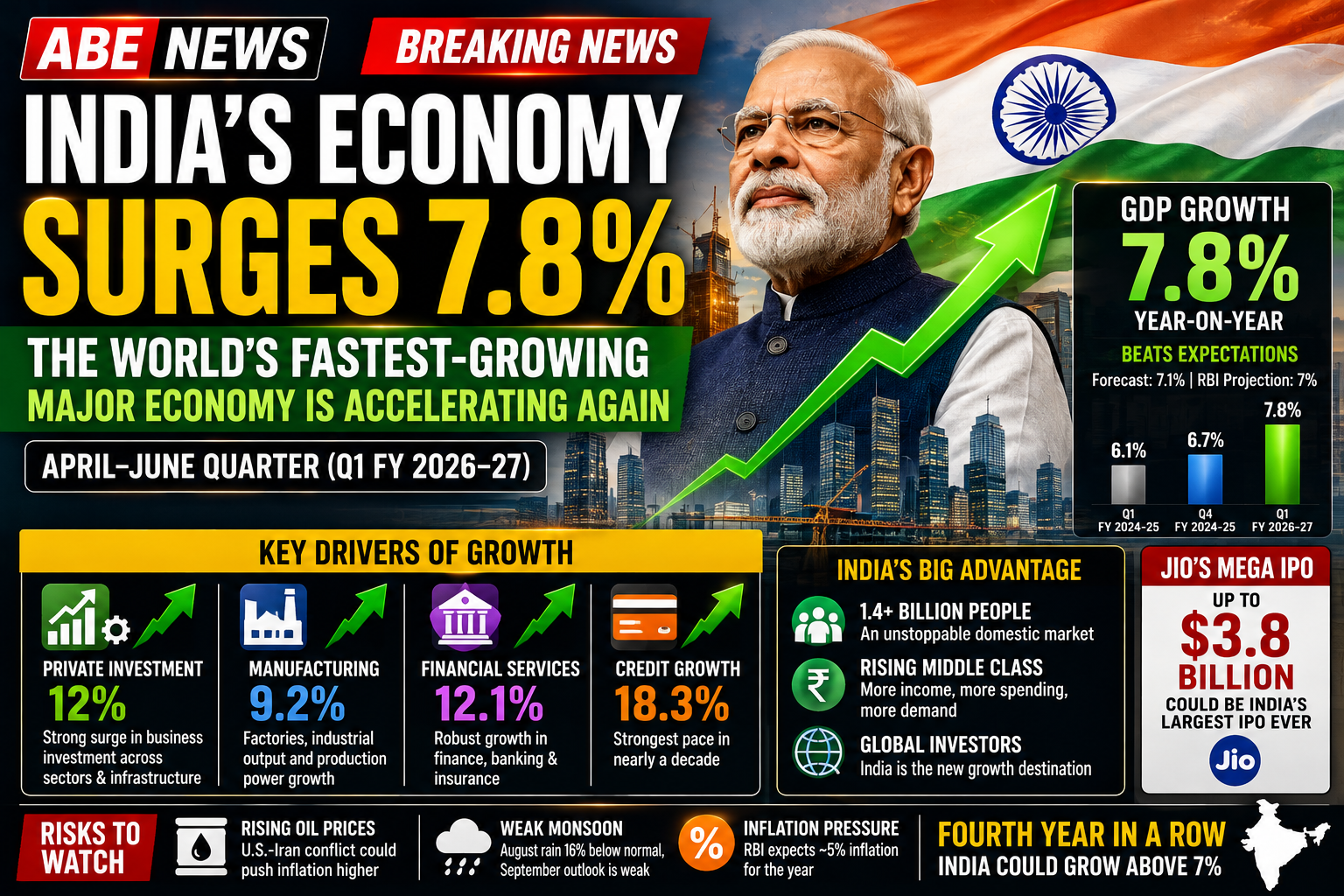
India has opened its new financial year with another powerful economic performance, expanding 7.8% year-on-year during the April–June quarter and beating expectations as investment, manufacturing, financial services and domestic demand helped the world’s most populous country maintain growth that most major economies can only envy.
The result exceeded the roughly 7.1% growth economists had expected and came in above the 7% projection from the Reserve Bank of India, reinforcing India’s position as one of the fastest-growing major economies in the world.
The expansion was slower than the revised 8.6% growth recorded during the previous January–March quarter, meaning India is not accelerating on every comparison. But the bigger story is the durability of the country’s growth.
India is expanding despite an increasingly difficult international environment.
Oil prices have surged again as the United States and Iran resume military attacks.
Global borrowing costs remain elevated.
Trade tensions are reshaping supply chains.
Major economies are struggling with inflation and weaker growth.
Yet India’s domestic economy continues to generate substantial momentum.
And underneath the headline 7.8% number, some of the strongest data came from the parts of the economy that could determine whether India’s boom lasts.
INVESTMENT IS STARTING TO MATTER MORE
One of the most important numbers in the report was not GDP itself.
It was investment.
Private investment increased by roughly 12%, providing evidence that India’s expansion is increasingly being supported by businesses putting money into new capacity rather than relying only on government spending and household consumption.
Companies are investing in sectors including data centres, electricity generation, metals and other industrial infrastructure.
That matters enormously.
Government spending can stimulate an economy.
Consumer spending can sustain demand.
But for a developing country trying to become significantly richer, private companies eventually need to build the factories, power systems, technology infrastructure, logistics networks and productive capacity that support long-term growth.
India has spent years trying to trigger precisely that investment cycle.
The latest numbers suggest it may be strengthening.
If that continues, India’s economic story could shift from one dominated by government infrastructure spending toward something broader: a self-reinforcing cycle in which public investment attracts private investment, new businesses create jobs, those jobs increase consumption and rising demand encourages companies to invest again.
That is the kind of cycle capable of sustaining high growth for years.
MANUFACTURING GREW 9.2%
Manufacturing expanded approximately 9.2% during the quarter.
That is particularly important because India wants to become a much larger global manufacturing power.
For decades, China dominated the world’s factory economy.
Its combination of infrastructure, enormous industrial clusters, skilled labour, ports, suppliers and scale turned the country into the manufacturing centre of globalisation.
India developed differently.
Its economy became extraordinarily strong in services, software and information technology, but manufacturing did not reach the same relative scale.
New Delhi is trying to change that.
Government programmes have encouraged companies to manufacture electronics, semiconductors, automobiles, renewable-energy equipment and other products domestically.
Global companies are simultaneously looking for alternatives to excessive dependence on China.
That has created the possibility of a historic opportunity.
If multinational companies decide they need a second major Asian manufacturing base, India wants to be the obvious choice.
The latest manufacturing numbers suggest industrial activity is contributing meaningfully to growth.
But India still has a long way to go before it can replicate China’s manufacturing ecosystem.
Infrastructure remains uneven.
Land acquisition can be difficult.
Regulation varies between states.
Logistics costs remain significant.
And competitors including Vietnam, Indonesia and Mexico are fighting for the same global investment.
India’s advantage is scale.
With more than 1.4 billion people and an enormous domestic market, companies can manufacture in India not only for export but also for Indian consumers.
That combination is difficult for smaller competitors to reproduce.
FINANCIAL SERVICES ARE BOOMING
Financial services were another standout.
The broader financial-services segment expanded by approximately 12.1%, while credit growth across the economy reached roughly 18.3%, its strongest pace in around a decade.
Credit is the bloodstream of a growing economy.
Businesses borrow to expand.
Families borrow to buy homes and vehicles.
Entrepreneurs borrow to start companies.
Developers finance construction.
Manufacturers finance machinery.
When lending expands alongside productive investment, it can amplify economic growth.
India’s increasingly digital financial system adds another dimension.
The country has built one of the world’s most sophisticated digital-payment infrastructures.
Hundreds of millions of people can move money instantly using mobile devices.
Banks and fintech companies are increasingly able to reach consumers and small businesses that historically operated outside formal financial systems.
That expansion of financial access can create enormous economic consequences over time.
More people enter the formal economy.
More transactions become visible.
Businesses develop financial histories.
Credit becomes easier to assess.
Tax collection improves.
Capital can move more efficiently.
India is effectively attempting to combine rapid economic development with digital infrastructure at a scale rarely attempted before.
INDIA’S CONSUMERS ARE AN ECONOMIC SUPERPOWER
Another major advantage is domestic consumption.
Unlike smaller export-oriented economies that depend heavily on foreign buyers, India has an enormous internal market.
More than a billion people need food, transportation, telecommunications, housing, financial services, entertainment, healthcare and consumer products.
As incomes rise, the composition of that spending changes.
Families that once spent most of their income on necessities begin buying motorcycles and cars.
They travel.
They use more financial products.
They purchase smartphones.
They subscribe to digital services.
They improve their homes.
They spend more on education and healthcare.
That expanding middle class is one reason multinational corporations increasingly view India as a market they cannot ignore.
It also gives the economy resilience.
Exports matter.
Foreign investment matters.
But India does not depend entirely on overseas demand to generate growth.
Its own population can become one of its largest economic engines.
JIO’S $3.8 BILLION IPO FITS INTO THE SAME STORY
The economic numbers also help explain why India’s capital markets are attracting so much attention.
India recently approved the planned approximately $3.8 billion initial public offering of Jio Platforms, the digital and telecommunications empire controlled by Reliance Industries.
If completed at that scale, the listing could become the largest IPO in Indian history.
Jio has more than 533 million subscribers, demonstrating the extraordinary scale available to companies serving Indian consumers.
That is what makes India’s economic rise different from the development stories of many smaller countries.
A successful Indian company can reach hundreds of millions of customers without leaving India.
Telecommunications.
Banking.
Retail.
Digital payments.
E-commerce.
Entertainment.
Insurance.
Transportation.
Energy.
Companies operating successfully in those industries are serving a market comparable in population to an entire continent.
Strong GDP growth makes that opportunity even larger.
INFRASTRUCTURE IS CHANGING THE COUNTRY
India’s government has spent heavily on infrastructure.
Roads have expanded.
Railways are being modernized.
Airports are being built and upgraded.
Electricity networks are improving.
Ports are expanding.
Digital infrastructure has grown dramatically.
The objective is straightforward:
reduce the friction that historically made doing business in India more difficult.
Infrastructure has a multiplier effect.
A new highway doesn’t merely create construction jobs.
It can reduce delivery times for thousands of companies.
A port expansion doesn’t simply employ dock workers.
It can make exports more competitive.
Reliable electricity doesn’t simply improve household life.
It allows factories and data centres to operate more efficiently.
Digital connectivity doesn’t merely allow people to browse the internet.
It enables banking, commerce, education and entirely new categories of business.
This is why India’s infrastructure push is so important to the country’s long-term growth story.
The goal isn’t merely to stimulate today’s economy.
It is to increase tomorrow’s productive capacity.
BUT INDIA HAS A BIG OIL PROBLEM
The renewed conflict between the United States and Iran creates one of the biggest external risks to India’s outlook.
India imports most of the crude oil it consumes.
That means high global oil prices act almost like a tax on the economy.
When crude becomes more expensive, India pays more for energy imports.
That can weaken the rupee.
Fuel costs can increase.
Transportation becomes more expensive.
Businesses face higher input costs.
Inflation can rise.
And consumers have less money available for other purchases.
Oil prices jumped more than 3% Monday after American forces struck Iranian launchers on Larak Island and Iran retaliated against U.S.-used bases in Jordan.
The location is especially worrying because Larak sits inside the Strait of Hormuz, through which enormous quantities of global oil historically moved.
For India, a country simultaneously experiencing rapid economic expansion and enormous energy demand, another prolonged oil shock would be particularly unwelcome.
India’s economic rise requires energy.
A lot of it.
And much of that energy still comes from abroad.
THE MONSOON IS ANOTHER WARNING
India’s second major risk comes from the sky.
Agriculture remains deeply dependent on the annual monsoon.
Farm output grew approximately 3.6% during the April–June quarter, but rainfall conditions have become less favourable.
August rainfall was around 16% below normal, and India’s weather authorities expect September rainfall to remain below the long-term average.
That matters because agriculture still employs a huge share of India’s workforce.
A weak monsoon can reduce crop production.
Food prices rise.
Rural incomes suffer.
Consumers spend less.
Inflation increases.
The Reserve Bank then faces a difficult policy problem.
Should it support economic growth?
Or raise interest rates to control inflation?
India’s headline GDP numbers can sometimes make the country look like a fully industrialised economic giant.
But agriculture remains a reminder that India’s economy still contains two realities at once.
One is modern, digital, urban and increasingly global.
The other remains rural, agricultural and heavily influenced by rainfall.
India’s development challenge is connecting those two economies.
INFLATION COULD COMPLICATE THE BOOM
The Reserve Bank of India is watching inflation carefully.
Higher oil prices and food costs could push inflation upward just as economic growth remains extremely strong.
The central bank expects inflation to average around 5%.
Strong growth gives policymakers room to focus on inflation if necessary.
But interest-rate increases come with costs.
Mortgages become more expensive.
Businesses pay more to borrow.
Investment can slow.
Bond yields rise.
Currency markets become volatile.
That means India’s impressive 7.8% expansion could ironically strengthen the case for tighter monetary policy if inflation also remains elevated.
The central bank therefore faces a balancing act.
India wants growth.
But it wants sustainable growth.
An economy expanding rapidly while inflation accelerates can eventually create instability.
INDIA COULD RECORD A FOURTH STRAIGHT YEAR ABOVE 7%
Economists are becoming more optimistic about the full financial year.
Several forecasts now place India’s growth around 7%, potentially giving the country a fourth consecutive year of expansion above that threshold.
For a major economy, that is extraordinary.
At 7% annual growth, an economy roughly doubles in size in about a decade if the pace can be sustained.
That does not mean living standards automatically double.
Population growth, inflation, currency movements and inequality all matter.
But sustained high real growth can transform a country.
Government tax revenues increase.
Companies become larger.
Infrastructure investment becomes easier to finance.
Household incomes rise.
Capital markets deepen.
Foreign investors pay attention.
And the country’s geopolitical influence expands alongside its economy.
That final point is increasingly important.
Economic power eventually becomes political power.
INDIA IS BECOMING TOO BIG FOR GLOBAL BUSINESS TO IGNORE
For multinational companies, India increasingly represents three opportunities simultaneously.
It is a consumer market.
It is a manufacturing base.
And it is a technology centre.
Very few countries can offer all three at enormous scale.
Apple and other global electronics companies have expanded manufacturing there.
Technology companies employ huge Indian workforces.
Banks and investors are increasing exposure to Indian markets.
Global consumer brands are competing for Indian households.
Energy companies see rapidly growing demand.
Infrastructure companies see enormous construction requirements.
And Indian companies themselves are expanding abroad.
That does not mean India automatically becomes the next China.
The comparison is often oversimplified.
China’s rise occurred under different geopolitical, demographic and economic conditions.
India will follow its own path.
But the underlying direction is increasingly difficult to ignore.
India is becoming one of the central economies around which global companies will have to build their strategies.
THE BIGGEST CHALLENGE: TURNING GDP INTO PROSPERITY
India’s GDP growth is impressive.
But the country’s ultimate success cannot be measured by GDP alone.
India needs jobs.
Millions of young people enter the workforce.
Economic growth must create enough productive employment for them.
That is one reason manufacturing matters so much.
Technology and financial services can create enormous economic value, but they do not always employ enough people to absorb a workforce as large as India’s.
Factories can.
Construction can.
Logistics can.
Tourism can.
Small businesses can.
The country also needs improvements in education, healthcare, women’s workforce participation and productivity.
India can become one of the world’s largest economies simply because of its enormous population.
Becoming one of the world’s prosperous economies is a much harder challenge.
The 7.8% growth rate shows how quickly the economy is expanding.
The next question is how widely the benefits spread.
🔴 THE ABE NEWS TAKE
India’s 7.8% growth matters because of what is happening underneath it.
Manufacturing is expanding.
Private investment is rising.
Financial services are booming.
Credit is growing.
Infrastructure continues to improve.
And more than 1.4 billion people provide an enormous domestic market for the companies being built around that expansion.
This is no longer simply a story about a developing country growing quickly from a low base.
India is becoming too large for its growth to remain a domestic story.
When India buys more oil, global energy markets notice.
When India builds more factories, multinational supply chains notice.
When Indian consumers spend more, global companies notice.
When Indian technology companies expand, Silicon Valley notices.
When India’s economy becomes larger, governments notice.
But the risks are equally real.
Oil remains a vulnerability.
The monsoon remains critical.
Food inflation can damage household budgets.
High interest rates can slow investment.
And India still needs to create enormous numbers of good jobs.
The country’s challenge is therefore not simply achieving another quarter of 7% or 8% GDP growth.
It is turning a decade of rapid expansion into something much more difficult:
a durable transformation in the lives of more than a billion people.
India grew 7.8% in the first quarter of its financial year.
That number beat expectations.
But the bigger story is what happens if India can keep doing something close to it.
Because an economy of India’s size growing around 7% for years doesn’t simply become richer.
It begins changing the balance of the global economy.
ABE NEWS
Business. Money. Style. The News.
Understand More. Think Bigger.