








ABE NEWS | September 2, 2026
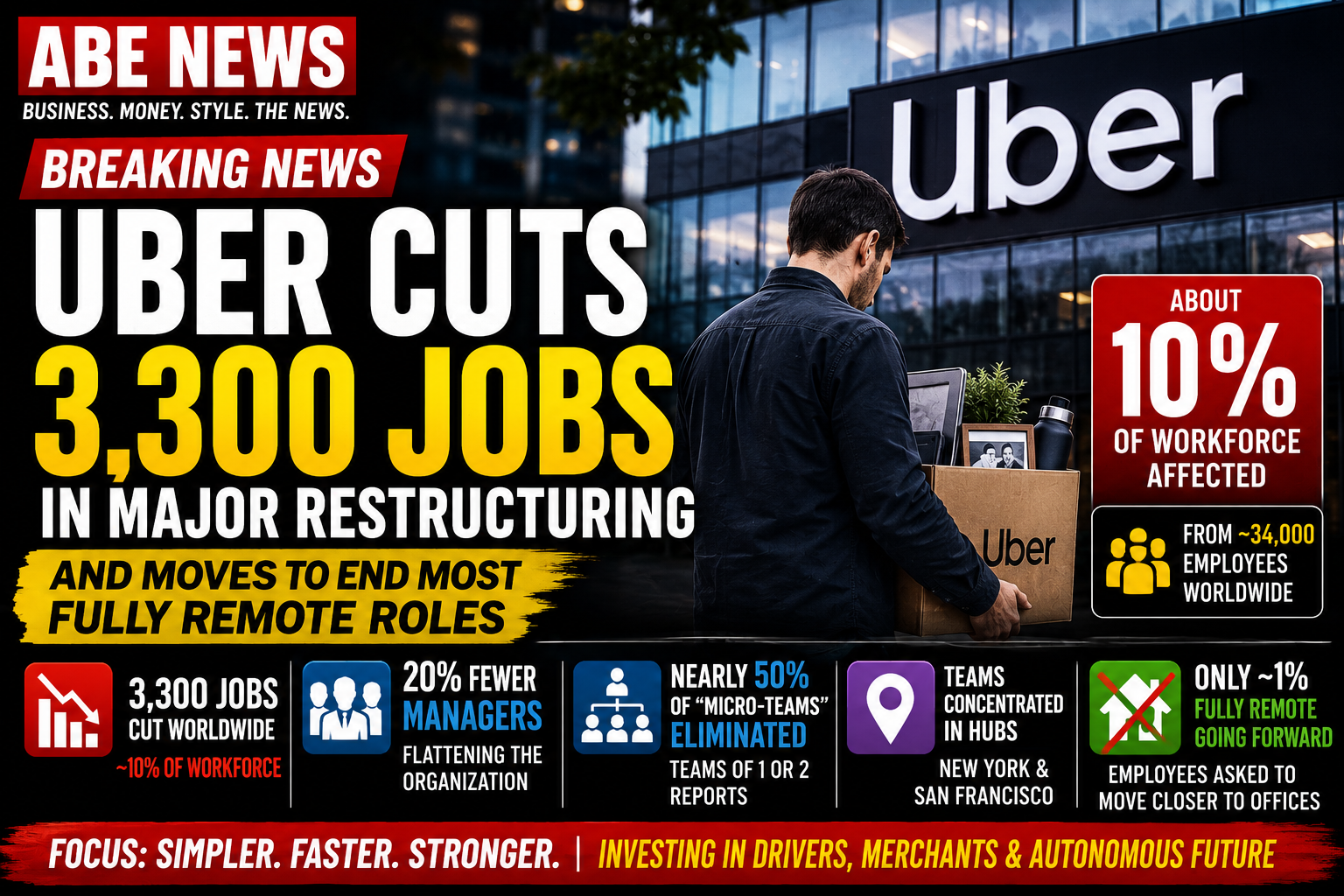
Uber is cutting approximately 3,300 jobs worldwide — around 10% of its global workforce — in one of the company’s biggest restructurings since the pandemic, as Chief Executive Dara Khosrowshahi moves to flatten management, consolidate teams and redirect resources toward the next phase of Uber’s growth.
The changes go far beyond layoffs.
Uber is reducing its management ranks by roughly 20%. It is eliminating many tiny teams containing only one or two direct reports. It is consolidating parts of its engineering, science and delivery operations.
And in one of the most significant changes for employees, the company is dramatically reducing fully remote work.
Going forward, Uber expects only about 1% of its employees to work completely remotely.
Most remote workers will be asked to relocate closer to an Uber office, while the company maintains its broader requirement for employees to spend at least three days per week in the office.
The company is also concentrating major global teams around hubs including New York and San Francisco.
The message from Uber’s leadership is clear:
The company became enormous.
Now management believes it became too complicated.
And Uber wants to become smaller, flatter and faster.
3,300 JOBS ARE DISAPPEARING
Uber employed approximately 34,000 people globally at the end of last year.
Eliminating 3,300 positions therefore represents roughly one employee out of every ten.
The cuts are Uber’s most substantial workforce reduction since 2020, when the collapse in travel during the COVID-19 pandemic forced the company to eliminate thousands of positions.
But the circumstances today are very different.
Uber isn’t facing the near-shutdown of its core business.
Instead, management says years of expansion have created too much organizational complexity.
Uber has expanded from its original ride-hailing business into food delivery, grocery and retail delivery, logistics and autonomous-vehicle partnerships.
Its revenue has nearly tripled over the past five years.
Growth created scale.
But scale created bureaucracy.
CEO Dara Khosrowshahi told employees that the company’s expansion had produced more layers, more coordination and increasingly fragmented responsibility.
The restructuring is designed to reverse that.
UBER WANTS FEWER BOSSES
One of the most interesting numbers in the announcement is 20%.
That’s how much Uber says it is reducing the number of managers across the organization.
Not every manager affected by the restructuring is necessarily being fired.
Some will move into individual-contributor positions.
But the direction is unmistakable.
Uber wants fewer layers separating the people building products from the people making major decisions.
The company says it has already reduced by about 20% the number of employees sitting seven or more organizational layers below the CEO.
It has also cut the number of what it calls “micro-teams” — groups with only one or two direct reports — by nearly half.
The theory is simple.
If a company has too many small teams, too many managers and too many layers of approval, employees can spend enormous amounts of time coordinating work rather than actually doing it.
Meetings multiply.
Approvals multiply.
Reporting structures multiply.
Decision-making slows.
Uber now wants to reverse that process.
THIS IS A FIGHT AGAINST CORPORATE BUREAUCRACY
There is a broader business story here.
Technology companies spent years expanding aggressively.
Cheap capital encouraged growth.
Digital businesses expanded internationally.
Companies hired managers to supervise newly created teams.
Teams created sub-teams.
Departments developed specialized functions.
Organizations became increasingly complicated.
Then the economic environment changed.
Interest rates increased.
Investors became more focused on profitability.
And companies began asking a different question:
How many people and layers are actually necessary to operate the business?
That question has driven repeated restructuring across corporate America.
Uber is now applying it aggressively.
Its restructuring is explicitly designed to move employees away from roles dominated by internal coordination and toward positions more directly connected to building products and serving customers.
THREE DELIVERY BUSINESSES ARE BECOMING ONE
Uber is also simplifying one of its most important operations.
The company has historically operated separate delivery teams across businesses including restaurants, retail and its direct delivery service.
That made sense when those businesses were smaller and developing independently.
But Uber now believes the structure creates unnecessary duplication.
So it is bringing those delivery operations together under more unified leadership.
The idea is to create clearer accountability and allow managers to allocate money and resources more efficiently across the delivery business.
Uber is making similar changes inside technology.
Its Core Services Engineering and Science organizations are being combined.
Again, the goal is fewer overlapping structures.
Uber wants one organization doing work that previously may have been spread across several.
REMOTE WORK IS ABOUT TO BECOME RARE AT UBER
For many employees, this could be one of the most consequential changes.
Uber says only approximately 1% of its workforce will remain fully remote under its new structure.
Most employees currently working remotely will be expected to relocate to an office.
The company will continue requiring most employees to work in person at least three days each week.
Uber argues that employees benefit from sitting together, collaborating face-to-face and solving problems as teams.
Global teams will increasingly be concentrated around large hubs such as New York and San Francisco, while regional and local teams will be based around designated regional offices.
Managers and their teams will also increasingly be expected to work in the same locations.
That is particularly important for early-career workers, according to the company.
THE REMOTE-WORK REVOLUTION KEEPS RETREATING
Uber’s decision fits into a much larger shift occurring across major corporations.
During the pandemic, millions of professional workers discovered they could perform their jobs from home.
Technology companies were among the most enthusiastic adopters.
Some predicted remote work would permanently transform corporate life.
Geography would matter less.
Workers could live anywhere.
Companies could hire talent globally.
Offices could shrink.
But the corporate pendulum has moved back.
Executives increasingly argue that in-person collaboration improves communication, training, innovation and company culture.
Employees often counter that remote work improves flexibility, reduces commuting costs and allows companies to recruit talent outside expensive urban centres.
Uber is clearly moving toward the first argument.
A 1% remote-work target means fully remote employment at the company will become the exception rather than a normal arrangement.
BUT THIS IS NOT AN “AI TOOK THE JOBS” STORY
That distinction is important.
Technology layoffs are increasingly attributed to artificial intelligence.
Executives across several industries have suggested AI tools will reduce the number of employees required for certain tasks.
Uber did not present its 3,300 job cuts that way.
The company’s explanation focuses on management complexity, duplicated structures, organizational layers and the need to reallocate resources.
That doesn’t mean AI will have no effect on Uber’s workforce over time.
Like virtually every major technology company, Uber uses and invests in artificial intelligence.
But claiming that AI caused these particular layoffs would go beyond the company’s stated rationale.
The more immediate story is organizational efficiency.
Uber believes it became too bureaucratic.
THE MONEY ISN’T SIMPLY BEING SAVED
There’s another important part of the restructuring.
Uber doesn’t intend merely to cut costs and put all of the savings on the bottom line.
Management says some of the money will be reinvested.
The company plans to increase investment in drivers, couriers and merchants while strengthening its core ride-hailing and delivery businesses.
But there is another destination for some of that capital:
autonomous transportation.
Uber increasingly believes self-driving vehicles could transform its business.
That creates both an enormous opportunity and an existential strategic challenge.
ROBOTAXIS COULD CHANGE EVERYTHING FOR UBER
Uber’s business currently depends heavily on human drivers.
Drivers supply the vehicles.
Drivers perform the transportation.
Uber provides the digital marketplace connecting passengers and drivers and takes a share of the transaction.
Autonomous vehicles could fundamentally alter that model.
If robotaxis eventually become cheaper, safer and widely available, human-driven ride-hailing could face significant disruption.
Companies such as Waymo are already operating autonomous ride services in several U.S. markets.
That means Uber has to prepare for a future in which the vehicle arriving after a passenger presses a button may have no driver.
Uber’s strategy has increasingly focused on becoming the platform through which consumers access autonomous vehicles rather than attempting to manufacture every autonomous vehicle itself.
That requires partnerships.
Technology integration.
Infrastructure.
And capital.
The restructuring frees resources for precisely those priorities.
UBER DOESN’T WANT TO BE DISRUPTED BY THE NEXT UBER
There is an irony here.
Uber became one of the world’s most famous technology companies by disrupting an established transportation industry.
Traditional taxis operated through local licensing systems.
Uber introduced an app-based marketplace capable of matching drivers and passengers almost instantly.
The company expanded across the world.
Now Uber faces technological disruption of its own.
Autonomous vehicles could change the economics of ride-hailing.
If a competitor controls both the autonomous driving technology and the customer relationship, Uber could lose some of the strategic position it spent years building.
So the company has to move quickly.
That helps explain why management is obsessed with becoming “simpler and faster.”
Corporate bureaucracy isn’t merely annoying when an industry is changing rapidly.
It can become strategically dangerous.
WALL STREET LIKED THE ANNOUNCEMENT
Investors initially responded positively.
Uber shares rose approximately 2% in premarket trading following news of the restructuring.
That reaction reflects something investors frequently reward:
cost discipline.
A company that eliminates unnecessary management layers can potentially improve margins while directing more money toward businesses expected to generate future growth.
But layoffs alone don’t create long-term value.
Uber still has to prove that the resulting organization operates more effectively.
The company must maintain its ride-hailing network.
Grow delivery.
Compete internationally.
Integrate autonomous vehicles.
Keep drivers and couriers engaged.
And continue attracting consumers.
Cutting 3,300 jobs is the beginning of the restructuring.
The results will determine whether it worked.
THERE IS ALSO A HUMAN SIDE
Corporate restructuring is often described through percentages.
10% of the workforce.
20% fewer managers.
50% fewer micro-teams.
1% remote workers.
But every percentage represents people.
Thousands of employees are losing jobs.
Others are being moved into different roles.
Remote workers may have to decide whether they are willing or able to relocate.
Managers may return to individual-contributor positions.
Teams that have worked together may be reorganized.
For the company, these are organizational charts.
For employees, they can mean careers, families, housing decisions and financial uncertainty.
That doesn’t automatically make the restructuring economically wrong.
But it is part of the story.
THE BIGGER CORPORATE QUESTION
Uber’s restructuring raises a question that extends far beyond Uber:
How complicated should a giant technology company become?
Large organizations naturally create hierarchy.
Someone manages a team.
Someone manages those managers.
Regional divisions emerge.
Specialized departments emerge.
Coordination becomes necessary.
But eventually the system can become self-reinforcing.
Managers manage managers.
Teams coordinate with other teams whose primary responsibility is also coordination.
Decisions that once required one conversation require six meetings.
And companies created to move quickly begin behaving like the institutions they originally disrupted.
Uber appears to believe it crossed that line.
Its response is dramatic.
Remove thousands of positions.
Cut managers.
Combine teams.
Concentrate employees geographically.
Bring remote workers back.
And redirect money toward the businesses management considers most important.
🔴 THE ABE NEWS TAKE
Uber’s 3,300 job cuts are easy to describe as another technology layoff.
But that misses the more interesting story.
This is an attempt to redesign the anatomy of a giant company.
Uber expanded enormously.
Its businesses multiplied.
Its revenue nearly tripled over five years.
And management now believes that success produced an organization with too many layers, too many tiny teams and too much internal coordination.
So Uber is trying to flatten itself.
The numbers tell the story.
3,300 jobs.
10% of the workforce.
20% fewer managers.
Nearly half of micro-teams eliminated.
Only around 1% of employees remaining fully remote.
And underneath all of it is another transformation.
Uber is preparing for a transportation industry increasingly shaped by autonomous vehicles.
The company that once disrupted taxis now has to ensure robotaxis don’t disrupt it.
That makes speed important.
Capital important.
Engineering important.
And, in management’s view, organizational simplicity important.
There is also a lesson here for the wider technology industry.
Growth creates complexity almost automatically.
Removing complexity is much harder because complexity eventually becomes someone’s team, someone’s title and someone’s job.
Uber has decided the cost of maintaining that structure is now greater than the cost of dismantling it.
Whether that decision makes Uber genuinely faster won’t be determined by today’s announcement.
It will be determined by what happens afterward.
Can a company employing tens of thousands of people really operate with fewer layers?
Does forcing employees back toward offices improve collaboration?
Can management remove bureaucracy without removing valuable expertise?
And most importantly:
Can Uber redirect the money and attention it saves today into the technologies that will determine how people move tomorrow?
The layoffs answer none of those questions.
But they show how urgently Uber believes it needs to find the answers.
ABE NEWS
Business. Money. Style. The News.
Understand More. Think Bigger.