









ABE NEWS | September 1, 2026
The artificial-intelligence boom has just produced another extraordinary set of numbers — and this time they are coming from Dell.
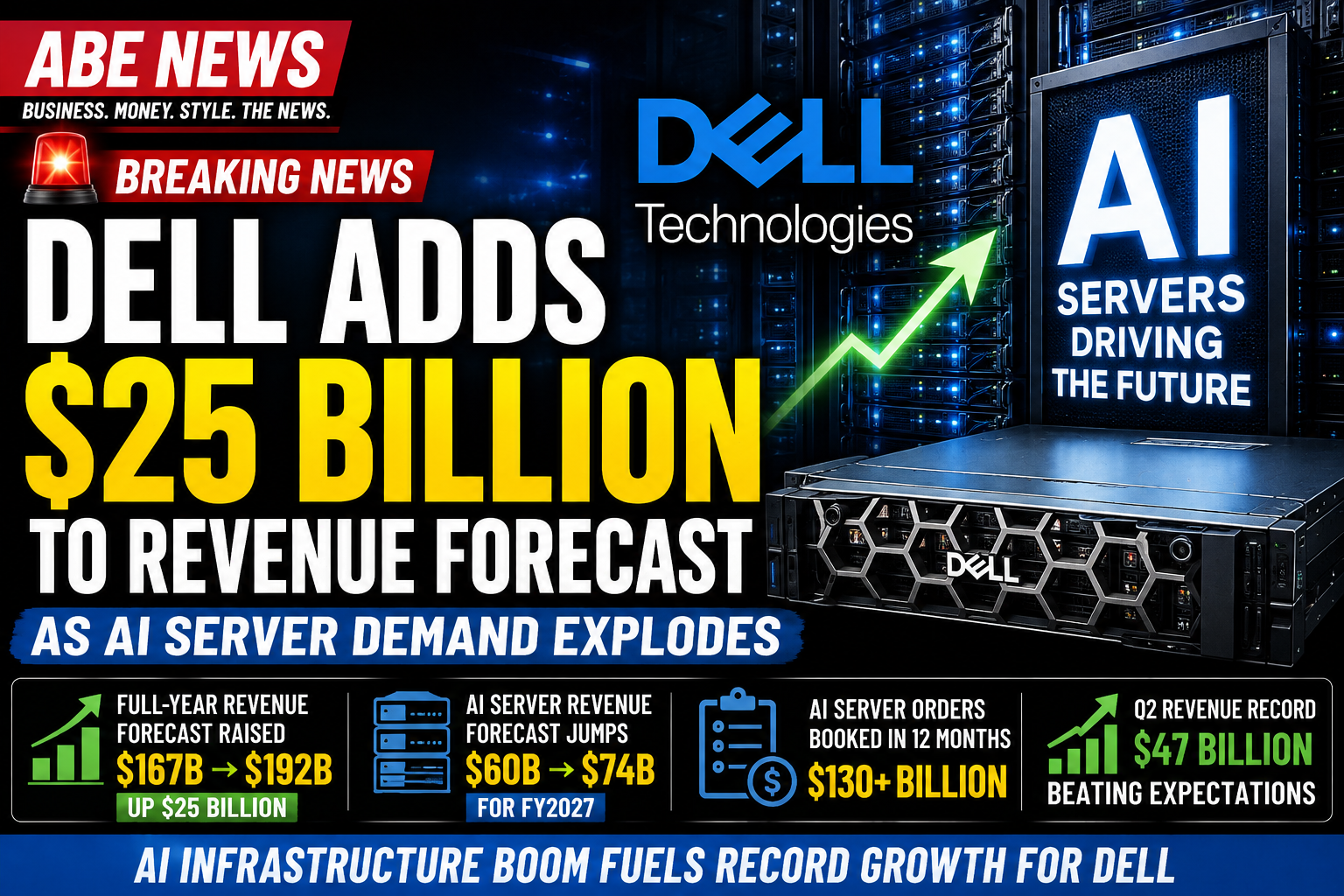
Dell Technologies raised its full-year revenue forecast by a staggering $25 billion on Tuesday, after soaring demand for the powerful servers used to build and operate artificial-intelligence systems helped push the company to record quarterly revenue.
Dell now expects approximately $192 billion in revenue for fiscal 2027, up from its previous forecast of $167 billion.
The company also dramatically increased its profit outlook, raising its forecast for adjusted earnings per share from $17.90 to $25.50.
But perhaps the clearest indication of what is happening inside the AI infrastructure boom is Dell’s server business.
The company now expects to generate approximately $74 billion from AI-optimized servers during fiscal 2027.
Its previous forecast?
$60 billion.
And only months ago, those expectations were already considered enormous.
The latest increase suggests that the AI investment cycle is not simply benefiting semiconductor companies such as Nvidia.
It is creating an enormous new infrastructure economy around them.
Chips need servers.
Servers need racks.
Racks need networking.
Data centres need storage.
And the entire system requires staggering amounts of electricity, cooling, land and capital.
Dell is increasingly sitting near the centre of that buildout.
DELL JUST HAD A RECORD QUARTER
Dell reported approximately $47 billion in second-quarter revenue, a company record and a 58% increase from the same period a year earlier.
Wall Street analysts had expected roughly $44.9 billion.
Dell beat that comfortably.
Adjusted earnings came in at $7.04 per share, compared with analysts’ expectations of approximately $4.91.
Investors responded immediately.
Dell shares jumped roughly 7% in extended trading following the announcement.
The scale of the forecast revision is particularly striking because Dell had already increased its outlook earlier this year.
In May, the company raised its full-year revenue midpoint to approximately $167 billion.
Now, just months later, it has added another $25 billion.
That is not a small adjustment.
It is evidence that the company believes demand is accelerating substantially faster than previously expected.
THE NUMBER TO WATCH: $130 BILLION
Dell disclosed another extraordinary figure Tuesday.
Over the past 12 months, the company says it has booked more than $130 billion in AI-server orders.
That figure provides a glimpse into the amount of money flowing into the physical infrastructure behind artificial intelligence.
AI models may appear to consumers as software.
A person opens a website.
Types a question.
Receives an answer.
But behind that seemingly simple interaction sits an enormous industrial system.
Thousands of advanced processors.
Specialized servers.
High-speed networking.
Cooling systems.
Storage.
Backup power.
Data centres.
Transmission infrastructure.
And electricity — enormous amounts of it.
Dell sells many of the machines connecting those pieces together.
NVIDIA’S CHIPS ARE INSIDE THE BOOM
Much of Dell’s AI-server growth is closely connected to Nvidia.
Nvidia has become one of the defining companies of the AI boom because its graphics processors are widely used to train and operate advanced artificial-intelligence systems.
But Nvidia doesn’t necessarily build the complete server systems customers ultimately deploy.
That’s where companies such as Dell Technologies enter the picture.
Dell integrates advanced processors into large computing systems that can then be deployed inside AI data centres.
Customers include cloud infrastructure companies and organizations building massive computing clusters.
Reuters reports that AI cloud providers including Nscale and CoreWeave are among the customers buying Dell systems equipped with Nvidia processors.
The AI economy therefore increasingly resembles a giant supply chain.
At one end are companies designing AI models.
Behind them are cloud providers.
Behind the cloud providers are data centres.
Inside those data centres are servers.
Inside those servers are chips.
And surrounding all of it is an expanding network of power plants, transmission lines, cooling systems and construction projects.
Dell’s results show just how much money is now flowing through that chain.
DELL’S AI-SERVER FORECAST HAS SURGED AGAIN
The trajectory is remarkable.
In May, Dell said it expected approximately $60 billion in AI-optimized server revenue for fiscal 2027.
That forecast itself represented a massive increase from the previous year.
Now Dell expects approximately $74 billion.
That’s another $14 billion added to the forecast in only a few months.
The company’s chief operating officer, Jeff Clarke, said AI demand is expanding across several types of customers, including specialized cloud operators, governments building sovereign AI infrastructure and traditional enterprises.
Dell says its AI customer count has now surpassed 6,500.
That matters.
The first phase of the generative-AI boom was dominated by a relatively small collection of giant technology companies.
Microsoft.
Amazon.
Google.
Meta.
Oracle.
And specialized AI companies.
But if demand increasingly spreads into governments, corporations and specialized cloud providers, the infrastructure market could become much broader.
That appears to be what Dell believes it is seeing.
THE AI BOOM IS BECOMING AN INDUSTRIAL BOOM
For years, technology investors became accustomed to businesses that could scale largely through software.
Build an application once.
Distribute it digitally.
Add millions of users without building millions of physical machines.
AI is different.
The most advanced systems require enormous physical infrastructure.
That makes the current boom look surprisingly industrial.
Factories manufacture chips.
Other factories build servers.
Construction crews build data centres.
Utilities expand electrical grids.
Power companies build generation.
Cooling systems consume water.
Transmission operators construct new lines.
Land becomes valuable because it sits near substations.
And companies like Dell ship enormous quantities of hardware.
The artificial-intelligence revolution may be digital at the user interface.
Underneath, it is becoming one of the largest physical infrastructure buildouts of the modern technology era.
DELL’S INFRASTRUCTURE BUSINESS IS EXPLODING
The transformation is visible across Dell’s infrastructure division.
Revenue from the business containing Dell’s servers, storage and related infrastructure increased approximately 89% during the quarter.
Traditional server and networking sales also more than doubled.
That’s interesting because it shows the boom isn’t limited entirely to specialized GPU systems.
Companies upgrading their infrastructure for AI may also need conventional computing equipment.
Agentic AI workloads — systems designed to perform increasingly complex tasks and interact with software autonomously — can require substantial CPU-based infrastructure alongside GPUs.
The result is a broader hardware upgrade cycle.
AI isn’t merely creating demand for one product.
It is encouraging organizations to reconsider large parts of their computing infrastructure.
EVEN DELL’S PC BUSINESS IS GROWING
The strength extended beyond data centres.
Dell’s PC division reported approximately 20% sales growth, driven particularly by commercial customers.
Clarke said the PC business is growing at its fastest rate in five years.
Part of that reflects businesses upgrading computers and adopting newer hardware.
But it also demonstrates how unusually broad Dell’s current growth has become.
The company is simultaneously benefiting from massive AI-server spending and improving commercial-PC demand.
That combination helped produce its record quarter.
BUT THERE’S A CHIP PROBLEM
The AI boom is creating another challenge.
Memory.
AI servers require enormous amounts of advanced memory, while global demand for AI infrastructure has tightened supply across parts of the semiconductor industry.
Dell has responded partly by increasing prices on some products, including PCs.
That has helped protect margins.
But the situation demonstrates another important characteristic of the AI investment cycle.
When hundreds of billions of dollars suddenly chase similar infrastructure, bottlenecks emerge.
First GPUs became scarce.
Then high-bandwidth memory.
Then transformers and electrical equipment.
Then data-centre land.
Then power connections.
Then cooling infrastructure.
The AI boom is repeatedly discovering that the physical world cannot scale as quickly as software expectations.
AND THAT BRINGS US TO ELECTRICITY
Dell’s earnings arrive on the same day as another extraordinary AI infrastructure story.
Across parts of the United States, electricity requests from very large power users — mostly proposed data centres — now exceed 700 gigawatts.
That is more than ten times estimates of current U.S. data-centre electricity consumption.
Texas alone has seen large-load connection requests surge from approximately 48 gigawatts in 2023 to more than 474 gigawatts.
The numbers have become so enormous that regulators are now trying to determine how much of the demand is actually real.
Texas has moved to freeze some new data-centre grid connections while authorities investigate projects.
Other states are introducing tougher requirements.
Some proposed projects appear to be speculative.
Others may lack financing.
Some developers may submit requests at several locations before deciding where to build.
Utilities call part of this phenomenon “ghost demand.”
That creates a fascinating contradiction.
Dell’s financial results provide powerful evidence that AI infrastructure demand is genuinely enormous.
But America’s electrical grids are simultaneously struggling to distinguish real future data centres from speculative ones.
The AI boom is real.
The exact size of the physical infrastructure needed to support it is much harder to determine.
THE MONEY BEHIND AI IS BECOMING STAGGERING
Big technology companies are expected to spend hundreds of billions of dollars this year expanding AI infrastructure.
The scale is difficult to comprehend.
The spending isn’t simply buying chips.
It finances buildings.
Networking.
Storage.
Power systems.
Cooling.
Backup generation.
Construction.
Engineering.
Land.
And increasingly, dedicated sources of electricity.
That means AI capital expenditure is beginning to influence industries far outside traditional technology.
Utilities.
Natural gas.
Nuclear energy.
Renewables.
Construction.
Real estate.
Copper.
Electrical equipment.
Industrial cooling.
Data-centre operators.
The AI boom is creating winners far beyond Silicon Valley.
Dell is one of the clearest examples.
DELL ISN’T AN AI LAB — AND THAT’S EXACTLY THE POINT
Dell doesn’t need to build the world’s best AI model to profit from artificial intelligence.
It doesn’t need to defeat OpenAI.
It doesn’t need to create the next ChatGPT.
It doesn’t even need consumers to associate Dell directly with generative AI.
It can sell the infrastructure everyone else needs.
This is a familiar pattern in economic booms.
During a gold rush, some of the most reliable businesses sell equipment to miners.
During an infrastructure boom, companies selling concrete, machinery and steel can prosper regardless of which individual project ultimately wins.
AI may produce a similar dynamic.
Model companies are fighting intensely for users and technological leadership.
But virtually all of them need computing infrastructure.
Dell can sell into that competition.
THERE IS STILL A MAJOR RISK
AI spending cannot grow exponentially forever.
At some point, companies financing these enormous data centres need economic returns.
Businesses have to generate revenue from AI.
Workers need to become more productive.
Consumers need to pay for products.
Governments need useful applications.
Cloud providers need customers.
If those returns fail to materialize, today’s infrastructure boom could eventually produce enormous excess capacity.
That possibility is becoming more important as spending rises.
The question is gradually shifting from:
Can companies build enough AI infrastructure?
to:
Will AI generate enough economic value to justify everything being built?
Dell’s results answer the first question.
Demand for infrastructure is currently enormous.
The second remains unresolved.
THE $192 BILLION FORECAST SHOWS HOW FAST EVERYTHING IS MOVING
Dell’s previous $167 billion revenue forecast was issued only months ago.
Now it’s $192 billion.
AI-server revenue was expected to reach $60 billion.
Now it’s $74 billion.
More than $130 billion of AI-server orders have been booked over the past 12 months.
Quarterly revenue has reached a record $47 billion.
And investors have pushed Dell shares dramatically higher this year.
Numbers that would once have looked extraordinary are becoming outdated within months.
That is one of the defining features of the current AI investment cycle.
Companies aren’t merely growing.
Their expectations about how quickly they will grow keep changing.
🔴 THE ABE NEWS TAKE
The most interesting thing about Dell’s results isn’t simply that another technology company beat Wall Street expectations.
It’s what Dell sells.
Servers.
Infrastructure.
Machines.
The physical equipment behind artificial intelligence.
That makes these results one of the clearest measurements we have of how much real money is moving from AI enthusiasm into actual construction of computing capacity.
And the number is enormous.
More than $130 billion in AI-server orders in 12 months.
$74 billion in expected AI-server revenue this fiscal year.
$192 billion in expected company-wide revenue.
Those aren’t hypothetical valuations.
They’re evidence of companies ordering hardware.
But Dell’s extraordinary growth also exposes the next question facing the AI boom.
The world is rapidly building the machines.
Now it has to build everything those machines require.
Electricity.
Transmission.
Cooling.
Data centres.
Semiconductors.
Memory.
Land.
And ultimately, enough profitable AI applications to justify the investment.
That last requirement may become the most important.
AI infrastructure spending can continue at extraordinary levels while investors believe the economic opportunity ahead is even larger.
But eventually, infrastructure must produce returns.
The server has to create something valuable.
The data centre has to generate revenue.
The electricity bill has to be justified.
The hundreds of billions invested have to produce economic output.
For now, Dell’s numbers suggest companies aren’t slowing down.
They’re accelerating.
A $167 billion revenue forecast lasted only a few months before Dell replaced it with $192 billion.
That’s a $25 billion change in expectations.
And behind that increase sits one of the largest technological infrastructure races in modern history.
The AI boom is no longer just a story about algorithms.
It is becoming a story about who can build the physical machinery of intelligence fastest — and whether the world can supply enough electricity to turn it all on.
ABE NEWS
Business. Money. Style. The News.
Understand More. Think Bigger.