








ABE NEWS | September 2, 2026
Europe’s confrontation with Russia is entering increasingly dangerous territory — and this time the centre of the story is not Ukraine.
It is Germany.
German authorities have formally accused Russia of orchestrating an attempted explosive-drone attack at Leipzig/Halle Airport, one of Europe’s important cargo hubs and a logistics centre connected to NATO and Ukraine, prompting Berlin and the European Union to prepare new measures against Moscow.
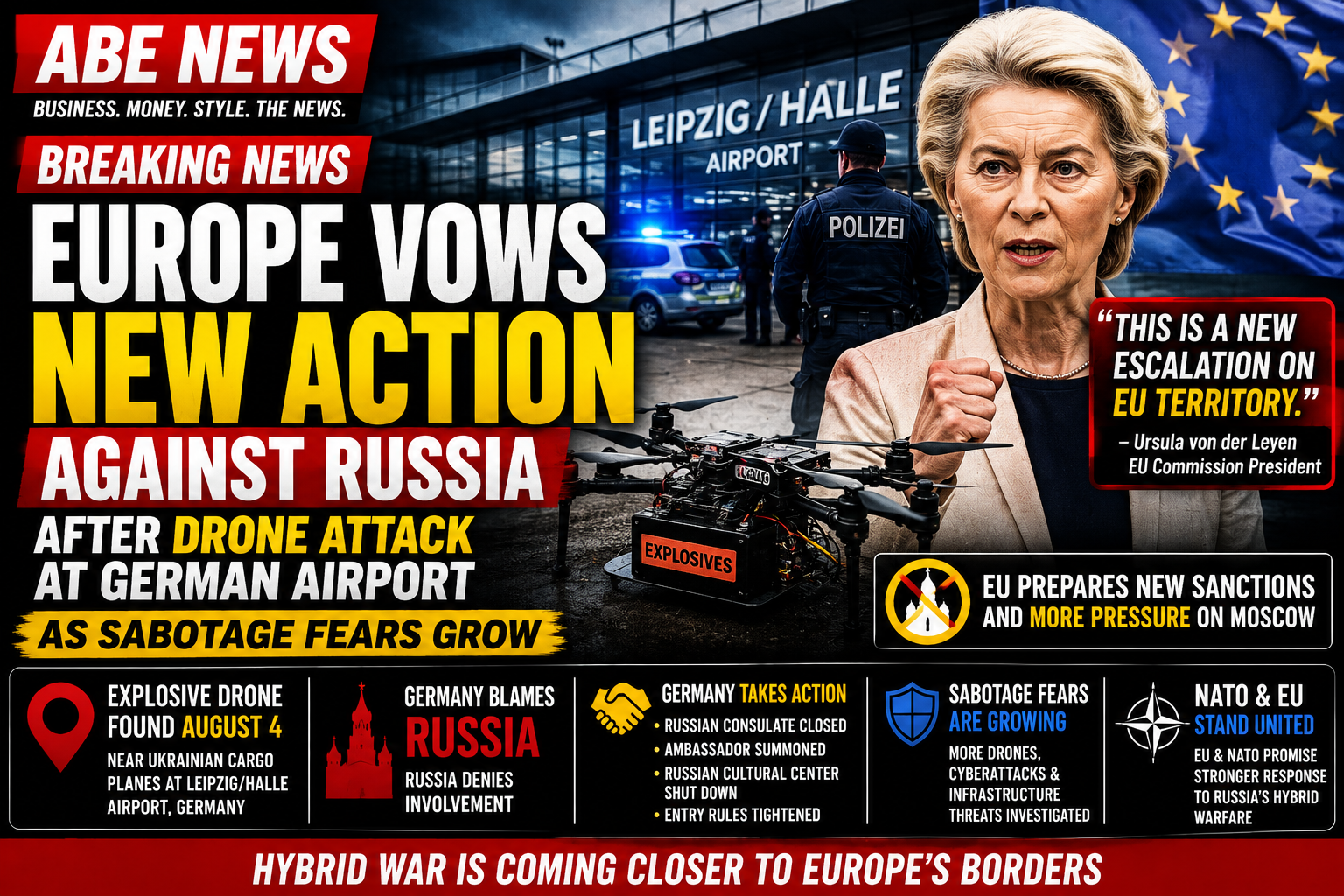
The incident itself occurred on August 4, when an explosives-laden drone was discovered inside the airport’s secured area near Ukrainian cargo aircraft.
The explosive device failed to cause the destruction investigators believe its operators intended.
But after weeks of investigation, Germany has now publicly concluded that Russia was responsible.
And Europe’s response is expanding.
Germany has summoned the Russian ambassador, ordered the closure of Russia’s Consulate General in Bonn, moved against the Russian House cultural centre in Berlin, tightened entry controls for Russian nationals and said it will push for additional European sanctions.
European Commission President Ursula von der Leyen went further Wednesday.
Standing alongside NATO Secretary General Mark Rutte in Brussels, she described Leipzig as a new escalation on European Union territory and said Europe and NATO would increase pressure on Moscow.
The attempted attack has therefore become about considerably more than one drone.
It is forcing Europe to confront a disturbing question:
What happens when the war surrounding Ukraine increasingly moves beyond Ukraine’s borders — not through conventional invasion, but through drones, sabotage, cyberattacks and attacks on critical infrastructure?
AN EXPLOSIVES-LADEN DRONE INSIDE A GERMAN AIRPORT
Leipzig/Halle is not an ordinary regional airport.
Located in eastern Germany, it is a major European freight hub.
It also has strategic importance because Ukrainian Antonov An-124 heavy cargo aircraft operate from the airport and because the location supports logistics connected with NATO.
That made what happened there particularly alarming.
On August 4, airport personnel discovered a drone carrying explosives and a detonator in the secured cargo area near Ukrainian aircraft.
German authorities moved to neutralize the device.
No one was killed.
But European officials now argue that the consequences could have been enormous if the device had functioned as intended.
German Interior Minister Alexander Dobrindt said investigators examined the drone’s configuration, components, explosives and detonation technology.
According to the German government, those characteristics correspond with methods authorities have encountered in previous Russian hybrid operations and in Russia’s war against Ukraine.
Police findings, intelligence assessments and the overall pattern of the incident led Berlin to formally attribute responsibility to Russia.
Moscow rejects that conclusion.
Russia has denied involvement and accused Germany of making politically motivated allegations.
That denial matters.
Russia’s responsibility is the official conclusion of the German government and its investigators — not something Moscow accepts.
But Berlin is sufficiently confident in its findings that it has begun taking diplomatic action.
GERMANY IS RETALIATING
Germany’s response is unusually broad.
The Russian ambassador has been summoned.
Russia’s Consulate General in Bonn is being closed.
Germany is terminating the arrangement governing the Russian House cultural centre in Berlin.
Entry controls affecting Russian nationals are being tightened.
And Berlin is pressing European partners for additional sanctions.
Germany also wants greater pressure placed on Russia’s so-called shadow fleet — the network of vessels Western governments say Moscow uses to move oil while circumventing sanctions.
These aren’t military strikes.
But they represent a significant diplomatic and economic response to what Germany describes as Russian hybrid warfare.
German Interior Minister Dobrindt summarized the increasingly uncomfortable position facing his country:
Germany may not formally be at war with Russia, but German officials believe the country is increasingly being targeted by operations designed to intimidate, disrupt and destabilize.
EUROPE SAYS LEIPZIG CHANGES THE SECURITY PICTURE
The reaction from Brussels has been particularly strong.
European Commission President Ursula von der Leyen said Wednesday that the attempted Leipzig attack represents a new escalation on EU soil.
She said that had the operation succeeded, it could have caused enormous damage and potentially loss of life.
Von der Leyen also framed the incident as part of something much larger.
Europe has experienced drone incursions, cyberattacks, infrastructure disruption and suspected sabotage incidents as Russia’s war against Ukraine has continued.
The concern in Brussels is that these are no longer isolated anomalies.
They may represent a security environment European governments will have to live with for years.
Von der Leyen said Europe must become capable of responding to such threats faster and protecting ordinary infrastructure as though it could become part of the front line.
That is a remarkable shift in European security thinking.
For decades, airports, power stations, communications systems, factories, railways and other infrastructure deep inside Western Europe largely existed outside any immediate expectation of conflict.
Hybrid warfare changes that calculation.
NATO IS WATCHING TOO
NATO Secretary General Mark Rutte stood beside von der Leyen as the two addressed the situation.
Rutte said Russia has become increasingly reckless and pointed to broader concerns about drones, missiles and malign activity affecting NATO territory.
The significance is difficult to miss.
NATO was created around the principle of collective defence against conventional military attack.
But modern confrontation doesn’t always arrive as tanks crossing a border.
It can arrive as malware.
A damaged undersea cable.
A mysterious fire.
A disinformation campaign.
An explosives-laden drone.
Or an operation carried out by individuals whose relationship to a foreign government can initially be difficult to establish.
That ambiguity is precisely what makes hybrid warfare useful.
WHAT EXACTLY IS HYBRID WARFARE?
Hybrid warfare occupies the uncomfortable space between peace and conventional war.
Instead of openly attacking another country with uniformed soldiers, a state can combine several forms of pressure.
Cyberattacks can disrupt government systems.
Sabotage can damage infrastructure.
Disinformation can deepen political divisions.
Economic pressure can create instability.
Covert operatives can target strategically important facilities.
Drones can enter restricted airspace.
Intelligence operations can recruit intermediaries to perform tasks while making attribution more difficult.
Each incident individually may remain below the threshold that would provoke a conventional military response.
Together, however, they can impose significant economic, political and security costs.
That is the environment European officials increasingly believe they face.
LEIPZIG’S CONNECTION TO UKRAINE MATTERS
The location of the attempted attack is particularly important.
Leipzig/Halle Airport has become an operating base for Ukrainian Antonov cargo aircraft.
The Antonov An-124 is one of the world’s largest cargo aircraft and can transport extremely heavy equipment.
Such aircraft have enormous logistical value.
Leipzig/Halle also participates in strategic airlift infrastructure connected to NATO.
That means the airport occupies an unusual position.
It is civilian infrastructure.
But it also supports logistics relevant to European defence and Ukraine.
That makes it precisely the kind of location that could become strategically important in a hybrid conflict.
An attack there can create disruption without requiring an attack on a conventional military base.
THE ATTACK FAILED — BUT THAT DOESN’T MAKE IT SMALL
There is a danger in measuring an attempted attack only by its immediate casualties.
At Leipzig, there were none.
The explosive device did not produce the catastrophe officials feared.
But from a security perspective, failure does not eliminate significance.
If investigators are correct about the operation’s origin and intent, someone managed to place an explosives-carrying drone inside the security environment of an important German airport.
That exposes vulnerabilities.
And those vulnerabilities can be studied.
European governments now have to assume that future operations could be more successful.
The question becomes not merely who conducted the Leipzig operation.
It becomes:
What could the next target be?
EUROPE’S CRITICAL INFRASTRUCTURE IS BECOMING A SECURITY PRIORITY
Airports are only one concern.
Power grids.
Ports.
Railways.
Telecommunications networks.
Defence factories.
Energy facilities.
Data infrastructure.
Undersea cables.
Government computer networks.
All can become potential targets.
Germany has already raised its assessment of the hybrid threat and strengthened coordination surrounding drone defence.
German authorities are also investigating separate suspicious incidents affecting energy infrastructure.
Importantly, those incidents should not automatically be attributed to Russia simply because the Leipzig attack has been.
Attribution in sabotage cases can take weeks or months.
Sometimes responsibility is never conclusively established.
That uncertainty is itself one of hybrid warfare’s advantages.
EUROPE NOW HAS AN ATTRIBUTION PROBLEM
Traditional warfare can be brutally straightforward.
A missile is launched.
Radar identifies where it came from.
A military unit crosses a border.
The attacking state may be obvious.
Hybrid operations are deliberately murkier.
Governments must gather forensic evidence.
Intelligence agencies must trace communications and networks.
Investigators must determine whether individuals acted independently, for money, through criminal networks or on behalf of another government.
That creates a difficult political problem.
Respond too quickly and a government risks blaming the wrong actor.
Respond too slowly and adversaries may conclude that covert attacks carry little cost.
Germany waited weeks before formally assigning responsibility for Leipzig.
Now that it has done so, Berlin is trying to demonstrate that attribution has consequences.
NEW EU SANCTIONS ARE COMING INTO VIEW
German Foreign Minister Johann Wadephul said Wednesday that the European Union will work in the coming weeks on further sanctions against Russian individuals.
EU foreign policy chief Kaja Kallas has also discussed additional measures connected to Russia’s military complex.
European governments are examining tougher measures against Russia’s shadow fleet as well.
The final scope of the next sanctions package remains uncertain.
That distinction matters.
Europe has not yet unveiled one fully defined new Leipzig sanctions package.
Instead, European officials are now working on additional measures and listings while promising increased pressure.
That process could become important in the coming weeks.
RUSSIA SAYS THE ACCUSATIONS ARE FALSE
Moscow strongly rejects Germany’s allegations.
Russia says it had no involvement in the Leipzig operation and has criticized Germany’s retaliatory measures.
That creates another escalation point.
Diplomatic representation between Germany and Russia has already deteriorated significantly since Moscow’s full-scale invasion of Ukraine in 2022.
Closing additional Russian institutions and tightening restrictions further reduces the remaining relationship.
The conflict is therefore producing another layer of separation between Europe’s largest economy and Russia.
Economic ties have collapsed.
Energy relationships have been transformed.
Military spending has increased.
And now diplomatic ties are shrinking further.
THE UKRAINE WAR IS RESHAPING EUROPE FAR BEYOND THE BATTLEFIELD
Russia’s invasion of Ukraine began as a conventional military assault.
But its consequences have spread across virtually every part of European policy.
Energy.
Defence.
Trade.
Migration.
Budgets.
Industrial policy.
Cybersecurity.
Infrastructure.
Diplomacy.
The Leipzig case adds another category:
domestic security inside European countries.
If European governments increasingly treat civilian infrastructure as potential targets of state-directed sabotage, the economic consequences could be substantial.
Airports require stronger drone detection.
Energy companies need greater physical security.
Governments need more cybersecurity.
Police and intelligence agencies need additional resources.
Companies involved in defence and logistics face higher security costs.
The boundary between economic infrastructure and national-security infrastructure becomes increasingly difficult to define.
WHY THIS MATTERS FOR BUSINESSES
Hybrid warfare sounds like a geopolitical concept.
But companies can end up carrying much of the cost.
Consider an airport.
Additional surveillance systems cost money.
Drone detection costs money.
Security personnel cost money.
Temporary closures disrupt cargo schedules.
Insurance costs can rise.
Supply chains become less predictable.
Now multiply that across ports, rail networks, energy infrastructure and telecommunications systems.
Europe is already trying to spend dramatically more on conventional defence.
Hybrid threats create another bill.
And unlike tanks or fighter jets, the assets requiring protection are spread throughout the economy.
THE ARTICLE 5 QUESTION HANGS OVER EVERYTHING
One of the most sensitive questions surrounding hybrid attacks is where NATO draws the line.
Article 5 of the North Atlantic Treaty establishes the principle that an armed attack against one NATO member can be considered an attack against all.
But hybrid warfare is often deliberately designed to remain below that threshold.
Germany is not treating Leipzig as an Article 5 event, nor has it invoked NATO’s Article 4 consultation mechanism over the incident.
That is important.
Europe is escalating diplomatic, security and economic pressure — not treating the failed drone operation as the beginning of conventional war between NATO and Russia.
But the underlying strategic problem remains.
What happens if a future sabotage operation succeeds?
What happens if dozens of civilians are killed?
What happens if a power grid is disabled?
What happens if an airport or defence facility suffers catastrophic damage?
At what point does hybrid warfare stop being considered hybrid and become an armed attack?
There is no simple answer.
And adversaries understand that ambiguity.
EUROPE IS ENTERING A DIFFERENT SECURITY ERA
For much of the post-Cold War period, Western Europe enjoyed an extraordinary degree of physical security.
War existed elsewhere.
Critical infrastructure was primarily designed around efficiency, reliability and economics.
Russia’s invasion of Ukraine shattered many of those assumptions.
Leipzig pushes the transformation another step.
European officials are now openly discussing ordinary infrastructure as potential frontline targets.
That means the continent may be entering an era where resilience matters almost as much as efficiency.
Redundant power systems.
Protected communications.
Drone detection.
Cybersecurity.
Physical security.
Intelligence sharing.
Rapid-response teams.
Those investments may increasingly become part of normal European economic planning.
🔴 THE ABE NEWS TAKE
The most important fact about Leipzig is not that an explosives-laden drone failed to cause mass destruction.
It is what Europe believes the incident represents.
Germany has formally concluded that Russia was responsible for an attempted attack on strategically important infrastructure inside Europe’s largest economy.
Russia denies it.
But Berlin is sufficiently convinced to close Russian institutions, tighten restrictions and push for additional sanctions.
And Brussels is sufficiently alarmed that the president of the European Commission is describing the incident as a new escalation on EU territory.
That changes the significance of the story.
The war surrounding Ukraine is no longer measured only by kilometres of territory gained or lost on the battlefield.
Europe increasingly believes another confrontation is unfolding simultaneously.
A confrontation involving airports.
Power infrastructure.
Computer networks.
Logistics hubs.
Communications.
Drones.
And covert operations.
That confrontation is harder to see and even harder to respond to.
If Europe overreacts to every unexplained incident, it risks escalating on incomplete evidence.
If it underreacts, it risks making sabotage cheap.
That is the strategic trap of hybrid warfare.
Leipzig also exposes a deeper transformation taking place across Europe.
For decades, European governments optimized infrastructure primarily for commerce.
Now they increasingly have to optimize it for resilience.
The airport moving packages today may move military equipment tomorrow.
The communications network serving businesses may become a strategic target.
The electricity substation powering homes may become part of a national-security calculation.
The line separating civilian infrastructure from security infrastructure is disappearing.
And that could become one of the largest — and most expensive — consequences of Europe’s confrontation with Russia.
Germany’s response is therefore about more than one failed drone.
It is an attempt to establish a principle:
If covert attacks on European infrastructure can be credibly attributed to a foreign state, they will carry consequences.
Whether sanctions and diplomatic measures create enough deterrence is another question entirely.
Because the greatest danger may not be the drone that failed in Leipzig.
It may be the operation Europe doesn’t stop next time.
ABE NEWS
Business. Money. Style. The News.
Understand More. Think Bigger.