





ABE NEWS | THURSDAY, AUGUST 20, 2026
Africa’s biggest oil refinery is preparing for another enormous milestone.
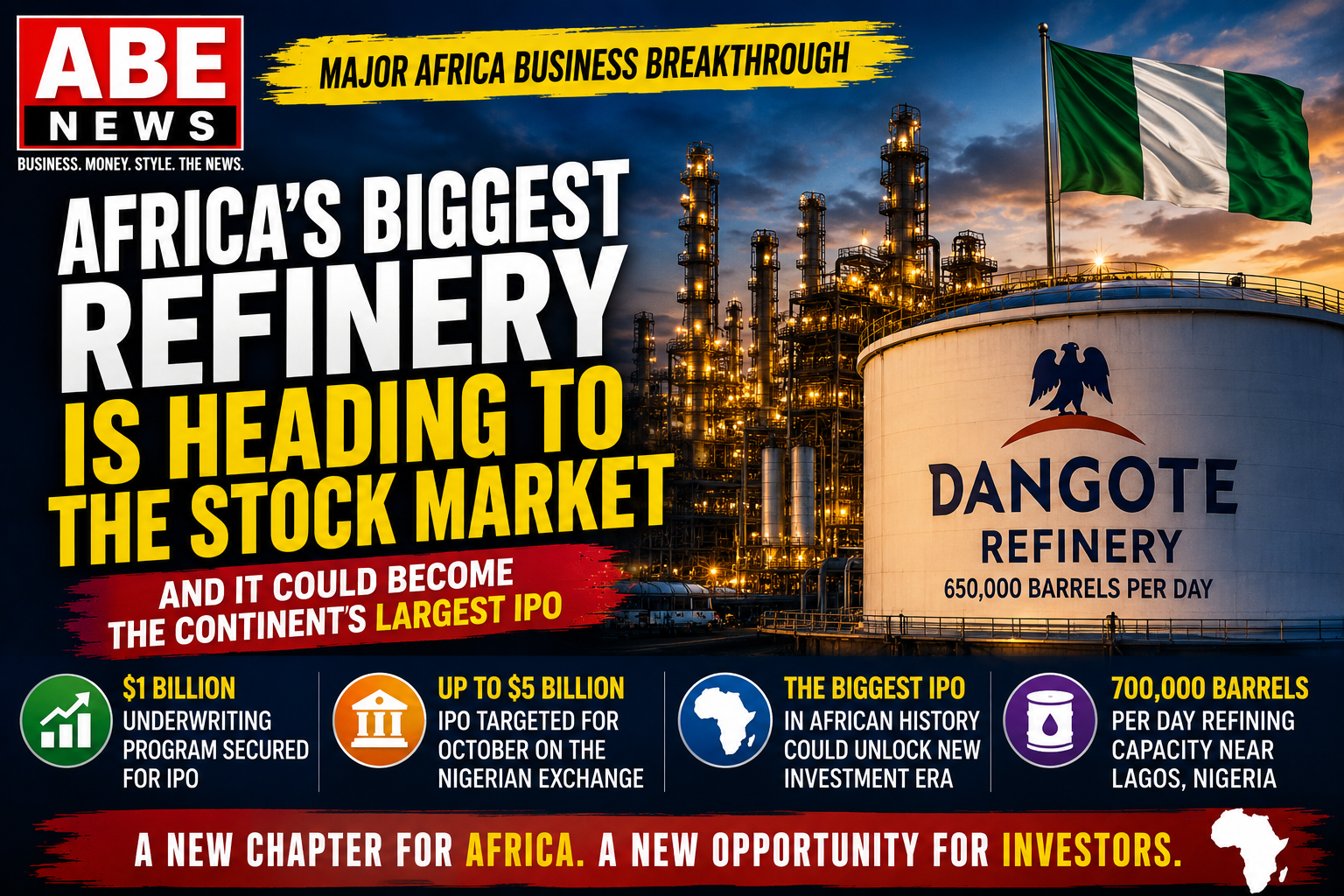
Nigeria’s Dangote Refinery has secured a $1 billion underwriting program ahead of a planned stock-market listing that could become the largest initial public offering in African history.
The refinery, majority-owned by Nigerian billionaire Aliko Dangote, has already transformed the continent’s fuel industry since beginning operations near Lagos. Now, ordinary and institutional investors could soon get the opportunity to own a piece of it.
The company has submitted an application for an IPO of as much as $5 billion, according to a source familiar with the process cited by Reuters. The final size has not yet been determined, but the refinery is expected to seek regulatory approval in the coming weeks, with a Nigerian stock-market listing targeted for October.
If the offering reaches anything close to that scale, this won’t simply be another company going public.
It could become a major test of whether African capital markets can finance African industrial giants.
From a $20 Billion Bet to the Stock Market
The Dangote Refinery was itself an extraordinary gamble.
Built near Lagos at a cost of approximately $20 billion, the massive complex can process about 700,000 barrels of crude oil per day. That gives it a scale rarely seen anywhere on the continent.
For decades, Nigeria lived with an economic contradiction.
It was one of Africa’s largest crude-oil producers, yet it depended heavily on imported refined petroleum products because its domestic refining capacity couldn’t reliably meet demand.
Think about how strange that is economically.
A country extracts crude oil from the ground, exports it, somebody else turns that crude into usable fuel, and then the country buys some of that refined product back.
The Dangote project was built partly to change that equation.
Instead of exporting raw resources and importing more expensive finished products, more of that processing could happen inside Africa.
And now the refinery’s ambitions are becoming even larger.
$1 Billion Is Already Behind the IPO
Financial advisers Marob Strategies and Lilium Capital announced this week that the refinery has secured a $1 billion underwriting program.
Of that amount, $600 million is fully funded for a completed private placement, while another $400 million commitment is intended to support the upcoming public offering, subject to regulatory approval and market conditions.
Underwriting is important because it helps provide confidence that shares being offered to investors can actually be sold. In a transaction this large, securing major financial backing before the IPO is an important step.
And investor interest apparently isn’t limited to Nigeria.
According to the refinery’s advisers, interest has come from sovereign wealth funds, governments and institutional investors across Africa and the Caribbean.
That’s where this story becomes much more interesting than Aliko Dangote potentially making another enormous business deal.
The question becomes whether African institutions themselves can increasingly finance the continent’s biggest companies.
Why This Matters for Africa
Africa has no shortage of enormous companies and natural resources.
What it has historically struggled with is turning enough of those resources into large-scale industrial businesses while also developing deep capital markets capable of financing them.
For many African businesses seeking billions of dollars, the obvious destinations have often been financial centres outside the continent.
New York.
London.
Dubai.
Other international markets.
A successful multi-billion-dollar Dangote Refinery listing in Nigeria could send a different message:
African companies can raise enormous amounts of capital through African markets too.
The advisers behind the transaction explicitly said they expect the offering to broaden ownership of a strategic African enterprise and demonstrate how African institutions can mobilize long-term capital for industrial development.
That matters because stock markets aren’t merely places where traders try to make money.
At their best, they connect savings with businesses that need capital to expand.
A pension fund invests.
A company receives capital.
The company builds infrastructure, increases production or expands.
Investors participate in the company’s future success.
That’s one of the mechanisms through which capital markets can help finance economic development.
And if the Dangote listing succeeds at enormous scale, other major African businesses will certainly be watching.
The Timing Couldn’t Be More Interesting
The refinery’s IPO push is also happening during a period of extraordinary disruption in global energy markets.
The Iran conflict and severe disruption around the Strait of Hormuz have forced energy buyers to search for alternative supplies.
Dangote Refinery has benefited from that environment, exporting jet fuel across Africa and into Europe as buyers look for other sources.
That’s important because it demonstrates something Africa has often wanted more of:
Not simply exporting a raw commodity.
But exporting the finished product created from it.
There’s an enormous economic difference between selling crude oil and selling refined gasoline, diesel or aviation fuel.
The more processing that happens domestically, the more of the industrial value chain can potentially remain within the producing economy.
That doesn’t automatically guarantee cheaper fuel, economic prosperity or employment for everyone. Refining remains a capital-intensive business exposed to crude prices, operating costs, regulation, currency movements and global competition.
But structurally, it represents a different economic model.
Instead of asking:
“Who wants to buy Africa’s raw materials?”
The question increasingly becomes:
“What finished products can Africa sell to the world?”
And Dangote Isn’t Stopping in Nigeria
There is another development worth watching.
Dangote is also planning a new refinery on Kenya’s coast, working alongside East African governments.
That could extend the company’s ambitions well beyond West Africa.
A refinery serving East African markets could potentially alter regional fuel supply chains, depending on its eventual scale, financing and construction.
But it also tells us something about the broader strategy.
Dangote isn’t treating the Lagos refinery as the end of the project.
It could become the foundation for something much larger: an African refining and energy network operating across different parts of the continent.
And access to public capital could make expansion on that scale easier.
But an IPO Isn’t a Guaranteed Success
The excitement needs some caution.
The refinery has applied for an offering potentially worth $5 billion, but the final IPO size has not been determined.
Regulatory approval is still required.
Market conditions can change.
Oil prices can change.
Investor appetite can change.
And large industrial businesses carry enormous operating and financial risks.
There’s also a broader question investors will eventually have to answer:
What is the refinery actually worth?
A strategically important company isn’t automatically a good investment at every valuation.
When the IPO documents become public, serious investors will want to examine revenue, profitability, debt, operating costs, margins, crude supply agreements, foreign-exchange exposure and the price being asked for the shares.
That’s where excitement has to meet mathematics.
🔴 THE ABE NEWS TAKE
The most important part of this story isn’t that Africa’s richest man could become even richer.
It’s the possibility of something much larger.
For generations, one of the continent’s greatest economic frustrations has been remarkably simple:
Africa produces enormous amounts of what the world needs, but too much of the value is created somewhere else.
Cocoa leaves Africa.
Chocolate comes back.
Crude oil leaves Africa.
Refined fuel comes back.
Minerals leave Africa.
Finished technologies come back.
That model creates exports, but it doesn’t capture as much of the value chain as processing, manufacturing and industrial production can.
Dangote Refinery represents an attempt to move further down that chain.
And its IPO introduces another question:
What if the capital financing those industries increasingly comes from Africa too?
A successful listing won’t solve Nigeria’s economic problems.
It won’t suddenly industrialize the continent.
And it certainly won’t guarantee that every investor makes money.
But a multi-billion-dollar African industrial company raising billions through African capital markets would be a meaningful signal.
Africa has spent a very long time selling resources to the world.
The next stage of its economic story may depend on whether it can increasingly process those resources, build global-scale companies around them — and own more of the capital behind those companies.
That is why the Dangote IPO could become much bigger than one refinery.
ABE NEWS
Business. Money. Style. The News.
Understand More. Think Bigger.