









ABE NEWS | August 29, 2026
For many small businesses, growth begins with a frustrating contradiction.
The customers are there. The product is selling. The entrepreneur knows that buying more inventory, adding equipment or expanding production could generate more revenue.
But the money needed to make that next move isn’t there.
For thousands of small and growing businesses across Africa, that problem can become a ceiling. Traditional lenders may want collateral the company does not own, years of financial history it has not accumulated, or financial statements sophisticated enough to satisfy a credit committee. Investors may like the business but consider it too small. And the cost of performing extensive due diligence can make a relatively modest loan unattractive to a lender.
Elana Laichena believes technology can change that equation.
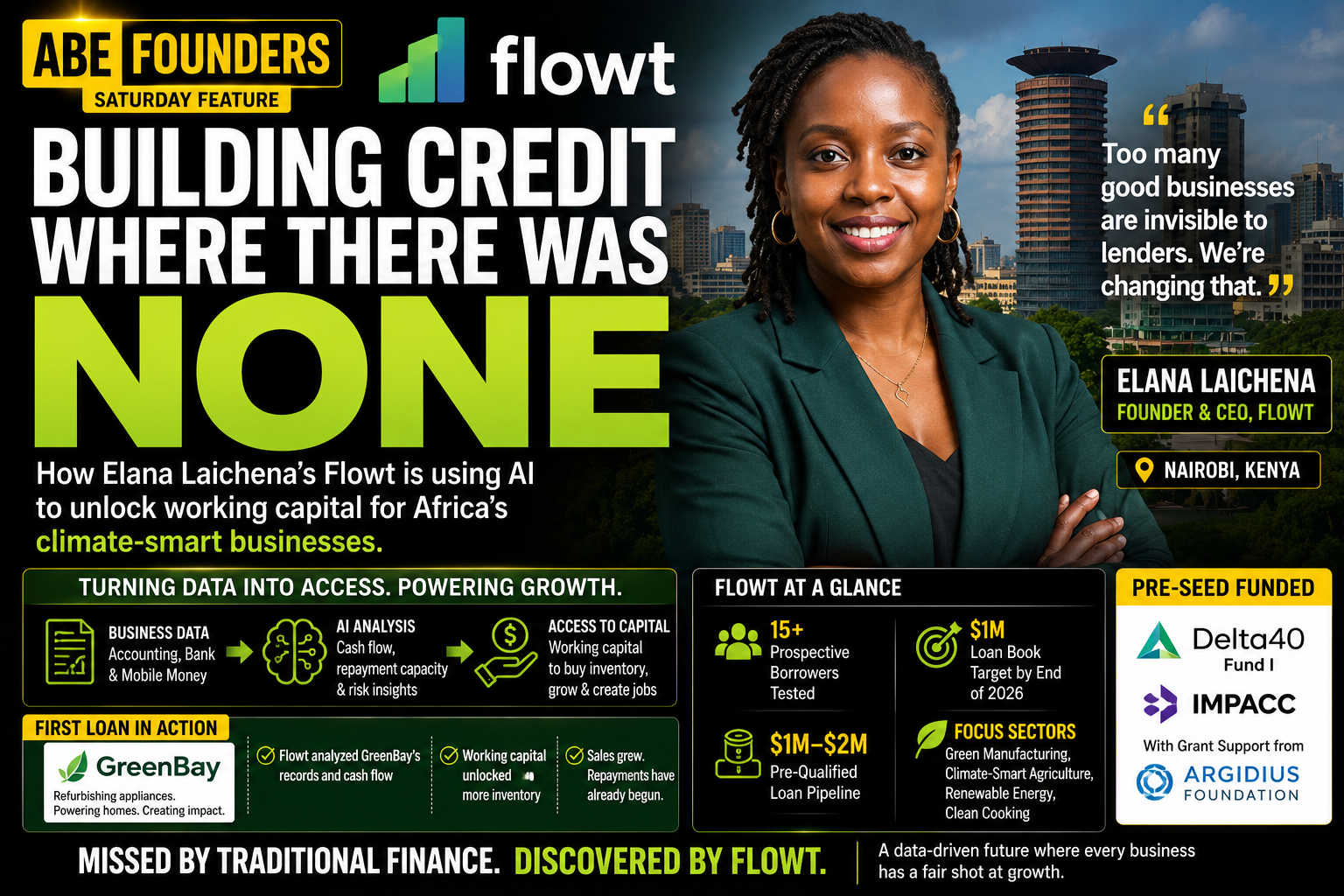
From Nairobi, she is building Flowt, an early-stage financial-technology company trying to make African climate-smart businesses easier to understand — and therefore easier to finance.
Flowt’s proposition is deceptively simple: instead of judging a young company mainly by the assets it can pledge as collateral, examine the financial information the business is already producing. Accounting records, bank transactions and mobile-money activity can reveal how money actually moves through a company, whether customers are paying, how stable cash flow is and whether the business appears capable of repaying financing.
Flowt uses artificial intelligence and machine learning to turn that fragmented information into financial intelligence that lenders can use.
The company has now secured the first close of an undisclosed pre-seed funding round backed by Delta40 Fund I and Impacc, alongside grant support from the Argidius Foundation. It is still very early. Flowt has not become a giant fintech company, and its model has not yet been proven at large scale.
That is precisely why Laichena belongs in ABE FOUNDERS.
We are watching the company while the difficult part is still happening.
While the founder is still building.
FROM INVESTOR BACK TO ENTREPRENEUR
Laichena’s path to Flowt is unusual because she has already experienced the startup world from both sides of the table.
She previously built Acacia Innovations, a business that worked on converting sugarcane waste into cleaner-burning fuel. She later moved deeper into venture building and investment, joining Delta40 Venture Studio and eventually serving as its managing director in Kenya.
That position gave her a close view of African startups trying to grow.
And she kept seeing the same problem.
Promising businesses could have customers, products and potential while remaining extremely difficult to finance.
For Laichena, the problem was also personal. In describing her decision to return to entrepreneurship full-time, she has said Flowt grew out of a challenge she had experienced herself as an entrepreneur and repeatedly witnessed among companies in the investment portfolio around her: working capital often arrives too late — if it arrives at all.
So she crossed back over the table.
The investor became a founder again.
Flowt was developed inside the Delta40 Venture Studio, where the idea moved toward an initial product before Laichena made the transition to full-time founder and CEO.
That experience could become one of Flowt’s advantages. Laichena has seen what entrepreneurs believe their companies look like, but she has also sat on the side where investors and lenders have to decide whether the numbers are trustworthy enough to put capital at risk.
Flowt is essentially trying to build a bridge between those two worlds.
THE $331 BILLION PROBLEM
The opportunity Flowt is pursuing is much larger than one Kenyan startup.
Small and medium-sized businesses are central to African economies, but access to finance remains one of their most persistent constraints. An International Finance Corporation estimate cited in recent reporting put unmet financing demand among micro, small and medium-sized enterprises in Sub-Saharan Africa at approximately $331 billion.
The problem is not necessarily that capital does not exist.
Part of the problem is that lenders struggle to determine which businesses can safely receive it.
Traditional lending systems work more comfortably when companies have established financial statements, substantial assets, long operating histories and collateral that can be seized if a borrower defaults.
Young businesses frequently have none of those things.
But they may have something else:
data.
They receive payments.
They purchase inventory.
They pay suppliers.
They collect money through banks and mobile-money systems.
They record sales through accounting software.
Those activities leave a financial trail.
Flowt’s bet is that the trail can tell a better story about a business than the absence of traditional collateral.
The company connects with accounting platforms and analyzes bank and mobile-money records. Its technology then categorizes transactions, checks information across different sources and produces indicators intended to help establish the company’s financial position, cash movement and repayment capacity.
The goal is not simply to produce another credit score.
Flowt wants to make businesses financially legible.
That distinction matters.
When a lender cannot confidently understand a small company, it has several choices. It can demand collateral. It can conduct lengthy and expensive due diligence. Or it can assume greater risk and charge the borrower accordingly.
For a small loan, each option can destroy the economics of the transaction.
If software can reduce the cost and time required to understand the borrower, loans that previously made little economic sense could become possible.
That is the business Flowt is trying to build.
GREENBAY BECOMES THE FIRST REAL TEST
Every startup eventually reaches the point where its pitch deck has to meet reality.
For Flowt, one of those first tests is GreenBay, a Kenyan circular-commerce company that sources, refurbishes and resells pre-owned household appliances, solar equipment and other products.
GreenBay had a straightforward business problem.
Its ability to sell more products depended on its ability to hold more inventory.
More inventory could mean more sales.
But buying that inventory required working capital.
For a conventional lender, GreenBay presented challenges. It is a young company and sells primarily to households and small businesses rather than relying on large corporate customers whose creditworthiness could provide additional comfort to a bank.
Flowt looked at the company differently.
It connected to GreenBay’s Odoo accounting system and compared the company’s operating information with its banking records. Using its technology, Flowt assessed the company’s financial position, cash movement and repayment capacity using information the business was already generating.
GreenBay received Flowt’s first working-capital facility.
It used the money to purchase additional inventory, sold more products and has begun making repayments.
The size and terms of that facility have not been publicly disclosed, so one successful borrower does not yet prove that Flowt’s model can scale.
But it does something important.
It moves the idea beyond theory.
WHY THE FLOWT WALLET MATTERS
Flowt is also trying to control risk after a loan is made.
Borrowers can make repayments through a dedicated Flowt wallet designed to separate money associated with purchasing inventory and collecting customer payments from ordinary operating expenses.
That creates additional visibility.
For a lender, knowing that a company generated revenue is useful. Understanding where that revenue went is even more valuable.
The structure could give Flowt a clearer view of the cash available for repayment while encouraging borrowers to maintain stronger financial discipline.
That matters because Flowt faces the same fundamental challenge as every lender:
Finding businesses that need money is easy.
Getting the money back is the business.
AI can analyze records faster. It can identify patterns. It can reduce administrative work.
It cannot eliminate credit risk.
If Flowt is going to become a meaningful financial company, the quality of its underwriting will ultimately matter more than how impressive the technology sounds.
THE EARLY NUMBERS ARE SMALL — AND IMPORTANT
Flowt remains at the beginning of its journey.
The company has tested its approach with more than 15 prospective borrowers and identified a pre-qualified lending pipeline estimated at between $1 million and $2 million. Its target sectors include green manufacturing, climate-smart agricultural processing, distributed renewable energy and clean cooking.
Flowt is working toward a loan book of up to $1 million by the end of 2026.
In the world of global finance, those numbers are tiny.
JPMorgan moves sums vastly larger than that.
Major private-credit funds manage billions.
Even established African fintech companies operate at a scale Flowt has not approached.
But that is the point of following a startup early.
The question isn’t whether Flowt is already large.
It is whether the company has found a problem large enough to build into.
And Africa’s small-business financing gap certainly qualifies.
THE BUSINESS MODEL COULD BECOME BIGGER THAN LENDING
Flowt’s most interesting long-term opportunity may not be the loans themselves.
The company is effectively building a financial-information layer.
The same data required to decide whether a business deserves financing can have value elsewhere.
A business owner can use better financial intelligence to understand the company.
A lender can use it for underwriting.
An investor can use it for due diligence.
A fund manager can potentially use it to monitor portfolio companies.
Flowt has described plans around financial-health tools, AI-powered accounting, working-capital loans, financial due diligence and real-time portfolio monitoring.
If that strategy works, Flowt could eventually make money from both sides of the financing relationship.
Businesses need capital and financial tools.
Investors and lenders need trustworthy information.
Flowt wants to sit between them.
That could produce a more scalable company than simply lending from its own balance sheet.
But building that platform will require proving that its financial analysis is accurate enough for other institutions to trust.
In finance, trust is the product.
WHY CLIMATE BUSINESSES?
Flowt is initially concentrating on climate-smart companies.
That includes businesses involved in areas such as renewable energy, green manufacturing, cleaner cooking and climate-smart agriculture.
There is logic behind the focus.
Billions of dollars globally are searching for climate-related investment opportunities, yet much of that capital gravitates toward larger projects because evaluating hundreds or thousands of smaller businesses can be expensive.
A large solar farm may justify months of due diligence.
A relatively small working-capital loan to an agricultural processor may not.
But collectively, those smaller companies could represent enormous economic and environmental impact.
If technology dramatically reduces the cost of assessing them, more capital could potentially move downstream.
That is where Flowt believes it can create value.
Instead of creating another pool of climate money, it wants to make more businesses capable of receiving the money that already exists.
THE AI LABEL WILL NOT BE ENOUGH
There is also a danger.
Almost every startup today can find a way to describe itself as an AI company.
Investors have heard the pitch repeatedly.
Flowt will therefore need to prove that artificial intelligence is not simply attached to its marketing.
The strongest argument in its favor is that the technology is being used for a specific operational task: reading, categorizing, comparing and verifying financial information that would otherwise require significant manual work.
That is a much more practical use of AI than simply adding a chatbot to an existing financial product.
But the real test will come with scale.
Can Flowt correctly distinguish between a temporarily cash-strapped good business and a genuinely bad borrower?
Can its models detect manipulation or fraudulent records?
Can it maintain loan quality while increasing the number of borrowers?
Can it operate across countries where banking systems, accounting practices and regulations differ?
And can it make enough money from relatively small businesses without charging those businesses the very prices it was created to help them escape?
Those questions will decide whether Flowt becomes an important financial platform or remains an interesting experiment.
THE FOUNDER HAS ANOTHER ADVANTAGE
Laichena’s background could prove particularly useful when fundraising.
She knows how investors think because she has been one.
She understands the language of venture capital, portfolio construction and due diligence.
She also knows how frustrating the process can feel from the founder’s side.
In recent public comments, Laichena described the transition from investor back to founder as a significant personal leap — leaving the security and prestige of an investment role to return to the uncertainty of building a startup.
That is the part of entrepreneurship that disappears once a company becomes famous.
After the billion-dollar valuation, the founder story sounds inevitable.
At pre-seed, nothing is inevitable.
The product can fail.
The company can run out of money.
Customers can refuse to adopt it.
Borrowers can default.
Investors can disappear.
A competitor can build something better.
Regulation can become difficult.
The founder can simply discover that the problem is harder than expected.
Flowt is still standing on that side of the journey.
WHAT COULD MAKE FLOWT BIG
The bull case is easy to understand.
Africa has millions of small businesses.
Many struggle to access affordable capital.
Digital payments and accounting systems are producing more financial data.
Artificial intelligence is reducing the cost of processing that data.
Climate investors are searching for viable companies to finance.
And traditional financial institutions have strong incentives to find better ways of assessing smaller borrowers without sending teams through months of manual due diligence.
If Flowt can prove that its technology identifies creditworthy businesses that conventional lenders overlook — while maintaining acceptable default rates — the opportunity could extend far beyond Kenya.
The platform could potentially become infrastructure used by banks, investment funds, development-finance institutions and other lenders seeking exposure to African SMEs.
That would be a much bigger company than a small startup making working-capital loans.
WHAT COULD KILL IT
But lending businesses can grow dangerously fast.
More capital does not automatically mean a healthier company.
If underwriting deteriorates, rapid expansion can simply create rapid losses.
Flowt will also need access to substantial debt capital if it intends to build a meaningful loan book. Equity investment can finance technology and employees, but lending at scale generally requires pools of capital specifically available to fund loans.
The company says it is pursuing additional equity as well as debt and repayable grant financing.
Then there is competition.
Banks are improving digital underwriting.
Fintech lenders already operate across African markets.
Accounting platforms are adding intelligence tools.
Mobile-money ecosystems possess enormous quantities of transaction data.
And larger financial institutions could eventually build similar systems themselves.
Flowt therefore needs more than technology.
It needs a defensible advantage.
That might come from proprietary borrower data, superior underwriting performance, specialization in climate businesses, relationships with lenders or a combination of all four.
We do not yet know.
That uncertainty is exactly what makes the company worth watching now.
THE LESSON FOR YOUNG FOUNDERS
There is something else worth noticing about Laichena’s story.
Flowt did not begin with the question:
What can we build with AI?
It began with:
Why can’t good businesses get the money they need?
The technology came afterward.
That distinction matters.
Some of the strongest startups are not created because a founder discovers a fashionable technology and searches for somewhere to use it.
They begin with a painful problem that already exists.
Then technology becomes the tool for solving it.
Working capital is not new.
Small-business financing is not new.
Banks rejecting young companies is certainly not new.
What has changed is the amount of digital financial information businesses now generate and the technology available to interpret it.
Laichena is betting that combining those two developments can unlock a market that traditional finance has struggled to serve.
That is a founder lesson worth remembering.
Do not always search for a new problem.
Sometimes the bigger opportunity is finding a better way to solve an old one.
🔴 THE ABE NEWS TAKE
Elana Laichena is not one of the world’s famous technology founders.
Flowt does not have a billion-dollar valuation.
There is no giant IPO approaching.
There isn’t even a publicly disclosed figure for its pre-seed round.
And that is precisely why ABE NEWS is watching.
The most interesting moment to discover a founder is not always after everyone else has discovered them.
It is when the company is still small enough to fail.
Flowt is attacking one of the least glamorous but most consequential problems in African entrepreneurship: businesses that can grow but cannot get the working capital required to do it.
Its solution is ambitious.
Turn messy financial records into trustworthy intelligence. Use that intelligence to identify businesses capable of carrying debt. Get capital to them faster. Build repayment histories. Then potentially make that financial intelligence useful to a much larger ecosystem of lenders and investors.
If it works, Flowt could help change how smaller African companies are financed.
If it doesn’t, the reasons will probably teach equally valuable lessons about the limits of AI-driven lending, credit risk and the difficulty of financing SMEs.
Either way, this is exactly where ABE FOUNDERS should be looking.
Not only at the people ringing the bell on the stock exchange.
Not only at founders standing beside billion-dollar valuations.
But at the entrepreneur in Nairobi who has just made the first loan, is raising the next round of capital and is trying to prove that an idea can become a company.
Today, it is Flowt.
Today, the target is a $1 million loan book.
Today, the founder is still building.
Years from now, we will know whether Elana Laichena built something much bigger.
ABE NEWS is watching from the beginning.
ABE NEWS
Business. Money. Style. The News.
Understand More. Think Bigger.