








ABE NEWS | August 29, 2026
The artificial-intelligence race is usually presented as a competition between a handful of technology giants. OpenAI releases a new model. Google responds. Meta spends billions. Nvidia sells more chips. Governments announce national AI strategies, investors pour money into startups, and every few months another company promises that its technology will bring the world closer to machines capable of reasoning, working and creating alongside humans.
But beneath that highly visible race, another competition is taking place — one that receives far less attention and may ultimately determine how far the AI revolution can actually go.
Artificial intelligence is beginning to collide with the physical world.
Every AI model needs computers. Those computers sit inside data centres. The data centres require land, enormous electrical connections, cooling systems, fibre networks, transformers, backup generators, water or alternative cooling technologies, and billions of dollars of construction and financing. The larger and more widely used AI becomes, the larger that physical footprint becomes.
For years, the technology industry encouraged us to imagine computing as something almost weightless. Businesses moved information into “the cloud.” Software could be distributed instantly. A digital company could serve customers around the world without building thousands of shops or factories.
But the cloud was never really floating above us. It was sitting inside enormous buildings filled with machines.
AI is making those buildings much harder to ignore.
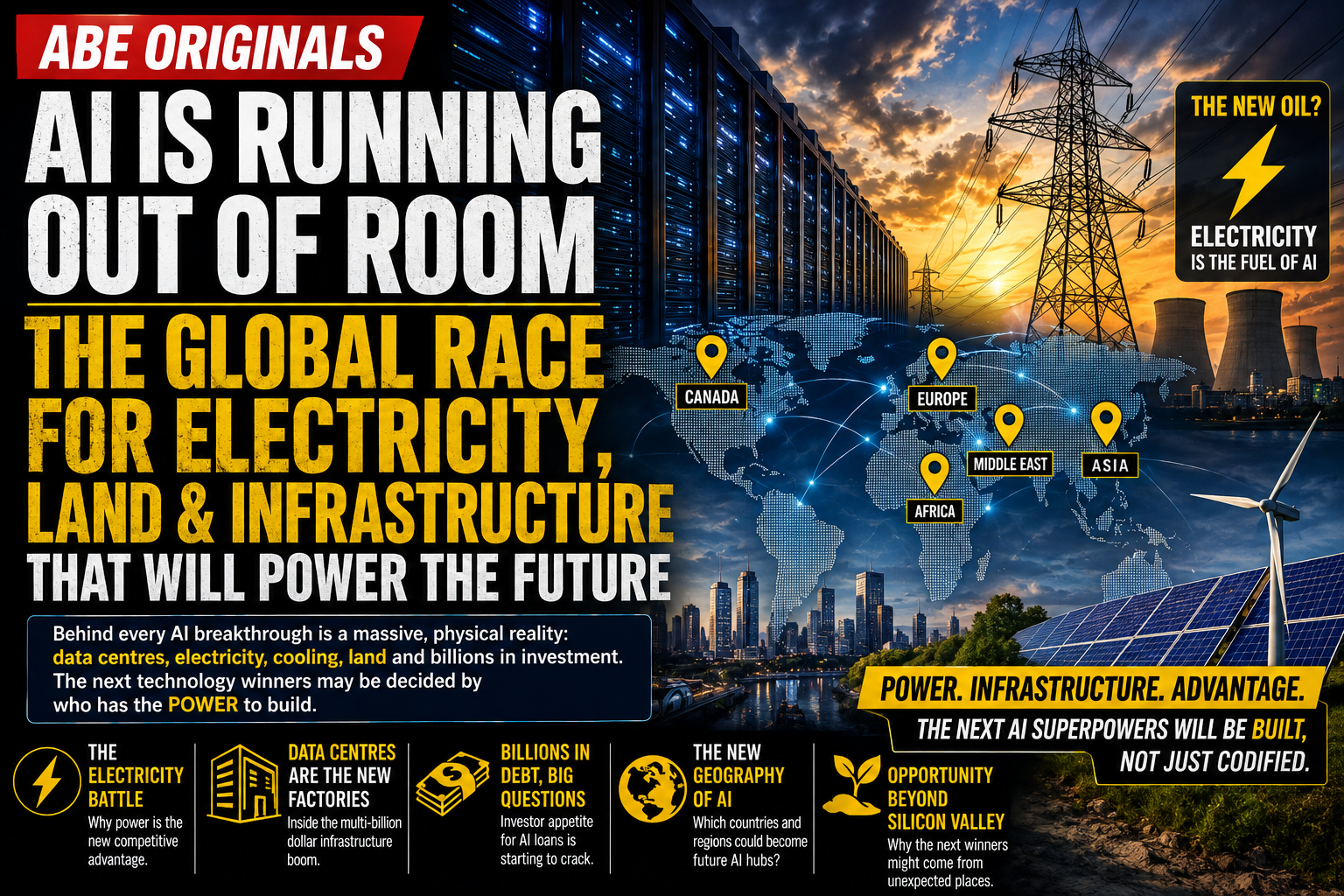
And that is creating a remarkable possibility: the next phase of the artificial-intelligence race may be determined as much by electricity, land and infrastructure as by algorithms.
THE NEW FACTORIES OF THE AI ECONOMY
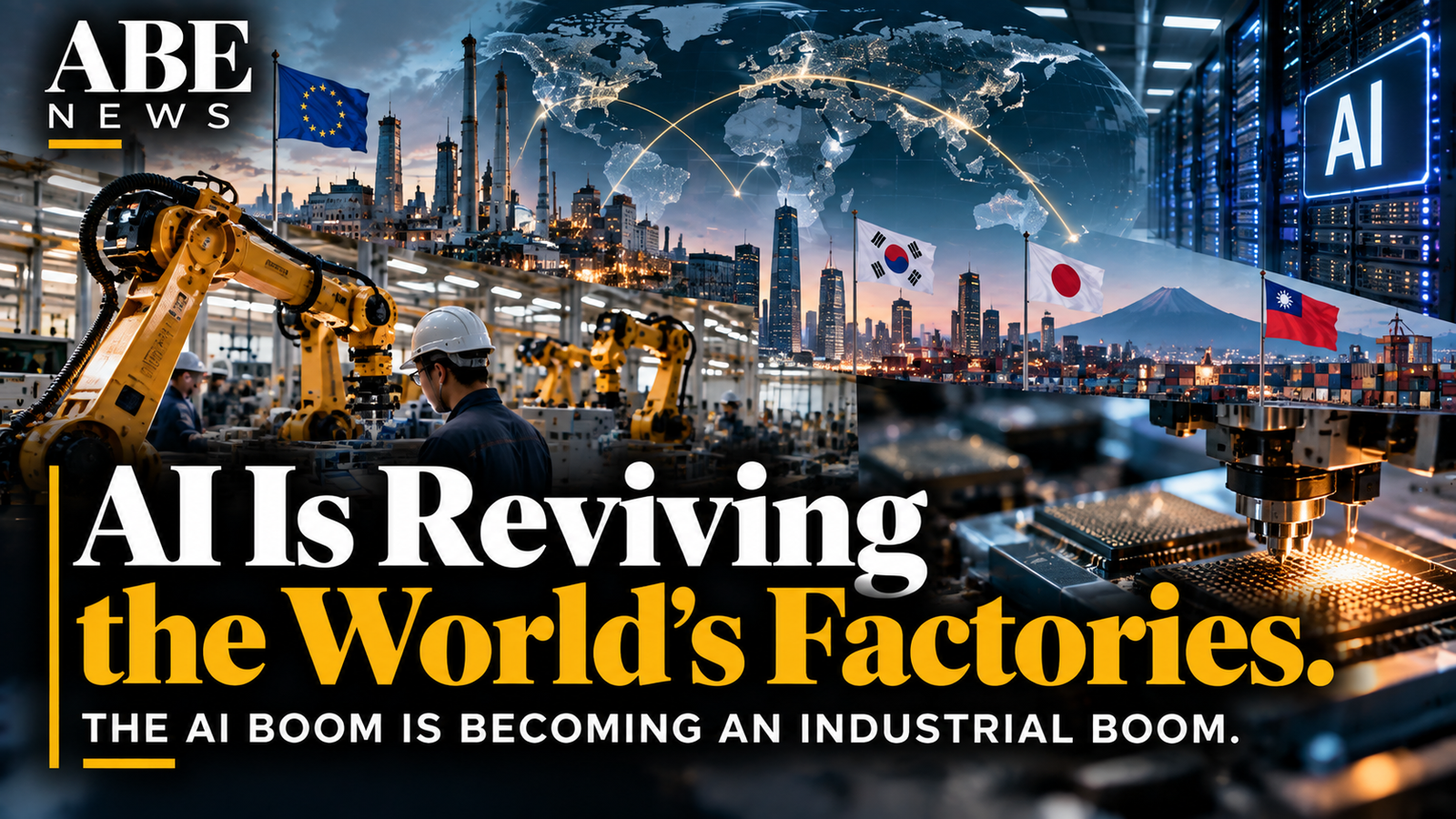
A modern AI data centre can be understood as a new kind of factory.
Traditional factories take raw materials and energy and turn them into physical products. An AI data centre takes electricity, computer chips and enormous quantities of data and converts them into computing power. That computing power trains models, answers questions, generates images, writes software, analyzes corporate information and increasingly performs work that once required people.
The product is digital, but the machinery producing it is extremely physical.
That distinction matters because the technology industry’s ambitions are expanding far faster than much of the infrastructure supporting them. Companies are spending extraordinary sums acquiring advanced processors and constructing data centres capable of running them. Yet simply purchasing the latest chips does not solve the problem. Those chips must be installed somewhere, supplied with reliable electricity and prevented from overheating while operating continuously.
That has transformed electricity from an ordinary operating expense into a strategic technology resource.
A company can have billions of dollars available. It can secure advanced processors. It can own land and have customers waiting for its services. But if the regional electricity grid cannot supply enough power, the project can still be delayed.
The AI race therefore has a bottleneck that cannot be solved by better software.
You cannot code your way out of an electricity shortage.
WHY THE AI MAP IS BEGINNING TO CHANGE
For years, Europe’s data-centre industry concentrated heavily around a small collection of established hubs, including London, Frankfurt, Amsterdam, Paris and Dublin. Those cities offered the connectivity, financial infrastructure, corporate customers and technical expertise operators needed.
Their success, however, created another problem.
Land became more expensive. Electricity networks became increasingly constrained. Planning and permitting grew difficult. Obtaining a large new grid connection could take years.
As AI increases demand for computing capacity, developers are beginning to search beyond those traditional locations. Reuters has reported growing interest in European markets where developers can obtain cheaper land and, perhaps even more importantly, access electricity faster.
That change tells us something fundamental about where the technology industry may be heading.
Imagine two cities competing for a major AI data centre.
The first is a famous technology centre filled with software engineers, investors and established companies, but its electricity grid is congested and a new project might wait years for enough power.
The second is barely known internationally as a technology hub, but it has abundant electricity, available industrial land, strong fibre connectivity and a government capable of approving construction quickly.
Ten years ago, the first city might have been the obvious winner.
In the emerging AI economy, the second city suddenly has something extremely valuable.
Capacity.
This could gradually redraw the world’s technology geography. Some of tomorrow’s most important AI infrastructure may be constructed far from the cities traditionally associated with the technology industry.
THE ELECTRICITY RACE HAS ALREADY BEGUN
The consequences are spreading well beyond Silicon Valley.
Utilities are negotiating enormous electricity agreements. Power companies are becoming indirect beneficiaries of AI investment. Technology companies are examining nuclear energy, renewable generation, natural gas, battery storage and other ways of securing reliable power. Businesses specializing in generators, cooling equipment, transformers, construction and electrical infrastructure are finding themselves connected to an industry that was once discussed primarily in terms of software.
Aggreko provides a revealing example. The power-supply company filed for a U.S. initial public offering in August as demand connected to data centres helped drive its business. Its data-centre revenue nearly doubled during its latest reported financial year.
Aggreko does not build famous chatbots.
It does not manufacture the world’s most advanced AI chips.
Yet it can benefit enormously from artificial intelligence because someone has to provide the electricity required to run the machines.
This is an old pattern appearing inside a new technological revolution.
During a gold rush, enormous fortunes can be made not only by finding gold, but by selling the equipment miners need to search for it. The AI equivalent may include power generators, electrical equipment, cooling systems, construction companies, grid technology, industrial real estate and energy producers.
The glamorous part of AI may be the model.
The profitable part for many other businesses could be everything required to keep that model running.
WALL STREET HAS TO PAY FOR ALL OF THIS
Then comes the money.
Building this infrastructure requires staggering amounts of capital. Data centres can cost billions of dollars. The power systems surrounding them require additional investment. New transmission networks, substations, cooling facilities and fibre connections add still more.
Corporate borrowing linked to the AI infrastructure boom has therefore surged.
But investors are beginning to become more selective. Reuters has reported signs that bond investors are demanding greater compensation for some corporate debt connected with the AI expansion as questions grow about the enormous amount of capital being committed.
That does not mean the AI boom is ending. It means investors are beginning to ask the question that eventually arrives in every investment boom:
Who is going to earn enough money to justify all of this spending?
The industry is making a gigantic bet that demand for artificial intelligence will continue expanding rapidly enough to fill the computing capacity being built today.
If that happens, today’s data-centre investments could become some of the most valuable infrastructure of the next economy.
But if demand disappoints, if technology changes faster than expected, or if companies discover that customers are unwilling to pay enough for AI services, some investors could find themselves owning extremely expensive infrastructure built around overly optimistic assumptions.
The AI race is therefore becoming not only a technological experiment, but one of the largest capital-allocation experiments of our time.
THE GRID MAY BECOME THE REAL BOTTLENECK
The most difficult problem may ultimately be the electrical grid itself.
Electricity networks in many developed economies were never designed for the sudden arrival of clusters of enormous computing facilities consuming industrial quantities of power around the clock.
A large data-centre campus can require electricity on a scale comparable to major industrial facilities. When several projects are proposed in the same region, utilities must determine whether sufficient generation and transmission capacity actually exists.
If it does not, the solution is rarely immediate.
New transmission lines can take years to approve and construct. Substations must be expanded. Transformers must be ordered. Additional generation may be required. Communities must approve projects. Environmental reviews can create further delays.
This creates an unusual problem for one of the fastest-moving industries in history.
Artificial-intelligence models can improve dramatically within months.
Electrical infrastructure often takes years.
The technology is moving at digital speed.
The power system is moving at infrastructure speed.
Somewhere between those two timelines sits one of the biggest challenges facing the AI economy.
WATER AND COMMUNITIES WILL MATTER TOO
Electricity is not the only resource entering the debate.
Computers generate heat, and enormous concentrations of high-performance processors generate enormous amounts of it. Data centres therefore require sophisticated cooling systems, some of which can use significant quantities of water.
That becomes politically sensitive when facilities are proposed in regions already experiencing water stress.
Communities may increasingly ask whether scarce water should be used to cool computing infrastructure. Residents may question whether rapidly expanding electricity demand could raise local prices. Governments may be asked who should pay for the transmission upgrades required to connect privately owned facilities.
Then there is employment.
A multibillion-dollar data centre can create substantial construction work while it is being built, but once operational it may require fewer permanent employees than a traditional factory of similar investment value.
That does not make the project economically worthless. Data centres can generate taxes, support surrounding businesses and attract additional technology investment.
But governments will increasingly have to demonstrate that communities receive genuine benefits from hosting infrastructure that consumes significant local resources.
AI may be digital.
Its politics will be extremely local.
CANADA COULD HAVE AN ADVANTAGE
This emerging competition creates an interesting opportunity for Canada.
Canada possesses several things the AI infrastructure economy increasingly values: political stability, large amounts of land, strong universities, close economic connections with the United States and substantial energy resources.
Several provinces also benefit from major hydroelectric systems.
Canada’s climate provides another potential advantage. Cooler temperatures can reduce some of the energy required to manage heat compared with hotter regions, although the economics vary significantly by facility and cooling design.
On paper, those characteristics should make parts of Canada attractive destinations for future data-centre investment.
But possessing advantages is different from converting them into projects.
Canada would still need adequate generation, transmission capacity, competitive electricity prices, efficient permitting and communities willing to host increasingly large facilities.
The countries that win this competition will not necessarily be those with the most impressive energy potential.
They will be those capable of turning that potential into reliable power when companies actually need it.
AFRICA MAY HAVE A MUCH BIGGER OPPORTUNITY THAN IT APPEARS
Africa presents an even more interesting long-term possibility.
The continent is usually discussed in the AI conversation as a future market — hundreds of millions of young consumers who will eventually use products developed elsewhere.
That view may be too limited.
Africa possesses extraordinary renewable-energy potential. Solar resources across large parts of the continent are among the strongest in the world. Countries such as Kenya have developed substantial geothermal resources. Others possess enormous hydroelectric potential. Africa also has large areas of available land and one of the youngest populations on Earth.
Those ingredients could eventually make parts of the continent attractive for computing infrastructure.
But there is a major contradiction.
Hundreds of millions of Africans still lack reliable electricity.
Businesses across many countries already struggle with outages and expensive backup generation.
That means governments must approach the data-centre opportunity carefully.
It would make little economic or political sense to provide enormous amounts of subsidized electricity to foreign-owned computing facilities while nearby factories, schools, hospitals and households struggle to keep their lights on.
The smarter strategy would be to use new technology investment to accelerate the expansion of energy systems themselves.
Imagine an African country attracting major data-centre investment because a new solar, geothermal or hydroelectric project creates abundant power — while the same infrastructure simultaneously strengthens electricity access for surrounding industries and communities.
Then AI infrastructure would become part of industrial development rather than an isolated technology enclave.
That is a much bigger opportunity.
Africa does not have to build the next famous chatbot to participate in the AI economy.
It can build parts of the physical system that makes the AI economy possible.
ENERGY-RICH COUNTRIES COULD BECOME TECHNOLOGY COUNTRIES
That idea has implications far beyond Africa.
For decades, countries blessed with abundant energy resources primarily exported those resources.
Oil was loaded onto tankers.
Natural gas was shipped through pipelines or exported as LNG.
Electricity generated by hydroelectric dams powered traditional industries.
AI creates another possibility.
Instead of exporting all available energy, countries may increasingly convert some of it into computing power domestically.
In other words, rather than exporting only the raw resource, they could export digital services produced using that resource.
That could become an important economic strategy.
A country with cheap electricity and little traditional technology industry may discover that energy itself provides an entry point into the digital economy.
The world’s future technology hubs might therefore emerge in unexpected places: regions with abundant hydroelectricity, deserts capable of producing enormous amounts of solar power, countries investing heavily in nuclear energy, or industrial areas with underused grid connections.
The geography of computing could increasingly follow the geography of power.
THE NEXT AI FORTUNES MAY NOT COME FROM CHATBOTS
There is also a lesson here for investors and entrepreneurs.
The most obvious companies in a technological revolution are not always the only businesses that capture enormous value.
The smartphone era created Apple and helped transform Google and Meta, but it also produced huge opportunities for semiconductor manufacturers, component suppliers, telecommunications companies and manufacturers operating behind the scenes.
The internet created famous websites, but it also created enormous businesses in cloud computing, networking equipment, cybersecurity and data storage.
Artificial intelligence will likely do the same.
Entrepreneurs are already building companies around cooling systems, energy management, specialized data-centre construction, chip infrastructure, electrical equipment and software that helps computing facilities use energy more efficiently.
As AI infrastructure expands, entirely new categories of businesses may emerge.
The next billionaire created by artificial intelligence might not build an AI model at all.
They might solve the problem of powering one.
THE COUNTRIES THAT UNDERSTAND THIS EARLY COULD WIN
This is where national policy becomes important.
Many governments now have an “AI strategy.”
They talk about research grants, startups, university programs, regulation and attracting technology companies.
Those things matter.
But a serious national AI strategy increasingly requires something much less glamorous:
an energy strategy.
Governments need to know where additional electricity will come from.
They need transmission networks capable of carrying it.
They need industrial land where infrastructure can be built.
They need fast but credible permitting systems.
They need enough water or cooling alternatives.
They need telecommunications infrastructure.
And they need policies ensuring that the arrival of enormous data centres benefits the broader economy rather than simply consuming scarce resources.
Countries that fail to think about those questions may discover that their AI ambitions cannot survive contact with physical reality.
You can announce a billion-dollar AI fund.
You can train thousands of programmers.
You can invite the world’s largest technology companies.
But if a new data centre has to wait seven years for electricity, the investment may simply go somewhere else.
THE RACE BENEATH THE RACE
This is why the most important map of the AI future may not show where technology companies are headquartered.
It may show where electricity is abundant.
Where new generation is being built.
Where transmission networks are expanding.
Where industrial land is available.
Where governments can approve infrastructure without endless delays.
Where cooling is affordable.
And where billions of dollars can be invested with enough certainty that companies believe their facilities will still be valuable decades from now.
The AI revolution has reached the stage where software and infrastructure can no longer be separated.
The models may live online.
Their foundations do not.
🔴 THE ABE NEWS TAKE
For the past several years, the world has been asking who will win artificial intelligence.
America?
China?
OpenAI?
Google?
Meta?
Some company that hasn’t been created yet?
Those are important questions.
But they may be incomplete.
The AI race is becoming a race for physical capacity.
The ability to generate electricity.
The ability to move that electricity across a grid.
The ability to build enormous computing facilities.
The ability to cool them.
The ability to finance them.
And the ability to do all of that quickly enough to keep pace with technological change.
That creates opportunities for countries and companies that have barely appeared in the AI conversation so far.
Canada could turn abundant energy and geography into a larger technology advantage.
African countries that successfully expand reliable electricity could eventually participate not simply as consumers of AI, but as hosts of the infrastructure behind it.
Energy-rich countries could convert power into computing rather than exporting only raw resources.
And entrepreneurs could build enormous companies solving the infrastructure problems that the world’s most famous AI laboratories cannot solve themselves.
For decades, control over oil shaped global power.
More recently, semiconductors became one of the world’s most strategic technologies.
Now electricity is acquiring another identity.
It is becoming the raw material of machine intelligence.
And that means the most important question in the next stage of the AI revolution may not be:
Who has the smartest model?
It may be:
Who has enough power to turn it on?
ABE NEWS
Business. Money. Style. The News.
Understand More. Think Bigger.