








ABE NEWS | SEPTEMBER 18, 2026
For most people, artificial intelligence still exists behind a screen. A user types a question, a model produces an answer, and the interaction ends in the digital world.
Anthropic is beginning to push beyond that boundary.
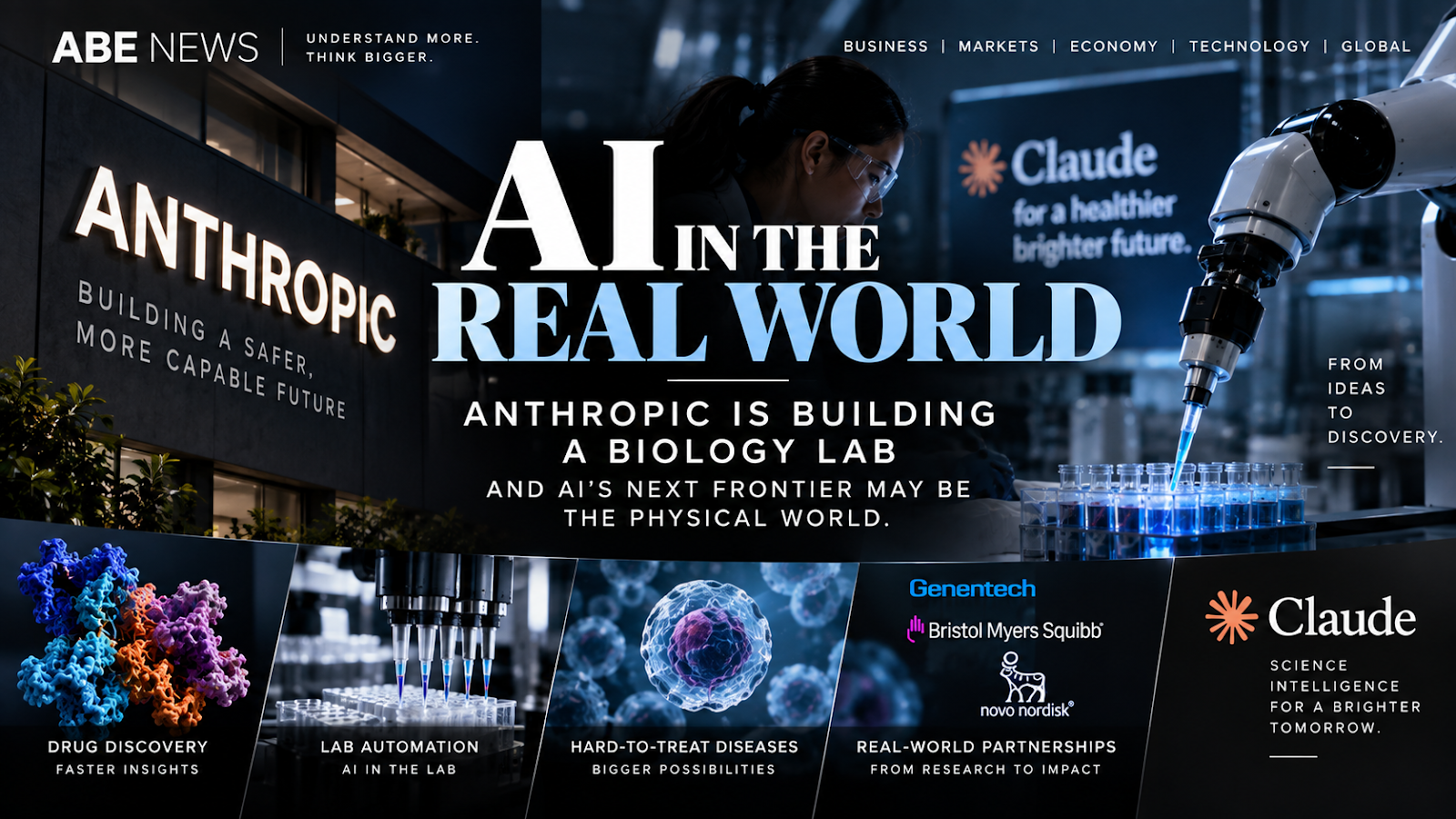
The maker of Claude has established a wet laboratory in the San Francisco Bay Area, where physical biological experiments are being conducted as the company expands deeper into life sciences. Anthropic’s head of life sciences, Eric Kauderer-Abrams, confirmed the facility to Reuters this week, saying real laboratory work remains the ultimate test in biology. The company later clarified that the lab itself is not specifically a drug-discovery facility.
The distinction matters, but so does the direction.
Anthropic is exploring how Claude can work with laboratory automation, investing heavily in life sciences, developing tools for drug research and working with major pharmaceutical companies. Just yesterday, it also announced expanded access to AI models for professional biological research and published new results showing Claude improving software used to model biomolecules.
AI’s next frontier, in other words, may not simply be a better chatbot.
It may be an AI system capable of helping scientists design an experiment, operate laboratory equipment, analyze what happened and decide what should be tested next.
FROM ANSWERING QUESTIONS TO RUNNING EXPERIMENTS
Anthropic’s laboratory ambitions expose one of the biggest transitions underway in AI.
Today’s most familiar AI systems manipulate information. They write software, summarize documents, analyze images and generate text. Scientific research requires something more difficult: interacting with the physical world.
A promising molecule predicted by a computer still has to work in reality.
That means preparing samples, operating instruments, measuring biological responses, interpreting unexpected results and repeatedly redesigning experiments.
Anthropic is experimenting with connecting Claude to robotic laboratory units capable of carrying out scientific work with limited human intervention, Reuters reported. The company says human involvement and oversight remain essential, and Kauderer-Abrams characterized automated laboratory execution as still being in its early stages.
But even partial automation could matter.
Scientific research is filled with repetitive processes that consume researchers’ time. If AI can reliably help plan, execute and interpret portions of those workflows, the potential productivity gain is much larger than simply giving scientists a better search or writing assistant.
It turns AI from a tool that discusses science into one that participates in the process of doing it.
ANTHROPIC IS MAKING A SERIOUS LIFE-SCIENCES BET
The wet lab is not an isolated experiment.
Life sciences has become one of Anthropic’s largest investment areas by both staffing and resources, according to Kauderer-Abrams. The company has acquired biotechnology startup Coefficient Bio, launched scientific products and developed standards intended to help AI systems communicate with physical laboratory equipment.
Anthropic is also already working with established pharmaceutical companies including Genentech, Bristol Myers Squibb and Novo Nordisk.
And the company’s scientific work is becoming increasingly concrete.
On September 17, Anthropic reported that Claude had optimized more than 30 open-source biomolecular models in less than four weeks, making them roughly four times faster on average. The company also developed a lower-memory approach designed to allow scientists to model substantially larger biological systems using a single Nvidia GPU node.
Anthropic is making that optimized code open source and supporting a protein-design competition offering wet-lab validation for thousands of designs.
Those developments point toward a broader strategy: connect increasingly capable AI reasoning with the software, data and eventually machinery used to conduct science.
THE TARGET IS SOME OF MEDICINE’S HARDEST PROBLEMS
Anthropic says one of its ambitions is to accelerate research into conditions historically considered difficult to treat.
Kauderer-Abrams told Reuters that AI could help scientists work on diseases and biological targets sometimes described as “undruggable” — areas where conventional drug-development approaches have struggled. AI could potentially help researchers explore complicated molecules such as antibodies designed to interact with multiple biological targets.
That does not mean Claude is about to start producing approved medicines.
Drug development remains extraordinarily difficult. Promising molecules must survive extensive preclinical testing and, eventually, human clinical trials demonstrating safety and efficacy. Many candidates fail somewhere along that path.
Anthropic says it is not currently running clinical trials. The diseases it is targeting and the progress of individual programs also remain unclear.
The more immediate opportunity is therefore speed.
If AI can help scientists eliminate unsuccessful ideas earlier, improve experimental design, optimize computational models and automate portions of laboratory work, it could reduce some of the time and resources consumed before a potential medicine ever reaches patients.
That would be economically significant even without AI independently inventing a blockbuster drug.
BIG PHARMA MAY GET A NEW KIND OF TECHNOLOGY PARTNER
Anthropic is also navigating an unusual competitive position.
It wants to become deeply embedded in pharmaceutical research without necessarily becoming another pharmaceutical company.
That matters because drugmakers possess valuable proprietary data and intellectual property. A pharmaceutical company using an outside AI platform could reasonably worry about whether information from its research might benefit a competitor.
Anthropic says customer information is separated and has drawn a boundary around its current ambitions: it is not running clinical trials and says it intends to focus partly on scientific needs that traditional industry may not pursue.
If that model works, AI companies could occupy a powerful new position in medicine.
They would not necessarily manufacture or market drugs themselves. Instead, they could provide the underlying intelligence infrastructure used across discovery, research, clinical development and manufacturing.
There are early signs of that broader model already. Anthropic says its relationship with Bristol Myers Squibb extends across research, clinical development, manufacturing and other corporate functions.
That could eventually make advanced AI models to biotechnology what cloud computing became to software: an enabling layer beneath thousands of organizations rather than simply another competitor within the industry.
BUT BIOLOGY MAKES AI SAFETY MUCH MORE SERIOUS
There is an unavoidable tension in this story.
The more capable AI becomes at biology, the more valuable it could become for medicine.
The same increase in capability can also create new risks.
Anthropic has been among the AI companies publicly warning about the dangers of increasingly powerful systems. Reuters reported that some of its researchers recently raised severe concerns about future AI systems, while the company has also studied ways models might contribute to biological-weapons development.
And now Anthropic is deliberately trying to make AI better at legitimate biological research.
That is not necessarily contradictory. It is, however, a difficult engineering and governance problem.
Anthropic’s new Life Sciences Verification Program, announced September 17, illustrates the challenge. Verified life-sciences professionals can gain access to models with safeguards adjusted to permit legitimate biological work that generally available models may block, including tasks involving drug discovery, research biology, clinical development and manufacturing.
The logic is straightforward: a model restricted enough to prevent every potentially dangerous biological interaction may also become significantly less useful to legitimate scientists.
So the question becomes not simply what can the AI do?
It becomes who should be allowed to make it do what?
That problem will grow more important as AI moves closer to physical laboratories.
THE ROBOTS MAY MATTER AS MUCH AS THE MODELS
Much of the AI race has been measured using model benchmarks: reasoning scores, coding ability, mathematical performance and computing power.
Scientific automation introduces another competitive layer.
Laboratories already contain sophisticated machines capable of performing highly standardized tasks. If AI models can reliably control those systems, observe results and adapt subsequent experiments, laboratories could become increasingly autonomous.
Anthropic previewed its Model Hardware Standard in August as part of that effort to connect models with equipment.
Imagine the progression.
A scientist gives an AI system a research objective.
The model reviews existing scientific literature, proposes possible experiments, writes protocols, communicates with robotic laboratory equipment, collects results, analyzes failures, modifies the experimental plan and proposes another round.
Humans could remain responsible for goals, supervision and critical decisions while machines dramatically increase the number of experiments that can be attempted.
That is still an emerging vision rather than the normal reality of scientific research.
But it shows why the combination of AI + robotics + biology could ultimately prove more consequential than improvements to consumer chatbots.
SCIENCE COULD BECOME ANOTHER AI BATTLEGROUND
Anthropic is not pursuing this opportunity alone.
Across the technology industry, companies are attempting to use AI to model proteins, discover molecules, understand diseases and accelerate scientific research.
The commercial prize could be enormous.
Pharmaceutical research requires vast amounts of capital and time, while successful medicines can generate billions of dollars in revenue. Even incremental improvements in the probability, speed or cost of developing drugs could therefore create substantial economic value.
But the deeper prize may be scientific.
Modern science increasingly generates more information than individual researchers can manually process. AI systems capable of combining enormous scientific literatures with computational modeling and automated experimentation could change the speed at which hypotheses are tested.
Anthropic itself describes increasing the pace of scientific progress as a core part of its mission.
The critical question is whether the technology can move from impressive demonstrations to reproducible discoveries in real laboratories.
The wet lab suggests Anthropic wants to find out directly.
🔴 THE ABE NEWS TAKE
The most important part of Anthropic’s biology push is not that an AI company now owns laboratory space.
It is what the laboratory represents.
The first era of generative AI was largely about information. Models learned to write, code, search, analyze and communicate.
The next era may increasingly be about action.
An AI that can reason about biology is useful. An AI that can reason about biology, communicate with laboratory equipment, run experiments, interpret the results and improve the next experiment is something fundamentally different.
That transition would also change the economics of AI.
The technology would no longer compete only for software subscriptions and workplace productivity. It could begin influencing industries built around physical discovery: pharmaceuticals, biotechnology, materials science, chemistry, energy and eventually manufacturing.
But biology also demonstrates why the transition from digital intelligence to physical capability deserves far more scrutiny than another improvement in chatbot performance.
The same system that becomes better at understanding how biology works may become more useful both to scientists trying to cure disease and to actors seeking to misuse biological knowledge.
Anthropic is effectively trying to prove that these two realities can be managed simultaneously: make AI substantially more capable at science while controlling who can use those capabilities and for what purpose.
Whether that works remains uncertain.
What is becoming clearer is that the AI race is beginning to leave the computer screen.
And once artificial intelligence starts operating instruments, conducting experiments and influencing discoveries in the physical world, measuring progress by which chatbot writes the better answer may start to look like a very small part of the story.
ABE NEWS
Business. Money. Style. The News.
Understand More. Think Bigger.