






Africa has spent decades watching some of its biggest businesses look overseas when they need serious money.
London.
New York.
International banks.
Foreign institutional investors.
But one of Africa’s biggest industrial projects is preparing to do something different.
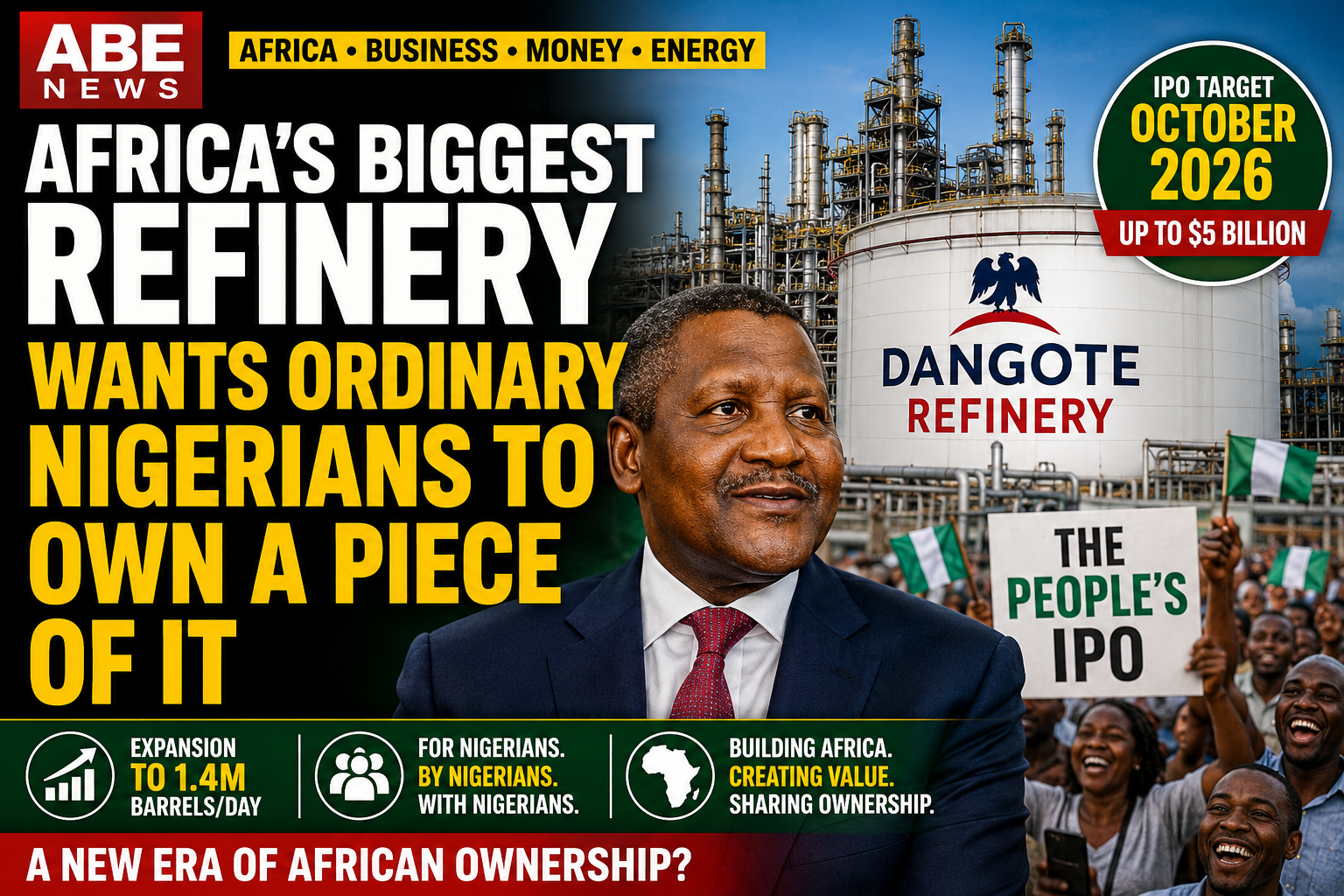
Dangote Petroleum Refinery wants Nigerians themselves to become owners.
The company is preparing for an initial public offering in Nigeria that could launch as early as October 2026 — and potentially become the largest IPO Africa has ever seen.
Its CEO has a simple name for the plan:
“The people’s IPO.”
But behind that phrase is a much bigger question.
Can Africa build giant companies, finance their expansion and create wealth —
without always looking outside Africa for the money?
The Refinery Is Already Enormous
The Dangote refinery isn’t a small startup looking for its first investors.
It is one of the most ambitious industrial projects ever built on the African continent.
The facility currently supplies most of Nigeria’s gasoline and diesel demand and all of the country’s jet-fuel needs, according to CEO David Bird.
And the company isn’t planning to remain at its current size.
Dangote wants to approximately double refining capacity to 1.4 million barrels per day within three years.
Part of the money required for that expansion is expected to come from the IPO, alongside debt financing.
If successful, that would turn an already enormous refinery into an even more important player in global energy markets.
But first, Dangote needs capital.
And that’s where the story becomes interesting.
Dangote Wants Nigerians in the Deal
A source familiar with the matter told Reuters that the refinery has submitted an application to Nigeria’s Securities and Exchange Commission for an IPO of as much as $5 billion, although the final amount has not yet been decided.
The company is targeting an October launch.
But CEO David Bird says the objective isn’t simply raising as much money as possible.
The company wants participation.
Broad participation.
Especially from Nigerians.
Bird told Reuters that the mandate was to make this “the people’s IPO.”
That’s important.
Because an IPO does something very different from a private investment.
Instead of ownership remaining almost entirely among founders, private investors and large financial institutions, shares can eventually become available to a much wider group of investors.
That gives ordinary investors an opportunity to participate in the future performance of the business.
Of course, buying shares always carries risk.
But the principle is significant:
one of Africa’s largest industrial assets could become partly owned by the investing public.
Investors Are Already Interested
We already have an indication of how much demand might exist.
In July, the refinery completed a $2.5 billion private placement.
That transaction valued the refinery at approximately $40 billion.
And demand was much larger than the amount of shares available.
The Africa Finance Corporation, which led a group of strategic investors in the transaction, said the offering was 3.7 times subscribed and attracted both African and international institutional investors.
Think about that.
Investors wanted considerably more exposure to the refinery than the company was offering.
That doesn’t guarantee the IPO will succeed.
But it tells us something important:
capital is paying attention.
Why Dangote Isn’t Rushing to London
Here’s another interesting part of the strategy.
The refinery isn’t currently planning an overseas stock-market listing.
And according to its CEO, that’s intentional.
Bird said the company wants roughly three years of demonstrated production and financial performance before considering a foreign listing.
London has been discussed as one possible future destination.
The logic is straightforward.
Build the business.
Prove its earnings power.
Expand production.
Develop a financial track record.
Then, if the company eventually approaches international markets, it could potentially command a stronger valuation.
In other words:
Dangote doesn’t appear desperate for foreign validation.
It wants to prove what the asset can do first.
The Iran Conflict Has Also Changed the Opportunity
There’s another reason this refinery suddenly matters beyond Nigeria.
Global energy trade is being disrupted.
With instability surrounding Iran and the Strait of Hormuz, buyers have been looking for alternative supplies.
Dangote has benefited.
According to its CEO, the refinery became Europe’s largest supplier of jet fuel during June and July.
That’s remarkable when you consider what the refinery was originally built to solve.
Nigeria is one of the world’s major crude-oil producers.
Yet for years, the country depended heavily on imported refined petroleum products.
Nigeria could extract crude oil —
but then often needed someone else to turn it into gasoline, diesel and aviation fuel.
Dangote is trying to change that equation.
And now its products aren’t only replacing imports.
They’re moving into international markets.
Africa’s Refining Problem Is Also an Opportunity
Africa produces enormous amounts of natural resources.
Oil.
Gas.
Copper.
Cobalt.
Gold.
Lithium.
Cocoa.
Coffee.
But there’s a problem that appears again and again across the continent:
Africa often exports the raw material and imports the finished product.
And the finished product is usually worth considerably more.
That means much of the value creation happens somewhere else.
Refining changes that.
Instead of simply exporting crude oil, a country can transform that crude into gasoline, diesel, aviation fuel, petrochemicals and other higher-value products.
That creates another layer of economic activity.
And according to Dangote’s CEO, Africa remains structurally short of both refined fuels and petrochemicals.
That shortage represents a problem.
But for a refinery?
It’s also a market.
And This Is Bigger Than Oil
The most interesting part of the Dangote IPO may ultimately have very little to do with gasoline.
It could become a test of something Africa badly needs:
deeper capital markets.
Imagine the cycle.
African workers earn money.
Some save and invest.
Those savings flow into African businesses.
Those businesses use the capital to build factories, infrastructure and services.
Those businesses grow.
Investors participate in that growth.
More capital becomes available for the next generation of companies.
That’s how financial markets can help transform savings into productive investment.
But when local capital markets remain shallow, companies often have to look elsewhere.
The biggest deals go overseas.
The biggest investors come from overseas.
And sometimes much of the resulting financial wealth goes overseas too.
A successful Dangote listing wouldn’t solve that problem by itself.
But it could demonstrate what’s possible.
The Risks Still Matter
Calling something a “people’s IPO” doesn’t make it automatically good for investors.
The refinery still operates in an extremely complicated industry.
Oil prices move.
Refining margins move.
Currencies move.
Governments change regulations.
Expansion projects can cost more than expected.
Debt can become expensive.
And a company valued at tens of billions of dollars still has to generate enough future profits to justify that valuation.
Retail investors should never confuse a famous company with a guaranteed investment.
There is no guaranteed investment.
That’s especially important if enthusiasm around a major national company becomes emotional.
The real questions remain the same:
What are its earnings?
How much debt does it carry?
What valuation will IPO investors pay?
How profitable is the refinery?
What are the expansion risks?
Those numbers will matter much more than the name on the building.
But Something Bigger Is Happening
For decades, one of the central economic questions facing Africa has been:
How does a resource-rich continent capture more of the value created from its own resources?
Dangote’s answer is becoming clearer.
Don’t just extract.
Refine.
Don’t just import.
Manufacture.
Don’t just sell domestically.
Export.
And now:
Don’t only depend on foreign capital.
Give local investors a seat at the table.
That model won’t work for every industry or every company.
But if it works here, others will notice.
THE ABE NEWS TAKE
The most important thing Dangote is building may not be a refinery.
It may be an example.
Africa doesn’t suffer from a lack of resources.
It suffers from losing too much of the value that comes after those resources leave the ground.
Crude oil becomes fuel somewhere else.
Cocoa becomes chocolate somewhere else.
Minerals become batteries somewhere else.
Raw materials leave cheaply.
Finished products return expensively.
That’s the economic pattern Africa has spent generations trying to escape.
Dangote’s refinery represents one possible answer:
Keep more of the value chain at home.
But the IPO introduces another layer.
If African companies are going to become global giants, Africans shouldn’t participate only as workers and consumers.
They should have opportunities to participate as investors and owners too.
That doesn’t mean buying Dangote shares will automatically make anyone rich.
It doesn’t mean the IPO is automatically a good investment.
And it certainly doesn’t eliminate the risks surrounding Nigeria’s economy or the global energy business.
But the bigger idea matters.
Africa has spent a long time asking:
Who will invest in Africa?
Perhaps the next question should be:
How do we make it easier for Africans to invest in Africa?
Because building African companies is one thing.
Building African ownership could be even more powerful.
ABE NEWS
Business. Money. Style. The News.
Understand More. Think Bigger.