






ABE NEWS | September 2, 2026
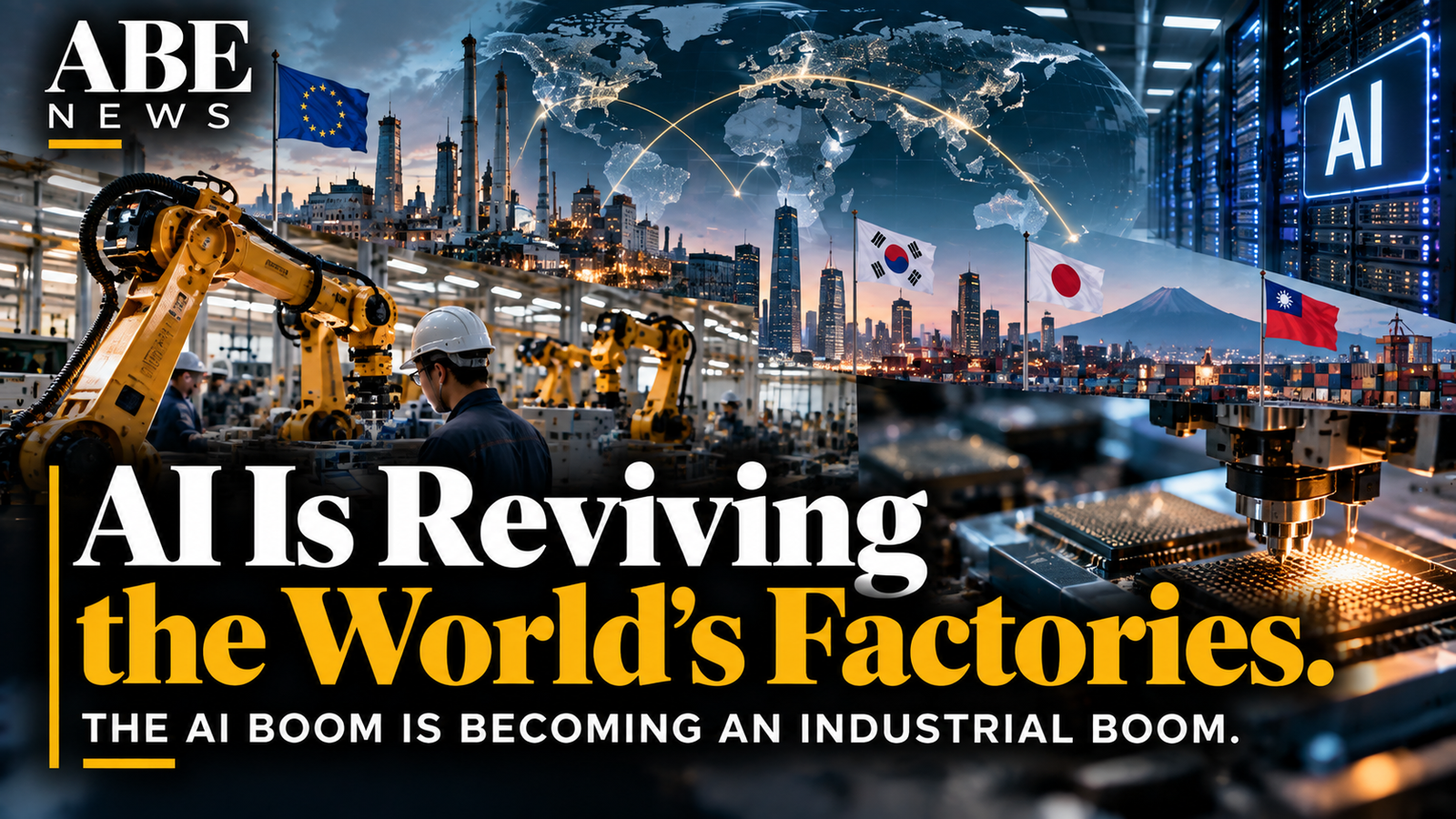
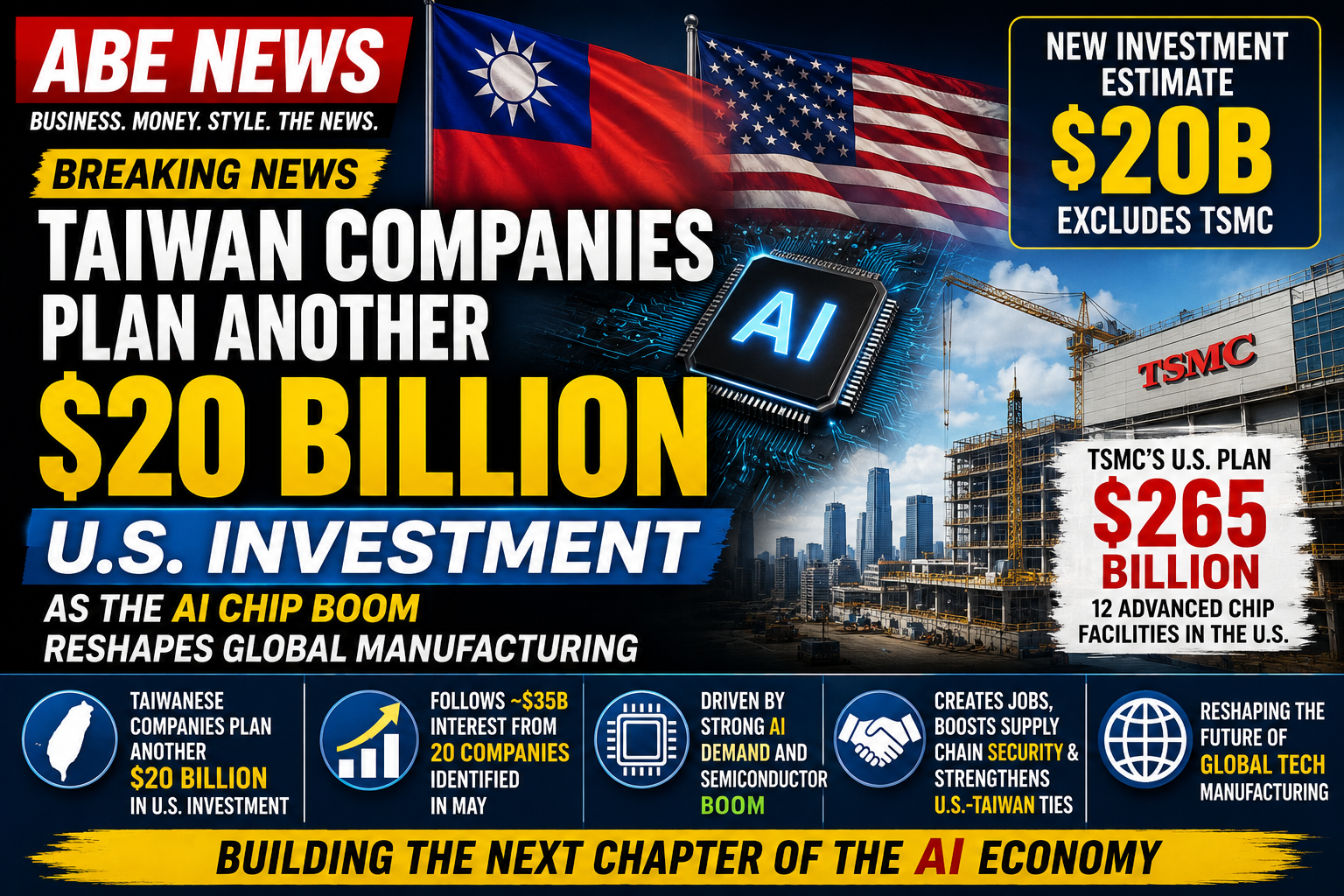
Taiwanese technology companies are preparing another $20 billion wave of investment into the United States, as exploding demand for artificial intelligence pushes one of the world’s most important technology supply chains deeper into American territory.
Taiwan Economy Minister Kung Ming-hsin announced the new investment estimate Wednesday at the SEMICON Taiwan trade show in Taipei, saying Taiwanese companies are investing “very actively” in the United States.
The driving force is increasingly obvious:
AI.
Demand for artificial-intelligence infrastructure, semiconductors and AI servers has become extraordinarily strong, encouraging Taiwanese manufacturers to expand closer to some of their largest American customers.
But the most important part of the announcement may be what the $20 billion figure does not include.
It excludes Taiwan Semiconductor Manufacturing Company — TSMC — the world’s dominant contract chip manufacturer, which already plans approximately $265 billion of investment in the United States.
The additional $20 billion therefore represents another layer of Taiwanese industrial expansion beyond the country’s most famous semiconductor company.
And it is becoming part of a much larger transformation.
The global semiconductor industry that helped make Taiwan indispensable to the technology economy is beginning to spread outward.
Factories.
Advanced packaging.
AI servers.
Electronics.
Materials.
Equipment.
Supply-chain companies.
All are increasingly being pulled toward the United States.
The result could reshape where some of the world’s most strategically important technology is manufactured.
ANOTHER $20 BILLION
The new figure emerged after Taiwan’s Ministry of Economic Affairs reassessed which Taiwanese companies — excluding TSMC — were considering further expansion in the United States.
The result:
approximately $20 billion in additional planned investment.
Kung did not identify every company responsible for the new amount.
But the broader investment pipeline has been developing for months.
In May, Taiwan’s Ministry of Economic Affairs said a preliminary survey conducted around the SelectUSA Investment Summit identified approximately 20 Taiwanese companies interested in investing around $35 billion in the United States.
Those companies were concentrated particularly in semiconductor and AI-server supply chains.
The ministry named companies including UMC, GlobalWafers, WIN Semiconductors, Foxconn, Quanta, Wistron and Compal among businesses associated with that earlier investment interest.
Now Taiwan has conducted another assessment.
And the potential investment has grown by another $20 billion.
That means this is not simply one giant semiconductor factory.
It represents something potentially more consequential:
an industrial ecosystem beginning to move with the AI boom.
AI ORDERS ARE DRIVING THE MONEY
Kung described demand for AI and semiconductor products as extremely strong.
That matters because AI requires far more than software.
Behind every chatbot, image generator, autonomous system and AI application sits enormous physical infrastructure.
Advanced processors.
Memory chips.
Servers.
Networking equipment.
Cooling systems.
Power equipment.
Data centres.
Semiconductor manufacturing tools.
Packaging facilities.
And thousands of components produced across complex global supply chains.
Taiwan occupies an extraordinary position inside that system.
The island is home not only to TSMC but also to a dense network of semiconductor, electronics and computer-hardware companies.
For decades, that industrial cluster helped Taiwan become one of the most important manufacturing centres in the technology economy.
Now the AI boom is encouraging portions of that ecosystem to expand overseas.
And the United States is becoming one of the biggest destinations.
TSMC’S $265 BILLION SHADOW
No discussion of Taiwanese investment in America can avoid TSMC.
The semiconductor giant already has enormous expansion plans in Arizona.
In July, TSMC announced another $100 billion of U.S. investment, bringing its total planned American commitment to approximately $265 billion.
According to the U.S. government, the expanded plan will ultimately involve 12 advanced semiconductor manufacturing and packaging facilities in the United States.
That is an extraordinary number.
TSMC’s expansion is designed to move more leading-edge semiconductor manufacturing onto American soil while serving enormous technology customers increasingly hungry for advanced chips.
But Wednesday’s announcement is significant precisely because it extends beyond TSMC.
If the world’s biggest chip manufacturer builds factories in Arizona while suppliers, server manufacturers and electronics companies also establish American operations, the United States begins gaining something much more valuable than individual factories.
It begins gaining a cluster.
WHY INDUSTRIAL CLUSTERS MATTER
The world’s strongest manufacturing centres rarely depend on a single company.
Silicon Valley isn’t powerful because of one technology company.
Detroit didn’t become synonymous with automobiles because of one automaker.
Taiwan didn’t dominate semiconductor manufacturing because of TSMC alone.
Industrial power develops when companies, suppliers, engineers, universities, logistics networks and specialized workers concentrate around one another.
A semiconductor factory requires chemicals.
Wafers.
Manufacturing equipment.
Precision components.
Maintenance companies.
Packaging.
Testing.
Engineers.
Electricity.
Water.
Transportation.
Software.
Security.
Once enough companies arrive, other companies have greater incentive to follow.
That creates a self-reinforcing industrial ecosystem.
This is why the additional $20 billion matters.
The United States isn’t simply trying to convince Taiwanese companies to build isolated factories.
Washington wants portions of the broader semiconductor and electronics ecosystem to establish permanent roots in America.
WASHINGTON HAS BEEN PUSHING FOR EXACTLY THIS
For years, U.S. policymakers have worried about America’s dependence on Asian semiconductor manufacturing.
The pandemic exposed how vulnerable global supply chains could become.
Chip shortages disrupted automobile production.
Electronics became harder to obtain.
Factories slowed.
Prices increased.
Then geopolitical tensions added another layer of concern.
Taiwan sits roughly 100 miles from China’s coast.
Beijing claims Taiwan as its territory and has not renounced the use of force to bring the island under its control.
The United States does not maintain formal diplomatic relations with Taiwan but remains its most important international supporter and arms supplier.
That makes the concentration of advanced semiconductor manufacturing on Taiwan both an economic advantage and a strategic vulnerability.
If a major conflict disrupted production on the island, the consequences could ripple through the global economy.
AI companies.
Automakers.
Smartphone manufacturers.
Cloud-computing companies.
Defence contractors.
Industrial manufacturers.
Almost every advanced economy would feel the impact.
Washington’s answer has been diversification.
Bring more semiconductor manufacturing home.
THE CHIPS ACT IS PART OF THE STRATEGY
The United States has spent years encouraging companies to manufacture semiconductors domestically through the CHIPS Act and other industrial policies.
Bill Frauenhofer, the U.S. Commerce Department official overseeing semiconductor investment and innovation, welcomed Taiwan’s new investment announcement Wednesday.
The U.S. government sees the projects as part of a strategy to create a semiconductor supply chain that is more secure, innovative and resilient.
That word — resilient — has become central to modern industrial policy.
For decades, globalization prioritized efficiency.
Companies manufactured products wherever costs were lowest.
Supply chains stretched across continents.
Businesses minimized inventory.
Manufacturing became highly specialized geographically.
The system produced enormous efficiencies.
But it also created dependencies.
Governments are now increasingly willing to sacrifice some efficiency in exchange for security.
AI HAS TURNED CHIPS INTO NATIONAL POWER
Semiconductors were already strategically important.
Artificial intelligence has made them even more important.
The countries and companies controlling advanced computing infrastructure increasingly influence how quickly AI systems can be developed and deployed.
Taiwanese President Lai Ching-te made that argument at SEMICON this week.
Advanced AI computing depends on semiconductors.
And semiconductors depend on complex international cooperation.
U.S. officials have made a similar argument.
Chips increasingly determine not just who manufactures smartphones or computers, but who leads in artificial intelligence, defence technology and the next generation of the global economy.
That changes the political meaning of a semiconductor factory.
It is no longer viewed merely as a commercial facility.
It becomes strategic infrastructure.
TAIWAN ISN’T ABANDONING TAIWAN
There is an important distinction here.
Taiwanese companies expanding overseas does not necessarily mean Taiwan is dismantling its domestic semiconductor industry.
Taipei continues to promote what it describes as a strategy of maintaining its foundation in Taiwan while expanding globally.
Taiwan remains home to an extraordinary concentration of semiconductor expertise, manufacturing capacity and engineering talent.
Recreating that ecosystem elsewhere will take years.
Possibly decades.
The investment strategy is therefore better understood as diversification rather than immediate replacement.
Taiwanese companies can maintain enormous operations at home while simultaneously building capacity closer to customers in the United States and Europe.
That provides businesses with geographic flexibility.
And governments with additional supply-chain resilience.
EUROPE WANTS A PIECE TOO
America isn’t the only economy trying to attract Taiwan’s technology companies.
Europe has been pursuing semiconductor investment as well.
TSMC is investing approximately €3.5 billion in a German semiconductor project — its first factory in Europe.
Taiwanese President Lai has called for deeper technology cooperation with European countries and urged governments to improve investment and taxation agreements.
That means a global competition is developing.
The United States wants Taiwanese semiconductor investment.
Europe wants Taiwanese semiconductor investment.
Japan wants advanced chip manufacturing.
Countries across Asia are expanding semiconductor ambitions.
The reason is simple.
Governments increasingly understand that the infrastructure powering the digital economy cannot be treated as an ordinary commodity.
AMERICA WANTS MANUFACTURING BACK
The Taiwan investment wave also fits into a broader transformation of American economic policy.
For decades, U.S. companies moved substantial manufacturing capacity overseas.
China became the world’s factory.
East Asia became central to electronics manufacturing.
America increasingly specialized in software, finance, intellectual property, design and high-value services.
That model produced enormous corporate profits.
But it also contributed to the decline of manufacturing employment in many American communities and increased dependence on overseas supply chains.
Washington is now attempting something difficult:
reindustrialization.
The goal is not to recreate every factory America once had.
Instead, policymakers are concentrating on industries considered strategically important.
Semiconductors.
AI infrastructure.
Energy.
Batteries.
Defence manufacturing.
Critical minerals.
Advanced technology.
Taiwanese investment fits almost perfectly into that strategy.
THERE IS A TRUMP CONTRADICTION
President Donald Trump has repeatedly criticized Taiwan’s semiconductor dominance.
He has accused Taiwan of taking semiconductor manufacturing away from the United States — an argument Taiwan’s government rejects as unfair.
Yet at the same time, the Trump administration has strongly encouraged Taiwanese companies to invest more in America.
That creates an interesting contradiction.
Washington criticizes the concentration of semiconductor manufacturing in Taiwan.
But America also needs Taiwanese companies because those companies possess manufacturing expertise that cannot simply be recreated overnight.
The practical solution is therefore partnership.
If American policymakers want more advanced chips manufactured domestically, convincing Taiwanese companies to build in America may be faster than attempting to construct an entirely new semiconductor ecosystem from scratch.
TAIWAN GAINS SOMETHING TOO
The relationship isn’t one-sided.
Taiwanese companies gain several advantages from expanding in America.
They move closer to major customers.
Companies including Nvidia, Apple, AMD, Microsoft, Google, Amazon and other American technology giants consume enormous quantities of advanced computing infrastructure.
Manufacturing closer to customers can improve supply-chain coordination.
American operations can also reduce geopolitical risk.
If companies operate facilities in several countries, disruption in one location doesn’t necessarily stop the entire business.
And there is a political benefit.
The more deeply Taiwanese technology companies become embedded in the American economy, the more economically intertwined Taiwan and the United States become.
That can strengthen an already important relationship.
BUT GLOBALIZATION ISN’T DISAPPEARING
There is a temptation to describe these investments as the end of globalization.
That would be too simplistic.
The semiconductor industry remains profoundly global.
A chip may be designed in the United States.
Manufactured using equipment from the Netherlands.
Produced by a Taiwanese company.
Using materials from Japan.
Packaged somewhere else in Asia.
Installed inside servers assembled by another manufacturer.
Then deployed inside an American data centre.
No single country controls every part of the chain.
What is changing is the geography.
Companies and governments increasingly want multiple manufacturing locations rather than dependence on one region.
The future may therefore be less about deglobalization and more about reconfigured globalization.
THE $20 BILLION IS ONLY PART OF THE STORY
Viewed alone, $20 billion is a major investment.
Viewed beside TSMC’s $265 billion U.S. commitment, it becomes part of something much larger.
And viewed beside the global AI infrastructure boom, the transformation becomes clearer still.
AI is creating enormous demand for physical capital.
Data centres.
Power generation.
Semiconductors.
Networking.
Cooling.
Servers.
Factories.
The digital revolution increasingly requires an industrial revolution underneath it.
That is why manufacturing investment is accelerating.
The AI economy may live in the cloud.
But the cloud has to be built somewhere.
🔴 THE ABE NEWS TAKE
Taiwan’s latest $20 billion U.S. investment wave tells us something important about artificial intelligence:
AI is no longer merely transforming software. It is beginning to redraw the industrial map of the world.
The first phase of the AI boom was dominated by models.
ChatGPT.
Gemini.
Claude.
Image generators.
AI assistants.
Investors focused on which company had the smartest system.
But underneath those systems is an increasingly enormous physical economy.
Chips must be manufactured.
Servers must be assembled.
Data centres must be constructed.
Power must be generated.
Cooling systems must be installed.
Supply chains must expand.
And the companies capable of building those systems are becoming strategically important.
Taiwan sits at the centre of that transformation.
Its semiconductor and electronics companies spent decades building one of the world’s most sophisticated manufacturing ecosystems.
Now pieces of that ecosystem are spreading outward.
TSMC’s planned $265 billion U.S. expansion is the giant everyone can see.
The additional $20 billion from other Taiwanese companies is interesting because it suggests the ecosystem may begin following the giant.
That is how industrial centres are created.
One factory attracts suppliers.
Suppliers attract workers.
Workers attract other companies.
Infrastructure improves.
Universities adapt.
Capital follows.
Eventually, what began as an investment becomes an ecosystem.
America is trying to make that happen in semiconductors and AI infrastructure.
Taiwan is helping build it.
And AI demand is providing the economic force pushing both sides together.
But there is another layer.
This isn’t purely about economics.
It is about national security.
Technology leadership.
China.
Supply-chain resilience.
And control over the infrastructure that will power the next generation of computing.
The world’s semiconductor map was once shaped primarily by economics.
Increasingly, it is being shaped by economics and geopolitics simultaneously.
That is why another $20 billion of Taiwanese investment matters.
The money isn’t simply moving.
The architecture of the global technology economy is moving with it.
ABE NEWS
Business. Money. Style. The News.
Understand More. Think Bigger.