





ABE NEWS | MONDAY, AUGUST 24, 2026
China has a problem.
The world’s second-largest economy is still growing, but one of the engines that helped power its extraordinary rise is moving in the wrong direction.
Investment is falling.
During the first seven months of 2026, China’s fixed-asset investment contracted 6.7%. Economic growth slowed from 5.0% in the first quarter to 4.3% in the second, its weakest quarterly pace in more than three years.
Beijing is now reaching for a very large financial lever.
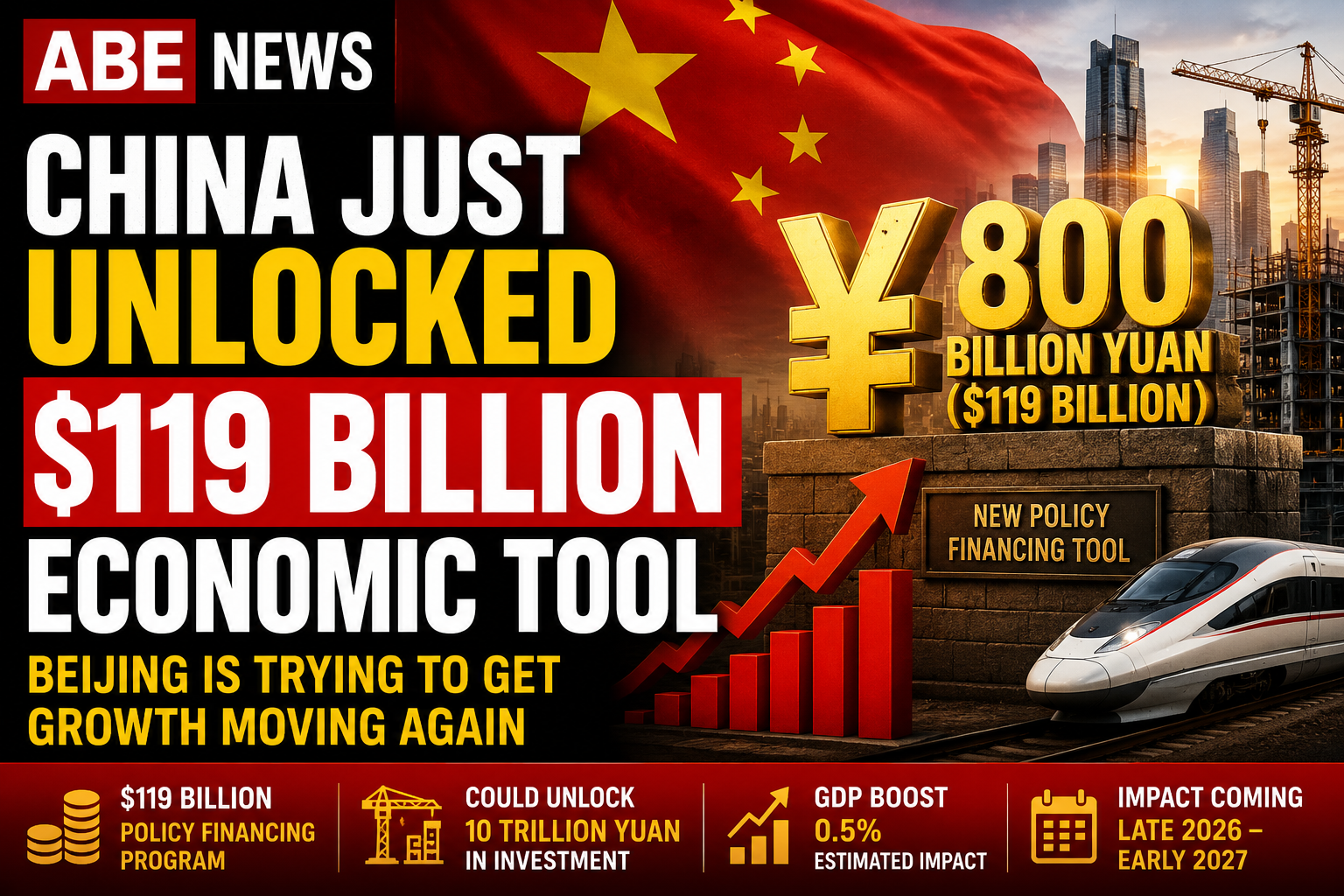
China has opened applications for an 800 billion yuan policy-financing program — approximately US$119 billion — designed to get infrastructure and strategic projects moving.
But the headline number only tells part of the story.
If the program works as intended, that $119 billion could help unlock far more investment from banks and other sources.
One estimate puts the potential total at roughly 10 trillion yuan.
That’s about US$1.5 trillion.
So China isn’t simply spending another $119 billion.
It is trying to use government-backed money as a catalyst to get a much larger part of its economy moving again.
Why China Is Doing This Now
For decades, investment played an enormous role in China’s economic expansion.
Roads.
Railways.
Factories.
Ports.
Power plants.
Housing.
Industrial parks.
Entire cities.
Investment helped transform China into the manufacturing powerhouse we know today.
But that model has increasingly run into limits.
Local governments accumulated large debts.
The property market weakened.
Some infrastructure produced poor returns.
Manufacturers expanded capacity faster than demand could absorb it, contributing to fierce price competition and deflationary pressure in some industries.
Beijing has consequently become more cautious about simply telling local governments to build more.
That creates a difficult balancing act.
China wants to reduce wasteful investment.
But it also needs enough productive investment to support jobs, demand and economic growth.
The latest numbers suggest that balance isn’t working particularly well.
Fixed-asset investment’s 6.7% contraction through July is exactly the kind of signal policymakers don’t want to ignore.
So Beijing is trying something more targeted.
This Isn’t Simply a $119 Billion Stimulus Cheque
The new program is what economists call a quasi-fiscal financing tool.
That sounds complicated.
The basic idea isn’t.
Instead of Beijing simply spending 800 billion yuan directly throughout the economy, the program provides capital to eligible projects that can then attract additional financing from banks and private investors.
Think of the government money as the first layer.
A project might already have planning approval and economic potential but lack enough initial capital to begin.
The policy tool helps fill that gap.
Once the initial capital is there, banks and other investors may be more willing to provide additional financing.
That creates leverage.
Government money → project capital → bank financing → construction → jobs and economic activity.
China expanded the program from 500 billion yuan in 2025 to 800 billion yuan this year.
And analysts think its reach could become much larger than the initial funding.
$119 Billion Could Potentially Support $1.5 Trillion of Projects
This is the eye-catching part.
Caitong Securities estimates that the 800 billion yuan program could theoretically support approximately 10 trillion yuan in total project investment, assuming leverage of around 13 times.
At current exchange rates, that’s roughly US$1.5 trillion.
But there’s an enormous difference between:
money that could eventually be supported
and
money actually entering the economy today.
Caitong estimates the direct investment boost during 2026 may be closer to 2 trillion yuan because of implementation delays and a shortage of suitable projects.
And that brings us to the biggest problem with Beijing’s plan.
China has money.
What it increasingly lacks are enough projects worth spending that money on.
China Doesn’t Want to Build Just for the Sake of Building
That is an important change.
During earlier periods of economic weakness, China’s response could involve massive infrastructure investment.
But eventually you run into diminishing returns.
The first high-speed rail line connecting major economic centres can transform productivity.
The twentieth marginal infrastructure project in a region that doesn’t really need it may simply create debt.
Chinese authorities have been tightening scrutiny of capital spending partly because of concerns about unproductive infrastructure, industrial overcapacity and destructive price competition among manufacturers.
That means local governments can’t simply submit anything and receive money.
Projects need to qualify.
The financing tool is primarily intended to provide capital for projects already being planned or that have preliminary approval—not invent an entirely new wave of construction demand from nothing.
That makes the policy more disciplined.
It also makes it harder to deploy quickly.
The $119 Billion Has Actually Been Sitting There
Here’s the surprising part.
This program wasn’t invented this morning.
Beijing announced the financing tool in March.
But it wasn’t used during the first half of 2026.
Why?
Economists cited by Reuters point to a shortage of eligible projects, restrictions related to local-government debt and initially less urgency for stimulus because China’s economy began the year relatively strongly.
Then the economy slowed.
First-quarter GDP growth came in at 5%.
Second-quarter growth dropped to 4.3%.
Investment weakened.
Now the urgency looks different.
Implementation guidelines have been sent to local authorities, which are compiling projects and submitting them to Beijing for approval.
In other words:
The money isn’t the announcement anymore.
The story now is that Beijing is finally trying to put the mechanism to work.
But It May Be Arriving Late
That’s the biggest criticism.
Caitong Securities estimates it could take at least another month to move from applications to actual fund disbursement.
We’re already in late August.
That leaves relatively little time for projects to receive financing, begin construction and meaningfully influence economic activity before 2026 ends.
That’s why the theoretical 10-trillion-yuan investment figure needs to be treated carefully.
China isn’t about to inject that entire amount into the economy tomorrow.
The actual near-term effect is expected to be much smaller.
Goldman Sachs estimates the program could add around 0.5 percentage point to GDP, with much of that effect concentrated in late 2026 and early 2027.
That would still be meaningful.
But it isn’t an instant rescue package.
Why China’s Slowdown Matters Outside China
It is easy to look at Chinese infrastructure spending and assume this is purely a domestic story.
It isn’t.
China is deeply integrated into the global economy.
When Chinese construction rises, demand can increase for commodities such as iron ore and copper.
When factories expand, they buy machinery and industrial equipment.
When Chinese consumers feel wealthier, global brands can benefit.
When Chinese growth weakens, exporters from Australia to Germany can feel it.
China is also a crucial market for energy producers, luxury companies, automakers and technology businesses.
So the question of whether Beijing can stabilize investment matters far beyond Shanghai or Shenzhen.
A stronger China can increase global demand.
A weaker China can export economic weakness.
And because China is one of the world’s largest manufacturing economies, domestic overcapacity can also affect competitors elsewhere through cheaper exports.
Beijing Is Trying to Avoid the Old Playbook
There is a deeper story behind this program.
China’s policymakers appear to understand that endlessly building infrastructure with borrowed money isn’t a sustainable long-term growth model.
That’s why this financing mechanism isn’t simply:
“Here is $119 billion. Go build.”
The emphasis is increasingly on projects that are already viable enough to qualify and can attract additional financing.
That reflects China’s broader economic challenge.
The country needs to move from growth driven heavily by:
property + infrastructure + debt
toward an economy with more:
technology + advanced manufacturing + services + productivity + household consumption.
That transition is difficult.
And while it happens, Beijing still needs enough traditional investment to prevent growth from slowing too sharply.
The $119 billion tool is therefore partly a bridge.
Not necessarily a return to China’s old economic model.
But an attempt to keep investment functioning while the economy changes underneath it.
The Real Question Is Whether Businesses Want to Invest
Government financing can solve one problem:
availability of money.
It cannot automatically solve another:
confidence.
A company borrows and invests when it expects future demand.
A bank lends when it believes the project can repay the money.
A local government builds when it believes the infrastructure will produce economic value.
If businesses are worried about weak demand, falling prices or excess capacity, cheap financing alone may not convince them to expand.
That’s why China’s economic challenge isn’t purely financial.
It’s psychological too.
Policymakers need businesses and consumers to believe tomorrow will be strong enough to justify spending money today.
That is harder to manufacture than credit.
🔴 THE ABE NEWS TAKE
The most important number in this story isn’t necessarily $119 billion.
It’s $1.5 trillion.
That’s roughly how much total project investment analysts believe the financing mechanism could theoretically support if the government capital successfully pulls in additional money.
But the word theoretically matters.
China’s challenge isn’t simply finding money.
It is finding enough productive places to put it.
That’s a very different problem from the one China faced during the early stages of its economic rise.
Back then, the country desperately needed infrastructure.
Today, it already has enormous amounts of it.
Building more can still create growth—but only if the projects make economic sense.
That is why this program tells us something important about modern China.
Beijing still has enormous financial firepower.
But policymakers are increasingly trying to use that firepower without recreating the debt, overcapacity and waste that previous investment booms helped produce.
If they succeed, the $119 billion could unlock a much larger wave of productive investment and help stabilize growth into 2027.
If they don’t, China could discover something every mature economy eventually learns:
Money can finance growth.
It cannot guarantee it.
And for the world’s second-largest economy, figuring out that difference may be one of the biggest economic challenges of the next decade.
ABE NEWS
Business. Money. Style. The News.
Understand More. Think Bigger.