




ABE NEWS | TUESDAY, AUGUST 25, 2026 | NEWS O’CLOCK
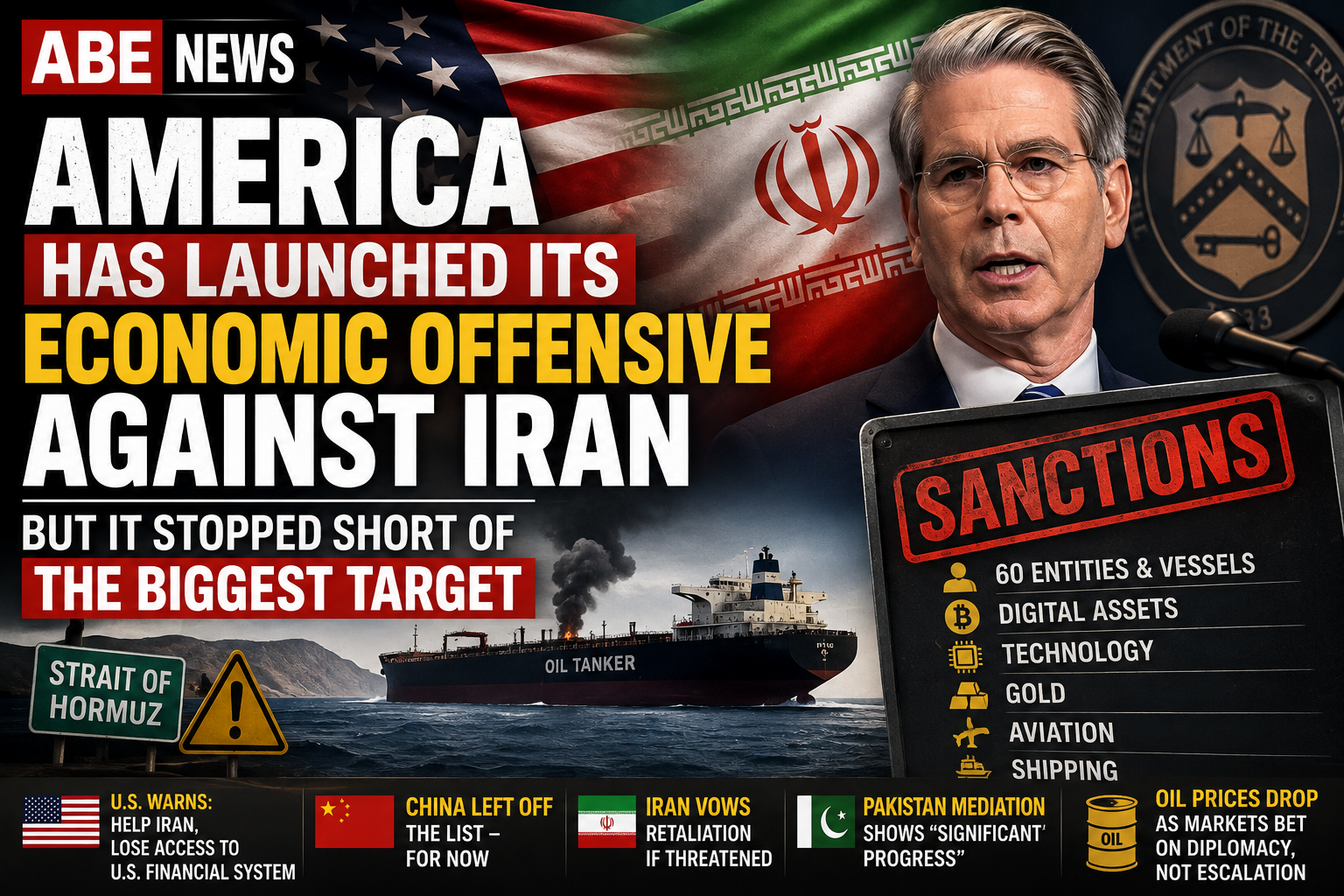
For days, Washington had been promising what Treasury Secretary Scott Bessent described as an “economic D-Day” against Iran. Now the first major pieces of that campaign have arrived, and they reveal an American strategy that is both aggressive and surprisingly cautious. The United States is expanding its economic pressure on Tehran, targeting nearly 60 Iran-linked individuals, entities and vessels while warning foreign governments and companies that continuing certain business relationships with Iran could eventually cost them access to the U.S. financial system.
But Washington did not immediately use the most powerful weapon it had threatened. The administration stopped short of imposing the harshest secondary sanctions on countries still trading with Iran, declined to say exactly when those penalties would begin, and left major Chinese financial institutions suspected of facilitating Iran’s oil trade off the new sanctions list. That restraint matters because China has been Iran’s largest oil customer for years, making Beijing potentially the most important outside player in Washington’s attempt to isolate Tehran economically.
The result is a sanctions campaign with two messages operating at the same time. To Iran, Washington is saying that the economic pressure is about to become much more painful. To Iran’s trading partners, it is saying that they have time to get out before the consequences become severe. And to China, the message appears even more carefully calibrated: America is threatening action without yet triggering the full confrontation that action could create.
That balancing act may determine whether Washington’s new strategy forces Iran back toward negotiations or pushes the conflict into an even larger economic confrontation.
Washington Is Going After More Than Iran’s Oil
Iran has lived under layers of American sanctions for decades, so simply adding another group of names to a sanctions list would not necessarily represent a major strategic change. What makes the latest announcement more important is the attempt to widen the range of economic activity that could eventually expose foreign companies, financial institutions and other entities to U.S. secondary sanctions.
The new framework expands the potential reach of sanctions into digital assets, technology, gold, aviation and shipping. Treasury also targeted networks it says are connected to Iranian oil sales, missile and nuclear procurement, cyber operations and financial activity. Five tankers identified as part of Iran’s so-called shadow fleet were designated as blocked property, while more than 20 of the new sanctions targeted people and entities accused of helping Iran obtain materials connected with nuclear research and missile development.
That expansion matters because Iran has spent years learning how to operate around conventional sanctions. When one company is sanctioned, another intermediary can emerge. When a tanker becomes unusable, ownership structures and registrations can change. When access to one financial channel disappears, payments can move through alternative institutions, commodities or digital assets. Washington’s latest strategy is therefore attempting to make the network surrounding Iran itself increasingly dangerous to participate in.
The objective is not simply to make it harder for Iran to sell something. It is to make banks, shipping companies, technology suppliers, commodity traders and governments around the world ask whether doing business with Tehran is worth potentially jeopardizing their relationship with the United States.
America’s Most Powerful Weapon May Be the Dollar
The reason Washington can make that threat credible has less to do with the size of Monday’s sanctions list than with the central role of the U.S. dollar in global finance. International banks depend heavily on dollar transactions, multinational businesses need access to American financial institutions, and governments and companies around the world hold enormous quantities of dollar-denominated assets. That gives the United States an unusual form of economic leverage: it can threaten companies that may not even be American with exclusion from a financial system they still need to conduct international business.
Secondary sanctions exploit precisely that leverage. Instead of merely telling an American company that it cannot do business with Iran, Washington can effectively tell a foreign company that it may have to choose between maintaining certain Iranian relationships and retaining access to the American financial system. For many international businesses, the U.S. market and dollar system are simply too important to risk.
Yet Bessent also acknowledged the danger of using that power too aggressively. When asked why Washington was not immediately imposing the harshest penalties, he responded by questioning why he would want to “blow up the global financial system.” The administration says foreign companies and governments will receive a period in which they can sever prohibited relationships before tougher consequences arrive.
That statement may be one of the most important things Bessent said. America’s financial power is enormous precisely because so much of the world participates in the system. But if Washington deploys that power too abruptly against large economies and major international banks, sanctions designed to hurt Iran could begin creating disruptions far beyond Iran.
And nowhere is that problem more obvious than with China.
China Is the Biggest Test Washington Hasn’t Taken Yet
China has been Iran’s biggest oil buyer for several years, although the renewed American blockade of Iranian ports has already reduced flows to Chinese customers. Beijing therefore occupies an uncomfortable position at the centre of Washington’s strategy: if the United States wants to seriously choke off Iran’s remaining economic lifelines, Chinese participation matters enormously.
Yet the latest sanctions did not include the major Chinese financial institutions suspected of facilitating Iran’s oil trade. Treasury did target some China-based businesses and other entities in places including Hong Kong, Singapore and the United Arab Emirates, but Washington stopped before taking the far more consequential step of sanctioning major Chinese banks.
Bessent insisted that this should not be interpreted as immunity. Asked specifically about Chinese banks, he said that no one was beyond the reach of U.S. sanctions and warned that institutions helping transform Iranian oil into usable money could eventually be targeted. But Washington has another calculation to make: President Donald Trump is expected to meet Chinese President Xi Jinping next month, and American officials are particularly sensitive to the possibility of Chinese retaliation involving critical minerals.
That means the United States is trying to pressure two countries without accidentally merging two separate confrontations into one. Sanctioning a small intermediary connected to Iran is one thing. Sanctioning a major Chinese financial institution could become a direct economic dispute between the world’s two largest economies.
China made its position clear Tuesday. Beijing said its cooperation with Iran is conducted within international law and should not be disrupted, while warning that it would protect Chinese interests.
So the most important sanctions decision may still be ahead of us. If Chinese institutions continue facilitating Iranian commerce after Washington’s compliance period expires, the United States may eventually have to decide whether its threat is worth enforcing against Beijing. Following through could provoke retaliation. Failing to follow through could weaken the credibility of the entire pressure campaign.
Iran Says It Is Ready to Resist
Tehran’s response has been defiant rather than conciliatory. Iranian Economy Minister Ali Madanizadeh said the country was prepared for the sanctions and argued that China, Russia and other governments would resist American pressure. He also suggested Iran’s response would not remain purely defensive, while an Islamic Revolutionary Guard Corps spokesperson threatened strikes against U.S. interests and energy chokepoints if Iranian infrastructure came under attack.
Those warnings matter because Iran still possesses something that gives it leverage over countries with no direct involvement in the conflict: its ability to disrupt shipping around the Strait of Hormuz. Before the war, more than 20 million barrels of oil moved through the strait each day, representing roughly one-fifth of global crude consumption. Provisional Vortexa data cited by Reuters showed flows at only about 5 million barrels per day on Monday, demonstrating how dramatically normal energy traffic has already been reduced.
The disruption is even more striking when measured by vessel traffic. Reuters reported that only two commodity vessels transited the strait on Monday, the lowest daily count since early May. Iran had already warned before the latest sanctions announcement that additional American economic pressure could produce further restrictions on Gulf oil exports.
This is Tehran’s counterweight to American financial power. Washington can threaten Iran’s access to money, but Iran can threaten the movement of energy through one of the most important shipping corridors on Earth. Neither side needs to completely execute its threat for the global economy to feel the consequences. The possibility alone changes shipping decisions, insurance costs, oil prices and business calculations.
A Tanker Attack Shows How Fragile Hormuz Remains
The danger became visible again Tuesday when an oil tanker was struck by an unidentified projectile near Oman at the entrance to the Strait of Hormuz. The attack disabled the vessel’s engine, although all crew members were reported safe and no environmental damage was reported. At the time of reporting, responsibility for the attack had not been established.
That last point is important. In an environment this tense, speculation can quickly become dangerous, and there is currently no basis for confidently assigning responsibility for the incident. What can be said is that another commercial vessel has been disabled near a shipping route that the global energy market desperately wants to see functioning normally again.
Every such incident increases uncertainty for shipping companies. Commercial vessels must consider whether a voyage is safe, insurers must calculate the probability of losing a ship or cargo, and energy traders must assess whether tomorrow’s supply will arrive as expected. Those decisions ultimately affect the price of moving oil around the world.
Yet markets produced a surprising reaction to Washington’s announcement.
Oil Fell Instead of Surging
Despite the dramatic language surrounding the sanctions, crude prices moved lower. West Texas Intermediate settled Monday at $85.01 a barrel, down 2.4%, while Brent fell to $92.17, ending a six-session winning streak.
At first, that appears contradictory. Tougher sanctions on an oil-producing country during a conflict around one of the world’s most important energy corridors would normally sound like a recipe for higher prices. But markets do not react only to what happened today; they constantly attempt to price what might happen tomorrow.
Some investors appear to believe that Washington’s decision to emphasize economic pressure rather than immediately escalate militarily could improve the chances of negotiations. The fact that the administration delayed the most punishing secondary sanctions also reduced the immediate risk of a sudden confrontation with China or other Iranian trading partners.
In other words, traders may be looking at the same sanctions and seeing two different possibilities. One is escalation: Iran retaliates, Hormuz becomes even more dangerous and global energy supplies tighten further. The other is leverage: economic pressure becomes severe enough that Tehran concludes returning to negotiations is preferable to continuing the confrontation.
That second possibility suddenly looks a little less theoretical because of what happened in Tehran this week.
Pakistan May Be Building a Diplomatic Exit
While Washington was unveiling its economic offensive, Pakistan was pursuing a different strategy. Army chief Field Marshal Asim Munir travelled to Tehran for talks aimed at preventing further escalation and helping reopen the Strait of Hormuz. Pakistan’s military later said the discussions had achieved “significant progress.”
An Iranian parliamentary official, Abbas Golroo, then said Munir had delivered a message from the United States and suggested its purpose was to revive the stalled political process. A Pakistani government source told Reuters that Iran had expressed a general willingness to resume peace talks and that Pakistan had conveyed that Washington could reverse sanctions before or during renewed negotiations. The White House and State Department had not confirmed that account at the time of Reuters’ reporting.
That qualification matters because we do not yet know exactly what Washington communicated through Pakistan. But the existence of active mediation changes how Monday’s sanctions should be interpreted. The United States may not be applying economic pressure simply to punish Iran; it may be trying to strengthen its negotiating position while leaving Tehran a path back to diplomacy.
Pressure and negotiation are not opposites in international politics. Governments frequently increase costs precisely because they want the other side to become more willing to bargain. If Iran believes its economic situation will deteriorate rapidly, negotiations become more attractive. If Tehran believes China, Russia and other partners can help it withstand the sanctions, it may decide that resistance is the better strategy.
That is the gamble now unfolding.
This Campaign Is Not Finished
Monday’s announcement should not be viewed as the complete American sanctions package. Bessent said another major sanctions announcement involving a financial institution could arrive by the end of this week, while also calling for foreign branches of Iran’s state-owned Bank Melli to be shut.
That means the next few days could tell us much more about how far Washington is prepared to go. If the next target is another Iranian institution, the campaign remains largely focused on squeezing Tehran. If it involves a major foreign financial institution accused of facilitating Iranian trade, the consequences become broader.
And if that institution is Chinese, the story changes dramatically.
At that point, what began as an attempt to isolate Iran could become another front in the much larger economic struggle between Washington and Beijing.
🔴 THE ABE NEWS TAKE
America’s new economic offensive against Iran is significant, but the most revealing part of Monday’s announcement may be the weapon Washington chose not to fire.
The United States expanded sanctions, targeted nearly 60 Iran-linked people, businesses and vessels, widened the categories of activity that could eventually trigger secondary sanctions and warned foreign companies that access to the dollar-based financial system could be at stake. Those are serious measures, and they create a much larger compliance problem for anyone still doing substantial business with Tehran.
But Washington simultaneously created space between the threat and the punishment. It gave foreign businesses time to adjust, declined to immediately impose the most severe secondary sanctions and avoided directly targeting the major Chinese financial institutions that could turn an Iran pressure campaign into a U.S.–China confrontation.
That looks less like hesitation than an attempt to manage several risks at once.
Washington wants Iran economically isolated, but it does not want to destabilize the global financial system. It wants China to reduce its support for Iranian trade, but it does not necessarily want a new confrontation with Beijing weeks before Trump and Xi are expected to meet. It wants to demonstrate that Tehran cannot simply wait out American pressure, while Pakistan appears to be quietly constructing a route back toward negotiations.
Iran faces its own version of the same calculation. It can continue resisting and use its remaining ability to threaten Gulf shipping as leverage, but doing so prolongs an economic crisis that has already severely disrupted its trade. Or it can test whether Washington is genuinely prepared to exchange sanctions relief for a negotiated settlement.
That is why this story is bigger than another sanctions list.
America has demonstrated the reach of its economic weapon, but it has not yet used it at full strength. Iran has demonstrated that it can still disrupt one of the world’s most important energy corridors, but doing so carries enormous risks of its own. And between them, diplomats are trying to find an exit before either side decides to test just how powerful those weapons really are.
The “economic D-Day” has arrived.
The decisive question is what happens after it.
ABE NEWS
Business. Money. Style. The News.
Understand More. Think Bigger.