



ABE NEWS | MONDAY, AUGUST 24, 2026
Alibaba just made one of the biggest financial bets of the artificial-intelligence boom.
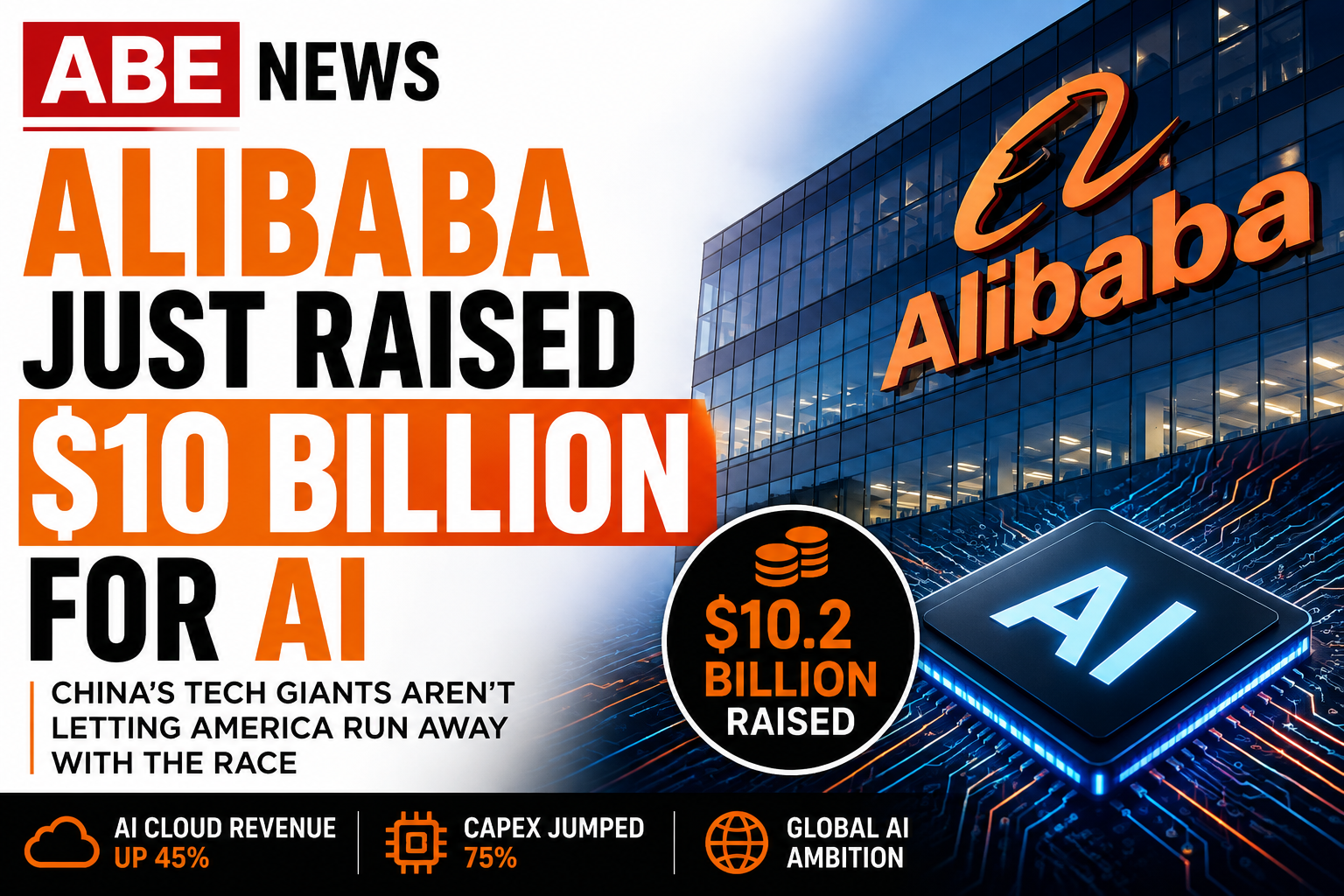
The Chinese technology giant is raising HK$80 billion — approximately US$10.2 billion — by selling 710 million new shares.
And Alibaba has already decided where essentially all of that money is going.
Artificial intelligence.
Not acquisitions.
Not dividends.
Not share buybacks.
Alibaba says 100% of the net proceeds will go toward its “full-stack AI capabilities,” including chips, computing infrastructure and AI-model development.
The scale of the transaction is extraordinary.
It is the largest-ever primary follow-on share offering by a Hong Kong-listed company and the third-largest globally this year, behind offerings from Alphabet and Intel.
But investors didn’t celebrate.
Alibaba’s Hong Kong shares plunged nearly 10% on Monday.
And that reaction reveals the bigger story.
The global AI race is entering a new phase.
Technology companies are no longer being judged simply on whether they have impressive AI models.
Investors increasingly want an answer to a much harder question:
When does all this AI spending start making enough money to justify itself?
Alibaba Is No Longer Just an E-Commerce Company
For much of the world, Alibaba is still associated primarily with online shopping.
That makes sense.
The company built one of the world’s largest digital commerce ecosystems.
But Alibaba increasingly wants investors to think about something else when they hear its name:
AI + Cloud.
Alibaba itself now describes the company as a global technology business focused on “AI + Cloud and commerce.”
And the numbers explain why.
In its latest quarter, Alibaba’s overall revenue rose about 9% to nearly 269 billion yuan, or roughly $40 billion.
But revenue from its AI cloud and computing services climbed 45% to 48.4 billion yuan, around $7.2 billion.
That’s a huge difference in growth.
Alibaba’s traditional e-commerce empire remains enormously important.
But AI is increasingly where the acceleration is happening.
That creates an obvious strategic calculation:
If AI becomes one of the defining technologies of the next decade, Alibaba doesn’t want to be a company that merely uses somebody else’s intelligence.
It wants to own the infrastructure.
The models.
The cloud.
The computing capacity.
And eventually, the applications businesses build on top of them.
$10 Billion Is Actually Only Part of the Bet
The new share sale sounds enormous.
But it is only one piece of Alibaba’s AI spending plans.
The company previously committed to investing 380 billion yuan — around $56 billion — over three years in cloud and AI infrastructure.
And Alibaba is already moving quickly through that money.
Its capital expenditure increased 75% in the latest quarter to approximately 67.7 billion yuan — around $10 billion. Much of that increase was connected to AI infrastructure and higher costs for computing components.
Alibaba says it has already spent nearly half of its three-year capital-expenditure plan.
That’s remarkable.
The company is effectively building the industrial infrastructure required for artificial intelligence before anyone can say with certainty how profitable that infrastructure will ultimately become.
And Alibaba isn’t alone.
That’s increasingly what the global technology industry is doing.
America Is Spending Enormous Amounts Too
Look across the Pacific and the same race is happening on an even larger scale.
American technology giants are pouring hundreds of billions of dollars into:
data centres,
AI accelerators,
networking equipment,
electricity,
cloud infrastructure,
and increasingly enormous AI models.
Microsoft, Amazon, Alphabet and Meta are all making huge infrastructure commitments.
That’s why Alibaba’s $10.2 billion fundraising matters beyond China.
This isn’t simply a Chinese company raising money.
It is another sign that the AI race is becoming a capital race.
Having clever engineers isn’t enough.
Having a powerful model isn’t enough.
If millions of businesses and consumers begin using increasingly sophisticated AI systems, somebody needs to provide the enormous computing infrastructure underneath them.
That requires chips.
Data centres.
Power.
Cooling.
Networks.
Cloud platforms.
And billions upon billions of dollars.
Alibaba Has Qwen
Alibaba also has something strategically important sitting on top of that infrastructure.
Qwen.
The company’s family of AI models has become one of China’s most important competitors in the global generative-AI market.
Alibaba is investing in increasingly capable Qwen models while connecting them with its enormous cloud-computing business.
That’s important because the model itself doesn’t necessarily have to be the entire business.
Think of the larger strategy:
A developer uses Qwen.
A company wants to deploy an AI application.
That application requires computing capacity.
Alibaba Cloud sells that computing capacity.
More applications mean more inference.
More inference means greater demand for cloud infrastructure.
That creates a potential flywheel:
Better AI → more users → more computing demand → more cloud revenue → more money for AI development.
Alibaba is betting that if it can establish that cycle early enough, today’s enormous capital expenditure could create tomorrow’s dominant infrastructure business.
The International Expansion Has Already Started
Alibaba isn’t limiting that strategy to mainland China.
Last week, Alibaba Cloud launched its third data centre in South Korea, bringing its network to 104 availability zones across 30 regions.
That matters.
The AI race isn’t simply about who builds the smartest chatbot.
It’s increasingly about who provides the computing layer underneath businesses around the world.
Amazon built an enormous business with AWS.
Microsoft has Azure.
Google has Google Cloud.
Alibaba wants Alibaba Cloud to occupy a major position in that same future—particularly across Asia and other international markets.
And AI gives the company an opportunity to reposition the business while cloud demand is being transformed.
So Why Did Alibaba’s Stock Collapse?
Because existing shareholders are paying part of the bill.
Alibaba priced the new shares at HK$112.70 each, an 8.4% discount to Friday’s closing price.
The newly issued shares increase the company’s share count by roughly 3.6%.
That means dilution.
If a company creates additional shares, each existing share represents a slightly smaller percentage of the company than before.
Investors can tolerate dilution when they believe the money raised will generate attractive future returns.
The problem is that markets are becoming increasingly nervous about precisely that assumption.
Alibaba’s Hong Kong shares fell as much as 10% Monday morning and remained down around 9% during afternoon trading.
Investors aren’t necessarily saying:
“AI is useless.”
They’re asking:
“How much are you going to spend before we see the return?”
And that’s a question facing far more than Alibaba.
Profit Has Already Taken a Hit
Alibaba’s latest earnings illustrate the cost.
Quarterly net profit fell approximately 75% from a year earlier, from 43.1 billion yuan to roughly 10.5 billion yuan.
Meanwhile, capital expenditure surged 75%.
That doesn’t automatically mean Alibaba’s strategy is failing.
Companies often sacrifice near-term profit when investing heavily in infrastructure expected to produce future growth.
Amazon famously spent years prioritizing expansion over immediate profitability.
Building cloud infrastructure is expensive.
Building AI infrastructure at global scale is extremely expensive.
But eventually investors need evidence that the spending produces returns.
Alibaba believes that evidence is beginning to appear.
The company says surging AI demand has allowed it to shorten its projected AI-investment payback period to around 2½ years, down from three years.
If that prediction proves accurate, today’s spending could look very different several years from now.
But predictions aren’t profits.
Execution matters.
This Is Also About China’s Technology Independence
There’s another layer that makes Alibaba’s strategy particularly important.
The global AI race isn’t happening in a normal geopolitical environment.
China and the United States are competing over advanced semiconductors, computing infrastructure and artificial intelligence.
Washington has imposed restrictions intended to limit China’s access to some advanced technologies.
That means Chinese companies cannot simply assume they’ll always have unrestricted access to the same hardware and technology available to American competitors.
Alibaba therefore has a strategic reason to develop as much of the AI stack as possible.
Models.
Cloud infrastructure.
Software.
Computing systems.
And potentially more domestic alternatives throughout the supply chain.
For China, artificial intelligence is becoming more than another profitable technology industry.
It is increasingly connected to economic competitiveness and technological sovereignty.
That raises the stakes dramatically.
The AI Race Is Becoming Expensive Enough to Reshape Companies
There was a period when much of the AI boom was about software.
Build a model.
Release a chatbot.
Add an AI assistant.
Watch users arrive.
The next phase looks much more industrial.
AI companies increasingly need the economics of infrastructure companies.
Huge upfront investment.
Long construction timelines.
Massive energy requirements.
Specialized hardware.
Enormous depreciation costs.
And constant pressure to build the next generation before the previous one has fully paid for itself.
That changes who can realistically compete.
A small startup may be able to invent an extraordinary model.
But building a global network of AI data centres requires another level of financial power entirely.
That’s one reason the largest technology companies may become even more important as AI matures.
They have something startups often don’t:
enormous balance sheets and businesses capable of financing the infrastructure race.
Alibaba’s $10.2 billion raise demonstrates exactly that.
But Bigger Spending Doesn’t Guarantee Victory
There is an obvious danger.
Companies can spend billions and still lose.
Technology history is full of enormous investments in products that never produced expected returns.
AI could become transformative while individual AI investments still turn out to be terrible businesses.
Those aren’t contradictory ideas.
Alibaba therefore has to prove several things.
Its models need to remain competitive.
Its cloud platform needs customers.
AI demand needs to continue growing.
Infrastructure needs to remain highly utilized.
Revenue needs eventually to outrun depreciation and operating costs.
And the company must navigate China’s economic slowdown, intense domestic competition and continuing geopolitical tensions.
That’s a lot of variables.
Which explains why investors aren’t simply cheering every billion dollars spent on AI anymore.
🔴 THE ABE NEWS TAKE
Alibaba’s $10.2 billion share sale isn’t really a story about fundraising.
It’s a story about how expensive the AI race is becoming.
For years, artificial intelligence was often discussed as a competition between researchers:
Who has the smartest model?
Who has the best benchmark?
Who can generate the most impressive image?
Increasingly, another question matters just as much:
Who can afford to build the infrastructure underneath all of it?
America’s technology giants have already demonstrated that they’re willing to spend enormous sums answering that question.
Alibaba just showed that China’s biggest technology companies aren’t planning to stand aside.
The company is putting billions into models, chips, cloud capacity and infrastructure while accepting lower near-term profits and dilution for existing shareholders.
Maybe that investment creates one of the world’s dominant AI platforms.
Maybe investors eventually decide the returns don’t justify the cost.
That’s precisely the tension markets are wrestling with now.
Because the first phase of the AI boom was about possibility.
The next phase is about economics.
And Alibaba has just placed another $10 billion bet that the economics will eventually work.
The global AI race isn’t slowing down.
It’s getting more expensive.
ABE NEWS
Business. Money. Style. The News.
Understand More. Think Bigger.