









ABE NEWS | August 29, 2026
India is preparing for what could become the biggest initial public offering in its history.
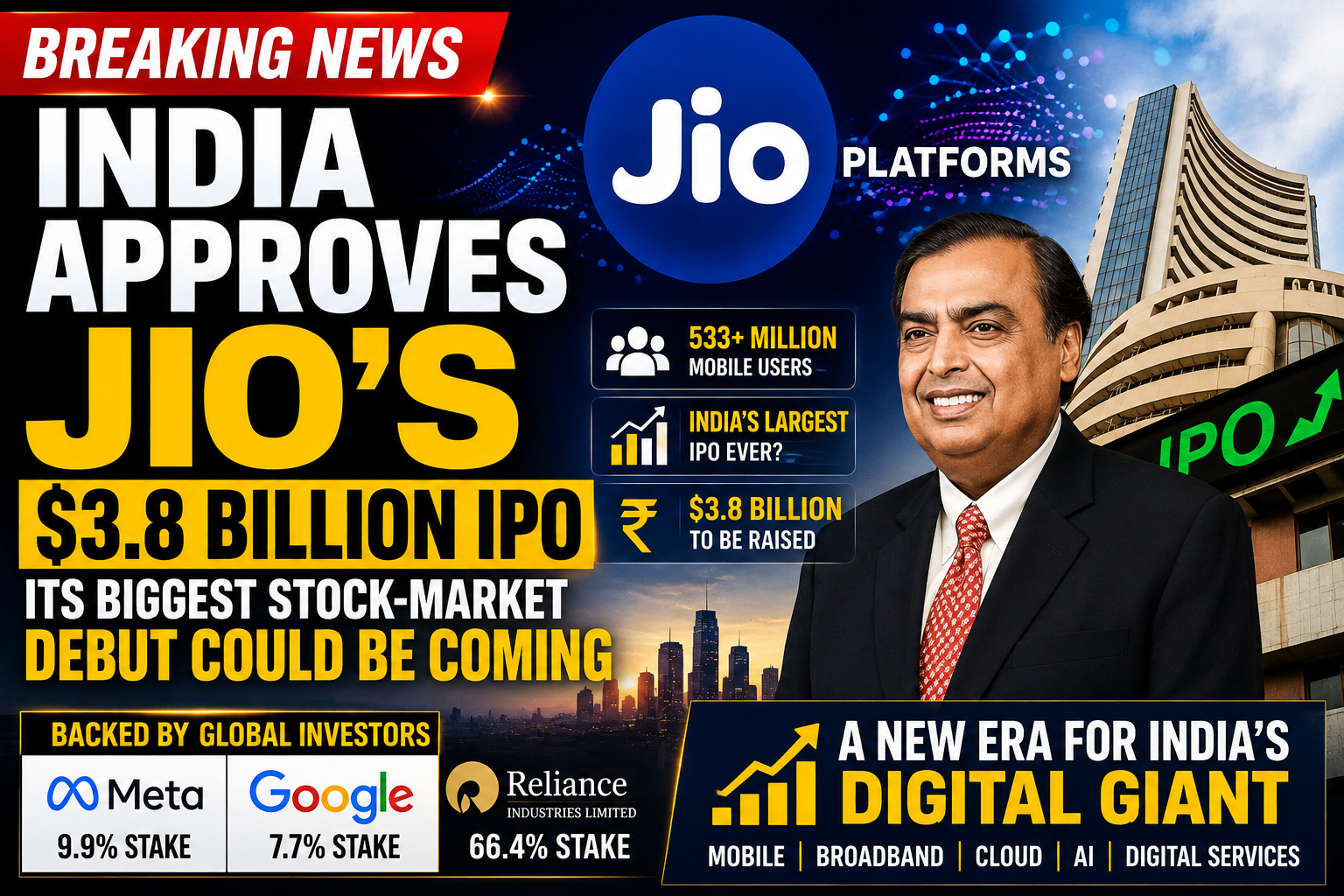
Jio Platforms, the digital empire controlled by billionaire Mukesh Ambani’s Reliance Industries, has received approval from India’s securities regulator for an IPO expected to raise approximately $3.8 billion.
The proposed offering would put one of India’s most important technology companies directly into the hands of public investors for the first time.
And the numbers behind Jio are enormous.
The company has more than 533 million mobile subscribers, making it the world’s second-largest mobile operator by subscribers.
It has expanded far beyond telecommunications into broadband, cloud computing, enterprise technology, digital services and artificial intelligence.
Meta and Google are already major shareholders.
Now ordinary and institutional investors could get their own opportunity to own part of the company.
If the IPO reaches its expected size, Jio would overtake Hyundai Motor India’s $2.95 billion 2024 offering and establish a new record for the Indian stock market.
But this isn’t simply another large IPO.
It represents something much bigger:
India’s attempt to turn one of its homegrown digital giants into a publicly traded technology champion.
A $3.8 Billion Market Debut
India’s Securities and Exchange Board has cleared Jio Platforms’ proposed public offering.
The company plans to issue approximately 270 million shares.
At the expected size, the offering would raise roughly $3.8 billion.
That would make it larger than any previous IPO in India.
The record currently belongs to Hyundai Motor India’s 2024 listing, which raised approximately $2.95 billion.
Crossing that mark would be symbolic for India’s capital markets.
For years, many of the world’s largest technology IPOs were associated with New York, Hong Kong or other major international financial centres.
A record Jio listing would demonstrate the growing capacity of India’s domestic markets to absorb enormous technology offerings of their own.
And Jio is not arriving on the market as a small startup promising future growth.
It is arriving with hundreds of millions of customers already connected to its ecosystem.
The Company That Changed India’s Internet Market
To understand why Jio’s IPO matters, you have to understand what happened when the company entered India’s telecommunications industry.
Reliance Jio launched commercial mobile services in 2016.
Its strategy was aggressive.
Jio offered extremely inexpensive data and initially provided services free to attract customers.
The result was one of the fastest transformations of a major telecommunications market anywhere in the world.
Data prices collapsed.
Internet consumption exploded.
Competitors were forced to respond.
Some companies merged.
Others disappeared.
And hundreds of millions of Indians gained cheaper access to mobile internet.
Jio didn’t simply capture customers.
It helped change how an entire country accessed the digital economy.
Today, more than 533 million subscribers use its mobile network.
That scale gives Jio something technology companies spend enormous amounts of money trying to obtain:
distribution.
Jio Is No Longer Just a Telecom Company
Calling Jio a mobile operator increasingly understates what Reliance is trying to build.
Jio Platforms sits at the centre of a much larger digital strategy.
The company has expanded into home broadband.
Cloud computing.
Enterprise services.
Digital entertainment.
Smart-home technology.
Artificial intelligence.
And other technology infrastructure.
Mukesh Ambani has outlined an ambition to make Jio part of virtually every layer of India’s digital transformation.
That includes connecting consumers.
Digitizing businesses.
Providing services inside Indian homes.
Building AI infrastructure.
And eventually taking Jio’s technology beyond India.
Ambani has described the company’s AI strategy with a simple ambition:
AI everywhere for everyone.
The IPO gives investors a chance to decide how valuable that vision actually is.
Meta and Google Already Made Their Bets
Some of the world’s largest technology companies made that decision years ago.
Meta owns approximately 9.9% of Jio Platforms.
Google owns roughly 7.7%.
Reliance Industries remains firmly in control with approximately 66.4%.
Those investments were strategically important.
India represents one of the largest internet markets on Earth.
For global technology companies, access to hundreds of millions of Indian consumers is extraordinarily valuable.
For Jio, partnerships with companies such as Meta and Google provided capital, technology relationships and global credibility.
The IPO now introduces another category of owner:
public-market investors.
And those investors will evaluate Jio differently.
They will examine revenue.
Margins.
Capital spending.
Subscriber growth.
Debt.
Competition.
AI investments.
And eventually profits returned to shareholders.
The company is moving from being primarily a strategic asset inside Reliance to becoming a business independently valued by the stock market.
Why Reliance Is Listing Jio
The IPO serves several purposes.
One is straightforward:
raise capital.
A large portion of the proceeds is expected to help repay approximately 275 billion rupees — around $3.3 billion — of debt at Reliance Jio Infocomm, Jio’s telecommunications operating business.
Reducing debt can strengthen the balance sheet and create more flexibility for future investment.
But there is another reason.
A separate listing allows investors to value Jio directly.
Reliance Industries is a massive conglomerate.
Its businesses span energy, petrochemicals, retail, telecommunications and technology.
That diversity can make valuation complicated.
An investor buying Reliance shares is buying exposure to many different businesses simultaneously.
Listing Jio changes that.
Investors who specifically want exposure to India’s digital economy will be able to buy Jio directly.
That could reveal just how much the market believes the digital business is worth independently.
A Huge Moment for Mukesh Ambani
For Mukesh Ambani, the IPO represents another major transformation of Reliance.
The company his father, Dhirubhai Ambani, built was historically associated with textiles, petrochemicals, refining and energy.
Mukesh Ambani pushed Reliance aggressively into consumer businesses.
Retail became one enormous pillar.
Digital technology became another.
Jio was the boldest expression of that strategy.
Building a nationwide telecommunications network required enormous capital.
Reliance spent heavily before Jio generated the scale it enjoys today.
That was a huge bet.
The IPO is effectively the market’s opportunity to place a price on the outcome.
Reliance has described the listing as evidence that India can build technology businesses with global scale, global capability and global value.
For Ambani, that message matters almost as much as the money being raised.
The Next Generation Is Moving Forward
There is also a succession story developing inside Reliance.
Mukesh Ambani has increasingly placed his children in leadership positions across the group’s major businesses.
Akash Ambani has become closely associated with Jio.
Isha Ambani has taken a prominent role in Reliance Retail.
Anant Ambani has responsibilities across other parts of the conglomerate.
Mukesh Ambani has said Isha, Akash and Anant are helping lead the Jio IPO process and will participate in the company’s next generation of value creation.
That means Jio’s listing is not simply a financial transaction.
It is happening during a gradual generational transition inside one of Asia’s most powerful business families.
The IPO therefore creates another test.
Can the next generation of Reliance leadership take businesses built under Mukesh Ambani and create another era of growth?
India’s IPO Market Is Booming
Jio is entering public markets at an important moment.
India is experiencing another surge in IPO activity.
More than two dozen companies have announced offerings since July 1 alone, nearly matching the number announced during the entire first half of 2026.
Investor appetite for new listings has remained strong.
That creates favourable conditions for a company with Jio’s size and brand recognition.
A successful record-breaking IPO could strengthen India’s reputation as one of the world’s most important capital markets.
It could also encourage other major privately held Indian businesses to pursue listings.
That matters because India’s economic growth is increasingly creating companies that require enormous amounts of capital.
Domestic public markets provide one way to finance that expansion without depending entirely on foreign exchanges or private investors.
Jio Could Become a Proxy for India’s Digital Economy
There is another reason global investors will watch the listing closely.
Jio offers exposure to several of India’s biggest economic trends at once.
India has more than 1.4 billion people.
Its middle class is expanding.
Internet penetration continues to grow.
Digital payments have exploded.
Businesses are moving online.
AI adoption is accelerating.
Cloud infrastructure is expanding.
And hundreds of millions of people increasingly use smartphones as their primary connection to commerce, entertainment, finance and information.
Jio sits across many of those trends.
That could make its shares something more than an investment in one telecommunications company.
Investors may treat Jio as a broad bet on India’s digital future.
But Scale Doesn’t Eliminate Risk
Jio’s enormous subscriber base is impressive.
It does not make the investment risk-free.
Telecommunications is capital intensive.
Networks constantly require upgrades.
Spectrum costs money.
Data consumption grows rapidly.
Customers demand faster connections.
Competitors fight aggressively over pricing.
And technological shifts can force companies to invest billions simply to remain competitive.
India also has powerful telecommunications competitors, including Bharti Airtel.
Jio therefore cannot simply rely on the disruption it created a decade ago.
It must continue finding ways to make more money from each customer.
That means selling additional services.
Broadband.
Entertainment.
Cloud products.
Business services.
AI.
And whatever comes next.
The next phase of Jio’s story is not primarily about acquiring another hundreds of millions of mobile subscribers.
It is about monetizing the enormous digital ecosystem it has already built.
AI Is Becoming Part of the Jio Story
Artificial intelligence is increasingly central to that strategy.
Reliance wants Jio to become a major player in India’s AI infrastructure.
The company has outlined plans spanning data centres, AI services and enterprise applications.
Reliance has also announced collaboration with Meta around AI-enabled data-centre infrastructure in Jamnagar.
India represents a potentially enormous AI market.
But much of today’s global AI infrastructure is concentrated among American and Chinese technology giants.
Reliance wants India to build more of its own capability.
Jio’s customer network gives it a powerful advantage.
If it can distribute AI products to hundreds of millions of consumers and millions of businesses, the company could become one of the primary gateways through which Indians access artificial intelligence.
That opportunity will almost certainly become part of the long-term investment case presented to shareholders.
One Number Investors Should Watch
The IPO will generate plenty of enormous figures.
$3.8 billion raised.
533 million subscribers.
Hundreds of millions of shares.
Billions invested in infrastructure.
But investors should watch something simpler:
How much value can Jio generate from each customer?
Subscriber scale built the empire.
Monetization will determine how valuable the empire becomes.
Can Jio increase revenue without losing price-sensitive customers?
Can it turn broadband users into digital-service customers?
Can it persuade Indian businesses to purchase cloud and AI products?
Can it expand internationally?
Can it convert enormous technological ambition into consistent profit?
Those questions will matter long after the excitement surrounding the IPO disappears.
What Happens Next
Regulatory approval clears one of the most important hurdles.
But Jio is not publicly traded yet.
The company must now move through the remaining steps of the offering process before shares begin trading.
Investors will scrutinize the final pricing.
Demand from institutional investors will be closely watched.
Retail participation will matter.
And the eventual valuation could influence the performance of Reliance Industries itself.
If demand is exceptionally strong, the IPO could reinforce investor confidence in India’s technology sector and capital markets.
If the valuation proves too aggressive, however, Jio could face the same problem confronting every highly anticipated IPO:
A famous company can still become an expensive stock.
The difference between the two is determined by price.
🔴 THE ABE NEWS TAKE
Jio’s IPO is bigger than the number written on the cheque.
Yes, $3.8 billion would make it India’s largest-ever public offering.
But records eventually get broken.
The more important story is what Jio represents.
Ten years ago, India had hundreds of millions of people who were still relatively disconnected from affordable high-speed mobile data.
Then Jio arrived.
Prices fell.
Consumption exploded.
Competition intensified.
And the internet became dramatically more accessible to ordinary Indians.
Now the company responsible for much of that disruption is entering its next phase.
Jio no longer wants simply to connect India.
It wants to become part of the infrastructure through which India watches television, runs businesses, stores data, uses artificial intelligence and participates in the global digital economy.
That is a much larger ambition.
And public investors are about to get the opportunity to place a price on it.
There is also something important here for the wider business world.
The next generation of global technology giants does not have to come exclusively from Silicon Valley.
India has the population.
It has engineering talent.
It has entrepreneurs.
It has rapidly developing capital markets.
And increasingly, it has companies operating at global scale.
Jio’s IPO will not prove that India has won the technology race.
But if a homegrown Indian digital company can attract billions of dollars from investors while serving more than half a billion subscribers, the direction of travel is becoming difficult to ignore.
The world’s technology map is getting bigger.
And India’s name is becoming much harder to overlook.
ABE NEWS
Business. Money. Style. The News.
Understand More. Think Bigger.