







ABE NEWS | MONDAY, AUGUST 17, 2026
The weekend was supposed to help.
Canadian negotiators stayed in Washington.
Meetings continued.
Officials kept talking.
Sunday came.
Another meeting happened.
And now it’s Monday morning.
There is still no deal.
That matters because Canada and the United States are no longer negotiating against some distant deadline.
They’re negotiating against Wednesday.
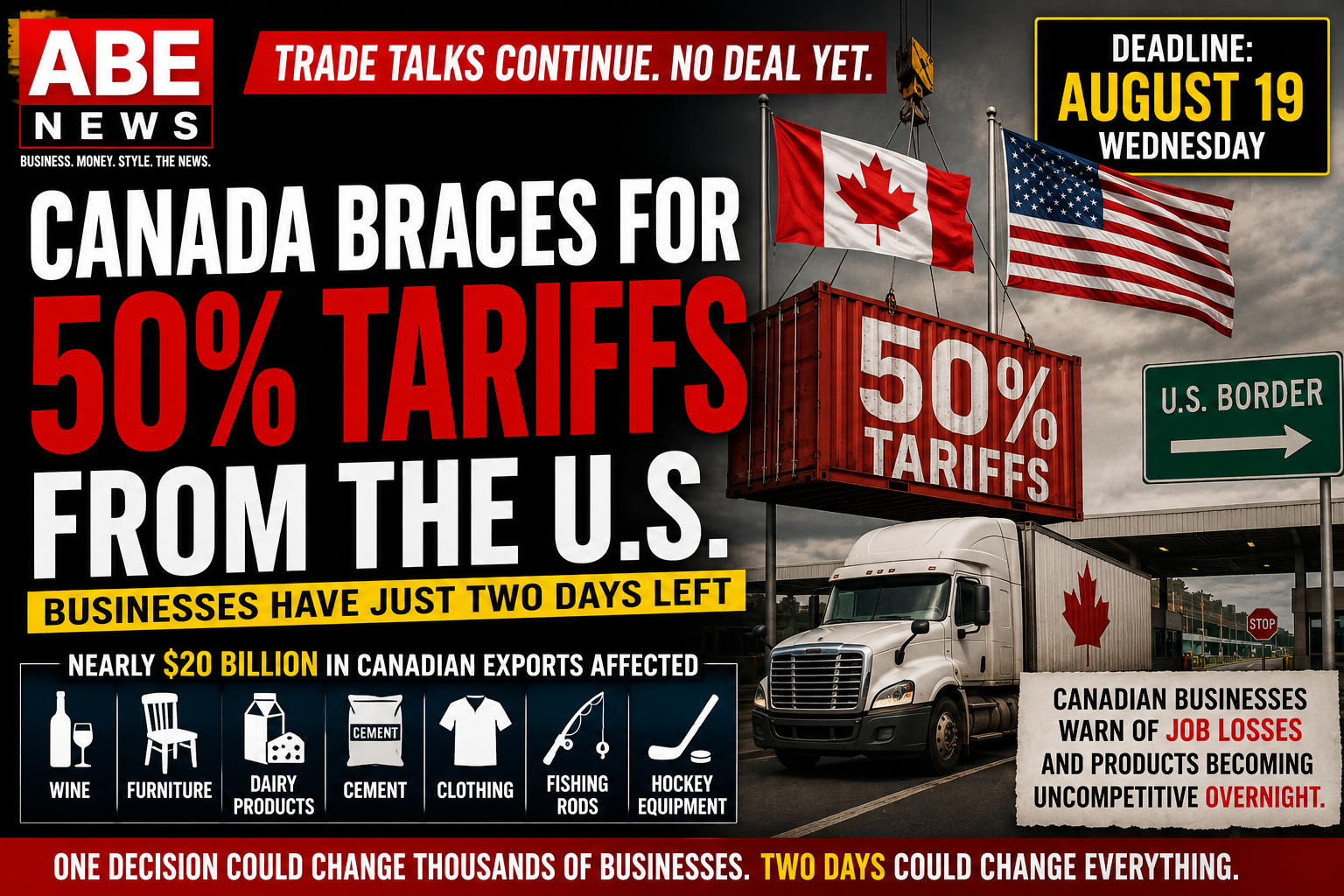
On August 19, the United States is scheduled to impose 50% tariffs on nearly $20 billion worth of Canadian goods.
Wine.
Furniture.
Dairy products.
Cement.
Clothing.
Fishing rods.
Hockey equipment.
And other Canadian products.
For some businesses, Wednesday could completely change the economics of selling into America’s enormous market.
And suddenly, what looked like another political trade dispute has become something much more immediate:
A two-day business countdown.
🇨🇦 Canada Stayed in Washington Through the Weekend
Canada didn’t simply walk away from negotiations Friday.
Dominic LeBlanc, the Canadian minister responsible for U.S. trade relations, and chief trade negotiator Janice Charette remained in Washington while negotiations continued.
LeBlanc has now met U.S. Trade Representative Jamieson Greer five times in four weeks, including a virtual meeting on Sunday.
That’s a lot of talking.
But frequency isn’t the same thing as agreement.
On Friday, LeBlanc told an advisory committee that Canada and the United States remained far apart on a draft deal.
Technical negotiations have continued.
Political negotiations have continued.
The weekend negotiations continued.
But as Monday begins:
The tariff deadline is still standing.
What Exactly Happens Wednesday?
President Donald Trump invoked Section 338 of the Tariff Act of 1930 to impose duties of up to 50% against Canadian products.
It’s an extraordinary provision.
Section 338 allows the U.S. president to impose punitive tariffs against countries determined to discriminate against American commerce.
The provision dates back to the same era associated with America’s infamous Depression-era tariff policies.
And now, almost a century later, it is at the centre of one of the world’s biggest trading relationships.
The new tariffs would cover nearly $20 billion of Canadian goods.
That’s roughly 5.2% of the $383 billion in goods the United States imported from Canada in 2025.
Five percent might not sound enormous.
But national percentages can hide enormous pain inside individual industries.
And that’s where this story becomes much more serious.
🪵 A 50% Tariff Can Change a Business Overnight
Imagine you’re a Canadian manufacturer.
You’ve spent years selling products to American customers.
You built relationships.
Hired workers.
Bought equipment.
Signed contracts.
Created a supply chain.
Then one morning your product effectively becomes dramatically more expensive to import into the United States.
What do you do?
Cut your price?
Accept smaller profits?
Ask the American customer to pay more?
Move production?
Find another country to sell to?
Lay off workers?
Those aren’t theoretical questions anymore.
They’re decisions Canadian businesses may soon have to make.
Alain Ouzilleau, owner of Canadian custom kitchen-cabinet company Cabico, told Reuters that a 50% tariff isn’t something manufacturers or their U.S. customers can reasonably absorb.
His warning was particularly striking:
Some Canadian products could become economically uncompetitive in the American market virtually overnight.
That’s what a 50% tariff can do.
It doesn’t merely make trade more expensive.
It can change whether the trade makes financial sense at all.
👷 And Then Come the Jobs
Businesses don’t exist separately from workers.
If an exporter loses American customers, revenue falls.
If revenue falls enough, companies cut costs.
Investment can be delayed.
Expansion can stop.
Production can fall.
And eventually:
Jobs can disappear.
Canada’s wood-products industry is already struggling.
Its wine industry is also dealing with the effects of severe wildfires in western Canada.
Now both could face another shock from the tariffs.
Small and medium-sized businesses may be particularly exposed because many don’t have dozens of international markets available to replace U.S. customers.
Some built their entire business model around predictable access to the American market.
Change that assumption and you change the business.
🇺🇸 But American Companies Aren’t Completely Protected Either
Tariffs are charged on imports.
That doesn’t mean only foreign businesses feel them.
Suppose an American company relies on Canadian materials or products.
Wednesday arrives.
Those imports suddenly face a massive tariff.
The American business now has choices too.
Pay the additional cost.
Negotiate a lower price from its Canadian supplier.
Raise prices for customers.
Find another supplier.
Or change what it sells.
Dan Kelly, president of the Canadian Federation of Independent Business, warned that the measures could create major disruption not only for Canadian small businesses dependent on U.S. clients, but also for American buyers dependent on Canadian suppliers.
That’s the part tariff debates often miss.
Modern economies aren’t isolated boxes.
They’re supply chains.
And Canada and the United States have spent decades connecting theirs.
🚨 This Round Is Different
There’s another reason businesses are paying attention.
USMCA won’t necessarily save them this time.
Many earlier U.S. tariffs provided exemptions for Canadian goods qualifying under the United States-Mexico-Canada Agreement.
That allowed a huge amount of Canada-U.S. trade to continue under preferential rules.
These new duties are different.
They are set to apply even to products that qualify for preferential treatment under USMCA.
That’s significant.
Because businesses that thought:
“We’re USMCA compliant, so we’re protected.”
may now have to rethink that assumption.
And once companies stop believing trade rules are predictable, something else happens.
They become cautious.
💰 Uncertainty Has a Price Too
Imagine you’re considering building a new factory in Canada.
It will cost $200 million.
Most of its products will eventually be sold in the United States.
Do you build it?
Maybe.
But first you’d probably ask:
What will the tariff be next year?
And the year after?
Will USMCA still protect us?
Could another tariff appear?
Could the rules change again?
If nobody can give you a confident answer, you might delay the investment.
That matters because uncertainty itself can damage an economy.
A tariff affects today’s trade.
Uncertainty can affect tomorrow’s investment.
And Reuters reports that prolonged trade uncertainty has already weighed on Canadian investment and job growth.
🥛 So What’s Holding Up the Deal?
One of the biggest disagreements involves something Canada has fought about with the United States for years:
Dairy.
Washington has pushed Canada over its dairy system and how access to the Canadian market is allocated.
Another dispute involves American alcohol.
Several Canadian provinces removed U.S. alcoholic products from stores during the broader trade fight.
Washington wants those issues addressed.
Ted McKinney, CEO of the U.S. National Association of State Departments of Agriculture, described dairy as potentially the major agricultural issue in the negotiations.
Canada, meanwhile, wants relief from U.S. tariffs affecting Canadian industries.
So both sides want concessions.
The problem is deciding:
Who gives up what?
🤝 Didn’t Both Countries Want a Deal?
Yes.
And that’s what makes this particularly interesting.
Last week, a Canadian government source familiar with the negotiations said Washington also wanted an agreement before August 19.
At that point, the source described negotiations as progressing relatively well.
Then Friday brought a much less optimistic assessment.
Canada and the United States remained far apart on important issues.
And after weekend negotiations?
We still don’t have an announced agreement.
That doesn’t mean a deal is impossible.
Trade negotiations can move extremely quickly when deadlines approach.
But the clock has become part of the negotiation now.
⏰ MONDAY
Businesses prepare.
Negotiators talk.
Markets watch.
⏰ TUESDAY
Potentially the final full negotiating day.
Pressure increases.
Businesses need to know what Wednesday looks like.
⏰ WEDNESDAY — AUGUST 19
Unless something changes:
The tariffs begin.
That’s why the next 48 hours matter much more than the previous two weeks.
🌎 But the Bigger Story Is USMCA
The $20 billion tariff package matters.
But there’s something potentially much larger underneath it.
The future of North American trade.
Canada, the United States and Mexico built an enormous integrated economic system under NAFTA and then USMCA.
Cars can contain components from multiple countries.
Canadian resources feed American factories.
American companies sell extensively into Canada.
Agricultural products move across borders.
Energy moves across borders.
Billions of dollars move across borders.
And companies have made decades of investment decisions based partly on those rules.
The current tariff fight raises a much bigger question:
How predictable will those rules remain?
Because businesses can survive expensive rules.
What they hate is rules they can’t predict.
🔴 THE ABE NEWS TAKE
Fifty percent sounds like a trade statistic.
It isn’t.
It’s a business decision waiting to happen.
If Wednesday arrives without a deal, executives across Canada won’t simply look at a tariff chart and complain.
They’ll start calculating.
Can we still make money selling this product in America?
If the answer is yes, business continues.
If the answer is no?
Something changes.
Maybe the price.
Maybe the supplier.
Maybe the factory.
Maybe the investment.
Maybe the employee.
That’s why tariffs can move through an economy much further than the border where they’re collected.
And there’s an even bigger lesson here.
Canada and the United States spent decades building one of the world’s deepest trading relationships.
Businesses organized themselves around the assumption that the border would remain economically predictable.
Now that assumption is being tested.
The weekend didn’t produce the breakthrough Canada wanted.
Wednesday is getting closer.
So forget the political speeches for a moment.
Watch what businesses do next.
Because if the tariffs arrive, the most important number won’t simply be 50%.
It will be:
How many companies decide the old way of doing business no longer makes sense?
ABE NEWS
Business. Money. Style. The News.
Understand More. Think Bigger.