








ABE NEWS | TUESDAY, AUGUST 25, 2026
Canada has officially answered Washington’s latest tariffs, and the response marks another serious deterioration in one of the world’s largest and most deeply integrated trading relationships.
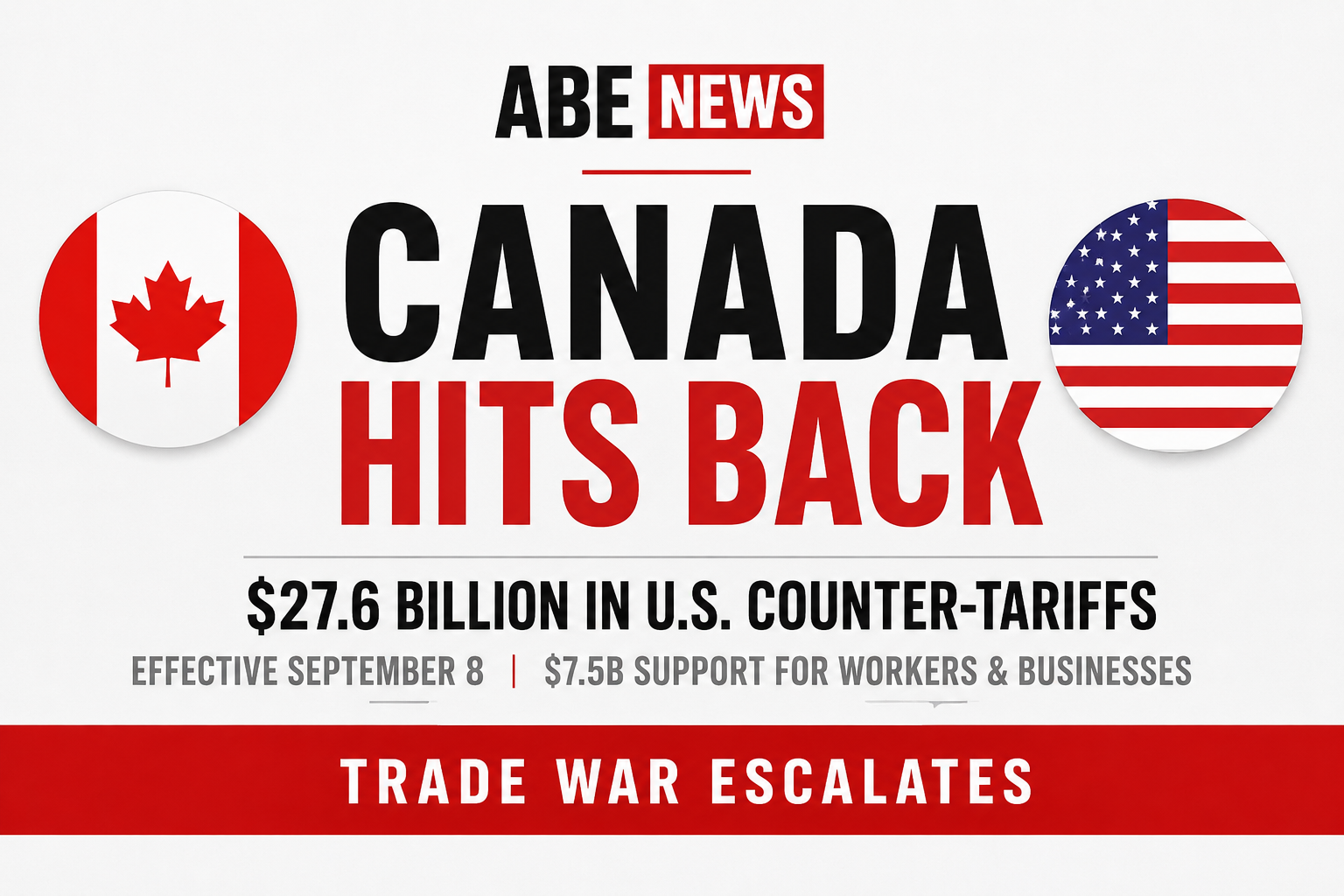
The federal government announced Tuesday that it will impose new retaliatory tariffs on C$27.6 billion worth of goods imported from the United States, matching the latest American tariffs dollar for dollar and rate for rate. Beginning September 8, hundreds of categories of American products entering Canada will face additional tariffs of 15%, 25% or 50%, depending on the product. Ottawa is also launching a C$7.5 billion support package for Canadian workers and businesses caught in the expanding trade confrontation.
This is no longer a trade dispute built primarily around threats and negotiations. The United States has imposed its latest duties, Canada has now announced its retaliation, businesses on both sides of the border are facing higher costs, and the two governments have failed to reach an agreement that could have prevented the escalation.
For decades, Canada and the United States built an economic relationship around the idea that their industries could operate across the border with relatively predictable access to each other’s markets. The latest measures are pushing that system in the opposite direction, and the longer the confrontation continues, the more businesses may have to reconsider supply chains, investment decisions and even where they manufacture their products.
Canada Is Matching Washington Dollar for Dollar
Ottawa’s approach is deliberately designed to mirror the American measures. The Canadian government says the United States imposed 50% tariffs on C$27.6 billion of Canadian goods effective August 22, after negotiations between the two countries failed. Canada will now apply tariffs to the same dollar value of American imports, with individual rates designed to correspond to the U.S. rates imposed on Canadian products.
The Canadian counter-tariffs will take effect at 12:01 a.m. on September 8 and will cover approximately 700 product categories, according to Reuters. The measures will target a broad range of goods, including steel, aluminum, furniture, clothing, dairy products, appliances, seafood, electronics and tools.
Some of the toughest measures will fall on metals. American steel and aluminum products that were already subject to Canadian tariffs of 25% will see those duties rise to 50%. Furniture and clothing will also face 50% tariffs in some categories, while products including appliances, cheese and certain seafood will face 25% duties. Other products, including some electronics and tools, will be subject to 15% tariffs.
Canada says the countermeasures have been designed to protect domestic producers that are being hurt by American tariffs while minimizing the damage to Canadian consumers and businesses. That will not be easy. Retaliatory tariffs may put pressure on American exporters, but Canadian importers still have to pay the duties when affected U.S. products cross the border. If alternative suppliers cannot be found quickly, some of those additional costs can eventually reach Canadian businesses and households.
That is one of the fundamental problems with tariff wars: governments may target each other, but businesses and consumers often end up somewhere in the middle.
Why Canada Walked Away From the Negotiations
The retaliation comes after intensive negotiations between Ottawa and Washington failed to produce an agreement. Canada’s Department of Finance says the United States presented new terms that Ottawa believed asked too much of Canada while offering too little in return. The Canadian government says accepting those terms would have harmed Canadian workers, businesses and strategic industries, so it suspended negotiations rather than accept the proposed deal.
That decision was followed by a rapid escalation from Washington. The latest U.S. tariffs took effect Saturday, and President Donald Trump has separately threatened to increase tariffs on Canadian-made cars, trucks and automotive parts to 50% beginning January 1, 2027.
The automotive threat is particularly important because Canada’s auto industry is deeply integrated with American manufacturing. Vehicles and components routinely move across the border as part of production systems that have developed over decades. A Canadian component can enter an American factory, while American materials can simultaneously be incorporated into vehicles assembled in Ontario.
That means the economic confrontation cannot easily be separated into a Canadian side and an American side. Increasing the cost of Canadian components can also increase the cost of manufacturing American products that depend on those components.
And that same problem extends beyond automobiles.
The Tariff List Is Designed to Put Pressure on American Businesses
Canada’s retaliation is not simply about collecting additional government revenue. The objective is to create economic pressure inside the United States while protecting Canadian companies competing against American imports.
Consider steel. If Canadian steel producers face a 50% tariff when selling into the United States while American steel can enter Canada much more cheaply, Canadian producers could find themselves disadvantaged in their own domestic market. Ottawa’s decision to impose a matching 50% tariff on certain American steel products is intended to reduce that imbalance.
The same logic applies to other industries. Higher tariffs on American furniture, clothing, appliances and agricultural products can make competing Canadian goods relatively more attractive inside Canada. Ottawa says that protecting domestic market share for affected Canadian producers is one of the primary objectives of the countermeasures.
But there is an unavoidable trade-off. Canadian companies that rely on American inputs may suddenly find those inputs more expensive. Retailers importing American products could face higher costs, while consumers may eventually encounter higher prices if businesses cannot absorb the tariffs or switch suppliers.
Ottawa is attempting to manage that risk through exemptions and its existing tariff-remission framework, which allows businesses to seek exceptional relief in certain circumstances. Goods already in transit when the new tariffs take effect will also be exempt from the new countermeasures.
Still, managing a tariff war without creating domestic economic pain is extraordinarily difficult.
Ottawa Is Putting $7.5 Billion Behind Its Response
Canada’s announcement goes beyond tariffs. The federal government also unveiled C$7.5 billion in new and expanded financial support for businesses and workers affected by the confrontation, adding to nearly C$25 billion in support measures that Ottawa says it has provided since the broader U.S. tariff campaign began.
The package includes an additional C$1.5 billion through the Regional Tariff Response Initiative to support small and medium-sized businesses, including companies facing liquidity problems. Another C$500 million will be made available through the Business Development Bank of Canada’s Pivot to Grow program to help businesses dealing with immediate cash-flow pressures.
Ottawa is also putting an additional C$2 billion into the Canada Strong Diversification Fund, intended to help tariff-affected companies finance investment projects and become more resilient to trade disruption. The largest component is C$3.5 billion in rapid-response support for workers and employers, including temporary Employment Insurance flexibilities, workplace training, Job Bank improvements and a new worker-retention and retraining program.
Those measures reveal something important about how seriously Ottawa is treating the confrontation. Governments generally do not create multibillion-dollar worker and business support programs if they expect a dispute to disappear within a few days.
Canada appears to be preparing for the possibility that the trade conflict could last.
The Bigger Strategy Is Diversification
There is another word appearing increasingly often in Canada’s response: diversification.
For decades, Canada’s geography made the economic strategy obvious. The world’s largest consumer economy sits directly beside it, the two countries share one of the world’s longest borders, and enormous infrastructure networks already connect Canadian businesses to American customers.
That relationship produced tremendous benefits. It also created dependence.
When the United States changes the rules, Canada has limited ability to insulate itself quickly because such a large share of Canadian trade has historically flowed south.
Ottawa’s new Canada Strong Diversification Fund reflects an attempt to change that calculation over time. Canadian businesses are being encouraged to develop new customers, strengthen domestic supply chains and reduce their vulnerability to sudden changes in U.S. trade policy.
That does not mean Canada can simply replace the American market. The scale, proximity and integration of the United States make that unrealistic in the short term. But the current confrontation is strengthening the argument that Canada needs more economic relationships outside North America so that one political decision in Washington cannot create such widespread uncertainty at home.
If this trade conflict lasts long enough, diversification could become one of its most consequential long-term effects.
The United States Will Feel Some of the Pressure Too
It would be a mistake to assume Canada is the only country exposed to economic damage.
American companies selling affected goods into Canada will now face a less competitive market. A product carrying a 25% or 50% tariff may become substantially more expensive than a Canadian-made alternative or a comparable product imported from another country.
That can reduce sales for U.S. manufacturers, farmers and exporters.
The retaliation is also arriving at the same time that American companies operating integrated North American supply chains are trying to understand the impact of Washington’s tariffs on Canadian goods. Some businesses may therefore face higher costs moving products north and higher costs moving components south.
This is where the economic logic of a prolonged tariff confrontation becomes increasingly uncomfortable. Each government can identify sectors in the other country that it wants to pressure, but decades of integration mean those sectors often have suppliers, customers, factories and workers on both sides of the border.
The deeper the tariffs spread into that system, the harder it becomes to control who ultimately pays.
September 8 Is Now the Next Deadline
Canada’s decision to delay implementation until September 8 is significant.
The tariffs have been announced, but they are not yet in force. That creates a window in which diplomacy could still prevent at least some of the measures from taking effect.
Ottawa has not said that negotiations with Washington can never resume. Canada’s position is that it wants a fair agreement that protects Canadian workers, strategic industries and sovereignty. Washington, meanwhile, has continued using tariffs as leverage to push for concessions.
That means the next two weeks could become another negotiating period, whether publicly acknowledged or not.
If the two governments find a compromise, some of the retaliatory measures could potentially be altered before September 8. If they do not, hundreds of American products will become more expensive to import into Canada, adding another layer to a trade confrontation that has already expanded into autos, metals and other strategically important industries.
And January 1 brings another deadline: Trump’s threatened 50% tariffs on Canadian vehicles and automotive parts.
The calendar is therefore beginning to fill with economic pressure points.
This Is Becoming Bigger Than a Tariff Dispute
The deeper issue is no longer whether one particular product carries a 15%, 25% or 50% duty.
It is whether Canadian and American businesses can continue making long-term decisions under a trading relationship that is becoming increasingly unpredictable.
Factories are not built for six months. Supply chains are not designed for one election cycle. Companies making billion-dollar investments need confidence that the rules governing cross-border commerce will remain reasonably stable for years.
If that confidence disappears, businesses begin adapting.
A Canadian company may seek customers in Europe or Asia. An American manufacturer may look for domestic suppliers. A multinational company may decide that a future factory should be built somewhere less exposed to political uncertainty.
Those decisions may not generate dramatic headlines tomorrow morning, but over several years they can permanently reshape trade flows.
That may ultimately be the biggest economic risk of the current confrontation.
Tariffs can be removed.
Supply chains that have already moved may not come back.
🔴 THE ABE NEWS TAKE
Canada’s announcement marks an important turning point because Ottawa is no longer merely warning that it will respond. It has now put a number, a product list and a date behind its retaliation.
C$27.6 billion. Approximately 700 product categories. Tariffs as high as 50%. September 8.
The government is also committing C$7.5 billion to help businesses and workers survive the consequences, which tells us that Ottawa understands retaliation itself carries economic costs. Canada may be able to hurt American exporters, but it cannot impose tariffs on such a large range of products without some Canadian companies and consumers feeling the effects too.
Washington faces the same problem. Tariffs can make Canadian goods less competitive in the United States, but American manufacturers operate inside supply chains that have spent decades crossing the Canadian border. Trying to separate those systems quickly could raise costs at home while inflicting damage abroad.
That is why the most important question is no longer simply who can impose the bigger tariff.
It is how much economic pain each country is willing to accept before returning to the negotiating table.
Canada has now demonstrated that it is prepared to retaliate. Washington has demonstrated that it is prepared to escalate. Businesses on both sides are being forced to prepare for a relationship that looks increasingly different from the one they built their strategies around.
There is still time before September 8.
There is still time before the threatened January auto tariffs.
And there is still a path back to negotiation.
But every escalation makes that path harder to take.
Canada and the United States spent decades constructing one of the deepest economic relationships in the world. The danger now is not simply that tariffs make products more expensive.
It is that a temporary trade war begins creating permanent changes to the relationship itself.
ABE NEWS
Business. Money. Style. The News.
Understand More. Think Bigger.