







ABE NEWS | WEDNESDAY, AUGUST 26, 2026
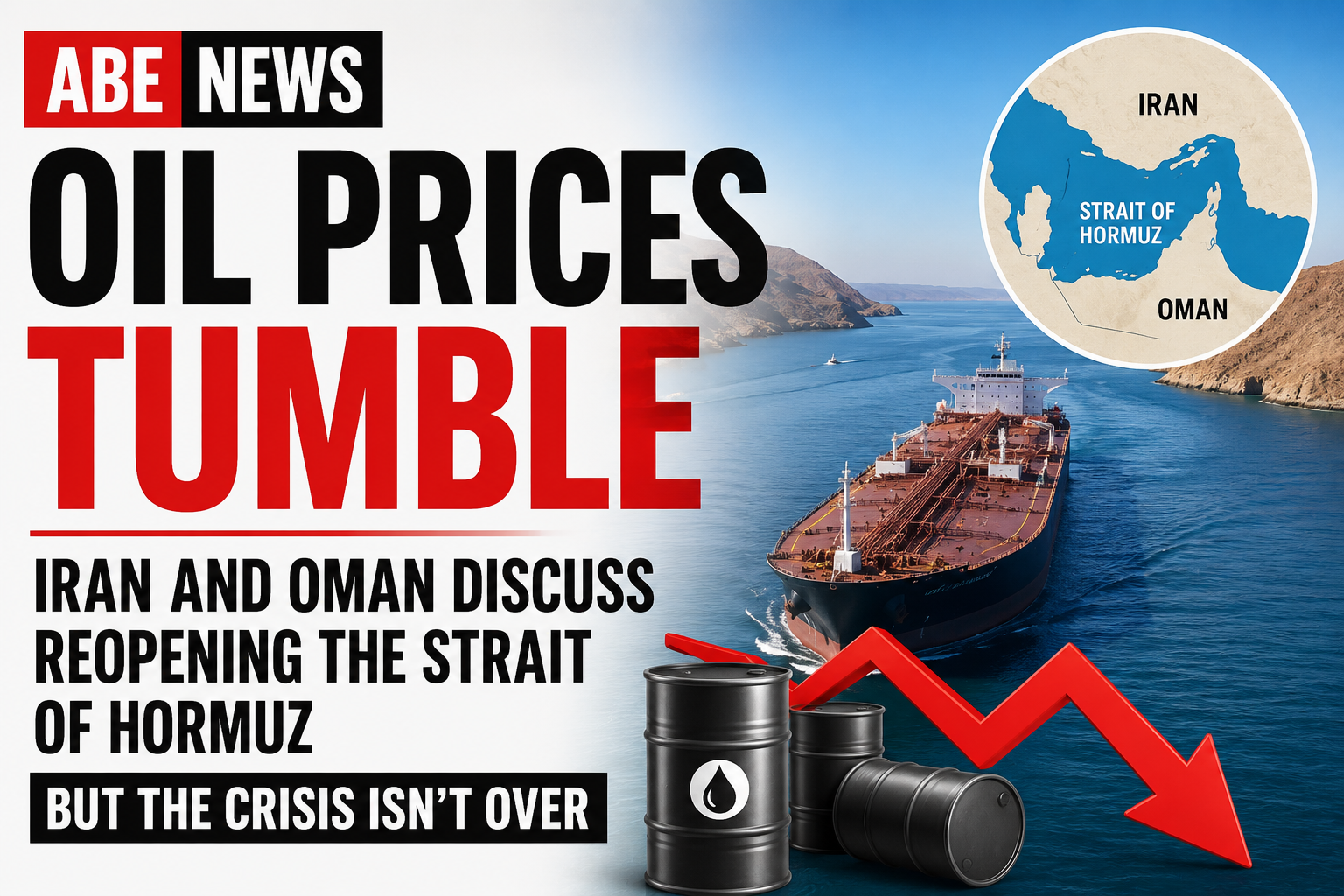
Oil prices are falling sharply, global markets are breathing a little easier, and one of the most economically important waterways on Earth may finally be moving toward a partial reopening. But beneath Wednesday morning’s optimism lies a much more complicated reality: the Strait of Hormuz remains severely disrupted, commercial shipping is still operating far below normal levels, companies are becoming increasingly cautious about which vessels they use, and a lasting political settlement between Iran and the United States remains elusive.
Iran and Oman have discussed establishing a joint temporary navigational corridor through the Strait of Hormuz and working together to clear mines from the waterway, raising hopes that commercial traffic could begin recovering after months of disruption. Before the war, roughly one-fifth of globally traded oil and liquefied natural gas moved through the Strait, making any credible prospect of reopening enormously important for energy markets, inflation and the wider global economy.
Markets reacted almost immediately. Brent crude fell for a third consecutive session Wednesday, dropping roughly 3% to around $86 a barrel in early trading, while U.S. West Texas Intermediate crude fell toward $80 a barrel. Brent had traded above $90 recently, but investors are now beginning to price in the possibility that more Middle Eastern energy supplies could eventually move through Hormuz again.
The decline is significant because oil prices have been one of the clearest economic transmission mechanisms of the Iran conflict. When traders believe shipping through Hormuz could become more dangerous or more restricted, oil prices can rise rapidly as markets price in the possibility of supply shortages. When diplomatic developments suggest that shipping could recover, some of that geopolitical risk premium begins disappearing.
That is exactly what markets are doing now.
But there is an important warning buried underneath Wednesday’s rally in optimism:
Hormuz has not reopened normally.
And the difference between negotiating a corridor and restoring one of the world’s most important shipping routes is enormous.
Iran and Oman Are Trying to Create a Temporary Route
The latest development follows talks between Iranian Foreign Minister Abbas Araghchi and Omani Foreign Minister Badr al-Busaidi in Tehran. The two sides discussed a framework that would establish a temporary shipping corridor while they continue negotiations over a more permanent arrangement governing navigation through the Strait.
The proposal would also involve mine-clearing operations.
Iran has now gone further in describing what it wants the arrangement to look like. Iranian Deputy Foreign Minister Kazem Gharibabadi said the proposed framework would prevent military vessels from transiting the Strait. Commercial ships entering the Persian Gulf would travel through Iranian waters, while outbound commercial traffic would use a route involving Iranian and Omani territorial waters. Negotiations toward a permanent arrangement could continue for another 30 to 60 days.
That provision could become a major obstacle.
The Trump administration has already expressed opposition to parts of the proposed arrangement, according to the Associated Press, particularly the idea that Iran and Oman would jointly control elements of the route.
So while the market is reacting to the possibility of reopening, the political structure required to make that reopening durable remains unsettled.
Oil Markets Are Already Pricing In Hope
Financial markets rarely wait for a diplomatic agreement to be signed before reacting.
They trade expectations.
That helps explain why oil has fallen even though shipping through Hormuz remains heavily restricted.
Brent crude dropped nearly 3% Wednesday morning to around $86 a barrel, while WTI moved toward $80. Global stocks edged higher and some government bond yields declined as investors interpreted the Iran-Oman talks as reducing the probability of a prolonged energy-supply disruption.
The economic implications extend far beyond people filling their cars at gas stations.
Oil affects transportation, aviation, manufacturing, agriculture, plastics, chemicals and logistics. Higher energy prices can filter through supply chains and contribute to inflation. That, in turn, influences decisions by central banks over interest rates.
Lower oil prices can work in the opposite direction.
That is why a diplomatic conversation about a relatively narrow stretch of water between Iran and Oman can move financial markets thousands of kilometres away.
The Strait of Hormuz may be geographically small.
Economically, it is enormous.
The Actual Shipping Numbers Tell a Different Story
This is where Wednesday’s optimism needs perspective.
Preliminary data from ship-tracking company Kpler showed that only five commodity vessels transited Hormuz on Tuesday. That was down from a 10-day average of 15 and remained far below normal pre-war traffic.
In other words, traders are betting on what might happen next, not celebrating a return to normal shipping that has already occurred.
That distinction matters.
A temporary navigational corridor could represent the beginning of normalization. But energy markets would need to see substantially more commercial traffic moving safely and consistently through the waterway before businesses could treat the crisis as resolved.
Shipping companies also have to believe their vessels, crews and cargoes are safe.
Recent events provide plenty of reasons for caution.
On Tuesday, an oil tanker was struck by an unidentified projectile near Oman at the entrance to the Strait and was disabled. The incident came at almost exactly the same time diplomats were discussing how to make the waterway safer.
That contrast captures the entire Hormuz situation:
Diplomacy is moving forward while the physical risks remain very real.
Shipping Companies Are Becoming More Cautious
Another development Wednesday shows why reopening Hormuz will require more than political announcements.
At least three Indian oil refiners and one global energy company are planning to stop using vessels appearing on a new Iranian blacklist because of security concerns, according to Reuters.
Iran has blacklisted 45 vessels that it says violated rules governing passage through Hormuz. Tehran has threatened penalties against vessels that interact with blacklisted ships, potentially including fines, detention and cargo seizure.
Some of those vessels have been involved in the complex ship-to-ship transfer system that Gulf producers have used to keep oil moving despite disruption in the Strait.
Saudi Arabia and the United Arab Emirates have relied on dedicated tankers to transport energy through Hormuz before transferring cargo to other vessels outside the Gulf. Some ships on Iran’s blacklist have been owned or chartered by Saudi Aramco and the Abu Dhabi National Oil Company, according to shipping data cited by Reuters.
That system has helped preserve at least some Middle Eastern energy exports.
But Iran’s blacklist introduces another layer of risk.
Companies now have to consider not only whether a vessel can physically pass through the Strait, but whether dealing with a particular tanker could expose another ship to Iranian penalties.
For large international energy companies, insurers and shipowners, that uncertainty matters enormously.
Insurance Could Become One of the Hidden Costs
Oil itself receives most of the attention during a shipping crisis, but another price can become equally important:
insurance.
Moving a tanker carrying millions of dollars worth of oil through a conflict zone requires insurers to evaluate the possibility that the ship could be attacked, detained, damaged or prevented from completing its journey.
Higher perceived risk generally means higher insurance costs.
Kpler trade-risk analyst Ana Subasic warned that if Iran follows through on threats against vessels interacting with blacklisted tankers, the number of shipowners, buyers and charterers willing to participate could shrink while due-diligence requirements and freight, insurance and risk premiums rise.
That creates an important economic paradox.
Oil prices can fall because traders expect Hormuz to reopen, while the actual cost of transporting oil through Hormuz can remain elevated because shipping companies still perceive significant physical and regulatory risks.
Those two realities can exist simultaneously.
And until they begin moving in the same direction, the crisis is not over.
Why Hormuz Matters So Much
The importance of the Strait comes from geography.
The narrow waterway connects the Persian Gulf with the Gulf of Oman and the Arabian Sea. Some of the world’s largest oil and gas producers depend on it to reach international customers.
Before the war began in February, approximately one-fifth of globally traded oil and liquefied natural gas shipments passed through the Strait.
That creates a vulnerability unlike almost anywhere else in the global energy system.
If a factory closes, another factory may eventually increase production.
If one shipping company stops operating, another may take its place.
But geography cannot easily be replaced.
There is no simple alternative waterway capable of instantly absorbing all the energy shipments that normally move through Hormuz.
Some Gulf producers have pipelines capable of bypassing the Strait, and alternative transport arrangements can preserve portions of exports. But those systems cannot effortlessly replace the enormous volumes that historically travelled through the waterway.
That is why every military threat, mine, tanker attack or diplomatic breakthrough involving Hormuz can influence the global price of oil.
The Iran-U.S. Conflict Is Still the Bigger Problem
Even if Iran and Oman successfully create a temporary commercial corridor, the broader confrontation remains unresolved.
The United States expanded sanctions this week as part of its effort to increase economic pressure on Tehran, threatening consequences for countries continuing certain forms of business with Iran, although Washington has not immediately imposed all of the threatened penalties.
Iran, meanwhile, continues trying to exert control over maritime traffic while resisting American economic pressure.
There are some signs of diplomatic movement beyond Oman. Pakistan said it made “significant progress” during talks with Iran concerning the conflict and a potential path toward peace.
But progress is not a peace agreement.
The military conflict has lasted nearly six months. Thousands have been killed, Iran’s conventional military capabilities have been heavily damaged, and uncertainty remains over the country’s nuclear program.
Until the political confrontation itself is addressed, any arrangement governing Hormuz remains vulnerable to another escalation.
One attack could change market sentiment.
One failed negotiation could push oil higher again.
One successful agreement could send prices sharply lower.
That is the environment businesses are operating in.
What Lower Oil Could Mean for Consumers
If Hormuz genuinely reopens and oil shipments begin returning toward normal levels, the effects could eventually reach consumers around the world.
Lower crude prices can reduce pressure on gasoline and diesel prices. Airlines can benefit from lower jet-fuel costs. Shipping and trucking companies can experience lower fuel expenses. Manufacturers that use petroleum-derived materials may also see some relief.
Perhaps more importantly, lower energy prices could reduce inflationary pressure.
Investors are already watching that connection closely.
Markets are awaiting new U.S. inflation data, while expectations for a Federal Reserve interest-rate increase in September have fallen compared with earlier this month. Reuters reported Wednesday that market pricing put the probability of at least a quarter-point September increase at around 36%, down from roughly 67% earlier in August.
Hormuz therefore connects directly to another question households and businesses care about:
interest rates.
If energy prices remain elevated, inflation can become harder to control.
If energy prices fall sustainably, central banks have more room to avoid tightening monetary policy.
Again, one waterway can influence much more than oil.
The Market Is Betting on Diplomacy — Before Diplomacy Has Delivered
This may be the most important point in Wednesday’s story.
Oil isn’t falling because Hormuz has completely returned to normal.
It hasn’t.
Oil is falling because investors believe the probability of normalization has increased.
That is a very different statement.
Iran and Oman have opened a diplomatic pathway. They are discussing a temporary corridor. Mine-clearing is part of the framework. A longer-term arrangement is being considered.
Those are meaningful developments.
But commercial traffic remains depressed. Shipping companies remain cautious. Iran is threatening vessels on its blacklist. The United States objects to elements of the proposed framework. And an oil tanker was disabled near the Strait only Tuesday.
The optimism is real.
So is the danger.
🔴 THE ABE NEWS TAKE
Markets are doing what markets always do: looking forward.
Traders do not need to see the Strait of Hormuz fully reopened before reducing the geopolitical premium built into oil prices. They only need to believe that reopening has become more likely than it appeared yesterday.
That is why Brent crude can fall roughly 3% while the Strait itself remains severely disrupted.
But businesses cannot operate entirely on expectations.
A refinery needs crude to arrive.
A tanker company needs confidence that its vessel will return safely.
An insurer needs to understand the risks it is underwriting.
And consumers need lower oil prices to persist long enough for those savings to travel through the economy.
Iran and Oman’s negotiations therefore represent an opportunity, not a resolution.
If the temporary corridor becomes operational, mines are cleared, commercial traffic increases and the United States accepts a workable framework, Wednesday could eventually be remembered as an important step toward reopening one of the world’s most important trade arteries.
If negotiations collapse or another serious attack occurs, today’s optimism could disappear almost as quickly as it arrived.
For now, oil traders are betting that diplomacy might finally be gaining ground.
The ships still have to prove them right.
ABE NEWS
Business. Money. Style. The News.
Understand More. Think Bigger.