







ABE NEWS | September 1, 2026
Russia’s oil industry — one of the financial engines that has powered the country for decades and helped Moscow sustain more than four years of war in Ukraine — is facing mounting pressure.
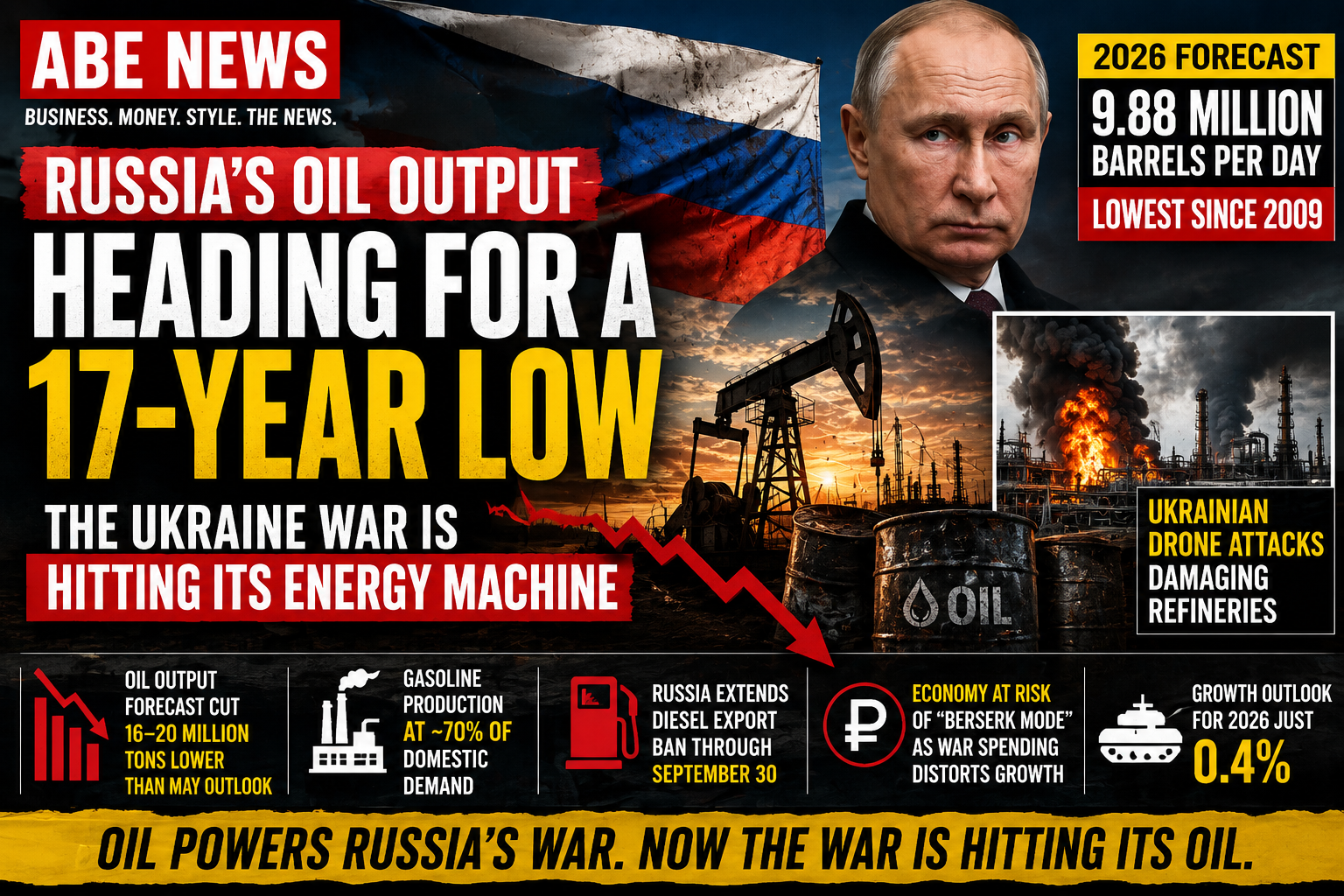
A Russian government draft economic forecast reviewed by Reuters has cut the country’s expected 2026 crude-oil production to 494.2 million metric tons, equivalent to roughly 9.88 million barrels per day.
If that forecast is realized, Russian oil production would fall to its lowest level since 2009.
The revision is substantial. Moscow reduced its production expectations for 2026 through 2029 by between 16 million and 20 million metric tons compared with projections published only months earlier in May.
And the reasons reach directly into the economics of the Ukraine war.
European restrictions have transformed Russia’s traditional energy markets. Export bottlenecks are making it harder to move petroleum products. Ukrainian drones have intensified attacks against Russian refineries and other energy infrastructure. Domestic gasoline production has fallen sharply. Fuel shortages have returned in parts of the country.
Russia has responded by restricting fuel exports in an attempt to keep enough supply at home.
Taken together, these developments reveal something much larger than another fluctuation in global oil production.
The war is increasingly reaching the energy system that helps finance it.
RUSSIA IS STILL AN OIL SUPERPOWER
It is important not to exaggerate the decline.
Russia is not running out of oil.
It remains one of the world’s largest crude producers and a central member of the OPEC+ alliance alongside Saudi Arabia and other major exporters.
At approximately 9.88 million barrels per day under the government’s base-case forecast, Russia would still produce an extraordinary amount of crude.
But oil is unusually important to the Russian economy.
For decades, revenues from oil and natural gas have supported government spending, foreign-exchange earnings, industrial investment and the country’s geopolitical power.
Energy exports helped Russia accumulate financial reserves.
They helped finance infrastructure.
They gave Moscow leverage over European economies that once depended heavily on Russian energy.
And since the full-scale invasion of Ukraine began in February 2022, energy revenue has remained crucial to the government’s ability to sustain enormous military spending.
That makes deterioration inside the oil industry strategically important.
THE FORECAST HAS BEEN CUT ACROSS FOUR YEARS
The 2026 number isn’t an isolated revision.
According to the draft government forecast, Russia has lowered expected oil production across 2026, 2027, 2028 and 2029 compared with its May outlook.
For 2026, production is expected to decline by about 17.2 million metric tons to 494.2 million tons.
The forecast is expected to be finalized toward the end of September and will help shape Russia’s budget planning.
That distinction matters.
These aren’t numbers produced by an outside critic predicting Russian economic collapse.
They come from Russia’s own government forecasting process.
And governments need realistic energy projections because oil prices and production volumes influence how much revenue they can expect to collect.
If Moscow expects less oil production, its fiscal calculations have to adjust accordingly.
UKRAINE HAS TAKEN THE WAR TO RUSSIA’S REFINERIES
One of the biggest developments has occurred far from the battlefield.
Ukraine has increasingly targeted Russian energy infrastructure with long-range drones.
Refineries have become particularly important targets.
The logic is straightforward.
Russia can extract enormous quantities of crude oil from the ground.
But crude isn’t gasoline.
It isn’t diesel.
It isn’t aviation fuel.
Refineries transform crude into the fuels required by households, businesses, transportation networks — and militaries.
Damage enough refinery capacity and a major oil producer can paradoxically find itself struggling to produce sufficient fuel.
That is increasingly part of Russia’s problem.
By late August, Russian gasoline production had fallen to approximately 70% of domestic consumption, according to industry sources cited by Reuters.
Major refineries were forced to suspend operations following waves of Ukrainian drone attacks.
Fuel shortages returned to several Russian regions.
For one of the world’s largest petroleum producers, that is an extraordinary vulnerability.
RUSSIA IS RESTRICTING FUEL EXPORTS
Moscow has responded by attempting to protect domestic supply.
Russia extended restrictions on diesel exports through September 30, with the measures also covering certain marine fuels and gas oils shipped by Russian producers.
The government said the measures were intended to stabilize the domestic fuel market.
That tells us something important.
When a major energy exporter begins restricting exports because its own domestic market needs protection, the disruption has moved beyond theoretical damage.
The government is actively managing scarcity.
Russia wants fuel available to ordinary consumers.
It needs fuel for agriculture.
It needs fuel for trucking.
It needs fuel for industry.
And, critically, it needs enormous quantities of fuel to sustain military operations.
Those priorities increasingly compete with export revenue.
THE WAR CREATES AN ECONOMIC CONTRADICTION
Russia needs its energy industry for two different reasons.
It needs petroleum products physically.
And it needs energy exports financially.
Restricting exports can help stabilize domestic supply.
But every barrel of fuel that doesn’t leave Russia is potentially export revenue that doesn’t enter Russia.
That creates an uncomfortable trade-off.
The government can prioritize domestic availability.
Or it can maximize foreign sales.
Doing both becomes harder when refinery capacity is disrupted.
Ukraine appears to understand this.
Rather than trying to destroy Russia’s enormous crude reserves — an impossible objective — Kyiv can attack bottlenecks inside the system.
Refineries.
Storage facilities.
Pipelines.
Export infrastructure.
Those are the places where physical disruption can create economic consequences far larger than the cost of the attack itself.
EUROPE HAS ALREADY CHANGED RUSSIA’S OIL BUSINESS
Before the invasion, Europe was an enormously important customer for Russian energy.
Pipelines connected Russian resources directly with European consumers.
European refineries processed Russian crude.
European economies purchased Russian oil products.
That relationship changed dramatically after 2022.
The European Union banned most Russian oil and petroleum-product imports, forcing Moscow to redirect enormous volumes toward other markets.
India and China became especially important.
Russia adapted.
Discounted Russian crude found buyers.
New shipping networks emerged.
A so-called shadow fleet of tankers expanded.
Trade routes became longer and more complicated.
That adaptation prevented Western sanctions from eliminating Russian oil revenue.
But adaptation carries costs.
Longer shipping routes require more vessels.
Sanctions complicate insurance and financing.
Price discounts can reduce revenue.
Export infrastructure becomes more important.
And additional restrictions can make every transaction more difficult.
Russia’s oil industry survived the initial sanctions shock remarkably well.
The question now is whether cumulative pressure is becoming harder to absorb.
THIS ISN’T ONLY ABOUT SANCTIONS ANYMORE
That distinction matters.
Sanctions attempt to restrict economic activity through financial and legal pressure.
Physical attacks on infrastructure are different.
A refinery damaged by a drone cannot resume normal production because a trader discovers a sanctions workaround.
It has to be repaired.
Specialized equipment may need replacing.
Production units may have to shut down.
Safety inspections are required.
Repeated attacks can interrupt repairs.
And sanctions can make it harder to obtain certain Western equipment and technology needed to maintain complex industrial facilities.
That combination can become much more difficult than either sanctions or military attacks alone.
Russia must operate an enormous energy system while parts of it are being targeted — and while access to some international technology and finance remains restricted.
THE ECONOMY IS ALSO SLOWING
The pressure extends beyond energy.
Russia’s economy expanded strongly during parts of the war as enormous government military spending drove factories, employment and industrial production.
But that wartime stimulus has limits.
Growth is now expected to slow dramatically.
A senior Kremlin-linked official delivered an unusually stark warning Tuesday.
Boris Titov, President Vladimir Putin’s special representative for international development, warned that the Russian economy risks going “berserk” if economic management becomes completely subordinated to the military-industrial complex.
The comments were notable because they came from within Russia’s political establishment.
The concern is straightforward.
A country can dramatically increase weapons production.
Factories can run at capacity.
Workers can receive higher wages.
Government spending can surge.
Measured GDP can rise.
But tanks, missiles and artillery shells don’t necessarily create the productive assets that generate long-term civilian prosperity.
An economy can look busy while becoming increasingly distorted.
THE MILITARY-INDUSTRIAL MACHINE HAS A COST
Russia has redirected enormous economic resources toward defence.
Factories that once produced civilian goods can produce military equipment.
Engineers work on defence projects.
Government procurement supports weapons manufacturers.
Workers move toward industries paying wartime wages.
In the short term, this can produce economic activity.
But resources are finite.
Workers employed in defence aren’t simultaneously building civilian products.
Capital invested in military factories isn’t financing every other business.
Government money spent replacing equipment destroyed in war isn’t available for healthcare, education or civilian infrastructure.
And weapons consumed on a battlefield eventually have to be replaced.
That is why wartime economic growth can be deceptive.
The economy is producing.
But what it produces matters.
ENERGY IS WHAT MAKES THE SYSTEM POSSIBLE
This is where the oil forecast becomes especially important.
Military spending requires government revenue.
Russia can borrow.
It can tax domestic companies.
It can draw on reserves.
But energy remains one of its most valuable sources of external income.
Oil is particularly useful because the world still needs enormous quantities of it.
Even countries opposed to Russia cannot easily remove millions of barrels per day from global supply without affecting prices.
That has given Moscow economic resilience.
But resilience is not immunity.
If production declines while refinery disruptions increase and export routes become more complicated, Russia’s energy advantage gradually weakens.
Not necessarily catastrophically.
Not overnight.
But incrementally.
And wars lasting years are often determined by incremental pressures.
THERE’S ANOTHER PROBLEM: OIL PRICES DON’T BELONG TO MOSCOW
Russia controls how much oil it attempts to produce.
It doesn’t control the global price.
Revenue depends on both.
A country can export enormous volumes and still experience fiscal pressure if prices fall.
Conversely, geopolitical crises can push prices higher and partially compensate for lower production.
The current global oil market is particularly complicated because Russia’s energy problems are happening simultaneously with severe disruption in the Middle East.
The Strait of Hormuz crisis has pushed Brent crude above $90 a barrel again.
That can actually help Russia.
Higher global oil prices increase the value of the barrels Moscow can sell.
So the same geopolitical instability damaging the world economy may partially cushion Russia’s falling production.
That’s one reason simplistic predictions of Russian economic collapse repeatedly fail.
Energy economics contains competing forces.
BUT REFINERY DAMAGE CREATES A DIFFERENT KIND OF PROBLEM
High crude prices cannot instantly repair a damaged refinery.
This is why the distinction between crude production and refined fuels matters.
Russia may continue extracting huge quantities of crude while struggling with gasoline or diesel availability in certain regions.
Domestic fuel shortages are politically sensitive.
Ordinary Russians notice immediately when gasoline becomes difficult or expensive to obtain.
Businesses notice.
Farmers notice.
Truckers notice.
Local governments notice.
The military notices.
That means Moscow has strong incentives to prioritize domestic fuel availability even when doing so reduces exports.
Ukraine therefore doesn’t necessarily need to stop Russian crude production to create pressure.
Disrupting the conversion of crude into usable products can be enough.
RUSSIA IS ALSO ATTACKING UKRAINE’S ECONOMIC INFRASTRUCTURE
The economic warfare runs both ways.
Russian forces continue attacking Ukrainian energy and export infrastructure.
On Tuesday, Ukrainian officials said Russia struck facilities in the Odesa region, including export infrastructure, energy facilities and a border crossing with Romania.
Ukraine’s Black Sea and Danube infrastructure is essential to the country’s ability to sell agricultural products and other goods internationally.
Russia’s strategy therefore mirrors Ukraine’s in an important way.
Both sides increasingly target the infrastructure that allows the other’s economy to function.
Ports.
Energy plants.
Refineries.
Transport links.
The battlefield is no longer only where soldiers fight.
It extends into the economic systems supporting them.
WHAT HAPPENS IF 9.88 MILLION BARRELS BECOMES REALITY?
If Russia’s government forecast proves accurate, the country will still be an energy giant.
But the direction matters.
A 17-year production low would arrive at a time when Moscow needs extraordinary amounts of money to sustain military spending and maintain the domestic economy.
Russia could respond in several ways.
It could attempt to increase investment in oilfields.
It could offer better commercial terms to buyers.
It could deepen energy relationships with China and India.
It could expand alternative export infrastructure.
It could reduce domestic spending elsewhere.
It could raise taxes.
Or it could hope higher global oil prices compensate for lower volumes.
None is painless.
And every additional year of war increases the cumulative economic burden.
THE BIGGER QUESTION IS HOW LONG RUSSIA CAN ABSORB THE PRESSURE
Russia has repeatedly demonstrated greater economic resilience than many Western policymakers expected.
It redirected trade.
It found alternative buyers.
It expanded domestic production.
It used capital controls.
It increased military manufacturing.
It built new commercial relationships.
Predictions of immediate economic collapse proved wrong.
That history matters.
A responsible analysis should not interpret one forecast as evidence that Russia’s economy is about to implode.
But resilience has a cost.
The more interesting question is how many pressures can accumulate simultaneously before adaptation becomes substantially harder.
Slower economic growth.
High military expenditure.
Labour shortages.
Inflation.
High interest rates.
Sanctions.
Export restrictions.
Refinery attacks.
Fuel shortages.
Lower expected oil production.
Each problem alone may be manageable.
Together, they form a much more difficult economic equation.
🔴 THE ABE NEWS TAKE
Ukraine’s war strategy is increasingly attacking something more important than individual Russian buildings.
It is attacking Russia’s economic conversion system.
Russia possesses enormous natural resources.
That isn’t changing.
But oil underground doesn’t finance a government.
Oil has to be extracted.
Processed where necessary.
Transported.
Insured.
Sold.
Paid for.
And the money has to make its way through an increasingly complicated financial system.
Every disruption along that chain reduces the advantage Russia receives from possessing some of the world’s largest energy resources.
That is why the government’s new production forecast matters.
9.88 million barrels per day is still enormous.
Russia would remain an oil superpower.
But if production really falls to its lowest level since 2009 while refineries struggle with repeated attacks and the government restricts fuel exports to protect domestic supply, the direction is unmistakable.
The energy machine is under pressure.
And that matters because Russia’s military machine ultimately depends on an economy capable of supporting it.
There is also an important warning against exaggeration.
Russia has survived sanctions that many expected to cripple it.
It has redirected enormous quantities of energy toward Asia.
Higher global oil prices can strengthen Moscow’s revenues even when production falls.
And a 17-year production low does not mean Russia is close to running out of oil.
The real story is subtler — and potentially more important.
The Ukraine war is becoming a contest over economic endurance.
Russia is trying to destroy Ukraine’s energy and export infrastructure.
Ukraine is increasingly trying to damage the infrastructure that turns Russia’s natural resources into fuel and money.
That contest could last long after individual battles disappear from the headlines.
For Moscow, the central question is no longer simply whether Russia has enough oil.
It clearly does.
The question is whether Russia can continue converting that oil into enough fuel, export revenue and economic stability to sustain an extraordinarily expensive war without increasingly weakening the civilian economy around it.
Russia’s own government now expects oil production to fall to a level not seen since 2009.
That doesn’t answer the question.
But it makes the question much harder to ignore.
ABE NEWS
Business. Money. Style. The News.
Understand More. Think Bigger.