








ABE NEWS | WEDNESDAY, AUGUST 26, 2026
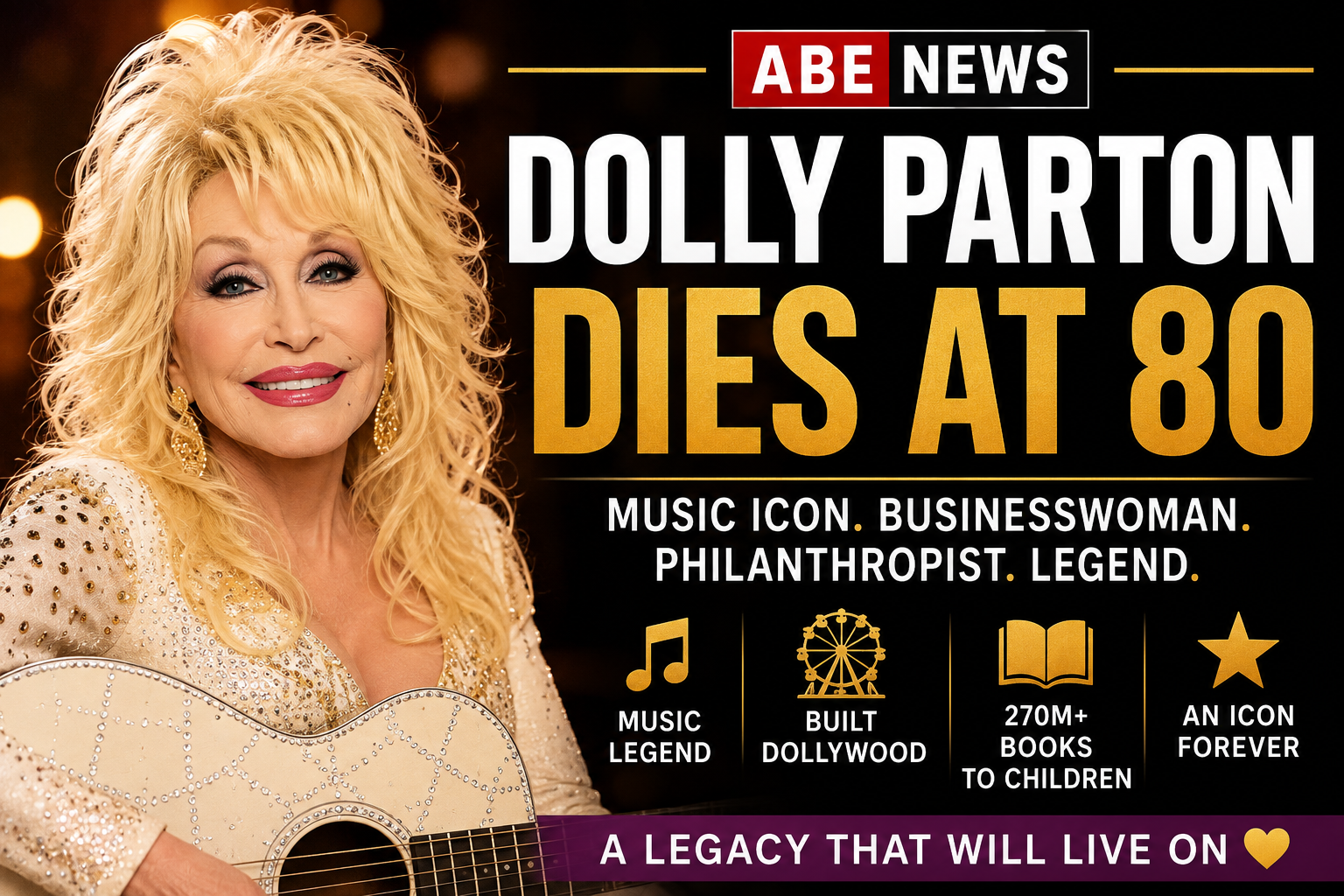
Dolly Parton, the country music superstar whose extraordinary journey took her from poverty in the mountains of Tennessee to global fame, Hollywood, business success and one of the world’s best-known children’s literacy programs, has died. She was 80 years old.
Parton died Tuesday at Vanderbilt-Ingram Cancer Center in Nashville after what her publicist described as a brief battle with cancer. She was surrounded by loved ones, according to a statement announcing her death.
Her death closes one of the most remarkable careers in modern American entertainment.
For more than six decades, Parton was a singer, songwriter, actress and performer. But describing her simply as a country musician understates what she eventually became. She transformed a distinctive voice, unmistakable appearance and extraordinary songwriting ability into a global personal brand spanning music, movies, television, publishing, tourism, philanthropy and business.
She sold more than 100 million records worldwide, accumulated more than one billion online streams and wrote hundreds of songs, including classics such as Jolene, Coat of Many Colors and I Will Always Love You. She received 55 Grammy nominations and won 10 Grammys, according to the Associated Press.
But perhaps the clearest demonstration of Parton’s influence is what happened after the music stopped.
The tributes came from across entertainment and popular culture. Dollywood, the Tennessee theme park carrying her name, announced that it would remain open Wednesday because that was what Parton wanted.
Her instruction was essentially simple:
The show must go on.
From Poverty in Tennessee to Global Stardom
Parton’s story began far away from Hollywood, major record labels and multimillion-dollar businesses.
She was born in Tennessee in 1946 and grew up as one of 12 children in a family she openly described as extremely poor. Music became part of her life through church, where her grandfather was a preacher. By 10, she was learning guitar and appearing on local television, and at 13 she performed at Nashville’s Grand Ole Opry.
After graduating from high school in 1964, Parton went to Nashville.
Her partnership with country star Porter Wagoner became an important turning point. She appeared on his television program, recorded successful duets with him and gained access to a much larger national audience.
But Parton was determined to become an independent star.
Her breakthrough arrived through songs that would eventually become part of American popular culture.
Coat of Many Colors transformed memories of childhood poverty into music. Then came Jolene, the 1973 song that became one of her signature recordings and one of the most frequently covered compositions of her career.
And then came another song whose business story would become almost as remarkable as the music itself.
“I Will Always Love You” Became a Lesson in Owning Your Work
Parton wrote I Will Always Love You as she prepared to leave her professional partnership with Wagoner.
The song became a major country hit.
Then Elvis Presley wanted to record it.
For many young artists, having Elvis record their song would have seemed like an opportunity impossible to reject. But there was a condition: Parton would have to surrender a significant portion of her publishing rights.
She refused.
That decision became one of the defining business choices of her career.
Almost two decades later, Whitney Houston recorded I Will Always Love You for the 1992 film The Bodyguard. Houston’s version became a global phenomenon and one of the defining recordings of the decade.
Parton still controlled the publishing.
It was a remarkable demonstration of something Parton understood long before celebrity ownership became a regular discussion in the music industry:
creating something valuable and owning something valuable are not necessarily the same thing.
Artists can become famous while other people own the commercial rights to their work. Parton understood the importance of controlling her intellectual property and managing the business surrounding her creativity.
That instinct would eventually extend far beyond music.
Dolly Was Also a Businesswoman
The wigs, rhinestones, humor and exaggerated glamour sometimes caused people to underestimate Parton.
She understood that.
And in many ways, she used it to her advantage.
Behind one of entertainment’s most recognizable public personas was a woman who understood branding exceptionally well. Her appearance wasn’t separate from the business—it was part of it.
But Parton’s most visible business achievement would eventually emerge back home in Tennessee.
In 1986, she became involved with an existing amusement park in the Smoky Mountains. It was renamed Dollywood.
The decision was significant because Parton could have simply licensed her name to products and collected royalties.
Instead, she attached her identity to a physical destination connected directly to the region where she grew up.
Dollywood expanded over the following decades into a major tourism operation encompassing a theme park, water park, resorts, entertainment and other attractions.
It also became an economic engine for the surrounding Appalachian region.
Parton had effectively transformed her personal brand into infrastructure.
People didn’t simply listen to Dolly Parton.
They could visit Dolly Parton’s world.
That is a business strategy modern entertainers now use frequently—turning fame into beauty companies, alcohol brands, fashion labels, restaurants, technology investments and other ventures.
Parton was doing her own version decades earlier.
Dollywood Will Stay Open
Parton’s death immediately created a question about what would happen at the place most closely associated with her business legacy.
The answer arrived quickly.
Dollywood is staying open.
The park said Parton’s wish was that it remain a place of joy, hope and togetherness and that people should celebrate her memory through music, laughter and shared experiences rather than closing the gates.
Dollywood Parks & Resorts President Eugene Naughton said the organization would continue carrying Parton’s vision forward.
The symbolism is difficult to miss.
One of the businesses she spent decades building continued operating the morning after her death.
Parton herself wanted it that way.
Millions of Children Know Her as “The Book Lady”
For all the awards, albums, films and business ventures, Parton’s most consequential legacy may ultimately have little to do with entertainment.
In 1995, she launched Dolly Parton’s Imagination Library in Sevier County, Tennessee.
The inspiration was personal.
Her father could not read or write, and Parton saw how profoundly illiteracy affected his life. She wanted young children in her home region to develop a relationship with books before entering school.
The concept was remarkably simple.
Children from birth to age five would receive free, age-appropriate books delivered directly to their homes.
What began as a local Tennessee initiative expanded throughout the United States and eventually internationally into Canada, the United Kingdom, Australia and the Republic of Ireland.
The program says it has now mailed more than 270 million free books.
Think about the scale of that number.
Parton’s songs reached millions of people.
Her movies reached millions.
Dollywood welcomed millions.
But hundreds of millions of books carrying her literacy mission have entered children’s homes around the world.
Her father became so proud of the project that, according to Parton, he particularly loved hearing children call his famous daughter “The Book Lady.”
For someone who became internationally recognizable through music and glamour, it may be one of the most meaningful titles she ever received.
Hollywood Discovered Dolly Too
Parton’s ambitions never remained confined to Nashville.
Her first major film role came in the 1980 comedy 9 to 5, alongside Jane Fonda and Lily Tomlin.
Parton also wrote and performed the movie’s title song, which became another enormous hit and earned her two Grammy Awards.
Other major acting roles followed, including The Best Little Whorehouse in Texas and Steel Magnolias.
What made the transition notable was how little Parton had to abandon the identity that made her famous.
Hollywood did not transform Dolly Parton into somebody else.
Dolly Parton brought Dolly Parton to Hollywood.
The Tennessee accent remained.
The enormous blond hair remained.
The rhinestones remained.
The humor remained.
And that authenticity became one of her greatest assets.
She Made Being Underestimated Part of the Strategy
Parton cultivated an image that was deliberately extravagant.
Big hair. Bright colors. Rhinestones. High heels.
She knew exactly how people reacted to it.
But underneath the image was a songwriter who protected her publishing, a performer who successfully crossed musical genres, a businesswoman who helped build a tourism destination and a philanthropist who created an international literacy network.
That contrast became central to her appeal.
Rather than spending her career trying to convince everyone she was sophisticated, Parton often made the joke first.
That gave her control over the image.
And because she remained remarkably consistent for decades, the appearance eventually became more than fashion.
It became intellectual property of another kind.
A silhouette could communicate Dolly Parton before anyone heard her voice.
Very few entertainers ever build that level of brand recognition.
Her Career Crossed Generations
Another remarkable feature of Parton’s career was longevity.
She became famous during an era when television variety shows and country radio could create national stars.
She remained relevant through cable television, blockbuster Hollywood films, CDs, digital downloads, streaming services and social media.
New generations repeatedly discovered her.
She collaborated with younger artists and became the godmother of Miley Cyrus. Her songs continued being covered and reinterpreted decades after their original release.
In 2022, she was inducted into the Rock & Roll Hall of Fame, despite initially questioning whether she belonged there because she considered herself primarily a country artist.
Her career had survived enormous changes in the entertainment business because it was built on something technology could not easily make obsolete:
songs people continued wanting to hear.
A Rare Celebrity Who Avoided Becoming a Political Symbol
Parton also accomplished something increasingly difficult for globally famous entertainers.
She remained broadly popular across political and cultural divides.
She deliberately avoided publicly aligning herself with political parties or candidates. Her reasoning was straightforward: she knew her audience contained people with very different beliefs and did not view politics as her role.
That did not mean she avoided social impact.
Her philanthropy supported literacy, disaster recovery, medical research and communities around Tennessee.
But she generally separated those efforts from partisan politics.
That approach helped create an unusual position in American culture.
People who agreed about almost nothing else could agree about Dolly.
The Music Industry Lost More Than a Singer
The numbers alone demonstrate the magnitude of Parton’s career.
More than 100 million records sold worldwide.
More than one billion online streams.
55 Grammy nominations and 10 victories.
Membership in the Country Music Hall of Fame.
Membership in the Rock & Roll Hall of Fame.
Successful films.
A major tourism business.
And an international literacy organization responsible for distributing hundreds of millions of books.
But statistics do not fully explain why her death has resonated so widely.
Dolly Parton became one of those rare entertainers whose public identity eventually exceeded the industry that created her.
She represented country music without being limited to country music.
She represented Tennessee without remaining a regional celebrity.
She became wealthy without trying to erase the poverty she came from.
And she built a glamorous public image while repeatedly redirecting attention toward children, education and the community that raised her.
🔴 THE ABE NEWS TAKE
There is an important reason Dolly Parton’s story belongs on a publication concerned with more than entertainment.
Her life demonstrates the extraordinary power of ownership, identity and consistency.
Parton did not merely become famous.
She built assets around that fame.
She wrote songs—and fought to retain control of them.
She developed an unmistakable image—and turned it into one of entertainment’s most recognizable brands.
She attached her name to Dollywood—but built it in the region where she grew up, connecting commercial success to local economic development.
And when she accumulated enormous cultural influence, she converted part of it into something entirely different: books arriving at children’s homes.
That is why her legacy cannot be measured only through album sales.
There will be other country stars.
There will be other movie stars.
There will certainly be other celebrities who launch businesses.
But Dolly Parton’s achievement was combining those identities without allowing one to destroy the others.
She could be glamorous without pretending she wasn’t intelligent.
Commercial without abandoning philanthropy.
Famous without hiding where she came from.
And enormously successful without surrendering ownership of the work that made her successful.
Dollywood opened its gates Wednesday morning because that is what she wanted.
The Imagination Library will continue putting books into children’s hands.
Her recordings will continue playing.
Her songs will continue being covered by artists who were not alive when she wrote them.
And somewhere, a child who may know nothing about Jolene, Nashville or country music will open a book delivered because a woman from a poor Tennessee family remembered what it meant that her father could not read.
Perhaps that is the most extraordinary part of Dolly Parton’s empire.
Some of its most valuable returns were never meant to make her richer.
ABE NEWS
Business. Money. Style. The News.
Understand More. Think Bigger.