


ABE ORIGINAL | SATURDAY, AUGUST 22, 2026
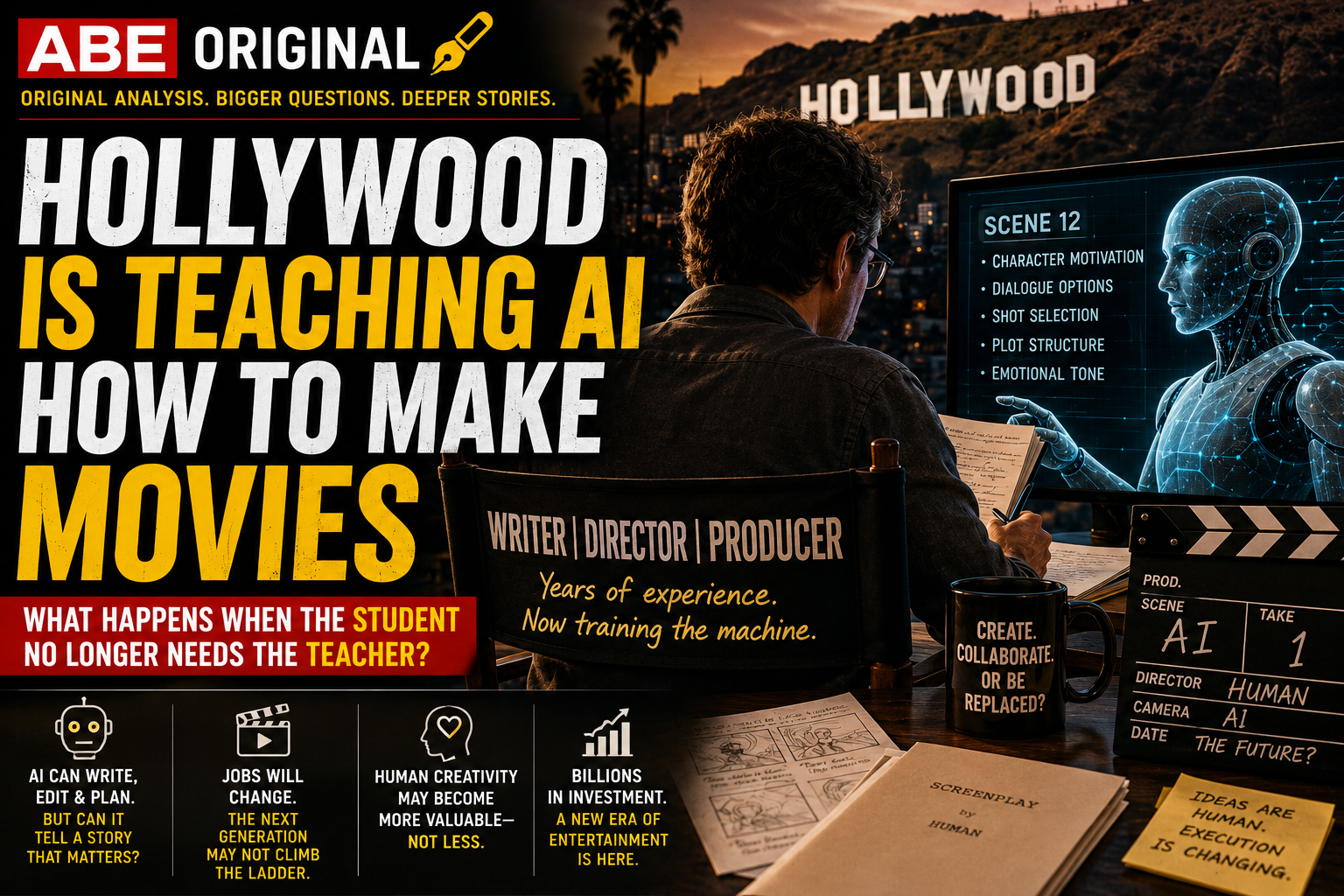
There is something deeply strange happening in Hollywood.
Writers are teaching artificial intelligence how to write screenplays.
Directors are helping machines understand filmmaking decisions.
Producers are showing AI how to plan shoots, organize productions and solve problems that professionals normally spend years learning to handle.
And some of the people doing this work are painfully aware of the contradiction.
They need the money.
But the better they teach the machine, the more capable that machine may become of doing parts of the work they once expected humans to be paid to perform.
This isn’t a hypothetical scenario from some distant AI future.
It is happening now.
An investigation published Saturday found experienced and award-winning Hollywood writers, directors and producers taking temporary jobs training AI systems in professional entertainment skills. Pay reportedly ranges dramatically—from around $12 to $200 an hour, depending on the work and expertise involved.
The situation creates one of the most uncomfortable questions of the AI revolution:
What happens when workers are paid to transfer their own expertise into machines?
Because Hollywood may be experiencing something much bigger than another technological upgrade.
It may be watching knowledge itself become automated.
The Machine Needs a Teacher
It’s easy to imagine artificial intelligence as something that simply becomes smarter by itself.
That’s not really how this works.
Behind increasingly capable AI systems are enormous quantities of human-generated information, feedback, examples and evaluation.
A model can generate a screenplay.
But somebody needs to teach it what makes dialogue unnatural.
Someone needs to recognize when a character’s motivation doesn’t make sense.
Someone understands why a scene that technically contains everything requested still feels lifeless.
And that knowledge doesn’t come from nowhere.
It comes from humans.
The Hollywood professionals doing this work reportedly evaluate AI-generated material and help models learn tasks ranging from screenwriting to production planning. Some of the training agencies involved have contracts with major AI companies, including OpenAI and Anthropic.
Think about what is actually being transferred.
A veteran screenwriter doesn’t merely know how to type a script.
Years of rejection, rewrites, writers’ rooms, bad drafts, good drafts and audience reactions have created judgment.
A producer doesn’t merely know that a movie needs a schedule.
They understand what happens when an actor becomes unavailable, weather destroys a shooting day, a location falls through or a scene becomes too expensive.
That is professional knowledge.
And AI companies increasingly want access to it.
Why Would Hollywood Workers Agree?
Because there is another story underneath the AI story.
Hollywood has been hurting.
According to figures cited in Saturday’s report, Los Angeles shoot days fell approximately 48% between 2021 and 2025, while employment in U.S. motion-picture and sound-recording industries declined substantially.
That means some experienced professionals aren’t choosing between:
a Hollywood job and an AI-training job.
They’re choosing between:
an AI-training job and no industry job at all.
That changes the moral calculation.
It’s easy for somebody with a secure salary to tell a struggling writer:
Don’t help train the machine.
It’s harder when that writer has rent due.
Technology disruption often works this way.
The people most vulnerable to a new technology can become some of the first people economically pressured into helping deploy it.
And that creates a brutal cycle.
The traditional industry contracts.
Workers need alternative income.
Technology companies offer it.
Workers transfer their expertise.
The technology improves.
Companies discover more tasks it can perform.
Traditional work faces even greater pressure.
The cycle repeats.
But Hollywood Is Not Simply Fighting AI Anymore
Something else has changed.
For years, much of Hollywood’s AI conversation sounded like a battle between technology companies and creative workers.
That distinction is becoming much less clear.
Filmmakers are increasingly experimenting with AI themselves.
Major studios and technology companies are exploring AI-assisted production. Earlier this month, Yash Raj Films and Google held an AI filmmaking workshop in Mumbai focused on integrating Google’s Flow tools into production while maintaining creative control.
AI-assisted filmmaking is also moving into actual productions. Studios are experimenting with AI-generated backgrounds, visual effects and synthetic elements as they search for ways to reduce costs and expand what smaller creative teams can accomplish.
Meanwhile, a rapidly growing market for short vertical dramas is already experimenting with AI-assisted production as companies try to produce entertainment faster and more cheaply for smartphone audiences.
So this isn’t simply:
Hollywood versus AI.
Increasingly, it is:
Hollywood using AI while Hollywood argues about what AI should be allowed to do.
That is a much more complicated fight.
AI Could Make Filmmaking More Accessible
There is a positive side that shouldn’t be ignored.
Movies are expensive.
Very expensive.
A filmmaker may have an extraordinary idea but lack the millions of dollars necessary to create it.
A young director might imagine a science-fiction world but have no visual-effects budget.
An independent producer might have a compelling screenplay but never convince a studio to finance it.
AI could change some of those economics.
Imagine a filmmaker with a laptop being able to create convincing concept art, storyboards, temporary visual effects, translations, backgrounds, sound design or previsualization that previously required entire specialist teams.
That doesn’t necessarily destroy creativity.
It could unlock creativity.
Someone who couldn’t afford to make a movie yesterday might be able to make one tomorrow.
The history of technology is full of examples of tools lowering the cost of creation.
Digital cameras made filmmaking cheaper.
Editing software put capabilities once requiring expensive equipment onto ordinary computers.
Smartphones gave billions of people cameras.
YouTube eliminated the need to own a television network to reach a mass audience.
AI could be another chapter in that story.
But there’s a crucial difference.
A digital camera doesn’t study the cinematographer using it so that it can later attempt cinematography itself.
AI can.
That’s what makes this transition different.
The Entry-Level Problem Could Be Huge
The biggest threat may not initially be to Hollywood’s biggest stars.
It may be to the bottom rung of the ladder.
Creative industries have traditionally relied on junior positions where people learn.
Assistants.
Junior editors.
Production coordinators.
Researchers.
Entry-level writers.
Concept artists.
People doing repetitive but necessary work while gaining experience that eventually qualifies them for larger responsibilities.
AI is often strongest at exactly these kinds of tasks.
And if companies automate the bottom of the career ladder, something strange happens.
They may save money today.
But where do tomorrow’s experts come from?
A 45-year-old award-winning filmmaker didn’t suddenly appear with 20 years of experience.
At some point, that person was inexperienced.
They made mistakes.
They watched more experienced professionals.
They did smaller jobs.
They learned.
If AI removes too many of those early opportunities, industries could eventually create a human expertise pipeline problem.
We might automate the work through which humans traditionally learned how to become experts.
That’s a much broader issue than Hollywood.
Law.
Accounting.
Programming.
Advertising.
Journalism.
Finance.
Design.
Many knowledge professions have junior tasks that AI can increasingly assist with or perform.
The short-term economic question is:
How much money can AI save?
The long-term institutional question may be:
How do humans become experts when machines perform the beginner work?
Human Creativity May Become More Valuable, Not Less
There’s another possibility.
AI may create so much content that simply creating content stops being impressive.
Imagine opening a streaming platform where millions of AI-generated movies are available.
Perfect visuals.
Perfect voices.
Infinite genres.
A new episode whenever you want one.
At first, that sounds extraordinary.
Eventually, it could become exhausting.
When content becomes infinite, scarcity moves somewhere else.
Maybe what becomes scarce is human perspective.
A film matters not simply because images move across a screen.
It matters because someone wanted to say something.
They experienced something.
They believed something.
They noticed something about being alive and turned that observation into a story.
AI can generate a breakup scene.
But audiences may increasingly ask:
Who is behind this?
Why was it made?
What did the creator experience?
What does this person have to say?
In a world flooded with synthetic media, human authorship itself could become a premium product.
We may eventually see labels that essentially mean:
Written by humans.
Performed by humans.
Human-directed.
Not because AI-generated entertainment is necessarily bad.
But because provenance may become part of the artistic experience.
Just as handmade goods can become more valuable in an industrial world, human-made stories could acquire a different kind of value in an automated one.
Or Audiences May Simply Stop Caring
We should also consider the opposite.
People often say they value craftsmanship.
Then convenience arrives.
Streaming replaced much of physical media.
Digital photography overwhelmed film photography.
Algorithmic feeds replaced carefully curated homepages for huge numbers of people.
Consumers frequently choose what is faster, cheaper and easier.
So what happens if an AI-generated television series is genuinely excellent?
Not “good for AI.”
Actually excellent.
Funny.
Moving.
Beautiful.
Addictive.
Personalized precisely to your tastes.
Would most viewers refuse to watch it because humans didn’t create every frame?
Some would.
Would everyone?
Probably not.
And that’s where the economics become potentially disruptive.
If audiences accept synthetic entertainment, studios won’t need AI to become better than the greatest human filmmakers.
It merely needs to become good enough at a dramatically lower cost for certain kinds of content.
That is often how disruption begins.
Not by defeating the best.
By making the acceptable dramatically cheaper.
Hollywood Has Seen Technological Revolutions Before
Sound changed cinema.
Colour changed cinema.
Television changed Hollywood.
Computer-generated imagery changed filmmaking.
Digital cameras changed production.
Streaming changed distribution.
Every transformation created anxiety.
Some jobs disappeared.
Others emerged.
Entirely new professions were created.
AI advocates often point to that history and argue this transition will be similar.
Maybe.
But generative AI has an unusual characteristic.
Previous filmmaking technologies mostly changed how humans made entertainment.
Generative AI increasingly raises the possibility of changing how many humans are required to make it at all.
That’s why the debate feels different.
A better camera makes the cinematographer more capable.
A sufficiently capable AI cinematography system could potentially make someone ask whether a cinematographer is required for a particular production.
Those are fundamentally different economic propositions.
And Yet the Student Still Has Serious Weaknesses
For all the fear surrounding AI, today’s systems still have limitations.
Hollywood professionals interviewed about training models describe weaknesses involving emotional nuance, originality and judgment.
That shouldn’t be surprising.
Storytelling isn’t merely pattern completion.
Great stories often work because someone breaks the pattern.
A strange casting decision.
An uncomfortable silence.
A character who doesn’t behave the way the audience expects.
A director ignoring conventional wisdom.
A writer drawing from grief, love, humiliation, childhood, culture or obsession.
AI can analyze enormous amounts of human expression.
Whether that eventually becomes equivalent to having something meaningful to express remains an open question.
And perhaps that’s where humans retain their strongest advantage.
Not execution.
Intent.
✍️ THE BIGGER QUESTION
The Hollywood workers training AI today are confronting a dilemma that millions of workers may eventually face.
Do you refuse to teach the technology that might compete with you—or learn to use it before somebody else does?
There is no comfortable answer.
Refusing doesn’t necessarily stop the technology.
Participating may accelerate it.
And economic necessity can make philosophical objections feel like a luxury.
But perhaps we’re asking the wrong question when we obsess over whether AI will “replace creatives.”
Technology rarely divides history so neatly.
The more interesting question is:
What parts of creativity are actually valuable?
If the valuable part is simply producing 120 pages formatted like a screenplay, machines may become extraordinarily good at it.
If it’s rendering a background, generating variations or reorganizing a production schedule, automation may take increasingly large pieces of that work.
But if the valuable part is having something worth saying—understanding people, choosing what matters, challenging assumptions and creating meaning from human experience—then the future becomes considerably less obvious.
Hollywood is teaching the machine.
The machine will improve.
Jobs will change.
Some will probably disappear.
New ones will probably emerge.
And the economics of making entertainment could be transformed.
But eventually, after AI can generate the image, write the dialogue, create the voice and assemble the scene, audiences may confront a surprisingly old-fashioned question:
Who had something worth saying?
Because the future of creativity may not ultimately belong to whoever can produce the most content.
It may belong to whoever can still give all that content meaning.
✍️ ABE ORIGINAL
Original Analysis. Bigger Questions. Deeper Stories.
A Saturday feature from ABE NEWS
Business. Money. Style. The News.