








ABE FOUNDERS | SATURDAY, AUGUST 22, 2026
The humanoid-robot industry has become very good at producing moments that look like science fiction.
Robots can dance.
They can box.
They can work through obstacle courses.
And, as we reported earlier today, one Chinese humanoid has now completed a 100-metre test run in 9.32 seconds.
But Wang Xiaogang believes the industry’s biggest breakthrough won’t happen when robots become faster.
It will happen when they become smarter.
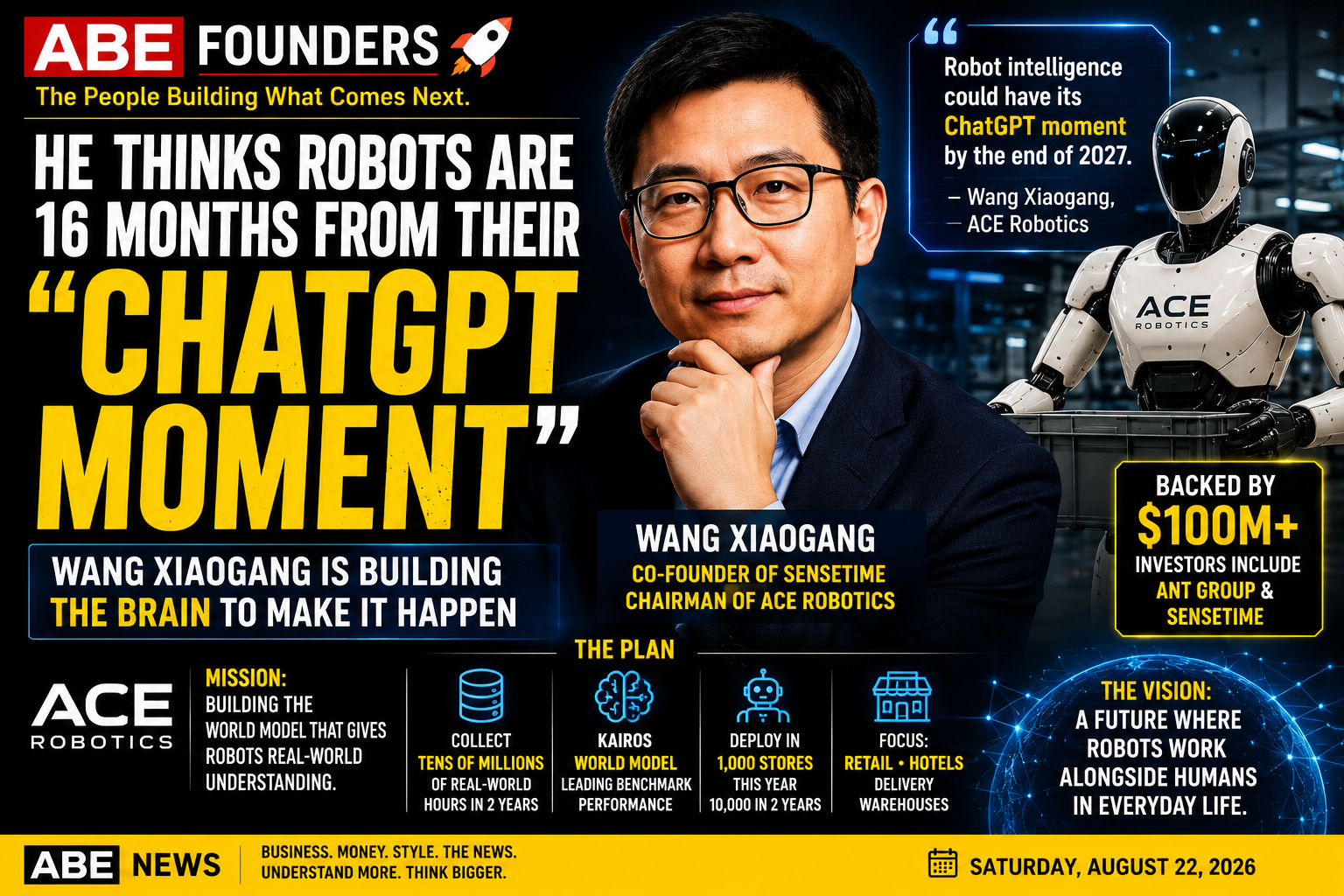
Wang, one of China’s prominent artificial-intelligence researchers and a co-founder of SenseTime, is now chairman of ACE Robotics, a young Shanghai embodied-AI company trying to solve what may be the most important problem in humanoid robotics:
How do you give a robot a brain capable of understanding the physical world?
And Wang has made a remarkably specific prediction.
He believes robotic intelligence could experience its own “ChatGPT moment” by the end of 2027—a breakthrough that suddenly changes what machines are capable of doing and how the world thinks about them.
If he’s right, the next great AI race may not be about software living inside our computers.
It may be about intelligence getting up and walking around.
Before Robots, There Was Computer Vision
Wang’s journey didn’t begin with humanoids.
It began with the question of whether computers could learn to see.
He earned his bachelor’s degree in electronic engineering and information science from the University of Science and Technology of China, an MPhil from the Chinese University of Hong Kong and a PhD in computer science from MIT in 2009. He later joined CUHK’s Department of Electronic Engineering, where he became a professor.
His research career centered heavily on computer vision—the field concerned with teaching machines to interpret images and visual information.
That work eventually helped lead Wang and other researchers into building SenseTime.
SenseTime grew into one of China’s best-known artificial-intelligence companies, developing computer-vision and AI technologies across numerous applications.
Wang remained deeply involved in research. SenseTime’s corporate biography lists him as co-founder, executive director, chief technology officer and executive vice president responsible for overseeing its research team.
Now he’s taking that experience into a considerably harder environment.
Because recognizing something in a photograph is one problem.
Recognizing an object, understanding where it is, predicting what will happen if you touch it, deciding how to pick it up and physically executing that movement is another.
That’s the world of embodied AI.
The Robot Industry Has Built Impressive Bodies
Look around China’s robotics industry today and you’ll find increasingly impressive hardware.
Companies are developing humanoids capable of walking, running and performing complicated physical movements.
China already accounts for an estimated 82% of global humanoid-robot shipments, according to IDC figures reported by Reuters.
But there’s a growing realization inside the industry:
A great body isn’t enough.
A robot might perform an impressive choreographed demonstration and still struggle badly when placed inside an unpredictable store, hotel or factory.
Move an object.
Change the lighting.
Introduce a task it hasn’t encountered.
Ask it to recover from a mistake.
Suddenly, the problem becomes much harder.
That is the opportunity Wang is pursuing.
ACE Wants to Build the Brain
ACE Robotics was founded in July 2025, according to Reuters, and Wang serves as its chairman.
The company’s philosophy can essentially be summarized like this:
Let other manufacturers build the bodies. ACE wants to make those bodies intelligent.
Its technology centers around an embodied-AI system called Kairos.
Rather than simply recognizing objects, a world model attempts to develop an internal representation of an environment—understanding relationships between objects and predicting what could happen next.
ACE describes its approach as combining environmental data, real-world cognition and embodied interaction. Its Kairos system integrates multimodal understanding, generation and prediction as part of an architecture intended to help machines reason about physical environments.
Think about something as simple as picking up a bottle.
A human sees it and almost unconsciously understands:
That’s a bottle.
It’s sitting on the table.
It’s probably solid.
My hand needs to move toward it.
My fingers need to close around it.
If I apply too little pressure, I’ll drop it.
If something blocks my arm, I need another path.
Humans accumulate that physical understanding from years of living in the world.
Robots don’t.
And that leads directly to what Wang thinks may be the industry’s biggest bottleneck.
Robots Have a Data Problem
ChatGPT and other large language models became possible partly because humanity had already created enormous quantities of text.
Books.
Websites.
Articles.
Forums.
Documents.
Code.
The internet effectively became a gigantic training resource for machines learning language.
Robotics doesn’t have an equivalent dataset for physical experience.
Wang estimates that the industry currently has only around 100,000 hours of useful real-world embodied training data.
ACE wants to change that dramatically.
The company’s ambition is to collect tens of millions of hours within two years, using lightweight sensors worn by people performing ordinary work in real environments.
That’s a clever strategic choice.
Instead of waiting for expensive robots to perform every task millions of times, ACE can potentially observe humans doing those tasks and turn those experiences into training material.
The bet is essentially:
If the internet helped teach AI how humans communicate, perhaps human activity can help teach robots how humans interact with the physical world.
And if ACE can build one of the largest useful datasets around that behaviour, the data itself could become an enormous competitive advantage.
Investors Are Paying Attention
ACE is barely a year old.
Yet Reuters reports that it has already raised more than $100 million in 2026, with backing from investors including Ant Group and SenseTime.
Its February angel financing was led by Ant Group and included Qiming Venture Partners, JinJing Capital, Hony Capital, Lenovo Capital and Shanghai Jiao Tong University Mother Fund Hanyuan Asset, while an existing SenseTime-related shareholder increased its investment.
That’s serious capital for a very young company.
But Wang isn’t talking only about laboratory research.
He wants commercial deployment.
ACE is targeting applications including retail, hotels and delivery warehouses, and Wang says the company wants its systems deployed in at least 1,000 stores over the coming year and 10,000 within two years.
That commercial test is crucial.
Because China’s humanoid industry is currently confronting an uncomfortable question:
Can these robots actually make money?
Reuters reports that industrial humanoids can currently cost roughly 300,000 to 500,000 yuan, while one brokerage estimates that a robot may need an all-in cost closer to 160,000 yuan to achieve a two-year payback against certain human labour costs.
Amazing demonstrations don’t automatically create sustainable businesses.
Customers ultimately need productivity.
Why Wang Says 2027 Could Change Everything
When ChatGPT appeared publicly in late 2022, large language models weren’t invented overnight.
Researchers had worked on the underlying technologies for years.
But ChatGPT represented an inflection point.
Suddenly, ordinary people could interact with powerful generative AI themselves.
The technology became tangible.
Investment exploded.
Companies changed strategies.
Governments started paying attention.
Entire industries began asking what AI meant for them.
Wang believes embodied intelligence could experience a similar technological inflection by the end of 2027.
But he’s also more cautious than the headline might suggest.
He doesn’t expect a breakthrough in robot intelligence to mean humanoids instantly appear everywhere.
Wang estimates widespread commercial adoption could take another four to five years after the technological breakthrough.
That’s an important distinction.
Breakthrough doesn’t mean deployment.
The technology still needs to become reliable.
Manufacturing needs to scale.
Hardware needs to become cheaper.
Businesses need to discover profitable applications.
Regulators need to establish rules.
Customers need to trust the machines.
And companies need to prove that robots can create more economic value than they cost.
The Biggest Risk: The Robot Hype Machine
There’s enormous money chasing humanoid robotics right now.
That creates opportunity.
It also creates hype.
China’s robots have become famous for spectacular demonstrations, but Reuters reports that some analysts estimate 50% to 70% of humanoids produced this year could end up primarily inside “data factories” collecting training information rather than performing economically productive work for paying customers.
That is a warning worth remembering.
The industry doesn’t win simply because robots look increasingly human.
It wins when somebody can answer:
What job does this machine perform?
How reliably?
How much does it cost?
How much money does it save or generate?
ACE will ultimately face exactly those questions.
A world-leading benchmark doesn’t automatically create a world-leading business.
Neither does $100 million of investment.
The technology has to leave the research environment and produce value in the real economy.
And that’s what makes Wang’s next few years fascinating.
🚀 THE FOUNDER LESSON
There’s a lesson in Wang Xiaogang’s strategy that extends far beyond robotics.
Don’t always build the thing everybody can see. Find the bottleneck preventing the entire industry from moving forward.
Hundreds of companies can compete to build increasingly impressive robot bodies.
Wang is asking a different question:
What if the real shortage isn’t bodies at all?
What if it’s intelligence?
And then he goes one level deeper.
What if the bottleneck preventing better intelligence is actually data?
That’s founder thinking.
Start with the enormous market.
Find what is stopping that market from working.
Then build directly at the constraint.
For ACE, the chain looks something like:
Robots need intelligence → intelligence needs models → models need experience → experience requires enormous amounts of real-world data.
So instead of merely building another humanoid, ACE is trying to own pieces of the intelligence and data infrastructure that could potentially work across many robot platforms.
Whether that strategy succeeds is far from guaranteed.
But the question behind it is powerful:
When everyone is competing to build the obvious product, what invisible problem will all of those products eventually need solved?
Sometimes that’s where the bigger company is waiting.
🔴 THE ABE FOUNDERS TAKE
Wang Xiaogang isn’t interesting because he predicted a date.
Predictions can be wrong.
He’s interesting because of what he’s betting on.
The first era of modern AI taught computers to recognize the world.
The generative-AI era taught machines to create and communicate.
Embodied AI is attempting something harder:
giving intelligence a physical presence.
If that works, AI stops being something we primarily access through screens.
It starts moving through factories.
Warehouses.
Hotels.
Stores.
Hospitals.
Eventually perhaps homes.
The companies that dominate that future may not necessarily be the companies that manufacture the strongest arms or fastest legs.
They could be the ones that create the intelligence telling those arms and legs what to do.
Wang thinks that turning point could arrive by the end of 2027.
Maybe he’s right.
Maybe he’s early.
Maybe the technological problems prove far harder than today’s investment frenzy suggests.
But that’s exactly why we’re starting ABE FOUNDERS with him.
Because founders aren’t merely building businesses around the world we already have.
The most interesting ones are making bets about what the world might become next.
🚀 ABE FOUNDERS
The People Building What Comes Next.
A Saturday feature from ABE NEWS