








ABE NEWS | August 31, 2026
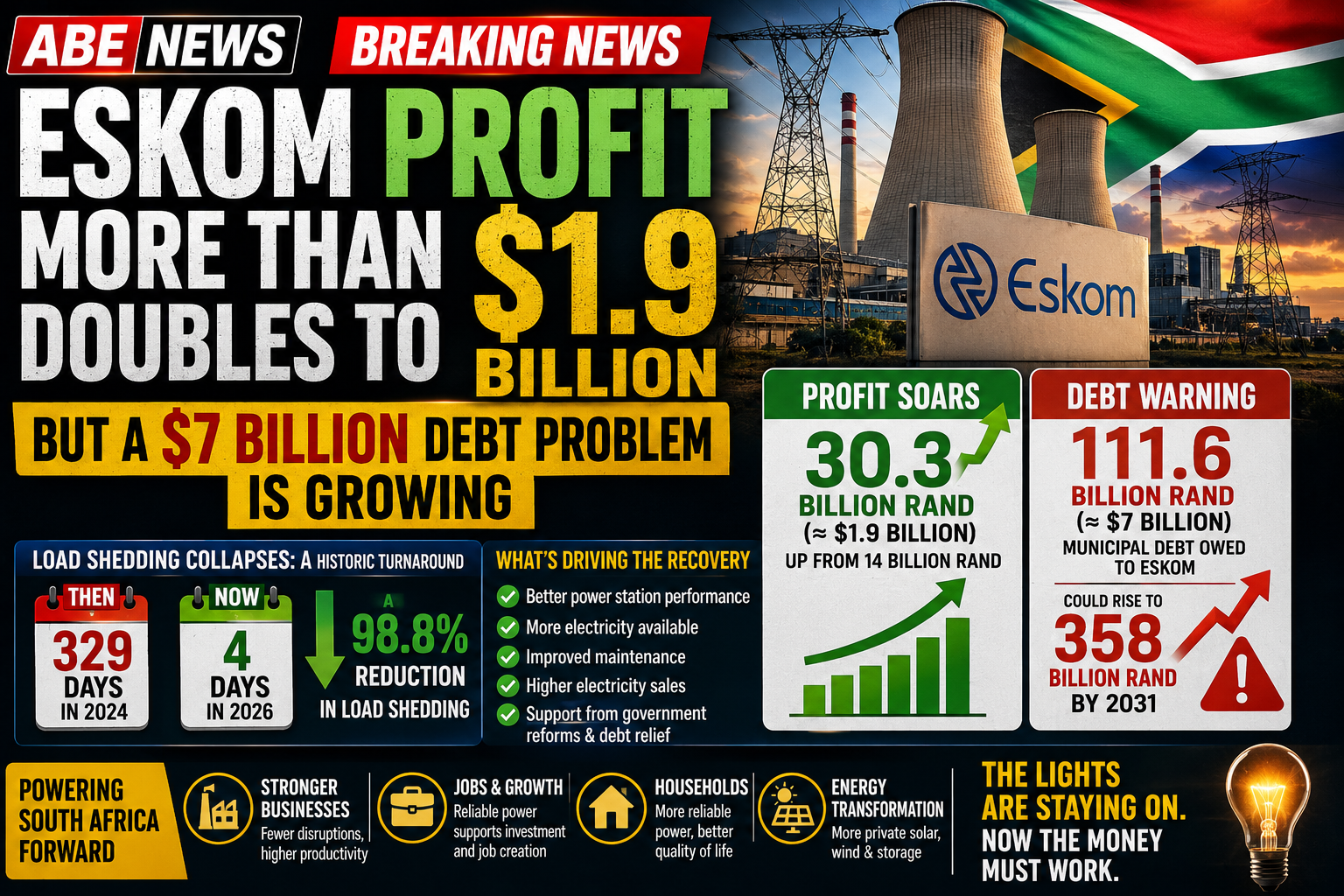
South Africa’s long-troubled electricity giant Eskom has delivered one of the most dramatic financial turnarounds in its recent history, more than doubling annual profit to 30.3 billion rand — roughly US$1.9 billion — as power shortages collapsed, electricity sales improved and years of government intervention began producing visible results.
For South Africans accustomed to blackouts, financial crises and repeated warnings about the future of the national electricity system, the numbers are striking.
Eskom’s net profit rose from approximately 14 billion rand the previous year to 30.3 billion rand in the financial year ending March 2026.
But perhaps the more remarkable number is this:
South Africa experienced only four days of load shedding during the year.
In 2024, there had been 329 days.
That represents an extraordinary operational improvement for a country where rolling blackouts had become so common that households, factories, mines, shopping centres and small businesses increasingly treated electricity outages as a normal part of economic life.
Yet underneath Eskom’s comeback is another number that could threaten the entire turnaround.
South African municipalities now owe the utility approximately 111.6 billion rand — around US$7 billion.
And Eskom warns that without serious intervention, that debt could explode to approximately 358 billion rand by 2031.
So South Africa’s electricity story has entered a fascinating new phase.
The immediate crisis of keeping the lights on has dramatically improved.
Now the country has to solve the financial crisis underneath the power system.
FROM NATIONAL CRISIS TO 30.3 BILLION RAND PROFIT
Eskom sits at the centre of South Africa’s economy.
The state-owned company produces most of the country’s electricity and operates a vast system of power stations, transmission infrastructure and other assets necessary to keep Africa’s most industrialized economy functioning.
For years, however, Eskom became almost synonymous with crisis.
Its ageing coal-fired power stations suffered repeated breakdowns.
Maintenance problems accumulated.
New generating projects were delayed and became extraordinarily expensive.
Debt increased.
Corruption scandals damaged the company.
And the electricity system increasingly struggled to produce enough power to meet national demand.
The result was load shedding.
When Eskom could not produce enough electricity, it deliberately switched off power to different parts of the country in rotating blocks to prevent the entire grid from collapsing.
At its worst, the crisis affected almost every part of South African life.
Businesses purchased diesel generators.
Families bought batteries and solar panels.
Restaurants lost refrigerated food.
Factories interrupted production.
Telecommunications infrastructure required backup power.
Traffic lights stopped working.
Mining operations faced disruptions.
Entrepreneurs calculated business hours around electricity schedules.
The economic damage became enormous.
That is why Eskom’s latest numbers represent more than an accounting improvement.
They suggest that one of South Africa’s biggest structural economic problems has become significantly more manageable.
ONLY FOUR DAYS OF LOAD SHEDDING
The collapse in load shedding is arguably more important than the profit itself.
South Africa experienced just four days of scheduled power cuts during Eskom’s latest financial year, compared with 329 days in 2024.
The improvement reflects better performance from the company’s generation fleet, stronger maintenance and increased electricity availability.
Eskom’s energy availability factor — a measure of how much of its generating capacity is actually available — has improved substantially from the worst years of the crisis.
That means more power stations are operating when they are supposed to.
For an electricity company, that sounds basic.
For Eskom, it represents years of difficult repair work.
South Africa’s electricity system had deteriorated to the point where unexpected breakdowns at ageing coal plants routinely removed enormous amounts of generating capacity from the grid.
Improving reliability changes the entire economic environment.
Businesses no longer need to assume electricity will disappear several times a day.
Factories can schedule production more confidently.
Retailers spend less on diesel.
Small companies lose fewer working hours.
Investors face less infrastructure risk.
And households regain something that should never have become unusual:
reliable electricity.
WHY ELECTRICITY MATTERS SO MUCH TO SOUTH AFRICA’S ECONOMY
Energy is not simply another sector.
It sits underneath almost every other sector.
A mine needs electricity.
A factory needs electricity.
A data centre needs electricity.
A bank needs electricity.
A supermarket needs electricity.
A telecommunications network needs electricity.
A hospital needs electricity.
When a country’s electricity system becomes unreliable, almost every business effectively pays an additional tax.
Companies buy generators.
They purchase fuel.
They install solar systems.
They invest in batteries.
They lose production during outages.
Equipment can be damaged when electricity disappears unexpectedly.
Employees become less productive.
Those costs eventually reach consumers.
South Africa’s electricity crisis therefore acted as a brake on economic growth for years.
Solving it could have the opposite effect.
Reliable electricity could become an economic stimulus without the government issuing a single cheque.
Companies simply spend less money protecting themselves from the power system.
SOUTH AFRICANS HELPED SOLVE THE CRISIS THEMSELVES
There is another reason load shedding has declined.
South Africans increasingly created their own electricity.
Businesses and households invested heavily in rooftop solar, batteries and private renewable-energy projects as Eskom’s reliability deteriorated.
That reduced demand on the national grid.
Large companies also pursued private power-purchase agreements.
Mining groups, manufacturers, shopping centres and other major electricity users began looking for alternatives to complete dependence on Eskom.
South Africa also relaxed regulations governing private electricity generation.
The result has been a gradual transformation of the country’s energy market.
Eskom remains dominant.
But it is no longer the only meaningful source of electricity investment.
That competition creates both an opportunity and a problem for the company.
Private generation helps stabilize the country’s electricity supply.
But customers producing more of their own power buy less electricity from Eskom.
The utility therefore has to become financially sustainable in an energy system where its monopoly position is gradually weakening.
THE 111.6 BILLION RAND PROBLEM
That brings us to Eskom’s biggest warning.
Municipal debt.
South Africa’s municipalities collectively owe Eskom approximately 111.6 billion rand for electricity.
The structure of the system helps explain how this happens.
In many parts of South Africa, Eskom supplies electricity to municipalities.
Municipalities then distribute that power to residents and businesses and collect payments from customers.
But some municipalities fail to transfer all the money they owe Eskom.
Over time, unpaid bills accumulate.
The amounts have become enormous.
Eskom now warns that municipal arrears could reach approximately 358 billion rand by 2031 if the problem is not addressed.
For perspective, that would be more than three times today’s already massive balance.
A company can produce electricity efficiently.
It can repair its power stations.
It can reduce blackouts.
It can increase sales.
But if customers responsible for billions of dollars in payments do not pay their bills, the financial system eventually breaks again.
That is why Eskom’s turnaround remains fragile.
WHY MUNICIPALITIES AREN’T PAYING
The debt problem reflects deeper weaknesses in local government.
Some municipalities struggle to collect electricity payments from residents.
Others face poor financial management.
Some communities have high unemployment and poverty, making household bills difficult to pay.
Illegal electricity connections and theft create additional losses.
In other cases, municipalities collect electricity revenue but use some of the money for other expenses instead of paying Eskom.
That creates a chain of financial weakness.
Residents owe municipalities.
Municipalities owe Eskom.
Eskom owes lenders and suppliers.
The national government ultimately faces pressure to intervene because allowing the country’s electricity company to collapse is not an option.
That means unpaid municipal electricity bills can eventually become a national fiscal problem.
THE GOVERNMENT HAS ALREADY SPENT BILLIONS RESCUING ESKOM
South Africa has already committed enormous public resources to stabilizing the utility.
Years of debt accumulation left Eskom unable to finance itself sustainably without government support.
The government introduced a debt-relief programme worth hundreds of billions of rand to reduce the company’s financial burden and allow management to focus on repairing the electricity system.
That intervention helped create the conditions behind today’s improvement.
But government support cannot permanently compensate for customers who do not pay.
If municipal debt continues climbing toward 358 billion rand, taxpayers could eventually find themselves confronting another rescue.
That would undermine much of the progress already made.
The next stage of Eskom’s turnaround therefore depends less on fixing turbines and more on fixing the financial relationships between the utility, municipalities and electricity customers.
SOUTH AFRICA IS REBUILDING ITS ENTIRE ELECTRICITY MARKET
The transformation goes beyond Eskom’s balance sheet.
South Africa is gradually restructuring the electricity industry itself.
Historically, Eskom dominated generation, transmission and large parts of distribution.
The country is now moving toward a system with greater private participation and a more independent transmission structure.
That matters because the future South African grid will likely contain a much more diverse mix of energy producers.
Coal will remain important for years.
But renewable energy is expanding.
Solar power is growing rapidly.
Wind projects are increasing.
Battery storage is becoming more important.
Private generators are entering the market.
Businesses are signing direct power agreements.
And transmission infrastructure will need enormous investment to connect new projects to the grid.
South Africa’s energy future therefore looks fundamentally different from its past.
The country isn’t simply repairing Eskom.
It is redesigning the electricity market around it.
THE COAL QUESTION ISN’T GOING AWAY
Eskom remains heavily dependent on coal.
South Africa has one of the world’s most coal-intensive electricity systems, and coal-fired power stations still provide most of the country’s generation.
That creates another enormous challenge.
Many of those plants are old.
They require expensive maintenance.
They produce large amounts of carbon emissions.
And international climate commitments are increasing pressure on South Africa to transition toward cleaner energy.
But closing coal plants too quickly could recreate the electricity shortages the country has spent years trying to escape.
South Africa therefore faces an extraordinarily difficult balancing act.
It needs reliable power.
It needs affordable power.
It needs economic growth.
It needs jobs.
And it needs to reduce emissions.
Those goals do not always move in the same direction.
A rapid transition away from coal could threaten reliability.
A slow transition could threaten climate commitments and future access to certain forms of international financing.
The solution will require enormous investment in renewables, transmission, storage and potentially other generation technologies.
THERE IS AN INVESTMENT OPPORTUNITY INSIDE THE PROBLEM
South Africa’s energy transformation could become one of Africa’s largest infrastructure investment opportunities.
The country needs new generation.
It needs transmission lines.
It needs grid technology.
It needs batteries.
It needs solar installations.
It needs wind projects.
It needs smart meters.
It needs energy-management software.
It needs financing.
And it needs companies capable of building and maintaining all of it.
That creates opportunities for local entrepreneurs and international investors.
The same crisis that damaged South Africa’s economy also forced the country to accelerate energy reform.
If those reforms continue, South Africa could eventually emerge with a more competitive, diversified and technologically advanced electricity market than the Eskom-dominated system that existed before the crisis.
But getting there will require enormous amounts of capital.
ESKOM’S COMEBACK COULD HELP SOUTH AFRICA GROW
South Africa has struggled with weak economic growth for years.
Electricity shortages were not the only reason.
The country also faces unemployment, infrastructure problems, logistics bottlenecks, inequality and political uncertainty.
But unreliable electricity made almost every other problem harder.
Removing that constraint matters.
A manufacturer considering a new South African factory can make very different calculations if it believes power will remain available.
A mining company can expand more confidently.
A technology company can operate data infrastructure more reliably.
A small business can spend money hiring workers instead of buying diesel.
Reliable energy alone will not transform South Africa’s economy.
But sustained unreliable energy almost guarantees weaker growth.
That is why Eskom’s operational recovery could become economically significant far beyond the electricity industry.
AFRICA IS WATCHING
The story also carries lessons for the rest of the continent.
Electricity shortages remain one of Africa’s largest development constraints.
Hundreds of millions of people still lack reliable access to power.
Businesses in many countries rely on generators.
Factories face high electricity costs.
Weak transmission networks limit industrial development.
South Africa demonstrates both sides of the problem.
It shows how damaging an electricity crisis can become even in one of Africa’s most industrialized economies.
But it may also demonstrate how investment, maintenance, private generation and structural reform can begin reversing the decline.
If Eskom’s recovery proves sustainable, other African governments will study what worked.
And they will study what didn’t.
Because South Africa has not solved everything.
The lights may be staying on.
The money still has to work.
THE NEXT BATTLE ISN’T GENERATION — IT’S COLLECTION
For years, South Africa’s electricity question was straightforward:
Can Eskom produce enough electricity?
Increasingly, the answer appears to be yes.
Now the question is changing:
Can Eskom get paid for it?
That may sound less dramatic than rolling blackouts.
It isn’t.
A utility that cannot collect revenue cannot maintain power stations.
It cannot build infrastructure.
It cannot repay debt.
It cannot attract capital.
Eventually, financial failure becomes operational failure.
That is why the municipal debt crisis deserves as much attention as Eskom’s 30.3 billion rand profit.
One number describes the recovery.
The other describes the threat to it.
🔴 THE ABE NEWS TAKE
South Africa should celebrate what happened to load shedding.
Going from 329 days of power cuts to just four is not a small improvement.
It is a transformation.
For years, Eskom’s crisis became a symbol of South Africa’s economic frustration: enormous potential undermined by failing infrastructure, debt, corruption and poor management.
Today, the picture looks different.
Power stations are performing better.
Blackouts have collapsed.
Profit has more than doubled.
Private electricity generation is expanding.
And South Africa is slowly redesigning its energy system.
That is real progress.
But Eskom’s 111.6 billion rand municipal debt is a warning against declaring victory too early.
If that number really climbs toward 358 billion rand by 2031, South Africa could repair the engineering problem only to recreate the financial crisis that helped cause it.
The next phase therefore requires something less visible than repairing power stations but just as important:
making the electricity economy financially functional.
Customers need to pay municipalities.
Municipalities need to pay Eskom.
Eskom needs to invest in the grid.
Private producers need fair access.
And government needs to complete reforms without destabilizing electricity supply.
South Africa has spent years asking when the lights will stay on.
For the first time in a long time, that question is becoming less urgent.
Now comes the harder question:
Can South Africa build an electricity system that stays financially healthy once the lights are on?
Eskom’s 30.3 billion rand profit says the turnaround is real.
Its 111.6 billion rand municipal debt says the turnaround is not finished.
And for Africa’s most industrialized economy, what happens next could determine whether reliable electricity finally becomes a foundation for faster growth — or whether another crisis is quietly accumulating underneath the grid.
ABE NEWS
Business. Money. Style. The News.
Understand More. Think Bigger.