






For years, Intel was considered one of the world’s most dominant technology companies.
Its processors powered millions of personal computers, data centres, and enterprise systems around the globe.
Today, however, the company finds itself fighting to reclaim that position in an industry transformed by artificial intelligence.
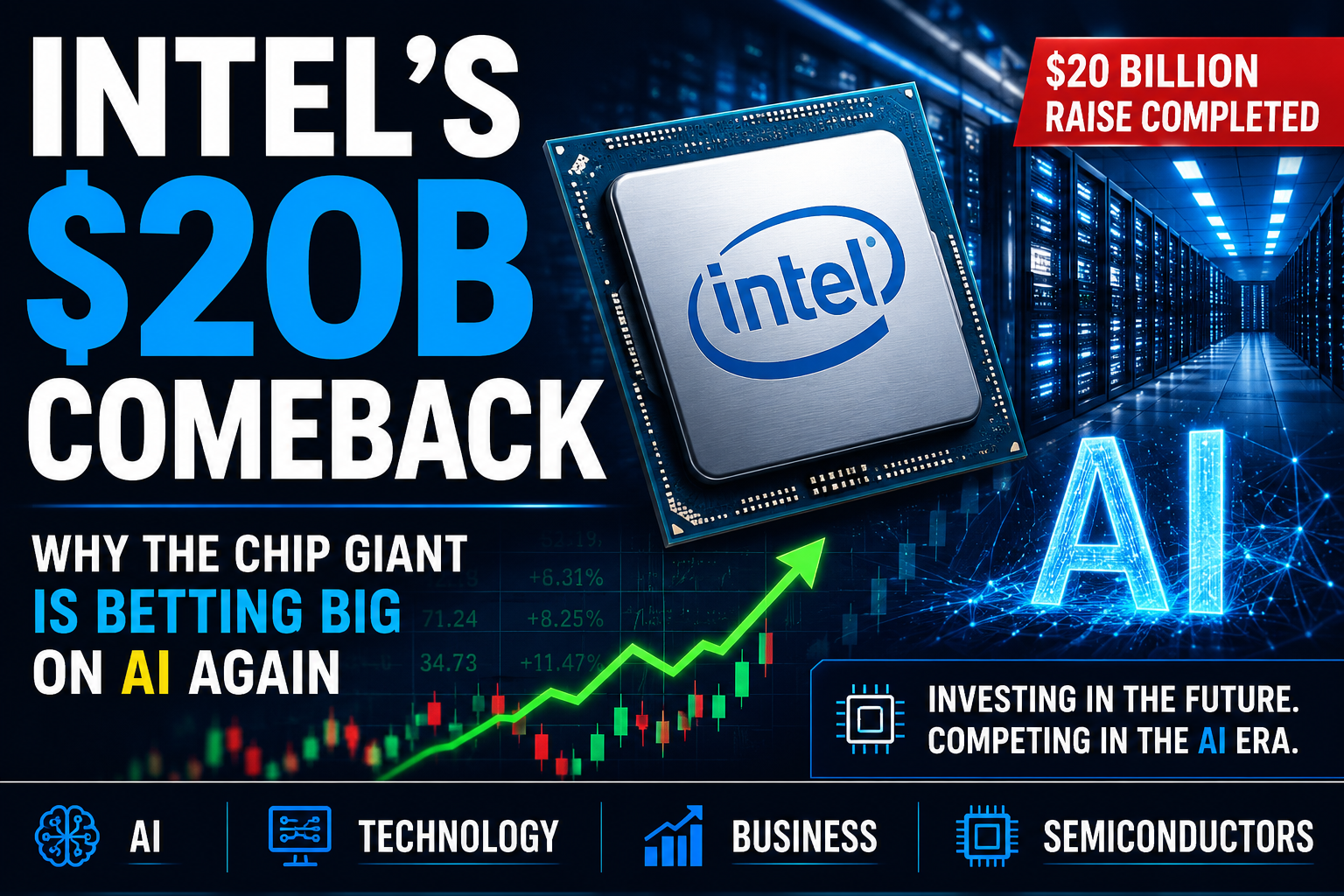
This week, Intel completed a nearly $20 billion stock offering, its largest since 1971, as it raises capital to strengthen its finances and accelerate investments in AI and semiconductor manufacturing. The move reflects one of the biggest strategic shifts in the company’s history. (investopedia.com)
At first glance, this may seem like another fundraising announcement.
It isn’t.
It is a signal that one of Silicon Valley’s oldest giants is preparing for a new era of competition.
Why Intel Needs the Money
The semiconductor industry has changed dramatically over the past few years.
Artificial intelligence has created an enormous demand for high-performance chips capable of training and running advanced AI models.
While companies like Nvidia have surged ahead by supplying much of the hardware behind today’s AI boom, Intel has struggled to keep pace.
The new funding gives Intel greater financial flexibility to invest in research, manufacturing capacity, and next-generation chip development while improving its balance sheet. (investopedia.com)
The AI Race Has Changed Everything
Artificial intelligence has become the biggest driver of growth in the semiconductor industry.
Cloud providers, governments, research institutions, and businesses are spending billions of dollars on AI computing infrastructure.
That demand has reshaped the competitive landscape.
Companies are no longer competing only to build faster computer processors.
They are competing to power the future of artificial intelligence.
For Intel, adapting to this shift is no longer optional.
It is essential.
Why Investors Are Paying Attention
Raising nearly $20 billion is more than a financing event.
It signals that Intel is preparing for long-term investment rather than short-term survival.
Large capital raises allow companies to expand manufacturing, develop new technologies, and position themselves for future growth.
Investors will now be watching whether Intel can translate that investment into stronger products and improved market performance.
Why This Matters Beyond Technology
Semiconductors sit at the centre of today’s digital economy.
They power:
- Artificial intelligence
- Smartphones
- Personal computers
- Data centres
- Electric vehicles
- Industrial automation
- Medical equipment
When chip companies invest, the effects often spread across multiple industries.
A stronger semiconductor sector can support innovation, productivity, and economic growth far beyond technology itself.
What This Means for Businesses
Businesses are becoming increasingly dependent on advanced computing.
From manufacturers using AI-powered automation to financial institutions processing large volumes of data, access to faster and more efficient chips has become a competitive advantage.
Intel’s renewed investment highlights how important semiconductor innovation has become for companies looking to remain competitive in an AI-driven economy.
The Bigger Picture
The semiconductor industry has entered a new chapter.
Success is no longer measured only by processor speed.
It is measured by a company’s ability to support artificial intelligence at scale.
Intel’s decision to raise nearly $20 billion reflects a broader reality.
The race to build the future of AI will require enormous amounts of capital, innovation, and long-term commitment.
For technology companies, standing still is no longer an option.
What’s Next?
Intel now faces the more difficult challenge.
Raising capital is only the beginning.
The real test will be whether the company can deliver competitive products, expand its manufacturing capabilities, and regain investor confidence in a rapidly changing semiconductor market.
The next few years could determine whether Intel reclaims its position among the world’s technology leaders—or continues to lose ground to faster-moving competitors.
THE ABE NEWS TAKE
The AI revolution is creating winners and forcing others to reinvent themselves.
Intel’s latest move shows that even the largest technology companies cannot rely on past success.
Markets reward innovation, not history.
Businesses that continue investing in the future are more likely to remain competitive than those trying to protect yesterday’s leadership.
Intel’s comeback is not guaranteed.
But its willingness to invest billions suggests the company understands one thing clearly:
In the AI era, the cost of standing still is often greater than the cost of change.
ABE NEWS
Business. Money. Style. The News.
Understand More. Think Bigger.