









ABE NEWS | August 27, 2026
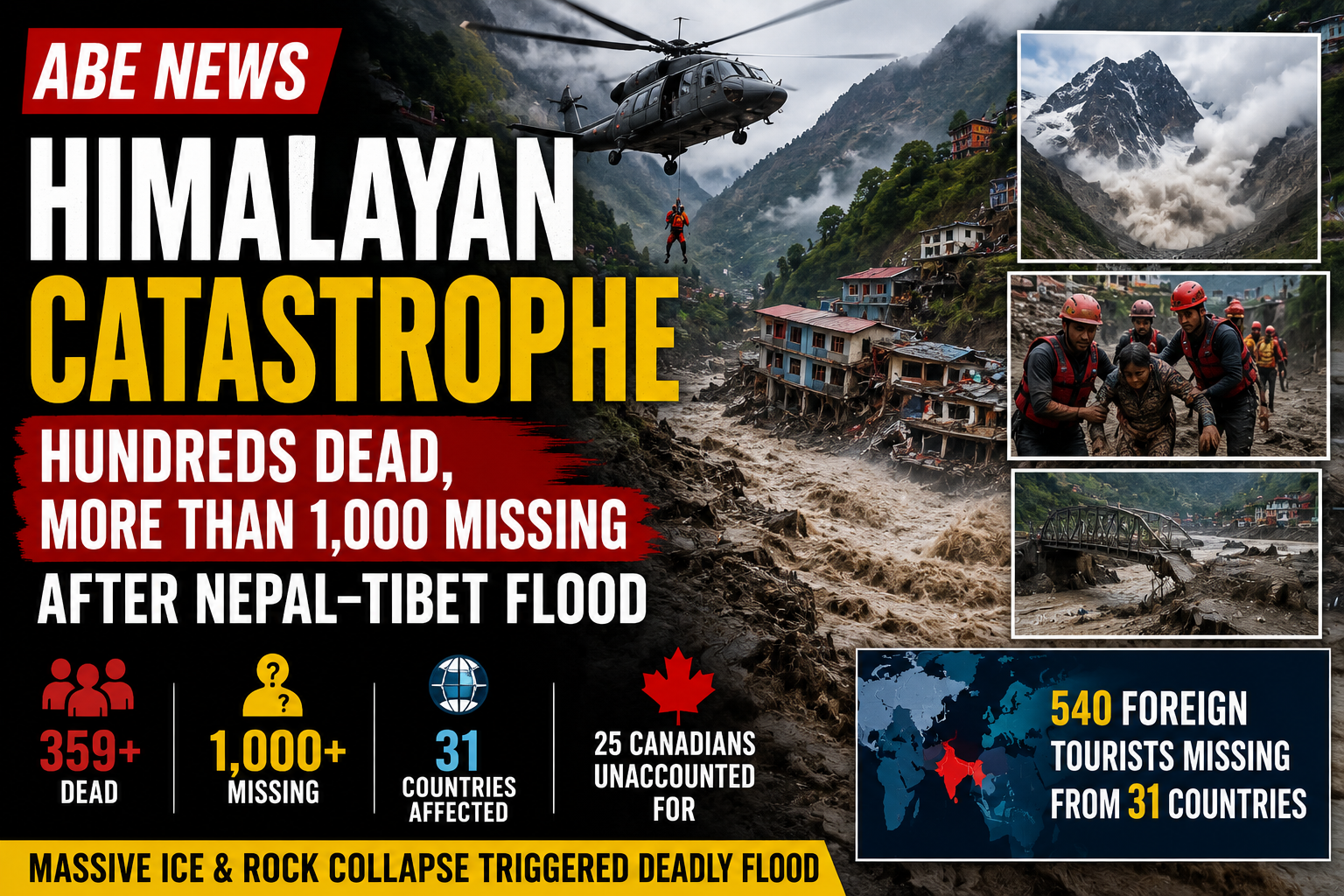
A catastrophic wall of ice, rock and mud has torn through the Himalayan border region between Nepal and China’s Tibet, killing hundreds of people, destroying communities and leaving more than 1,000 people missing as rescuers race against time to find survivors.
The scale of the disaster continued to grow Thursday.
Nepalese police said 359 people had died, while hundreds more remained unaccounted for across Nepal and Tibet. Helicopters were flying over devastated valleys, delivering emergency supplies and searching for people stranded after roads, bridges, homes and power infrastructure were swept away.
The disaster began Wednesday when a high-altitude collapse of glacier ice and rock sent an enormous mass of debris into a mountain river near the Nepal–Tibet border. The resulting torrent raced downstream with extraordinary force, devastating settlements along a corridor used by residents, tourists, trekkers and religious pilgrims.
And the danger may not be over.
Nepal’s disaster management authority has warned that debris from the catastrophe has blocked another river and created a rising lake, raising fears that the natural dam could fail and unleash another flood downstream. Authorities have urged residents and rescue workers near the Bhotekoshi River to move away from vulnerable areas.
What began as a remote Himalayan disaster has now become an international emergency.
Hundreds of foreign visitors from dozens of countries are among those still missing.
A Wall of Ice, Rock and Mud
The catastrophe unfolded with terrifying speed.
Investigators say a high-altitude collapse of glacier ice and rock triggered a debris flow that rushed through the mountains before becoming a massive mudslide and flash flood.
A Chinese government geologist cited by Reuters estimated that the debris travelled at approximately 50 metres per second — about 180 kilometres per hour — as it moved through the mountain system.
The destructive flow extended for more than 20 kilometres before striking infrastructure and communities around the Nepal–China border.
People in its path had almost no time to escape.
Verified footage from the border region showed enormous masses of mud, rock and water engulfing buildings, roads and vehicles.
Entire riverside settlements were swept away.
Homes disappeared.
Bridges collapsed.
Hydropower infrastructure was damaged.
Vehicles were carried downstream.
And in some places, virtually everything standing near the river was flattened.
The devastation then continued far beyond the original disaster zone.
Authorities in Chitwan district, roughly 100 kilometres from the worst-hit region, reported recovering more than 100 bodies carried downstream through the river system. Local hospitals struggled with the number of victims, forcing officials to establish temporary facilities where families could identify and claim relatives.
Hundreds Dead — And the Toll Could Rise
The number of confirmed deaths has climbed rapidly as rescue teams reach areas previously cut off by destroyed roads and communications.
Nepalese police said Thursday that 359 people had died.
The situation across the border in Tibet remained extremely serious as well.
Chinese state broadcaster CCTV reported 558 people missing in Tibet’s Gyirong County, including 260 foreign nationals.
The full scale of the disaster remains uncertain.
The Red Cross warned that entire villages had been destroyed while damaged roads and bridges were making it extremely difficult for emergency crews to reach some affected communities.
That means the casualty figures could continue changing as search teams gain access to isolated valleys and settlements.
For thousands of families, the waiting has become agonizing.
Some have gathered near rescue operations looking for information about missing relatives. Others around the world are trying desperately to establish contact with family members who had been travelling through the region.
Hundreds of Foreign Tourists Are Missing
The Himalayan disaster has quickly become a global tragedy because the affected region attracts large numbers of international visitors.
The route connects Kathmandu with Lhasa in Tibet and is popular with tourists, trekkers and religious pilgrims.
By Thursday, Nepalese tourism officials said 540 foreigners from 31 countries were among 667 tourists missing in Nepal.
India has been particularly badly affected.
Hundreds of Indian nationals were reported missing or stranded, many of them travelling through the region as religious pilgrims.
Chinese nationals were also among those missing in Nepal, while large groups of Americans, Malaysians, Australians, Britons and visitors from numerous other countries remained unaccounted for.
Authorities did report some hopeful developments.
Nepal’s government said rescue teams had located 100 missing Indian visitors, mostly pilgrims, along with 25 Chinese workers in the worst-hit region around Trishuli.
But hundreds of foreigners were still missing.
Canadians Are Among the Missing
The catastrophe has also reached Canada.
Reuters reported Thursday that 25 Canadians remained unaccounted for in Nepal, based on the latest figures cited in its reporting.
The number has changed as authorities reconcile lists of tourists and locate survivors, illustrating how fluid the situation remains.
Canadian Prime Minister Mark Carney described the flooding as devastating as Canadian authorities followed developments and efforts to account for citizens in the region.
For families in Canada and dozens of other countries, the disaster is therefore no longer a distant international headline.
They are waiting to find out whether relatives travelling through one of the world’s most spectacular mountain regions survived.
A Sacred Pilgrimage Route Becomes a Disaster Zone
Many of those caught in the catastrophe were travelling toward Kailash Mansarovar, one of Asia’s most important religious pilgrimage destinations.
Mount Kailash and nearby Lake Mansarovar in Tibet hold deep spiritual importance across several religions.
For Hindus, Mount Kailash is traditionally associated with Lord Shiva.
The region is also sacred to Buddhists, Jains and followers of the Bon tradition.
That makes the route a destination for thousands of pilgrims who travel through Nepal toward Tibet despite the challenging high-altitude environment.
Now families are searching for members of pilgrimage groups who were travelling through the area when the flood struck.
Reuters reported Thursday on families in India desperately seeking information after groups of pilgrims disappeared during the catastrophe.
The disaster has transformed what was supposed to be a spiritual journey into an international search-and-rescue operation.
Was It an Earthquake? Investigators Say No
One of the earliest mysteries surrounding the catastrophe concerned what actually triggered it.
Initial reports suggested that an earthquake might have caused part of a glacier to collapse.
A seismic event initially estimated at magnitude 4.4 appeared to have occurred around the time of the disaster.
But the U.S. Geological Survey later concluded that what instruments detected was not a conventional earthquake.
Instead, the seismic energy was generated by the enormous collapse of glacial rock and ice itself, followed by the movement of debris through the mountains.
Satellite analysis subsequently indicated that a landslide involving ice and rock had triggered a debris-heavy flood in the Lhende River northeast of the Nepal–China border crossing.
Chinese authorities have also identified a high-altitude glacier collapse as the trigger for the disaster.
That finding has shifted attention toward another major issue facing the Himalayas:
the increasing instability of high-mountain environments.
Climate Change Raises a Bigger Question
Scientists caution that attributing any individual disaster entirely to climate change requires careful analysis.
But experts say warming temperatures are creating conditions that can destabilize mountain ice and rock, potentially increasing the likelihood of cascading disasters involving glaciers, landslides and floods.
Simon Cox, chief scientist with Earth Sciences New Zealand’s Mountains to Sea programme, told Reuters that climate change is producing conditions capable of destabilizing high-mountain rock and ice.
The Himalayas are particularly vulnerable.
The mountain range contains enormous quantities of ice outside the polar regions and supplies river systems relied upon by hundreds of millions of people across Asia.
As temperatures rise, glaciers retreat and mountain slopes change.
The result can be a dangerous combination of unstable rock, ice, glacial lakes and increasingly unpredictable water systems.
This week’s catastrophe demonstrates how quickly those hazards can cascade.
A collapse high in the mountains can become a debris flow.
The debris flow can enter a river.
The river can become a destructive wall of mud and rock.
And within minutes, communities many kilometres downstream can be overwhelmed.
Another Flood Threat Is Emerging
Even as rescuers search for survivors from Wednesday’s disaster, authorities are confronting a new threat.
Satellite imagery and preliminary analysis indicate that debris has blocked part of the Bhotekoshi River, creating a lake behind the obstruction.
Water is continuing to accumulate.
Nepal’s disaster management authority warned that the lake could eventually break through the natural barrier, potentially producing another sudden flood downstream.
Residents and emergency personnel in vulnerable areas have been told to move to safer ground.
The warning complicates an already extremely difficult rescue operation.
Teams need to search areas close to rivers and destroyed settlements while simultaneously protecting themselves from another potential surge of water and debris.
Helicopters Become a Lifeline
With roads destroyed and communities isolated, helicopters have become one of the most important tools in the rescue effort.
Aircraft have been searching valleys, transporting survivors and dropping emergency supplies to people cut off from conventional transportation.
In some mountainous areas, however, conditions have made even helicopter operations difficult.
The terrain is steep.
Communications have been damaged.
Electricity has been disrupted.
And entire road networks have disappeared beneath mud or floodwater.
The destruction around the Gyirong border crossing has been particularly severe.
Chinese authorities reported roads, communications and power links cut in the region. The border port is also economically significant because it forms part of a major land connection between China and South Asia.
China’s Premier Li Qiang travelled to the disaster-stricken area Thursday, signalling the seriousness with which Beijing is treating the catastrophe.
International Aid Begins to Arrive
The international response is now accelerating.
Countries and organizations have begun sending emergency supplies, financial assistance and personnel to Nepal.
India has already sent nearly 50 metric tons of disaster-relief supplies, including temporary shelters, blankets, hygiene kits, lamps and medicines.
China has also coordinated emergency assistance and supplies with Nepal.
The United Nations and humanitarian organizations are mobilizing resources as the scale of the catastrophe becomes clearer.
More assistance is likely to be needed.
Thousands of people have been displaced or isolated.
Infrastructure will need to be rebuilt.
Families will require shelter.
Tourists and pilgrims must be located.
And authorities face the difficult task of restoring roads, bridges, electricity and communications across mountainous terrain.
The emergency response could continue for weeks.
Reconstruction will take much longer.
The Economic Damage Could Be Significant
Beyond the human tragedy, the disaster could carry serious economic consequences.
The affected region contains tourism infrastructure, hydropower facilities, transportation links and communities dependent on Himalayan travel and trade.
Tourism is particularly important to Nepal’s economy.
The country attracts trekkers, climbers, pilgrims and adventure travellers from around the world, supporting hotels, guides, transportation companies, restaurants and countless small businesses.
Images of entire settlements destroyed and hundreds of foreign tourists missing could affect travel patterns even after the immediate emergency ends.
Infrastructure damage could also prove expensive.
Roads and bridges through Himalayan terrain are difficult and costly to rebuild.
Damage to hydropower installations could affect electricity production and investment.
The Gyirong crossing is also an important commercial route connecting Tibet with Nepal and forms part of China’s broader Belt and Road network linking it with South Asia.
The economic consequences will become clearer only after emergency teams can fully assess the affected areas.
What Happens Next
For now, everything revolves around the search for survivors.
Rescue teams are attempting to reach communities cut off by landslides and destroyed roads while helicopters continue searching from the air.
Authorities must also determine exactly how many people are missing.
Tourist manifests, pilgrimage groups, hotel records and reports from families are being compared as officials try to build an accurate picture of who was in the disaster zone.
At the same time, scientists and disaster officials will be watching the newly formed lake and other unstable areas upstream.
The possibility of another flood means the region remains dangerous even after the initial catastrophe.
And as each hour passes, the search becomes more urgent.
Hundreds of families across Nepal, China, India, Canada, the United States, Britain, Australia, Malaysia and many other countries are still waiting for answers.
🔴 THE ABE NEWS TAKE
There are disasters whose magnitude is immediately obvious.
This one is still revealing itself.
What began Wednesday as reports of a Himalayan flash flood has developed into a catastrophe spanning borders, nationalities and continents.
Hundreds are dead.
More than 1,000 remain missing.
Entire communities have been destroyed.
And another flood threat may still be developing upstream.
But there is something else this disaster should force the world to confront.
The Himalayas are not simply spectacular mountains on postcards or destinations for climbers and pilgrims.
They are part of an enormous environmental system supporting communities, economies and rivers across Asia.
When that system becomes unstable, the consequences can travel far beyond the mountain where the original collapse occurs.
A mass of ice and rock can fall in seconds.
A river can become a weapon minutes later.
And families thousands of kilometres away can suddenly find themselves waiting beside a telephone for news that may change their lives.
There will eventually be time to investigate what could have been prevented, whether infrastructure was sufficiently protected and how climate change is altering the risks faced by Himalayan communities.
Today, the priority is simpler.
Find the missing. Reach the isolated. Protect those still in danger.
Because in the valleys of Nepal and Tibet, this disaster is not over yet.
ABE NEWS
Business. Money. Style. The News.
Understand More. Think Bigger.