



ABE NEWS | September 7, 2026
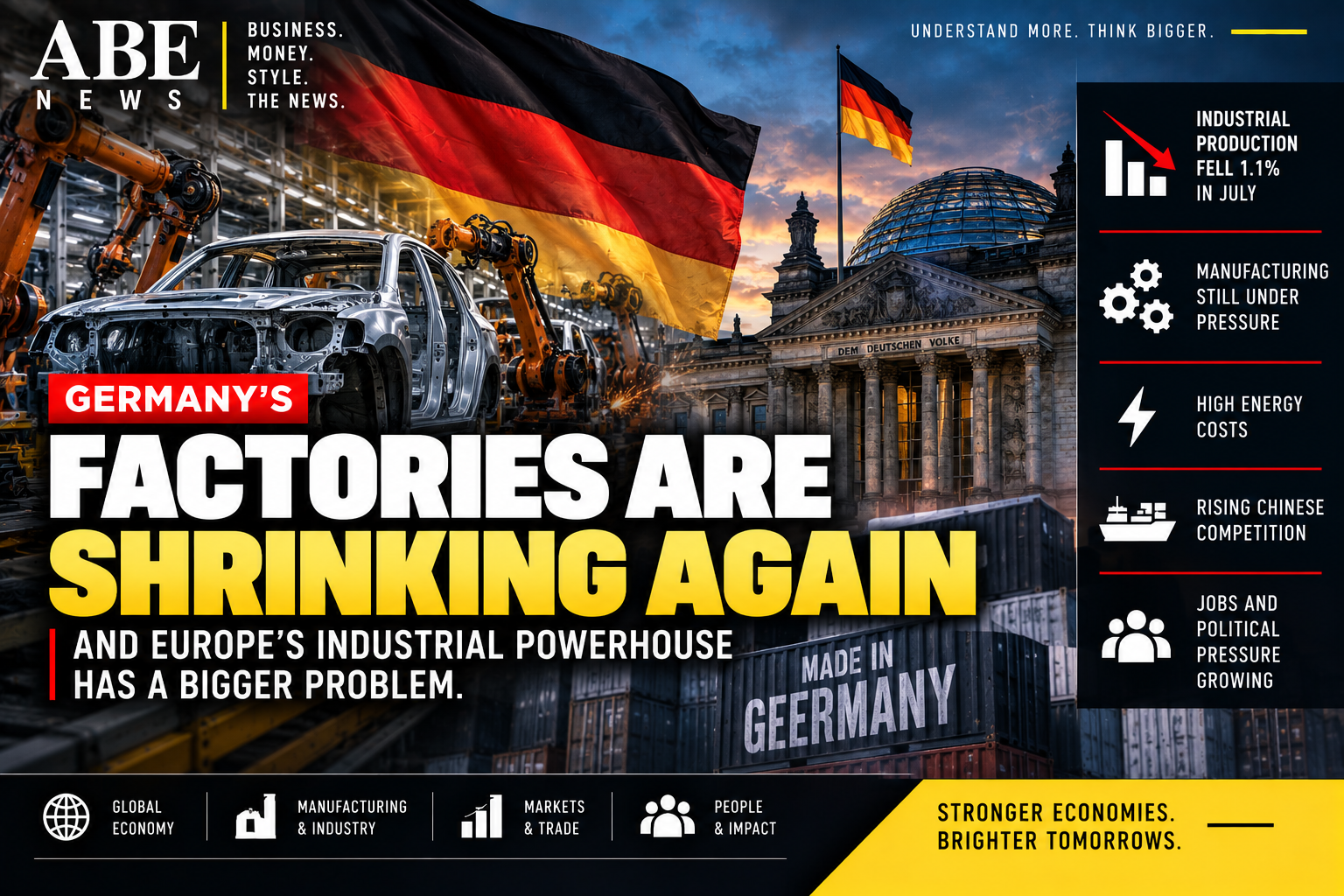
Germany’s industrial production unexpectedly fell in July, delivering another reminder that Europe’s largest economy is still struggling to produce a convincing industrial recovery despite stronger government spending and recent signs of improvement in manufacturing demand.
Production declined 1.1% from June after seasonal and calendar adjustments, according to Germany’s Federal Statistical Office, Destatis. The fall was weaker than economists had expected and interrupted some of the optimism created by improving factory surveys and a recent increase in industrial orders.
The monthly figure does not mean German industry has suddenly entered another collapse. Production across the three months from May through July was still 0.4% higher than during the previous three-month period.
But the July decline matters because Germany has spent years trying to answer a much larger question: Can the industrial model that made it Europe’s manufacturing powerhouse remain competitive in a world of expensive energy, stronger Chinese companies, trade tensions and enormous technological change?
That question reaches far beyond one month’s factory numbers.
Germany built much of its economic strength around manufacturing. Automobiles, chemicals, machinery, electrical equipment and highly specialized industrial products became the foundation of an export machine that sold German engineering around the world.
For decades, the model worked extraordinarily well.
Today, nearly every part of it is under pressure.
THE JULY NUMBERS WERE WEAKER THAN EXPECTED
Industrial production is one of the clearest ways to measure what is actually happening inside factories, mines, energy facilities and construction sites.
Unlike sentiment surveys, which ask companies how conditions feel or what they expect, production data measure actual output.
July’s 1.1% monthly decline therefore offers a less encouraging picture than some of the more optimistic signals that have emerged recently.
The manufacturing sector has shown signs of improvement. A purchasing managers’ survey released earlier this month indicated that German manufacturing expanded more strongly in August, with production rising at its fastest pace since January 2022. New orders also improved substantially.
Official data provided another encouraging signal last week: German factory orders increased 2.5% in July, far exceeding economists’ expectations.
But the details complicated the picture.
The increase was heavily driven by large-scale orders, particularly in the transport-equipment category covering products such as aircraft, ships, trains and military vehicles. Orders in that category surged more than 126%.
Strip out those unusually large contracts and overall new orders actually fell 1.4%.
Foreign orders also declined 2.1%, while domestic orders rose strongly.
Germany therefore appears to be experiencing something more complicated than either a straightforward industrial recovery or an uninterrupted decline.
Certain industries are benefiting from major investment and government spending.
Others remain under considerable pressure.
GERMANY’S OLD ECONOMIC FORMULA HAS BEEN DISRUPTED
To understand why Germany’s industrial difficulties matter, it helps to understand the model that made the country wealthy.
Germany developed an extraordinary collection of globally competitive manufacturers.
Volkswagen.
Mercedes-Benz.
BMW.
BASF.
Siemens.
Bosch.
And thousands of lesser-known Mittelstand companies producing specialized machinery, chemicals and industrial components.
Many became world leaders in highly specific markets.
Germany combined engineering expertise with relatively affordable energy, access to the European single market and enormous international demand — particularly from China.
That created a powerful formula:
German factories produced high-value goods and sold them around the world.
Russia supplied significant quantities of relatively inexpensive energy.
China bought German machinery and automobiles.
Europe provided a huge integrated market.
Globalization allowed sophisticated German manufacturers to build international supply chains and export at enormous scale.
Then several assumptions behind that model began changing at roughly the same time.
Russia invaded Ukraine.
Russian pipeline gas largely disappeared from Germany’s energy system.
Energy became more expensive.
China became not merely a customer but an increasingly formidable industrial competitor.
The United States embraced more protectionist trade policies.
And industries central to Germany’s economy — particularly automobiles — entered a period of technological upheaval.
Germany did not suddenly lose its engineering expertise.
The world around that expertise changed.
CHINA MAY BE THE BIGGEST LONG-TERM CHALLENGE
Germany’s relationship with China illustrates the transformation particularly clearly.
For years, China’s economic expansion was enormously beneficial to German industry.
A growing Chinese middle class wanted premium German automobiles.
Chinese factories needed German machinery.
Infrastructure development required industrial equipment.
German companies invested heavily in China because the market appeared almost impossible to ignore.
China remains an important customer.
But it has also become a competitor.
Chinese companies increasingly manufacture many of the products Germany historically excelled at producing.
Automobiles.
Machinery.
Chemicals.
Electrical equipment.
Renewable-energy technology.
Industrial components.
And the competition is no longer confined to the Chinese domestic market.
Chinese companies are increasingly selling internationally.
That means German manufacturers can find themselves competing against Chinese rivals in Europe, Asia, the Middle East, Latin America and other markets where German engineering once enjoyed a stronger advantage.
A recent survey found that 83% of German industrial companies feel competitive pressure from Chinese businesses, highlighting how widely the challenge is being felt.
For Germany, this is fundamentally different from simply losing sales in China.
It means facing Chinese competition almost everywhere.
THE CAR INDUSTRY SHOWS WHAT IS AT STAKE
Few sectors illustrate Germany’s challenge more clearly than automobiles.
Germany built one of the most successful automotive industries in history.
Volkswagen became one of the world’s largest manufacturers.
BMW and Mercedes-Benz became global luxury brands.
Porsche established extraordinary pricing power.
A vast supplier network developed around those companies, supporting hundreds of thousands of jobs.
But the industry’s competitive environment is changing rapidly.
Chinese manufacturers have become major forces in electric vehicles, batteries, software and increasingly traditional segments such as SUVs and hybrids.
At the same time, European manufacturers are being asked to invest enormous sums in electrification and software while continuing to operate expensive legacy manufacturing systems.
Volkswagen has responded with a sweeping restructuring programme involving tens of thousands of job reductions and major changes to its industrial footprint.
The issue is not that German manufacturers suddenly forgot how to build cars.
It is that competitors have become better while the cost of remaining competitive has increased.
That distinction matters.
A company can still make an excellent product and nevertheless find its economics deteriorating.
ENERGY REMAINS PART OF THE PROBLEM
Germany’s industrial model was also built around access to reliable energy at competitive prices.
Energy-intensive companies — particularly chemicals, metals, glass and other heavy industries — depend on enormous quantities of electricity and gas.
The loss of cheap Russian pipeline gas following Moscow’s invasion of Ukraine forced Germany to reorganize its energy supply.
The country avoided the catastrophic shortages some feared.
But avoiding shortages is not the same as restoring the previous economics.
Companies compete internationally.
If a German factory pays significantly more for energy than a competitor elsewhere, that cost eventually appears somewhere.
The manufacturer can increase prices.
Accept lower profit margins.
Improve productivity.
Move production.
Or close facilities.
None of those choices is painless.
The consequences have been particularly visible in Germany’s chemical sector, one of the country’s traditional industrial strengths.
Energy costs therefore remain part of the larger competitiveness debate even as Germany invests heavily in renewable power and new infrastructure.
GOVERNMENT SPENDING IS NOW TRYING TO CHANGE THE EQUATION
Germany is not simply watching the problem develop.
The government has begun deploying enormous amounts of capital into infrastructure and defence after loosening fiscal restrictions and establishing a €500 billion infrastructure fund.
That spending is already visible in parts of the industrial data.
July’s enormous increase in orders for transport equipment — including aircraft, ships, trains and military vehicles — reflects some of the demand being generated by larger public investment programmes.
That could become an important source of industrial growth.
Germany needs rail infrastructure.
Energy networks need modernization.
Defence spending is rising.
Digital infrastructure requires investment.
Roads and bridges need upgrades.
Those projects can generate demand for German companies while simultaneously improving the infrastructure businesses depend upon.
But government spending also raises an important question:
Can public investment create the conditions for a self-sustaining private-sector industrial recovery?
The strongest outcome would not simply be factories receiving government contracts.
It would be government investment helping German companies become productive enough to win customers globally without permanent public support.
THERE ARE REASONS NOT TO BE TOO PESSIMISTIC
Germany’s industrial story is not entirely negative.
The August manufacturing survey showed the strongest increase in production since early 2022, suggesting momentum may have improved after the official July data were collected.
The three-month production trend is also positive.
Industrial output from May through July was 0.4% higher than in the previous three months, according to Destatis.
Factory orders have improved in headline terms.
Germany continues to possess world-class engineering expertise.
Its manufacturers own valuable brands and intellectual property.
Its vocational training system produces skilled industrial workers.
Its research institutions remain strong.
And its position inside the European Union provides access to one of the world’s largest economic markets.
Germany therefore isn’t facing industrial extinction.
It is facing something arguably more difficult:
industrial adaptation.
THAT REQUIRES MORE THAN LOWER COSTS
Cutting costs can improve competitiveness.
But Germany cannot cost-cut its way into becoming the cheapest manufacturing location in the world.
Wages are relatively high.
Environmental standards are high.
Worker protections are strong.
Energy costs can be substantial.
Competing purely on price against lower-cost manufacturing centres would therefore be extremely difficult.
Germany’s advantage has historically come from producing goods customers were willing to pay more for.
Engineering.
Reliability.
Precision.
Brand.
Technology.
Specialization.
That remains the more plausible strategy.
But maintaining a premium requires continuous innovation.
A German automobile cannot simply cost more because it is German.
A German machine cannot simply command a premium because its manufacturer has existed for 100 years.
Customers compare performance, technology, reliability and price.
Industrial heritage can open a door.
It cannot permanently protect a market.
THE MITTELSTAND MATTERS TOO
The debate often focuses on Volkswagen, Mercedes-Benz, BASF and other enormous corporations.
But much of Germany’s industrial strength comes from companies most people outside the country have never heard of.
The Mittelstand includes thousands of small and medium-sized manufacturers, many specializing in extremely narrow industrial niches.
Some produce components used in factories around the world.
Others build specialized machines.
Some dominate obscure markets that rarely make headlines.
These businesses form an important part of Germany’s export engine and provide skilled employment across the country.
They can also be particularly exposed to prolonged periods of high energy costs, weak demand and international competition because they do not possess the financial resources of multinational corporations.
Germany’s industrial transformation therefore cannot be judged solely by whether its famous brands survive.
It also depends on whether its network of specialized manufacturers remains competitive.
POLITICS IS MAKING THE ECONOMIC CHALLENGE HARDER
Germany’s industrial problems are increasingly colliding with political dissatisfaction.
The Alternative for Germany won approximately 44% of the vote in Sunday’s Saxony-Anhalt state election, delivering a major defeat to Chancellor Friedrich Merz’s CDU and demonstrating the depth of frustration in parts of eastern Germany.
Economic insecurity is not the only reason voters supported the AfD, but it forms part of the environment in which the party has expanded.
Industrial jobs carry significance beyond salaries.
Factories support towns.
They fund suppliers.
They train apprentices.
They create identities that can last generations.
When workers believe those industries are declining and established political parties do not have convincing answers, economic anxiety can become political anger.
That makes Germany’s industrial challenge more than a question for economists.
It is increasingly a question for its political system.
EUROPE HAS A STAKE IN THE ANSWER
Germany accounts for a large share of European manufacturing.
German companies purchase components from suppliers elsewhere in Europe.
They sell products throughout the European Union.
They invest across the continent.
Their workers consume goods and services produced by neighbouring countries.
Weak German industry therefore creates effects beyond Germany’s borders.
The same is true in reverse.
If Germany successfully modernizes its infrastructure, strengthens its defence sector, builds more competitive energy systems and restores industrial investment, the benefits can spread throughout Europe.
That is why Germany’s industrial recovery matters to the wider European economy.
Europe needs growth.
And it is difficult to imagine a strong European industrial economy without a competitive Germany at its centre.
🔴 THE ABE NEWS TAKE
A 1.1% monthly decline in German industrial production is not an economic catastrophe.
Monthly data fluctuate.
Large factory orders can distort comparisons.
Production can rebound the following month.
And several indicators suggest German manufacturing may already be improving.
But focusing only on July’s percentage would miss the larger story.
Germany is trying to rebuild the economic assumptions underneath one of the world’s most successful industrial models.
For decades, that model benefited from affordable Russian energy, enormous Chinese demand, relatively open global trade and German technological leadership.
Each pillar has changed.
Russia is no longer the energy partner it once was.
China is increasingly a competitor.
Global trade has become more protectionist.
And technological leadership has become harder to maintain.
Germany’s challenge is therefore not simply to make its factories produce more next month.
It is to decide what those factories should look like ten years from now.
More automated.
More energy-efficient.
More digitally integrated.
More focused on high-value products.
Connected to modern infrastructure.
Supported by reliable and competitively priced energy.
And innovative enough that customers around the world continue choosing German products even when cheaper alternatives exist.
The country has enormous resources available to make that transition.
Engineering talent.
Capital.
Research institutions.
Industrial expertise.
Global companies.
And now hundreds of billions of euros in additional infrastructure and defence spending.
But money alone cannot guarantee competitiveness.
Companies must innovate.
Infrastructure must actually improve.
Energy must become more affordable.
Investment must produce higher productivity.
And Germany needs to create an environment in which businesses believe manufacturing there remains worth the cost.
July’s factory numbers will eventually become another line in an economic database.
The more important question will remain.
Germany became Europe’s industrial powerhouse by building products the world wanted.
Can it reinvent that model quickly enough to keep the title?
ABE NEWS
Business. Money. Style. The News.
Understand More. Think Bigger.