







By ABE Magazine | November 4, 2026
Canadian energy giant Suncor Energy has reported a sharp increase in third-quarter profits, benefiting from higher global oil prices and stronger refining margins despite a slight decline in production. The Calgary-based company generated C$3.81 billion in net earnings during the three months ended September 30, more than double the C$1.62 billion recorded during the same period last year.
The Suncor Energy Q3 2026 results highlight how international energy disruptions can significantly influence the financial performance of Canada’s largest oil producers. While the company produced slightly less oil than a year earlier, stronger commodity prices and refining profitability helped it generate record adjusted funds from operations and increase returns to shareholders.
Suncor also announced a 10% dividend increase and expanded its share repurchase programme, signalling management’s confidence in the company’s financial position.
Suncor Delivers Stronger-Than-Expected Earnings
Suncor reported adjusted operating earnings of C$4.63 billion, equivalent to C$3.97 per share, compared with C$1.79 billion, or C$1.48 per share, during the third quarter of 2025.
The result exceeded analysts’ average expectation of C$3.28 per share, according to LSEG data reported by Reuters. The earnings beat demonstrates how improved energy prices can strengthen profitability even when production volumes decline.
The company also generated C$6.71 billion in adjusted funds from operations, compared with C$3.83 billion a year earlier. Free funds flow increased to approximately C$5.20 billion, more than twice the C$2.35 billion recorded in the comparable period.
Free funds flow is particularly important for investors because it measures the cash available after capital expenditures. Companies can use this money to reduce debt, expand operations, pay dividends or repurchase shares.
For Suncor, the increase provides greater financial flexibility while allowing the company to return substantial amounts of capital to investors.
Higher Oil Prices Drive Revenue Growth
One of the biggest factors behind Suncor’s performance was the increase in global crude oil prices.
Benchmark Brent crude averaged US$89.27 per barrel during the quarter, approximately 31% higher than a year earlier. The increase reflected disruptions to global energy supplies associated with the continuing conflict involving Iran.
Higher oil prices generally benefit producers because they can receive more revenue for each barrel sold. However, the effect on profitability depends on production costs, transportation expenses and the prices companies receive for different grades of crude.
Suncor’s oil sands revenue increased 32% to approximately C$9.32 billion, even though overall upstream production declined.
This illustrates an important feature of the energy industry: higher commodity prices can sometimes have a greater influence on earnings than modest changes in production volumes.
The relationship also works in reverse. When global oil prices fall sharply, energy companies can experience substantial earnings declines even if production remains stable.
Refining Operations Become a Major Profit Driver
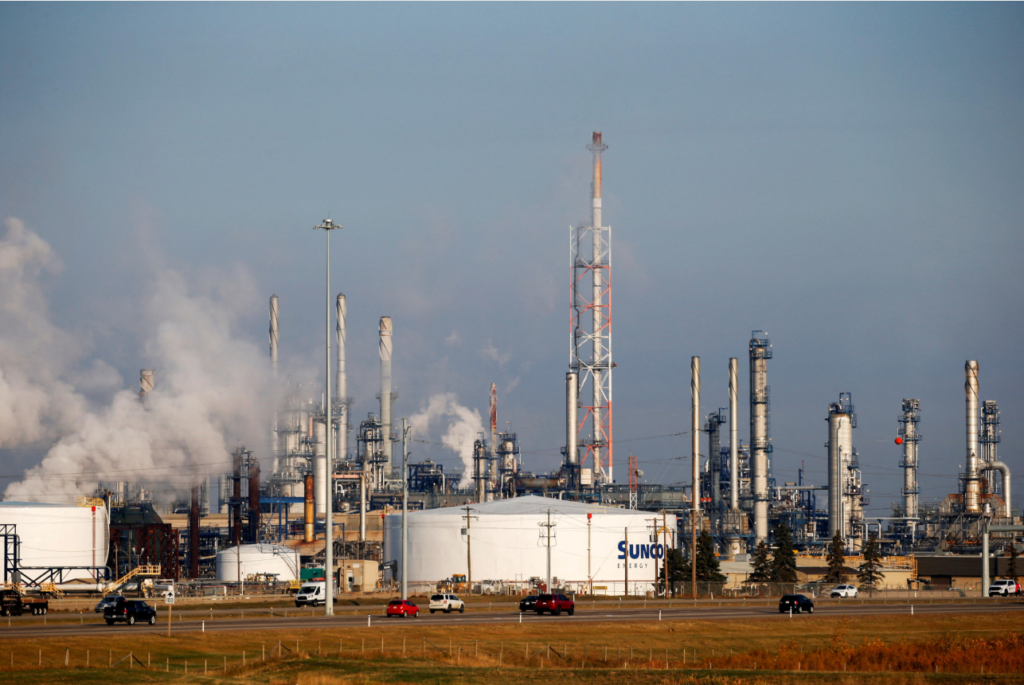
Suncor’s refining business also benefited from favourable market conditions.
According to Reuters, revenue from refining operations increased by more than 65% to approximately C$13.4 billion. Benchmark refining margins strengthened significantly as the difference between crude oil prices and the value of refined petroleum products widened.
These differences are commonly measured using crack spreads, which provide an indication of the potential profitability of converting crude oil into products such as gasoline, diesel and jet fuel.
When crack spreads increase, refiners can earn more from processing each barrel of crude, provided operating expenses and other factors remain manageable.
Suncor’s refinery throughput was approximately 487,700 barrels per day, slightly below the 491,700 barrels processed daily during the comparable quarter in 2025.
Despite the decline, the company achieved refinery utilization of approximately 95%, reflecting continued strong operating performance.
Its refined product sales reached approximately 677,000 barrels per day, a third-quarter record.
The results demonstrate the advantages of Suncor’s integrated business model, which combines oil production, upgrading, refining and petroleum product distribution.
Production Declines Despite Strong Earnings
Although profitability improved, Suncor reported lower overall production.
Total upstream production averaged approximately 852,500 barrels per day, compared with 870,000 barrels per day during the third quarter of 2025.
The decline was partly associated with maintenance activities at Syncrude, where mining and upgrading operations experienced reduced output.
However, Suncor’s Firebag oil sands operation delivered record third-quarter production, helping offset some of the weakness elsewhere.
The company also reported increased production from its exploration and production business, including its Terra Nova offshore operations.
These developments show that production performance can vary considerably across a large energy company’s assets.
For investors, the key question is whether Suncor can maintain operational reliability and manage costs while benefiting from favourable commodity prices.
Strong oil prices can support earnings temporarily, but sustained profitability also depends on efficient production, disciplined capital investment and effective maintenance planning.
Shareholders Receive Higher Dividends and Buybacks
Suncor is using its stronger financial position to increase shareholder returns.
The company announced that its quarterly dividend would rise 10% to C$0.66 per share, with the next payment scheduled for December 24, 2026.
It also increased planned monthly share repurchases from C$500 million to C$750 million beginning in October.
Share repurchases allow a company to buy back its own stock, potentially reducing the number of shares outstanding. This can increase earnings per share for remaining shareholders, although the financial benefit depends on the price paid and the company’s alternative investment opportunities.
During the third quarter, Suncor returned more than C$2 billion to shareholders through dividends and share repurchases.
The company expects total share repurchases to reach approximately C$5.5 billion in 2026.
These decisions reflect a broader trend among established energy producers that prioritize shareholder distributions alongside operational investment.
However, aggressive capital returns also require careful financial management because oil prices can change rapidly.
Suncor Moves to Sell Offshore Oil Assets
Beyond its quarterly earnings, Suncor is simplifying its business portfolio.
The company has agreed to sell its interests in the Terra Nova, White Rose and West White Rose offshore oil projects to Ithaca Energy for approximately C$1.2 billion, with a potential additional payment of up to C$350 million depending on future oil prices.
The transaction is expected to close in early 2027, subject to regulatory approvals and other conditions.
The proposed sale would allow Suncor to reduce its exposure to certain offshore operations while concentrating more resources on its core oil sands and refining businesses.
Suncor recorded a C$1.08 billion non-cash impairment associated with the planned disposal.
An impairment occurs when a company reduces the recorded value of an asset because its expected recoverable value has declined. Although it affects reported accounting earnings, it does not necessarily represent an immediate cash outflow.
The transaction also includes the transfer of certain future obligations associated with the offshore assets.
For Suncor, the sale forms part of a strategy focused on operational efficiency, financial discipline and shareholder returns.
What the Results Mean for Canada’s Economy

Suncor’s financial performance carries significance beyond its shareholders.
Canada is one of the world’s major oil-producing countries, and the energy sector contributes substantially to exports, employment, government revenue and business investment.
Strong profitability at large energy producers can increase corporate income tax payments and resource royalties, particularly in Alberta.
Suncor reported approximately C$3.52 billion in current income tax and royalty expenses during the third quarter, with most attributable to Canada.
The company also supports employment and commercial activity through its operations, contractors, transportation networks and suppliers.
However, higher oil prices create mixed economic consequences.
While energy producers may benefit from stronger revenues, consumers and businesses can face higher gasoline, diesel and transportation costs.
Manufacturers, airlines, logistics companies and households may experience additional financial pressure when energy prices remain elevated.
This creates an important economic trade-off for Canada: the same market conditions that increase revenue for oil producers can also raise costs elsewhere in the economy.
Can Suncor Sustain Its Strong Performance?
The sustainability of Suncor’s earnings will depend on several factors.
Global oil prices remain one of the most important. The company’s recent performance benefited from unusually strong energy market conditions, which may change if supply disruptions ease or global demand weakens.
Refining margins are another consideration. The substantial increase in refining profitability contributed significantly to quarterly results, but crack spreads can narrow as market conditions normalize.
Operational performance will also matter. Suncor must continue managing maintenance requirements, production costs and capital expenditures while maintaining reliable output.
The company enters this period with relatively low net debt of approximately C$1.75 billion, down from C$7.15 billion a year earlier.
That improvement strengthens its balance sheet and may provide additional flexibility if commodity markets become less favourable.
For investors, the central question is not simply whether Suncor can repeat one exceptionally profitable quarter, but whether it can maintain strong cash generation across changing oil market conditions.
THE ABE TAKE
The Suncor Energy Q3 2026 results demonstrate how powerful global commodity prices can be in shaping corporate profitability.
Suncor generated billions in earnings and free cash flow despite producing slightly less oil than a year earlier. Stronger crude prices and refining margins more than compensated for the decline in production.
The results also illustrate the financial advantages of an integrated energy company. Suncor earns revenue from producing crude oil and processing it into refined products, allowing different parts of its operations to contribute under changing market conditions.
However, investors should distinguish between operational improvements and favourable external circumstances. Higher oil prices can produce exceptional earnings, but they are not guaranteed to last.
For Canada, Suncor’s performance highlights both the economic importance and the complexity of the energy industry. Strong producer earnings support investment and government revenue, while elevated fuel prices can increase costs for consumers and other businesses.
The broader lesson is that strong corporate profits do not always require higher production. Sometimes, the price of what a company sells matters more than the quantity it produces. The challenge is building a business that remains resilient when those prices eventually change.
ABE MAGAZINE
Understand More. Think Bigger.