








SATURDAY ABE FOUNDERS | September 12, 2026
Iman Abuzeid had already completed the kind of education that usually determines the rest of a person’s career.
She had trained as a doctor in London. Medicine ran through her family. Becoming a physician offered prestige, stability and a clear professional path. After years of medical school, the conventional next step would have been residency, followed by a career treating patients.
Abuzeid chose something else.
Her decision disappointed her father, but she had become interested in a different question. Practising medicine allowed a doctor to improve the life of the patient sitting in front of them. Technology, she believed, could potentially solve problems for millions of people simultaneously.
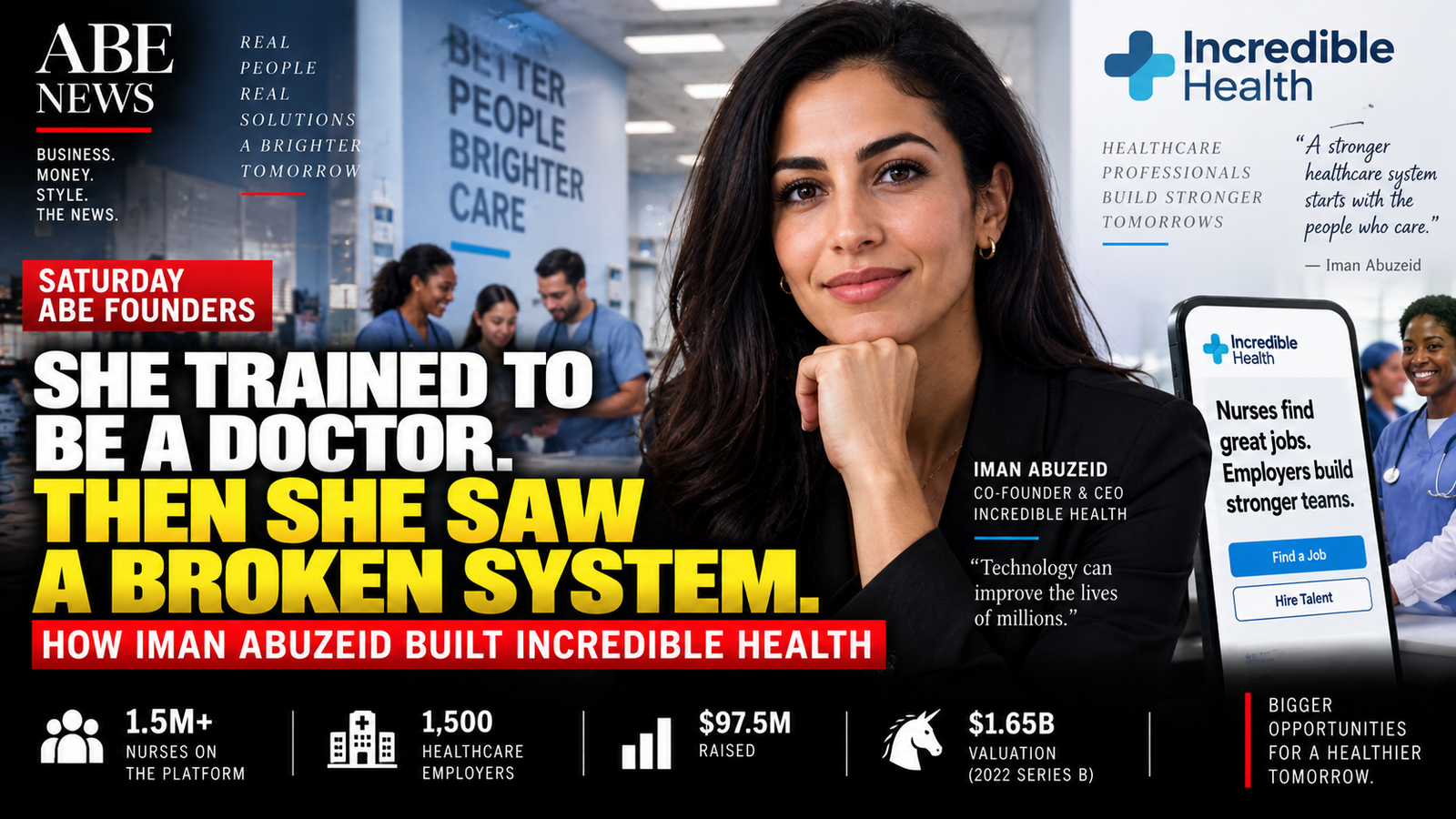
That conviction eventually took her through healthcare consulting, product management and entrepreneurship. In 2017, alongside software engineer Rome Portlock, she co-founded Incredible Health, a San Francisco healthcare hiring company built around a deceptively simple observation: American hospitals desperately needed nurses, while qualified nurses were simultaneously struggling through slow and frustrating hiring processes.
The two sides of the market needed each other.
Yet somehow, they weren’t finding each other efficiently.
Abuzeid and Portlock decided to reverse the traditional recruiting model. Instead of forcing nurses to repeatedly apply to employers and wait for responses, Incredible Health created a marketplace where healthcare employers could compete for qualified professionals.
Nine years later, the company says its platform is trusted by 1.5 million U.S. nurses, works with 1,500 healthcare employers, and partners with 75% of the country’s top-ranked healthcare employers. It has raised approximately $97.5 million, and its 2022 Series B valued the company at $1.65 billion.
But those numbers aren’t the most interesting part of Abuzeid’s story.
The more useful story for entrepreneurs is how she got there.
Because Incredible Health did not begin with somebody trying to invent the next billion-dollar company.
It began with two people noticing something that didn’t make sense.
THE DOCTOR WHO DIDN’T WANT THE OBVIOUS CAREER
Leaving medicine after medical school can look irrational from the outside.
Medical education requires years of work. By the time someone finishes, they have already invested enormous amounts of time and effort into reaching a career that many people spend their lives trying to enter.
Abuzeid had another ambition.
After medical school, she worked with healthcare companies at Booz Allen and McKinsey before moving into product management at a health-tech startup. Those experiences gave her a view of healthcare very different from the one she would have received solely from treating patients. She could see hospitals as organizations, understand their operational problems and observe how technology could affect systems rather than individual encounters.
She also discovered something that should matter to anyone considering starting a technology company.
She couldn’t code.
Abuzeid was a physician and business operator, not a software engineer. Rather than attempting to become every type of founder herself, she partnered with Rome Portlock, an MIT-trained engineer whose previous experience included companies such as Amazon and Eventbrite.
Their skills were complementary. Portlock could build the technical systems. Abuzeid understood healthcare, customers, operations and the market.
That combination would become important when they stumbled upon the problem that eventually became Incredible Health.
SOMETHING ABOUT HEALTHCARE HIRING DIDN’T MAKE SENSE
The idea didn’t begin with a complicated market report.
It began with conversations.
Doctors in Abuzeid’s family and social circle kept complaining about understaffing. Hospitals were struggling to find enough nurses and healthcare workers, creating pressure on existing employees and increasing dependence on expensive temporary labour.
Meanwhile, nurses in Portlock’s family were describing almost the opposite experience. They were qualified. They wanted jobs. Yet they could apply repeatedly and sometimes wait weeks or months to hear from employers.
The contradiction was obvious once somebody put the two stories beside each other.
Hospitals were saying:
We cannot find enough nurses.
Nurses were saying:
We cannot get hospitals to respond to us.
How could both things be true?
Abuzeid and Portlock investigated and found that hospital recruiting departments were often overwhelmed. Recruiters had large numbers of applications to process, screening could be highly manual, and hiring systems weren’t efficiently connecting appropriate candidates with the positions hospitals urgently needed to fill.
The labour shortage was real.
But part of the problem wasn’t simply the number of workers available.
It was the machinery connecting workers with employers.
That became their opportunity.
THEY FLIPPED RECRUITING AROUND
Traditional hiring usually puts most of the work on the applicant.
Find a vacancy. Prepare an application. Submit a résumé. Wait. Repeat the process with another employer. Wait again. Perhaps receive an interview. Perhaps hear nothing.
Incredible Health inverted that relationship.
Healthcare professionals create profiles containing their qualifications, preferences, experience and other information. The platform screens and matches candidates with healthcare employers looking for their skills. Instead of nurses endlessly chasing vacancies, employers can approach suitable candidates.
The healthcare professional uses the service for free.
Employers pay an annual subscription.
That detail is crucial because it explains the business model.
Incredible Health is not merely a jobs website. It is a marketplace attempting to solve a costly business problem for hospitals.
An unfilled nursing position has consequences. Existing employees may need overtime. Hospitals may rely on expensive travel nurses or temporary agencies. Staff can become exhausted. Patient care can suffer. Recruiters spend substantial amounts of time trying to fill positions.
If software can shorten that process, the hospital receives something economically valuable.
That gives Incredible Health something every startup eventually needs:
a customer with a reason to pay.
THE BEST MARKETPLACES SOLVE A PROBLEM ON BOTH SIDES
Building a marketplace is notoriously difficult because the company effectively needs two groups of customers at the same time.
Uber needs drivers and passengers.
Airbnb needs hosts and travellers.
A hiring marketplace needs workers and employers.
Without enough nurses, hospitals have little reason to join Incredible Health. Without enough hospitals, nurses have little reason to create profiles.
This is commonly described as the marketplace cold-start problem.
But successful marketplaces can become increasingly powerful once they overcome it.
More healthcare workers attract more employers because the employer has access to a larger pool of talent. More employers make the service more valuable to healthcare workers because they gain access to more opportunities.
Eventually, each side can make the other stronger.
Incredible Health says its network now includes 1.5 million nurses and 1,500 healthcare employers, with customers including major systems such as Kaiser Permanente, Tenet Health, Trinity Health, NewYork-Presbyterian and Johns Hopkins.
The company says employers using its marketplace can hire workers in under 20 days, compared with a national average of 86 days, while nurses hired through the platform stay in their positions 15% longer than average.
Those are company-reported figures, so they should be understood as such. But they reveal the metric around which Incredible Health has built its value proposition.
It isn’t selling hospitals another piece of software simply because software is fashionable.
It is selling time.
THEN CAME THE PART EVERY FOUNDER HEARS ABOUT: RAISING MONEY
Today, Abuzeid runs a company valued above $1 billion.
The beginning looked very different.
When Incredible Health was raising its seed round, Abuzeid says she spoke with approximately 70 investors.
Eight invested.
That means most didn’t.
At that stage, she wasn’t presenting investors with a giant established marketplace containing more than a million healthcare professionals. She had to persuade them that the healthcare labour market contained a large enough problem, that technology could meaningfully improve it and that she and Portlock were the founders capable of building the solution.
The company eventually attracted investors including Andreessen Horowitz, Base10 Partners, Obvious Ventures, Precursor Ventures and NFX. Its largest publicly announced financing came in 2022, when Incredible Health raised an $80 million Series B at a $1.65 billion valuation, bringing total funding at the time to $97.5 million.
That turned Incredible Health into a unicorn.
But there is an important detail in Abuzeid’s approach to venture capital that young founders should notice.
She says the company generally operates near cash-flow break-even and has at times been cash-flow positive. That allowed it to approach fundraising from a stronger position rather than constantly needing another investment round simply to survive.
That’s a very different philosophy from treating venture capital as the objective.
Funding is fuel.
The business still has to be the engine.
SHE ALSO BECAME SELECTIVE ABOUT WHOSE MONEY SHE WANTED
Abuzeid’s fundraising strategy became increasingly deliberate.
Rather than approaching every possible venture firm, she says she prioritizes investors who understand marketplaces and partners with actual operating experience. She has also looked at whether investors have previously backed women and founders of colour rather than spending her time trying to persuade investors who have demonstrated little willingness to do so.
There is a broader founder lesson hidden inside that approach.
Entrepreneurs frequently think about fundraising as though investors are selecting them.
The strongest companies eventually realize selection goes both ways.
An investor can remain on a company’s capitalization table for a decade. They may sit on the board. They can influence future financing, hiring, acquisitions and strategy.
Taking someone’s money therefore creates a relationship.
The largest cheque is not automatically the best cheque.
For Abuzeid, the question became whether an investor understood the company she was attempting to build and could contribute to that journey.
THE NURSING SHORTAGE MADE THE PROBLEM EVEN MORE URGENT
Incredible Health launched before COVID-19.
Then the pandemic placed extraordinary pressure on healthcare workers.
Burnout intensified. Hospitals struggled with staffing. Travel-nursing costs surged. Healthcare organizations became even more aware of how expensive and dangerous chronic vacancies could become.
That created enormous demand for tools capable of making healthcare recruitment more efficient.
Incredible Health’s 2022 financing came after the company said its revenue had increased fivefold during 2021 and the number of hospitals using the platform had grown substantially.
But there is an important distinction here.
The pandemic didn’t invent the problem.
Abuzeid and Portlock had already identified it.
COVID made an existing structural weakness much more visible.
That distinction appears repeatedly in successful startups. Some of the strongest companies are not built around temporary trends. They identify problems that already exist and become more valuable when external events make those problems impossible for customers to ignore.
NOW INCREDIBLE HEALTH IS MAKING AN AI BET
Nine years after the company was founded, Incredible Health is evolving again.
In 2025, it began introducing AI agents into its recruiting platform.
One of them, Lyn, can conduct an initial recruiter interview with candidates. It asks clinical and behavioural questions, discusses available positions and explains the employer before handing suitable candidates toward a potential hiring-manager interview.
Another agent, Gale, assists healthcare professionals with areas such as résumé preparation and interview practice.
The interesting part isn’t simply that Incredible Health has added artificial intelligence.
Almost every software company can add “AI” to a product announcement.
The more important question is whether the technology removes an actual bottleneck.
Incredible Health says Lyn has reduced hiring time by about 30%, with three-quarters of interviews now taking place within 24 hours of an application. Around 40% happen at night or on weekends, times when human recruiters may not ordinarily be available.
That illustrates a useful approach to AI adoption.
Instead of asking, “Where can we put AI?”, the company appears to have asked something closer to:
“Which part of hiring is still too slow?”
Then it applied automation there.
THE COMPANY STILL HAS PLENTY TO PROVE
A $1.65 billion valuation does not mean the story is finished.
Valuations are not revenue.
They are not profit.
And they are certainly not guarantees.
Healthcare is notoriously difficult to sell into. Large health systems can have lengthy procurement processes, complicated compliance requirements and deeply entrenched workflows. Recruiting itself is intensely competitive, with staffing agencies, traditional job platforms and newer technology companies all fighting for pieces of the market.
Artificial intelligence creates another set of questions. Employers will need confidence that automated interviews are fair, reliable and appropriate for healthcare hiring. Candidates will need to trust the experience. Regulators and hospitals will pay close attention to privacy, bias and the handling of sensitive information.
There is also the fundamental challenge faced by every marketplace: maintaining quality as it scales.
A network containing millions of professionals becomes valuable only if employers can quickly identify the people they actually want to hire. More users alone do not guarantee a better marketplace.
Incredible Health’s next phase therefore may be considerably harder than simply getting bigger.
It needs to become more useful as it gets bigger.
WHAT MAKES IMAN ABUZEID’S STORY WORTH STUDYING
There is a temptation when studying successful founders to begin at the end.
A $1.65 billion company.
Nearly $100 million raised.
Major venture-capital firms.
Large hospital customers.
More than a million healthcare professionals.
When the story is told backwards, success begins to look inevitable.
It wasn’t.
Abuzeid left a career for which she had already trained extensively. She entered technology without being able to code. She partnered with someone whose skills complemented her own. She and Portlock investigated a contradiction people inside healthcare had apparently learned to tolerate. Then she had to convince dozens of investors that the problem was worth building a company around.
The most important moment in the story may therefore have happened long before the funding rounds.
Doctors were saying hospitals couldn’t find nurses.
Nurses were saying hospitals wouldn’t respond.
Abuzeid and Portlock asked:
Why?
That question became the company.
🔴 THE ABE FOUNDERS TAKE
Founders are often encouraged to search for brilliant ideas.
Iman Abuzeid’s story suggests a better place to begin:
Look for something that doesn’t make sense.
Hospitals desperately needed nurses.
Qualified nurses desperately wanted jobs.
Yet connecting the two could take months.
That contradiction contained a business.
Abuzeid didn’t invent healthcare. She didn’t invent recruiting. She didn’t invent nurses, hospitals or online marketplaces.
She changed the way the pieces interacted.
That is worth remembering because entrepreneurship is frequently portrayed as an exercise in creating something the world has never seen before. Sometimes it is.
But many enormous businesses begin differently.
They find an existing industry where everybody has become accustomed to an inefficient process and ask why the process has to work that way.
There is another lesson here for people who believe they need to possess every skill before starting.
Abuzeid couldn’t code.
So she didn’t pretend she could.
She understood healthcare, business and product. Rome Portlock brought deep engineering expertise. Their different abilities became complementary rather than competitive.
The founder’s job is not necessarily to know how to do everything.
It is to understand the problem deeply enough to know what needs to be done — and who you need beside you to do it.
There is also something significant about Abuzeid walking away from medicine.
That decision should not be romanticized. Most people should not abandon years of professional training simply because entrepreneurship appears exciting.
But Abuzeid wasn’t necessarily throwing away her medical education.
She was redeploying it.
Her understanding of healthcare became part of her founder advantage. Consulting taught her how health systems operated. Product management taught her how technology companies build. Portlock supplied the engineering capability she lacked.
What initially looked like an unconventional career path eventually became a collection of experiences pointing toward the same company.
And perhaps that is today’s most useful founder lesson.
Your previous chapter does not always become irrelevant when you change direction.
Sometimes it becomes the reason you can see an opportunity other people miss.
Nine years after Incredible Health was founded, Abuzeid is no longer treating patients one at a time.
She is attempting to redesign part of the system that determines whether those patients have enough nurses around them in the first place.
That is the kind of founder Saturday ABE Founders should be looking for.
Not simply the person everyone already knows.
The builder who saw something broken, asked why it remained broken, and decided to build the answer.
ABE NEWS
Business. Money. Style. The News.
Understand More. Think Bigger.