







ABE NEWS | August 29, 2026
The United States is making an extraordinary move into Venezuela’s vast oil industry.
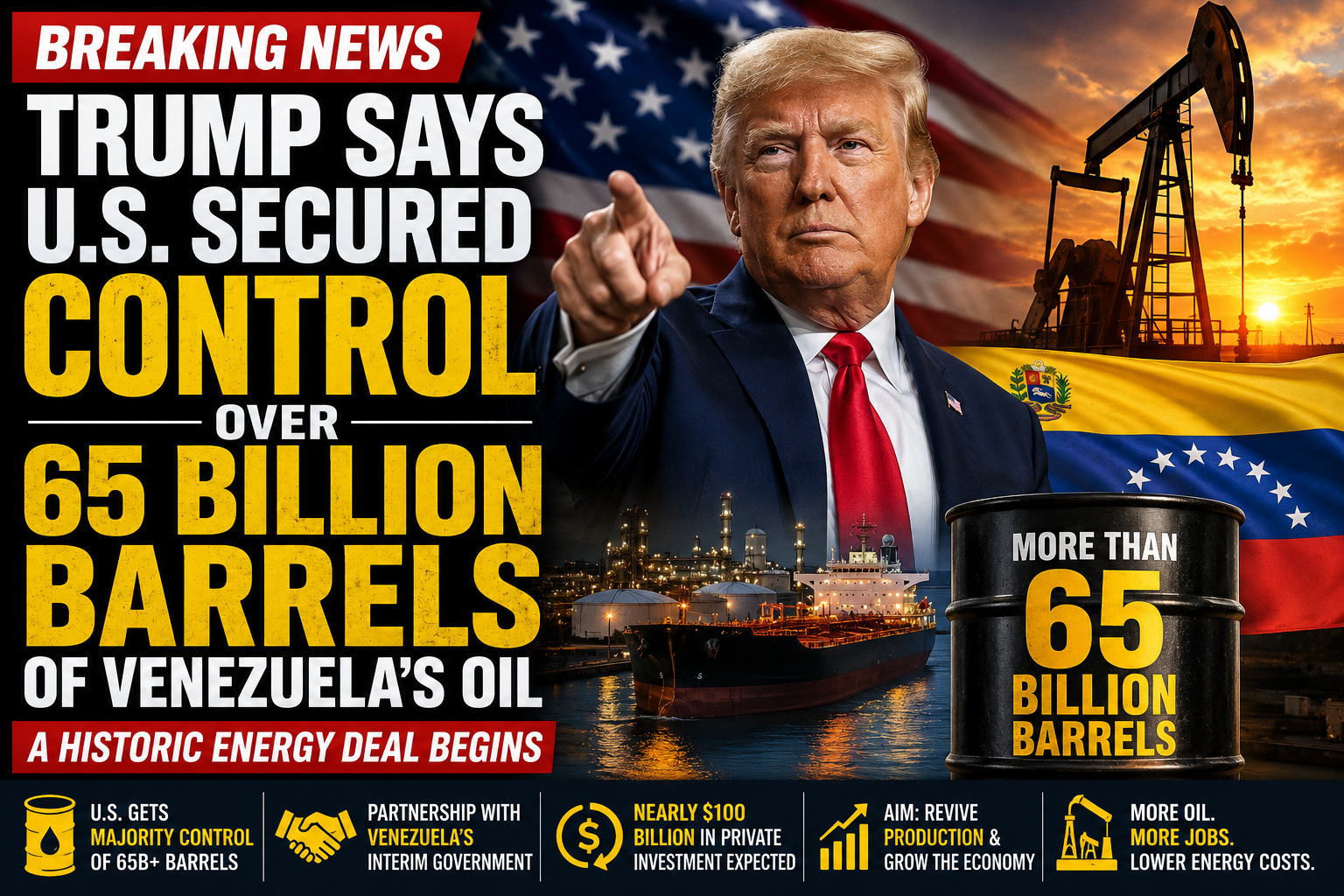
President Donald Trump says Washington, working with Venezuela’s interim government and private companies, has secured majority control over more than 65 billion barrels of proven Venezuelan oil reserves — an amount equivalent to roughly one-fifth of the reserves held by the country with the largest proven oil deposits on Earth.
If implemented as described, the arrangement would mark a dramatic expansion of American influence over one of the world’s most strategically important energy resources.
The ambition is enormous.
American companies would gain long-term access to Venezuelan oilfields, billions of dollars in private investment would be deployed to rebuild an industry weakened by years of underinvestment and sanctions, and more Venezuelan crude could eventually flow toward U.S. refineries.
But there is an equally important part of the story:
Much of the deal remains unclear.
Trump has not publicly detailed exactly how the United States would exercise majority control, which companies would participate, how ownership and revenues would be structured, or whether the arrangement can withstand Venezuela’s legal and constitutional requirements.
That means the announcement is simultaneously one of the biggest energy developments of the year — and the beginning of an enormous economic experiment.
More Than 65 Billion Barrels
Trump announced the agreement Friday, saying his administration had secured majority U.S. control over more than 65 billion barrels of Venezuela’s proven oil reserves through cooperation with private business.
That number deserves perspective.
Sixty-five billion barrels is larger than the entire proven oil reserves of many major petroleum-producing countries.
And it represents only part of Venezuela’s extraordinary resource base.
Venezuela possesses the world’s largest proven crude-oil reserves, concentrated heavily in the Orinoco Belt and other producing regions.
Yet enormous reserves have never translated into equally enormous production.
Venezuela currently produces only around 1.25 million barrels of oil per day, far below the country’s historical levels and dramatically below what its geological resources might suggest is possible.
That gap between what Venezuela possesses underground and what it can actually produce is exactly what the new agreement is attempting to exploit.
The oil exists.
The challenge is turning it into reliable production.
Seventeen Strategic Oilfields
Venezuela’s interim government has welcomed the agreement.
Interim President Delcy Rodríguez said the plan would involve development of 17 strategic fields and significantly increase Venezuelan oil production.
The fields involved reportedly include assets in two of Venezuela’s most important petroleum regions:
the Orinoco Belt and Lake Maracaibo.
Venezuelan officials are preparing additional agreements that would grant exploration and production rights to companies, with American firms expected to play a particularly important role.
Rodríguez says the investment could ultimately generate $209 billion in tax revenue for Venezuela.
U.S. officials are making similarly enormous economic projections.
Secretary of State Marco Rubio said the arrangement could attract nearly $100 billion in private investment, create thousands of high-paying jobs and help rebuild Venezuela’s economy.
If those numbers materialize, the consequences would extend far beyond the petroleum industry.
Oil remains central to Venezuela’s economy.
More production means more exports.
More exports mean greater government revenue.
And greater revenue could finance infrastructure, public services and broader economic reconstruction.
But reaching that point will not be easy.
America’s Bet: Rebuild Venezuela’s Broken Oil Machine
Venezuela’s problem has never been a shortage of oil.
It has been getting the oil out of the ground efficiently.
Years of underinvestment, political turmoil, deteriorating infrastructure, sanctions and poor management severely damaged production capacity.
Oil fields require continuous investment.
Pipelines require maintenance.
Refineries require modernization.
Power systems must function.
Ports must move exports reliably.
Specialized equipment and technical expertise must remain available.
Once those systems deteriorate, simply possessing enormous reserves is not enough.
That is why Washington is betting heavily on private capital.
Rather than expecting the American taxpayer to finance Venezuela’s petroleum reconstruction directly, the plan would rely substantially on private companies willing to invest billions of dollars in production.
For those companies, the prize could be enormous.
But so could the risk.
The Legal Question Is Huge
One of the biggest unanswered questions is what “majority U.S. control” actually means.
Trump has announced the scale of the reserves involved.
But the administration has not publicly disclosed the complete contractual structure.
It has not identified all participating companies.
And it has not explained precisely how an American government role would interact with Venezuelan law.
That matters because Venezuela’s petroleum industry has historically been structured around state control.
The country nationalized its oil industry in the 1970s, placing state oil company PDVSA at its centre.
Under former President Hugo Chávez, government control expanded further.
Foreign companies were pushed into state-led joint ventures.
Some foreign assets were ultimately expropriated.
Those historical decisions created disputes that lasted for years.
Now American companies are being asked to return with enormous amounts of capital.
Investors will therefore want something Venezuela has struggled to provide consistently:
certainty.
Certainty that contracts will survive.
Certainty that political changes will not rewrite the rules.
Certainty that companies can recover their investment.
And certainty about who actually owns and controls the petroleum being developed.
Without that certainty, 65 billion barrels underground can remain exactly where they are.
Chevron Is Already Moving
The announcement comes as Chevron is separately moving toward a significant expansion of its Venezuelan operations.
The American oil major is close to completing negotiations that would move its Venezuelan joint ventures into the country’s new energy framework.
That transition would give Chevron greater operational control and allow important oilfield expansions.
Its Petropiar heavy-crude project is expected to expand into the neighbouring Ayacucho 8 block, while another area of the Orinoco Belt is also involved in negotiations.
Chevron’s position matters because it already possesses something other American companies considering Venezuela may not:
experience operating inside the country.
If Washington’s broader plan moves forward, Chevron could therefore become one of the most important corporate players in Venezuela’s energy revival.
Why Venezuelan Oil Matters to American Refineries
There is another reason Washington wants these barrels.
Venezuelan crude can be particularly useful to certain U.S. refineries.
Much of Venezuela’s petroleum is heavy crude.
Several large refineries along the U.S. Gulf Coast were designed to process heavier grades of oil.
That creates a natural industrial connection between Venezuelan production and American refining capacity.
More Venezuelan crude could therefore provide U.S. refiners with another major supply source.
Trump’s administration argues that increased production could eventually contribute to lower energy costs.
That argument is politically important.
American consumers care deeply about gasoline prices.
And with congressional midterm elections approaching in November, the administration has strong incentives to demonstrate that it is expanding energy supplies and attempting to reduce pressure at the pump.
But consumers should not expect 65 billion barrels suddenly to flood the market.
Oil development doesn’t work that way.
This Could Take Years
The reserves are enormous.
The timeline is not necessarily short.
Developing Venezuelan fields requires infrastructure, electricity, drilling equipment, transportation networks, skilled workers and enormous amounts of capital.
Some of the country’s oil is also technically difficult and expensive to produce.
Venezuela’s heavy crude often requires specialized processing and blending before it can be transported or refined effectively.
Years of deterioration have made the challenge harder.
That means the announcement could have a much larger impact on long-term energy strategy than on gasoline prices next week or next month.
Investors will be watching actual production numbers rather than political promises.
How quickly does Venezuelan output rise from approximately 1.25 million barrels per day?
That will become one of the most important measures of whether the strategy is working.
A $100 Billion Investment Opportunity — Or Risk?
The proposed scale of private investment is staggering.
Nearly $100 billion could eventually flow into Venezuela’s petroleum sector, according to U.S. projections.
That would create opportunities far beyond major oil producers.
Oilfield-service companies could benefit.
Engineering firms could receive contracts.
Pipeline construction could accelerate.
Ports could require modernization.
Power infrastructure could need rebuilding.
Equipment manufacturers could see new demand.
Shipping companies could carry additional crude.
Banks and financial institutions could eventually participate in financing.
And thousands of workers could be required across the petroleum supply chain.
A Venezuelan oil revival could therefore become one of the world’s largest energy reconstruction projects.
But companies will calculate political risk just as carefully as geological opportunity.
Venezuela’s Economy Could Be Transformed
Few countries demonstrate the paradox of resource wealth as dramatically as Venezuela.
The country sits above more oil than Saudi Arabia.
Yet its economy experienced years of severe contraction, inflation, shortages and migration.
Millions of Venezuelans left the country during the prolonged economic and political crisis.
That history shows why natural resources alone do not guarantee prosperity.
Oil wealth must pass through institutions.
Those institutions determine how contracts are enforced, how revenue is distributed, how companies invest and whether citizens ultimately benefit.
If new investment dramatically increases production and revenue, Venezuela could gain an extraordinary opportunity to rebuild.
But if the money is poorly managed, the country could repeat an old cycle:
enormous petroleum wealth without broad prosperity.
The Geopolitical Battle Behind the Barrels
This agreement isn’t only about business.
It is also about power.
Venezuela’s oil relationships have historically involved countries including China and Russia, particularly as Caracas became increasingly isolated from Washington.
Greater American control over Venezuelan production would shift that balance.
It could give Washington greater influence over energy flows in the Western Hemisphere.
It could strengthen supply to American refineries.
And it could reduce the strategic space available to rival powers inside one of the world’s most resource-rich countries.
That makes the agreement part of a much bigger competition.
Energy is not merely a commodity.
It is geopolitical leverage.
Countries that control production, transportation and refining possess influence over the global economy.
Sixty-five billion barrels therefore represent much more than potential corporate profit.
They represent strategic power.
The OPEC Question
Venezuela is also a founding member of OPEC.
A major revival of Venezuelan production would eventually have implications for the wider oil cartel.
The global petroleum market depends on a delicate balance between supply and demand.
If Venezuela eventually adds hundreds of thousands — or potentially much more — barrels of daily production, other oil producers would have to account for that supply.
That could complicate efforts by OPEC members to manage prices.
It could also alter Venezuela’s position within the organization.
Again, none of this happens overnight.
But energy markets think years ahead.
Companies considering billion-dollar projects do the same.
America’s Own Oil Reserve Is Under Pressure
The timing also intersects with another American energy issue.
U.S. Strategic Petroleum Reserve inventories recently fell to around 289.7 million barrels, their lowest level since 1982.
The Strategic Petroleum Reserve exists as an emergency buffer against severe supply disruptions.
Washington has been examining ways to strengthen energy security and eventually replenish that stockpile.
Greater access to Venezuelan crude could become another piece of America’s broader energy-security strategy.
The comparison is striking.
The Venezuelan reserves covered by Trump’s announcement — more than 65 billion barrels — are more than 200 times the crude currently stored in America’s emergency reserve.
Of course, reserves underground and barrels sitting inside U.S. storage caverns are completely different things.
But the comparison demonstrates the extraordinary scale of what is being discussed.
What Happens Next
The announcement is historic.
The implementation will determine whether it becomes transformative.
Several things now need to happen.
Venezuelan authorities are expected to move forward with agreements granting companies exploration and production rights.
The identities of participating American companies should become clearer.
Investors will demand details about taxation, ownership, contract duration and legal protection.
Chevron’s expanded Venezuelan framework is expected to become clearer as its negotiations conclude.
And energy markets will begin looking for evidence that investment is actually translating into higher production.
Above everything else, one number will matter:
barrels per day.
Political leaders can announce billions of barrels in reserves.
Companies can announce billions of dollars in investment.
But the success of this strategy will eventually be measured by how much additional oil Venezuela can actually produce and sell.
🔴 THE ABE NEWS TAKE
This may become one of the most consequential energy deals of Trump’s presidency.
But the headline number — 65 billion barrels — should not distract from the harder story underneath it.
Oil underground is potential wealth.
It is not automatically real wealth.
Venezuela has already proved that.
For decades, the country possessed the largest proven petroleum reserves on Earth while its oil industry deteriorated and its economy collapsed.
Now Washington is betting that American capital, technology and corporate management can help reverse that decline.
If it works, the consequences could be enormous.
Venezuela could regain its position as a major global oil producer.
American refineries could receive another large source of heavy crude.
Private companies could gain access to one of the biggest undeveloped energy opportunities on the planet.
Caracas could collect hundreds of billions of dollars in revenue over time.
And the geopolitical balance of the Western Hemisphere’s energy industry could shift decisively toward Washington.
But there is another possibility.
Legal uncertainty could frighten investors.
Political instability could return.
Infrastructure problems could make production increases painfully slow.
Billions could be promised without ever being invested.
And Venezuela could discover once again that possessing the world’s biggest oil reserves is very different from successfully developing them.
That is why the real story does not end with Trump’s announcement.
It begins there.
The world now has to watch whether 65 billion barrels on paper can become millions of additional barrels flowing through pipelines, tankers and refineries.
If they do, this isn’t simply an American-Venezuelan oil agreement.
It could redraw part of the global energy map.
ABE NEWS
Business. Money. Style. The News.
Understand More. Think Bigger.