






ABE NEWS | MONDAY, AUGUST 17, 2026
Canada just got another inflation warning.
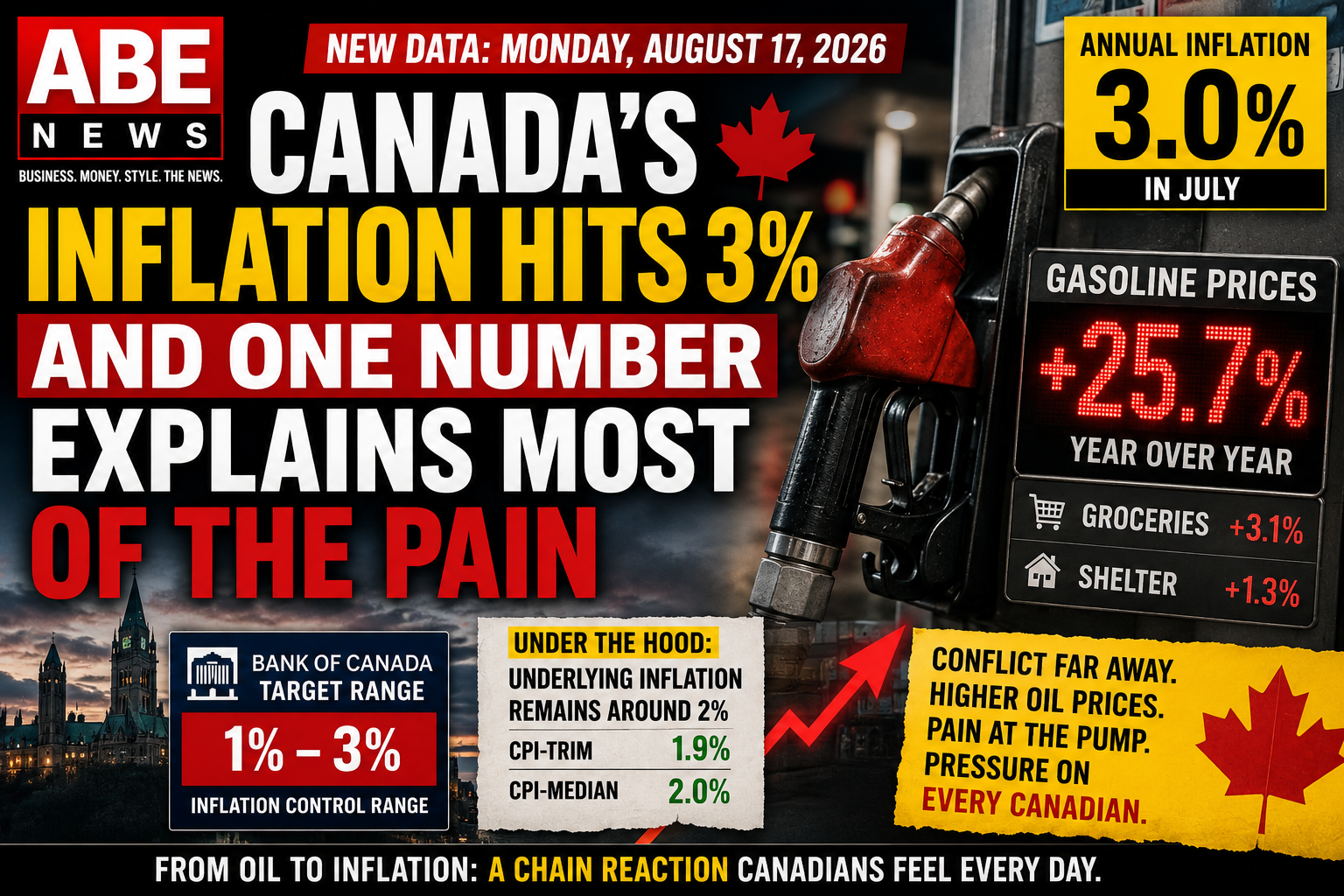
The country’s annual inflation rate climbed to 3.0% in July, reaching the top of the Bank of Canada’s 1%–3% inflation-control range.
But before blaming rent.
Or groceries.
Or wages.
Look at one number:
25.7%.
That’s how much gasoline prices increased compared with a year earlier.
And that number tells a much bigger story.
Because the inflation Canadians are seeing today isn’t being created entirely inside Canada.
Part of it begins thousands of kilometres away — with oil, geopolitical tension and disrupted global energy markets.
Then it travels.
Oil → gasoline → transportation → businesses → households → inflation.
Yesterday, ABE NEWS explained how that chain could happen.
Today, Canada’s inflation numbers are showing us what it looks like.
🇨🇦 Canada’s Inflation Rate Reaches 3%
Statistics Canada’s latest Consumer Price Index showed annual inflation accelerating to 3.0% in July.
Economists surveyed by Reuters had expected approximately 2.8%.
That means inflation came in hotter than anticipated.
At first glance, 3% may not sound extraordinary.
Canada has experienced much worse inflation in recent years.
But remember the Bank of Canada’s framework.
The central bank aims to keep inflation around 2%, the midpoint of a 1% to 3% range.
So 3% puts headline inflation right at the upper edge.
But here’s where this report becomes interesting.
The headline doesn’t tell the whole story.
⛽ The Gas Pump Is Doing A Lot of the Damage
Gasoline prices surged 25.7% year over year in July.
That was the largest contributor to the acceleration in Canada’s headline inflation rate.
Think about what a move that large means for someone who drives every day.
You still have to get to work.
Take the kids somewhere.
Buy groceries.
Visit family.
Run your business.
A household can delay buying a television.
It can skip new clothes.
It can cancel dinner at a restaurant.
But for millions of Canadians, transportation isn’t optional.
And that’s what makes an energy shock particularly painful.
It attacks spending that can be difficult to avoid.
🌍 How Does a Conflict Far Away Reach Canada?
This is where the story connects directly to global energy markets.
Oil prices have been elevated amid the continuing Iran conflict and severe disruption around the Strait of Hormuz, one of the world’s most important energy routes.
And when global oil prices rise significantly, Canada isn’t somehow isolated from the consequences.
Crude oil is the major input behind gasoline.
Higher crude prices can eventually translate into higher prices at the pump.
Then the effect starts spreading.
A delivery company pays more for fuel.
A trucking company pays more.
An airline pays more.
A farmer pays more.
A construction company pays more.
And businesses have to decide:
Do we absorb the additional cost?
Or:
Do we pass some of it to customers?
That’s how an energy shock can become an inflation story.
🛒 But What About Groceries?
Food prices are still rising too.
Prices for food purchased from stores increased 3.1% from a year earlier in July.
That’s still meaningful.
But there is actually some encouraging news hidden inside that number.
June’s grocery inflation rate was 3.9%.
So grocery inflation slowed in July.
This distinction matters.
Canadians can simultaneously experience:
Expensive groceries
and
slowing grocery inflation.
Those statements aren’t contradictory.
Prices can remain high even when they’re increasing more slowly.
That’s something we explained in yesterday’s ABE ORIGINAL.
Lower inflation doesn’t necessarily mean:
Prices are going back down.
It usually means:
Prices aren’t rising as quickly as before.
🏠 Housing Tells a Different Story
Shelter costs increased 1.3% year over year.
That was the smallest increase since January 2021, according to the latest report.
That’s important because housing was previously one of Canada’s most stubborn inflation problems.
Mortgage-interest costs and rent put enormous pressure on households during the previous inflation cycle.
Now shelter inflation is showing considerably more moderation.
So look at the contrast:
Gasoline: +25.7%
Groceries: +3.1%
Shelter: +1.3%
Suddenly the 3% headline makes more sense.
This isn’t every category exploding simultaneously.
Energy is heavily influencing the number.
📊 Now Look Underneath the Headline
Central bankers don’t only look at headline CPI.
They also examine measures designed to show the underlying inflation trend.
Two important Bank of Canada measures are:
CPI-trim
and
CPI-median.
In July:
CPI-trim: 1.9%
CPI-median: 2.0%.
That’s a completely different picture from the 3% headline.
And it’s probably the most important part of today’s report for understanding what happens next.
Headline inflation:
3.0%.
Underlying measures:
around 2%.
That suggests Canada’s inflation problem may not be as broad as the headline number initially makes it appear.
🏦 So What Does the Bank of Canada Do?
This is where things get complicated.
Imagine you’re running the central bank.
Headline inflation just reached 3%.
Normally, that might make you nervous about cutting interest rates.
But then you look underneath.
Core inflation is around the 2% target.
Shelter inflation has moderated.
Grocery inflation slowed.
And much of the headline acceleration came from gasoline.
Now the question becomes:
Should monetary policy respond aggressively to an energy shock?
That’s difficult.
The Bank of Canada can change interest rates.
It cannot reopen the Strait of Hormuz.
It cannot produce additional barrels of oil in the Middle East.
And it cannot negotiate a geopolitical settlement.
Raising interest rates won’t directly make crude oil cheaper.
But if expensive energy starts spreading into other prices and wages, the central bank can’t simply ignore it either.
That’s why today’s report creates a balancing act.
💳 Why Interest Rates Matter to Ordinary Canadians
This isn’t merely a debate between economists.
Bank of Canada decisions eventually affect:
Mortgages.
Loans.
Business financing.
Credit.
Housing.
Investment.
A household already paying more at the gas pump doesn’t exactly want higher borrowing costs too.
But a central bank also doesn’t want temporary energy inflation to become permanent inflation.
So policymakers need to figure out whether this is:
an energy shock
or the beginning of:
a broader inflation problem.
Those are very different situations.
🚚 The Second-Round Effect Is What We Need to Watch
Gasoline becoming expensive is one thing.
The bigger danger comes if higher energy prices begin spreading.
Imagine a trucking company.
Its fuel bill increases dramatically.
At first, the company absorbs some of it.
But eventually margins become too small.
So it raises delivery prices.
Now a supermarket pays more to receive products.
The supermarket’s costs increase.
Eventually some prices on shelves rise.
That’s a second-round effect.
And that’s what policymakers will be watching.
Not simply:
Is gasoline expensive?
But:
Is expensive gasoline making everything else more expensive too?
If the answer becomes yes, Canada’s inflation problem becomes much more difficult.
🇨🇦 And Canada Has Another Problem This Week
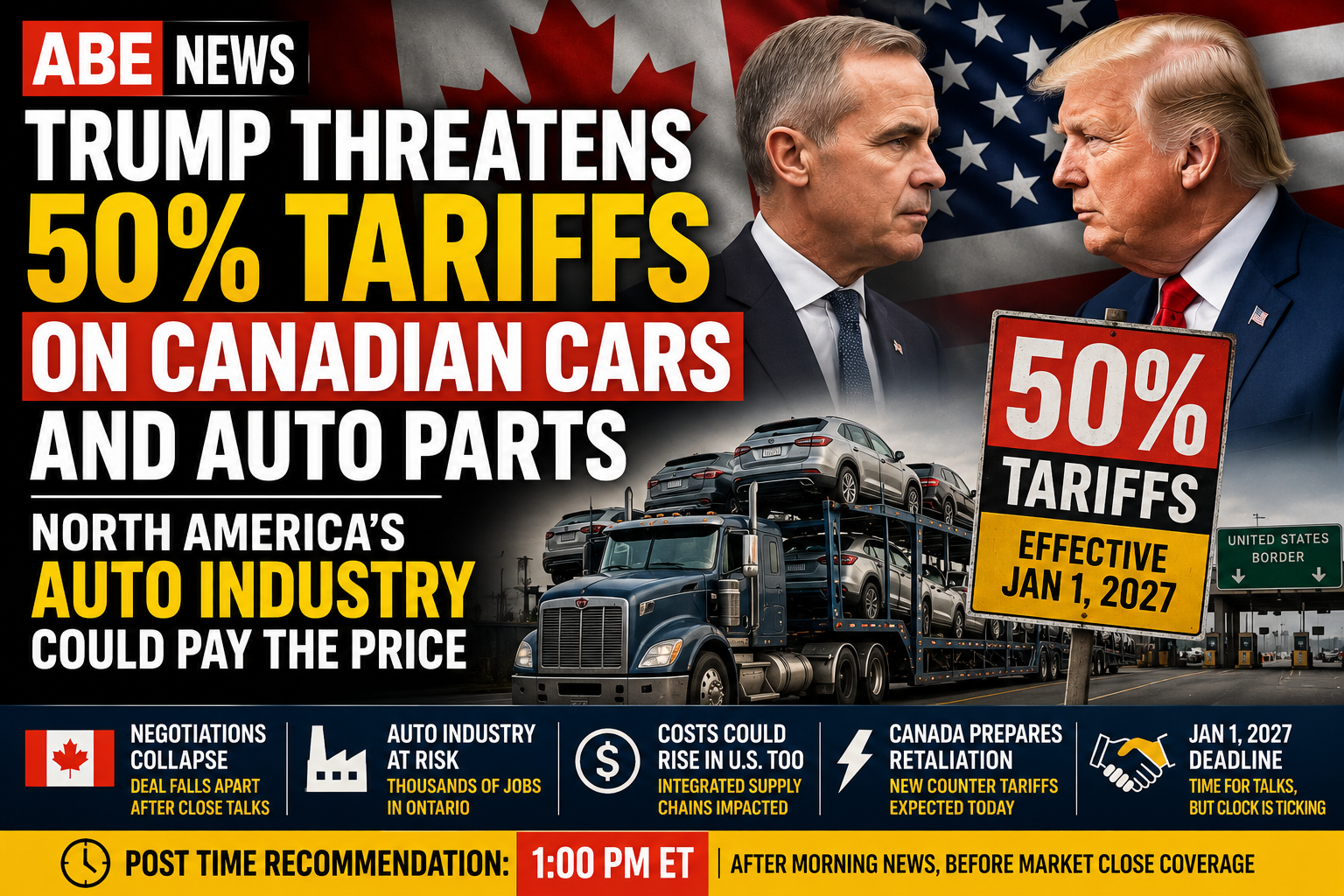
All of this is happening while Canada is simultaneously facing a major trade deadline with the United States.
On Wednesday, the U.S. is scheduled to impose 50% tariffs on nearly $20 billion of Canadian goods unless negotiators reach an agreement.
Think about the combination.
Businesses are dealing with:
Higher energy costs.
Trade uncertainty.
Potential 50% tariffs.
And questions about future interest rates.
That’s a difficult environment for companies making investment decisions.
A business considering a new factory isn’t looking at just one problem.
It’s calculating all of them.
💵 This Is Why Inflation Feels Different Depending on Who You Are
Suppose you don’t drive very much.
You live close to work.
Your rent hasn’t increased significantly.
You don’t have a large mortgage.
Today’s inflation report might not feel particularly dramatic.
Now imagine someone else.
They commute an hour every day.
They operate a delivery business.
They drive a pickup truck for work.
Their family owns two vehicles.
That 25.7% gasoline increase feels completely different.
Same inflation rate.
Same country.
Different economy.
And that’s exactly what yesterday’s ABE ORIGINAL argued.
Economic averages tell us what’s happening broadly.
They don’t tell us how every household experiences it.
🔴 THE ABE NEWS TAKE
Three percent is going to get the headline.
But 25.7% tells the story.
Canada’s inflation report is a reminder that inflation doesn’t always begin inside the economy experiencing it.
Sometimes it arrives on a ship.
Sometimes it starts with a war.
Sometimes it starts with a drought.
Sometimes it starts with a supply chain.
And sometimes it begins in a narrow stretch of water thousands of kilometres away.
That’s what makes modern inflation so difficult.
A central bank can control the price of money.
It cannot control geopolitics.
And Canada now finds itself caught between those two worlds.
Underlying inflation is sitting around 2%.
That’s encouraging.
But gasoline has exploded higher.
That’s painful.
So the real question isn’t whether Canada’s inflation rate reached 3%.
We already know that.
The question is:
Does the energy shock stay inside the gas pump?
If it does, today’s inflation spike may eventually fade as energy markets stabilize.
But if higher fuel costs spread into transportation, food, services and wages?
Then 25.7% won’t remain just a gasoline statistic.
It will become everybody else’s bill.
ABE NEWS
Business. Money. Style. The News.
Understand More. Think Bigger.