








ABE NEWS | August 27, 2026
One of North America’s five Great Lakes has suddenly become the latest battleground in the deteriorating relationship between the United States and Canada.
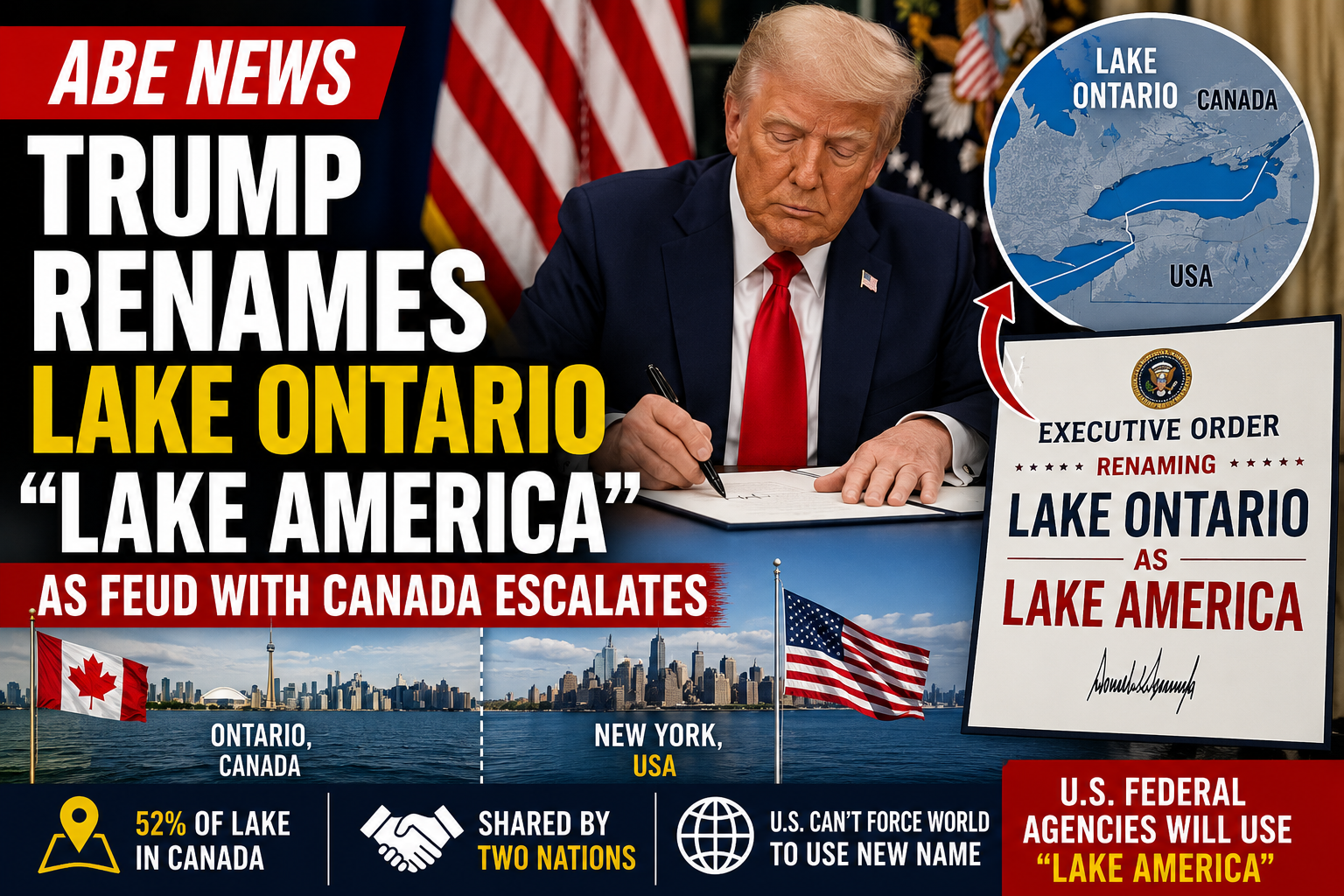
U.S. President Donald Trump signed an executive order Thursday directing the American federal government to rename Lake Ontario as “Lake America,” turning what had been an idea floated only days earlier into official U.S. federal policy.
Trump announced the decision from the Oval Office, declaring that the change would take effect immediately as he signed the order.
The move comes amid an increasingly bitter confrontation between Washington and Ottawa after trade negotiations collapsed and both countries imposed sweeping new tariffs on each other’s goods.
But there is an important limitation to what Trump has done.
The United States cannot force Canada—or the rest of the world—to call the shared body of water Lake America.
Instead, the executive order directs the U.S. Department of the Interior and the Board on Geographic Names to update American federal records and geographic naming systems. For U.S. federal purposes, the Trump administration wants the lake known as Lake America.
For Canadians, Lake Ontario remains Lake Ontario.
That distinction may be legal and geographic.
Politically, however, the symbolism is difficult to miss.
From Lake Ontario to “Lake America”
Trump had publicly floated the idea of renaming Lake Ontario earlier this week.
On Thursday, he followed through.
The executive order, titled “Honoring the American History of the Great Lakes and Renaming Lake Ontario as Lake America,” instructs Interior Secretary Doug Burgum to work with the U.S. Board on Geographic Names and take the necessary steps to implement the new designation.
The administration argues that the lake has played an important role in American trade, defence, settlement and economic development.
The White House also pointed to U.S. spending on protecting the Great Lakes ecosystem and the role of the U.S. Coast Guard’s icebreaking fleet in keeping regional shipping routes operating.
Under the order, the Interior Department has 30 days to take appropriate action to implement the name in the American geographic naming system.
Trump presented the decision as something he had considered for some time.
But its timing places it unmistakably inside the much larger confrontation between the United States and Canada.
Canada Does Not Have to Accept the New Name
Despite the dramatic announcement, Lake Ontario is an international body of water shared between two countries.
Approximately 52% of its surface area lies on the Canadian side, with the remainder on the New York side of the international boundary, according to Reuters.
Trump therefore has the ability to change how the U.S. federal government refers to the lake.
He does not have the authority to order the Canadian government to do the same.
Canada can continue calling it Lake Ontario.
International organizations, foreign governments, mapmakers and private companies are also not automatically required to adopt Washington’s terminology.
That means the world could now encounter two names for the same Great Lake depending on which government or organization is producing the map.
It is a situation Americans have already seen.
Trump Has Done This Before
The Lake Ontario decision follows Trump’s controversial move shortly after returning to the presidency in January 2025 to rename the Gulf of Mexico as the “Gulf of America” for U.S. federal purposes.
That executive order directed the Interior Department to update federal terminology covering the relevant U.S. continental shelf area.
The change subsequently appeared in American government systems and was adopted by some private mapping and technology services, although Mexico and many international organizations continued using Gulf of Mexico.
Trump later proclaimed February 9, 2025, the first “Gulf of America Day.”
Lake Ontario now becomes the latest major geographic landmark targeted by the administration’s renaming campaign.
But this time the politics are considerably more complicated.
The lake does not merely sit beside another country.
It physically forms part of the border between two nations currently engaged in one of their most serious economic confrontations in decades.
A Trade War Is Sitting Behind the Name Fight
The renaming cannot be separated from the rapidly deteriorating relationship between Washington and Ottawa.
Trade negotiations between the two countries collapsed last week following three days of intensive talks, with each government blaming the other for the breakdown.
The dispute has already resulted in tariffs affecting tens of billions of dollars in cross-border commerce.
Trump has repeatedly accused Canada of treating the United States unfairly on trade.
Canada has rejected that characterization and responded with retaliatory measures of its own.
The result is a remarkable deterioration in a relationship that has historically been among the closest economic partnerships in the world.
Canada and the United States share the world’s longest international border.
Their economies are deeply interconnected.
Automobiles and auto parts cross the border repeatedly during manufacturing.
Energy moves south from Canada into the United States.
Agricultural products, machinery, minerals and consumer goods flow in both directions.
Millions of jobs depend directly or indirectly on that relationship.
And Ontario sits at the heart of much of that commerce.
Why Ontario Matters So Much
Ontario is Canada’s most populous province and its largest provincial economy.
It is also deeply integrated with the United States.
The province is the largest export destination for more than a dozen U.S. states, according to Associated Press reporting.
Manufacturing supply chains connect Ontario with Michigan, Ohio, New York and other industrial states.
Toronto—the provincial capital—is Canada’s largest city and one of North America’s most important financial and business centres.
Lake Ontario itself also forms part of the Great Lakes–St. Lawrence Seaway, one of the continent’s most strategically important transportation systems.
Cargo moving through the broader Great Lakes network supports manufacturing, agriculture, energy production and international trade.
The White House specifically highlighted that economic history in its executive order, arguing that Lake Ontario has long been important to American commerce and defence.
That makes the decision more than an unusual naming dispute.
It places a symbol of shared Canadian-American geography directly inside their economic confrontation.
A Name Older Than Either Country
There is another reason the decision is likely to generate strong reaction.
The name Ontario predates both modern Canada and the United States.
It originates from an Indigenous language associated with the Huron people and is commonly interpreted as referring to a beautiful or shining body of water.
The lake carried the name long before Ontario became a Canadian province in 1867.
The province itself ultimately took its name from the lake.
That history makes Lake Ontario more than a geographic label for Canadians.
The name is intertwined with the identity of Canada’s largest province and with centuries of Indigenous and regional history.
Changing it for American federal use therefore touches not only politics but culture and identity.
The Great Lakes Have Always Been Shared
Lake Ontario is one of five Great Lakes alongside Superior, Michigan, Huron and Erie.
Together, the Great Lakes form the largest group of freshwater lakes on Earth by total area and hold roughly one-fifth of the world’s surface freshwater.
Four of the five are shared by Canada and the United States.
Only Lake Michigan lies entirely within the United States.
That geography has required generations of cooperation.
The two countries jointly manage water quality, environmental protection, navigation, fisheries and other issues affecting the lakes.
Agreements between Washington and Ottawa have helped establish a system in which the Great Lakes function less like dividing lines and more like shared economic and environmental infrastructure.
That is what makes the current dispute particularly striking.
A geographic system historically associated with bilateral cooperation is becoming part of the language of confrontation.
Will Maps Actually Change?
In the United States, some of them probably will.
Trump’s executive order directs the Interior Department to update federal geographic records.
The U.S. Board on Geographic Names standardizes names used by the federal government.
Following Trump’s Gulf of America order in 2025, it took approximately two weeks for the federal naming system to reflect the change, Reuters reported.
Private companies will make their own decisions.
Some mapping services could display Lake America for users in the United States while retaining Lake Ontario for users in Canada or elsewhere.
Others could continue using Lake Ontario universally.
Internationally, there is no single authority capable of forcing every country and mapmaker to use one particular name for an international body of water.
So the most likely result is not that Lake Ontario disappears from maps around the world.
Instead, the lake may acquire competing names depending on location, government policy and mapping provider.
Canadians Are Already Pushing Back
Even before Trump formally signed Thursday’s order, the idea had drawn criticism and ridicule in Canada.
Ontario Premier Doug Ford dismissed the proposal after Trump first floated it, while other Canadian political figures questioned why the U.S. president was focusing on renaming a shared lake during an escalating economic dispute.
The reaction reflects something larger than attachment to a geographic name.
For many Canadians, the episode fits into a broader pattern of increasingly confrontational rhetoric from Washington toward Canada.
Trump has repeatedly criticized Canadian trade practices and previously suggested that Canada should become the 51st U.S. state, comments that triggered significant political backlash north of the border.
The Lake America order therefore lands in an environment where seemingly symbolic comments can carry considerable political weight.
Yet Americans Still Like Canada
There is an interesting contradiction inside the confrontation.
While political relations between the two governments have deteriorated, public attitudes in the United States remain much warmer.
A Reuters/Ipsos poll conducted in May found 72% of Americans had a favourable view of Canada.
Canada ranked more favourably among Americans than any other country included in that survey.
That suggests the government-level dispute does not necessarily reflect how ordinary Americans view their northern neighbour.
The contrast is striking.
Washington and Ottawa are exchanging tariffs.
Trade negotiations have collapsed.
The president is renaming a lake shared with Canada.
Yet Canada remains one of the countries Americans view most positively.
That gap between political confrontation and public sentiment could become increasingly important if the dispute continues.
What Happens Next
The immediate question is how Canada responds.
Prime Minister Mark Carney’s office had not immediately commented when Reuters first reported the signing Thursday.
Ontario’s response will also be closely watched because the province shares the lake directly with New York and has enormous economic ties to the United States.
Meanwhile, the U.S. Interior Department will begin implementing Trump’s order across federal geographic systems.
Private mapping companies, publishers and other organizations will then have to decide whether to follow the American government’s terminology.
But the much bigger question has little to do with maps.
It is whether Washington and Ottawa can repair their economic relationship.
The lake may now have two names.
The factories, pipelines, railways, power grids, farms and businesses connecting Canada and the United States cannot be separated nearly as easily.
🔴 THE ABE NEWS TAKE
On the surface, this is a story about a name.
Underneath it is a story about a relationship.
Presidents rename landmarks. Governments change terminology. Maps evolve.
But Lake Ontario is not an isolated mountain sitting entirely inside one country’s borders.
It is shared water.
Canadian communities sit on one shore.
American communities sit on another.
Ships cross it.
Businesses depend on it.
Families live around it.
And an international boundary runs through it.
Calling the lake “Lake America” in U.S. federal documents will not move that boundary one metre.
It will not change where Toronto sits.
It will not change where New York ends.
And it will not erase centuries of history attached to the name Ontario.
What it does change is the political temperature.
At another moment, a geographic renaming might have been dismissed as political theatre.
But this is happening while tariffs are rising, negotiations have collapsed and two of the world’s most deeply integrated economies are struggling to find common ground.
That makes the symbolism matter.
The United States can call its federal version of the map Lake America.
Canada can continue calling it Lake Ontario.
The real challenge for both governments is ensuring that the disagreement over what appears on the map does not do lasting damage to everything that crosses the border drawn across it.
ABE NEWS
Business. Money. Style. The News.
Understand More. Think Bigger.