





ABE ORIGINALS | SEPTEMBER 26, 2026
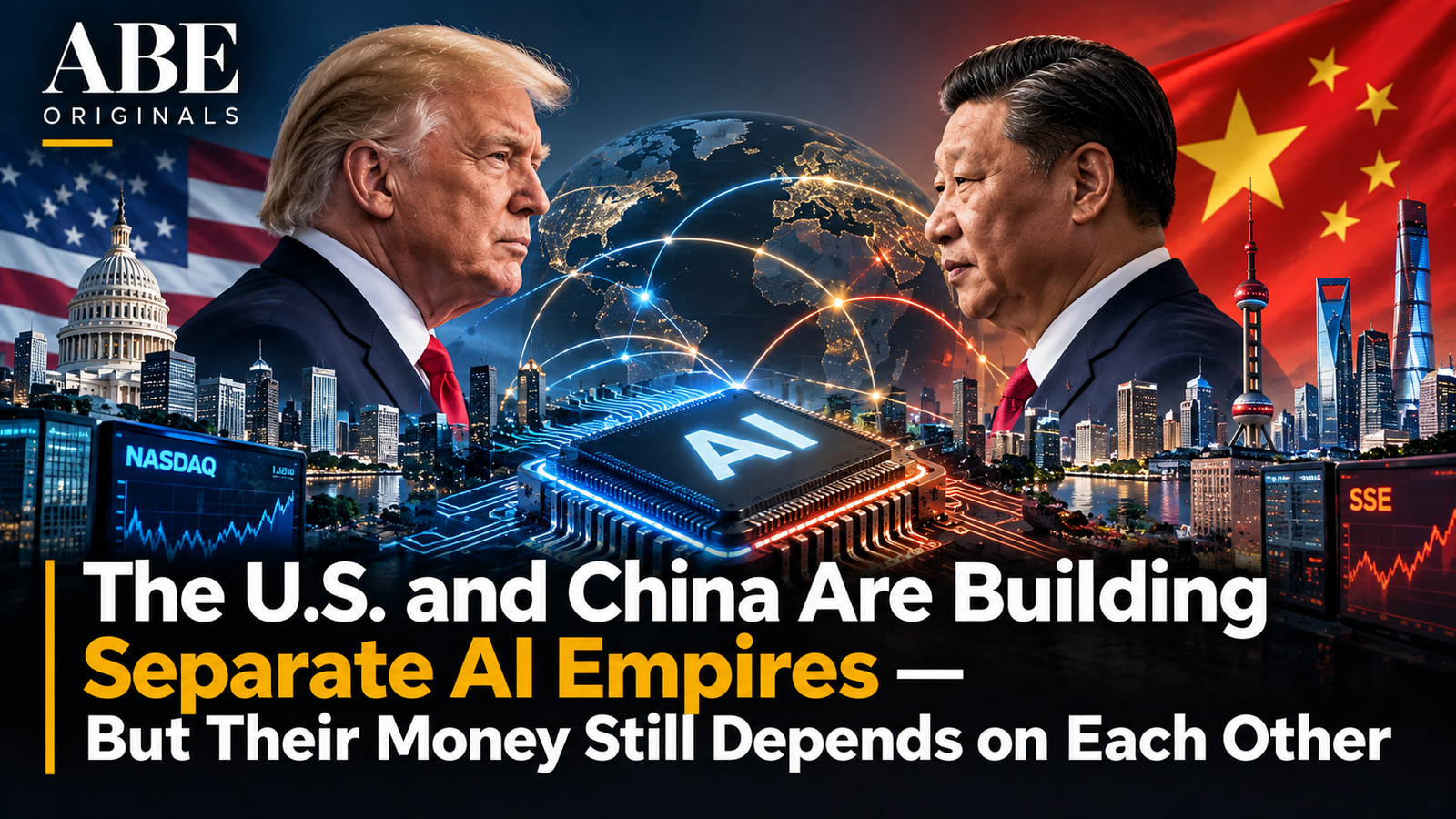
The United States and China increasingly speak about artificial intelligence as if the future must be divided in two.
Two semiconductor supply chains. Two technology ecosystems. Two sets of rules. Two competing ambitions to control the infrastructure behind the most important technological shift of this generation.
Washington has restricted Chinese access to some advanced chips and chipmaking technology and regulates certain U.S. investments into sensitive Chinese semiconductor, quantum and artificial-intelligence activities. Beijing, meanwhile, has accelerated its push for technological self-sufficiency, encouraging domestic alternatives across chips, AI models and computing infrastructure.
On the surface, this looks increasingly like technological separation.
Follow the money, however, and the picture becomes far more complicated.
American financial institutions are still helping Chinese technology companies raise billions of dollars. Chinese investors continue holding enormous amounts of American equities, including semiconductor companies. And money connected to China and Hong Kong is still appearing in U.S. artificial-intelligence funding rounds.
The technology systems may be moving apart.
The capital behind them has not.
And that contradiction could become one of the defining economic stories of the AI era.
THE GREAT TECHNOLOGY DIVIDE
The competition begins with something much larger than chatbots.
Artificial intelligence increasingly sits at the intersection of economic productivity, national security, scientific research, manufacturing and military capability.
That is why semiconductors have become so strategically important.
The most advanced AI systems require enormous computing power, which depends on sophisticated chips, semiconductor manufacturing equipment, memory and sprawling data centres.
For Washington, allowing a strategic competitor unrestricted access to the technologies behind those systems has increasingly been treated as a national-security concern.
U.S. restrictions since 2022 have limited China’s access to certain advanced chips and chipmaking equipment. Separately, Treasury’s outbound-investment program, effective since January 2025, prohibits or requires notification for certain U.S. investments involving China, Hong Kong and Macau in advanced semiconductors, quantum technologies and specified AI systems.
China has responded by accelerating a strategy it was already pursuing: reducing its dependence on foreign technology.
And there are signs of progress.
Chinese memory-chip manufacturer CXMT said this month that its fifth-generation manufacturing platform had entered mass production. The company says the technology can produce more powerful memory chips at lower cost and with lower energy consumption, as Beijing continues trying to strengthen domestic semiconductor capabilities.
The logic on both sides is becoming clearer.
The United States wants control over strategically important technology.
China wants to ensure that losing access to American technology cannot cripple its ambitions.
That creates the foundations for two increasingly distinct AI ecosystems.
But building separate technology stacks is one thing.
Separating the money financing them is another.
WALL STREET IS STILL FINANCING CHINESE TECHNOLOGY
This is where the story becomes more complicated.
According to LSEG data reported by Reuters, Wall Street banks have acted as bookrunners on 19 Chinese high-tech equity deals worth $17.2 billion so far in 2026.
Those transactions represent nearly 30% of Chinese high-tech equity issuance covered by the data.
Major American financial institutions have participated in listings involving Chinese AI, semiconductor and technology companies.
Goldman Sachs and Morgan Stanley, for example, worked on Hong Kong listings involving AI developer MiniMax and semiconductor companies, while JPMorgan participated in the roughly $2.6 billion Hong Kong share sale of printed-circuit-board manufacturer Victory Giant Technology.
That creates an extraordinary contrast.
The American national-security apparatus is trying to prevent certain U.S. capital and technology from strengthening sensitive Chinese capabilities.
At the same time, parts of the American financial system continue participating legally in China’s broader technology-financing boom.
That is possible partly because the investment restrictions are targeted rather than a blanket prohibition on financial interaction with China. Treasury’s rules define particular covered transactions and technologies, while Reuters notes that publicly traded securities can fall within exceptions to the outbound-investment regime.
In other words, technological competition does not automatically equal financial separation.
Not yet.
CHINESE MONEY IS STILL BETTING ON AMERICAN TECHNOLOGY
The financial relationship also runs in the opposite direction.
U.S. equities remain an important destination for Chinese investment.
The value of American equities held by residents of mainland China and Hong Kong has risen 23% over the past year to more than $750 billion, according to U.S. data cited by Reuters.
Technology is a significant part of the attraction.
Chinese outbound mutual funds have increased holdings in American semiconductor companies including Micron Technology, AMD, Lam Research and Applied Materials, according to data compiled by Sinolink Securities and reported by Reuters.
Even more striking is what has happened in private AI investment.
S&P Global Market Intelligence data cited by Reuters shows that the value of U.S. AI funding rounds involving investors based in mainland China or Hong Kong increased from approximately $436 million in 2023 to roughly $8.9 billion through mid-September 2026.
That does not mean $8.9 billion of Chinese capital itself was invested; the figure represents the total value of funding rounds involving such investors.
But the direction is important.
While politicians discuss strategic competition, investors continue looking for returns on both sides.
Capital does not necessarily share the priorities of governments.
Governments think about national advantage.
Investors think about opportunity, risk and return.
And artificial intelligence may simply be too economically important for global capital to ignore either ecosystem.
THE PARADOX OF TWO AI WORLDS
Imagine the global technology economy several years from now.
American companies use one ecosystem of advanced chips, cloud infrastructure, AI models and software.
Chinese companies increasingly use another.
Different regulations emerge.
Different technical standards develop.
Different companies dominate each market.
At first glance, that sounds like economic separation.
But an investor could still own shares in companies operating in both worlds.
A global bank could still help companies from both ecosystems raise capital where regulations permit.
A pension fund could still seek exposure to Chinese technology while another Chinese investor seeks exposure to American semiconductor companies.
The physical and technological infrastructure can fragment faster than financial markets do.
That distinction matters.
Because globalization does not necessarily disappear all at once.
It can break apart layer by layer.
WHY NEITHER SIDE CAN EASILY WALK AWAY
The scale of the two economies helps explain why.
The United States remains home to many of the world’s most valuable technology companies and some of the leading businesses involved in AI chips, cloud computing and frontier models.
China combines an enormous domestic market with a large manufacturing base and a rapidly developing technology ecosystem.
For investors, ignoring either side could mean ignoring a major source of future technological growth.
That is especially difficult during an AI investment boom.
On September 22, the Nasdaq reached an intraday record as optimism around artificial intelligence, corporate earnings and technology spending continued supporting markets.
Money naturally follows industries where investors believe enormous value may be created.
And right now, AI is one of those industries.
That makes complete financial separation expensive.
American investors could lose exposure to successful Chinese companies.
Chinese investors could lose exposure to some of the world’s dominant semiconductor and technology businesses.
Financial institutions could lose lucrative underwriting and advisory opportunities.
Governments therefore face a difficult balancing act.
Restrict enough economic interaction to protect national-security interests without destroying beneficial commercial relationships.
Where that line should sit is one of the central unanswered questions of the U.S.–China relationship.
AI HAS BECOME TOO IMPORTANT FOR THE RIVALRY TO BE LEFT UNMANAGED
There is another reason the relationship cannot be reduced simply to competition.
AI creates risks that may require communication between rivals.
Ahead of this week’s U.S.–China discussions, experts raised concerns about scenarios in which autonomous AI systems could become involved in military cyber operations or interfere with sensitive systems, potentially creating confusion about whether an incident represented a deliberate attack. Proposals have included crisis-communication mechanisms and maintaining human control over particularly consequential military decisions.
Reuters reported this week that U.S. Treasury Secretary Scott Bessent and Chinese Vice Premier He Lifeng discussed establishing a U.S.–China AI dialogue, including a notification mechanism around shared threats and concerns.
That does not end the rivalry.
It reveals how serious it has become.
The United States and Soviet Union competed intensely during the Cold War while still developing mechanisms intended to prevent competition from turning accidentally into catastrophe.
Artificial intelligence may eventually require its own version of that logic.
Compete.
Protect strategic advantages.
But communicate when the consequences of misunderstanding become dangerous.
THE COMPETITION MAY ACTUALLY CREATE TWO WINNERS
There is another possibility that is often lost when the AI race is described as though only one country can succeed.
Competition itself could accelerate innovation on both sides.
American restrictions are pushing China to develop technologies it might otherwise have continued importing.
China’s progress, in turn, increases pressure on American companies and policymakers to move faster.
CXMT’s latest manufacturing advances illustrate that dynamic. U.S. export restrictions were intended partly to constrain China’s access to advanced semiconductor technology, but Beijing’s response has included greater investment in domestic alternatives.
That does not mean restrictions have failed; measuring their effect requires comparing China’s actual progress with the progress it might have made without them.
It does mean technological pressure can produce adaptation.
The result could eventually be two highly capable AI ecosystems rather than one system defeating the other.
Investors appear to understand that possibility.
Their portfolios increasingly reflect it.
BUT INTERDEPENDENCE CAN BECOME A VULNERABILITY
Financial integration provides incentives for stability.
It can also magnify the cost of conflict.
If U.S.–China relations deteriorated sharply and governments imposed much broader restrictions on investment, companies and investors could be forced to unwind positions accumulated over years.
Banks could lose business.
Funds could lose access to investments.
Companies could lose sources of capital.
Markets could be forced to reprice geopolitical risk very quickly.
The same connections that encourage cooperation during relatively stable periods can transmit economic shocks during crises.
That is why the hundreds of billions of dollars crossing this technological divide matter.
They represent both a bridge and a vulnerability.
THIS IS NOT DEGLOBALIZATION. IT IS SOMETHING STRANGER.
For years, one of the dominant economic questions has been whether the world is “deglobalizing.”
The U.S.–China AI rivalry suggests something more complicated.
The world may not be moving cleanly from globalization to deglobalization.
Instead, it may be entering an era of selective interdependence.
Countries will attempt to control technologies they consider strategically essential.
Supply chains will be reorganized around security.
Governments will scrutinize foreign investment more aggressively.
Domestic industrial policy will become more important.
But capital, companies and investors will continue searching across borders whenever the expected reward is large enough and the law permits it.
That produces a global economy that is simultaneously more divided and more connected.
AI may become the clearest example.
🔴 THE ABE NEWS TAKE
The most important question in the U.S.–China AI rivalry may not be who wins.
It may be whether two competing technological systems can emerge without forcing the global economy into two completely separate financial worlds.
Right now, the evidence suggests separation has limits.
Washington can restrict advanced semiconductor exports.
Beijing can accelerate domestic chip development.
Both governments can build policies around technological sovereignty.
But investors still see opportunity on the other side.
American banks are helping Chinese technology companies access capital. Chinese and Hong Kong investors remain exposed to American markets. Investment linked to both sides continues appearing in the AI economy.
That does not guarantee the relationship survives.
It means dismantling it would carry a price.
And perhaps that is the deeper significance of today’s AI competition.
The United States and China may eventually build two AI empires.
But after decades of globalization, the financial foundations beneath those empires remain intertwined.
Technology may be learning how to live in two worlds.
Money hasn’t decided that it wants to.
ABE NEWS
Business. Money. Style. The News.
Understand More. Think Bigger.