









ABE NEWS | SATURDAY, AUGUST 22, 2026
For more than 16 years, one number has represented the outer edge of human sprinting:
9.58 seconds.
That is how long it took Jamaican superstar Usain Bolt to run 100 metres at the 2009 World Athletics Championships in Berlin, establishing a men’s world record that no human athlete has broken since.
On Saturday in Beijing, a machine reportedly went faster.
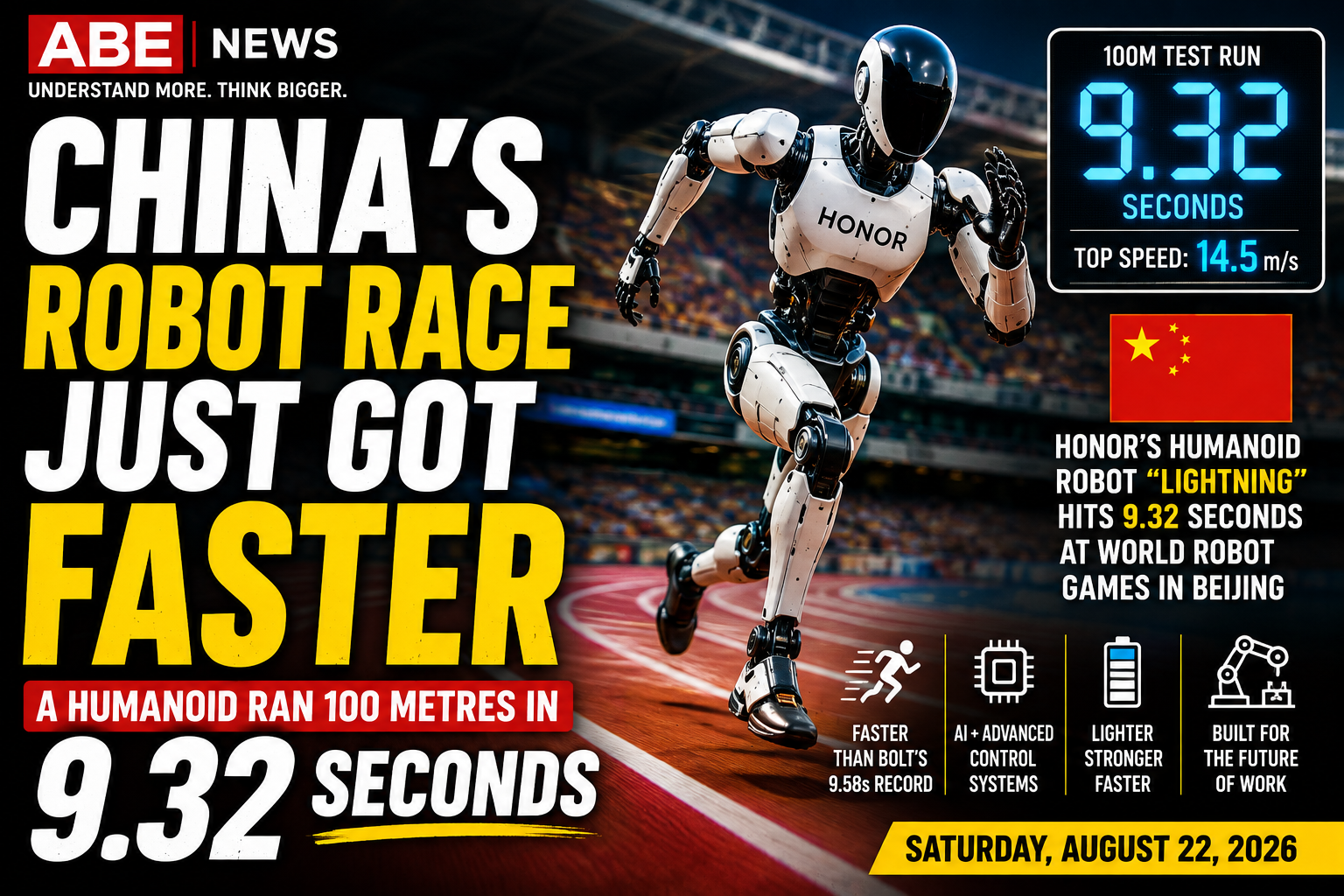
A humanoid robot developed by Chinese smartphone maker Honor completed a 100-metre test run in 9.32 seconds, according to China’s state broadcaster CCTV.
The robot, appropriately named Lightning, reached a peak speed of 14.5 metres per second during the test ahead of the second World Humanoid Robot Games, which opened in Beijing on Saturday.
That puts its test time 0.26 seconds below Bolt’s human world record.
But before declaring that robots have defeated humanity on the running track, there’s an important distinction.
This was a robot test run, not an official human athletics competition, and Bolt remains the men’s 100-metre world-record holder recognized in human athletics.
The bigger story isn’t about taking a record away from Bolt.
It’s about how quickly humanoid robots are becoming faster, more capable—and potentially more useful.
From Awkward Machines to 9.32 Seconds
Go back only a few years and humanoid robots were impressive simply because they could walk reliably.
Running was difficult.
Running quickly was much harder.
Keeping balance while doing it was another engineering challenge entirely.
Yet China’s robot competitions have changed dramatically in a relatively short period. What began as smaller academic and hobbyist events has evolved into a nationally backed showcase for an industry Beijing increasingly considers strategically important.
Lightning is a striking example of that progress.
The robot had already attracted attention in April when it completed Beijing’s humanoid half-marathon in 50 minutes and 26 seconds. Researchers subsequently modified the machine before this week’s World Humanoid Robot Games.
One of the most visible changes was its legs.
During the half-marathon, Lightning stood 169 centimetres tall and had legs measuring 95 centimetres. Researchers later extended them by another 10 centimetres, bringing effective leg length to 1.05 metres and allowing a longer stride.
Engineers also worked on reducing weight and improving the torque and response of its joint modules.
The result?
A machine capable of reaching 14.5 metres per second during Saturday’s test.
But Why Is China Making Robots Run?
This is where the story becomes much bigger than a race.
China isn’t spending enormous amounts of money developing humanoid robots because it wants machines collecting athletics medals.
Running is the demonstration. Commercial usefulness is the objective.
China has designated robotics as a strategic emerging industry, with policymakers hoping advances in artificial intelligence, hardware, batteries, motors, sensors and manufacturing can eventually put humanoid machines into factories, logistics operations and consumer environments.
A robot that can sprint is impressive.
A robot that can work reliably for eight hours could be economically transformative.
That’s why this year’s World Humanoid Robot Games aren’t limited to races.
The competition is increasingly testing abilities that resemble actual work.
Robots are being challenged on precision tasks such as tightening screws, opening bottles and picking up beads with tweezers. Researchers consider robotic hands particularly difficult because machines need both precision and sensitivity to manipulate everyday objects reliably.
Those challenges might look less exciting than a 100-metre sprint.
Economically, however, they could matter much more.
China Wants the Humanoid Robot Industry
There’s another reason to pay attention.
China doesn’t simply want to manufacture robots.
It wants to become one of the countries defining the industry.
Beijing’s robotics strategy has included subsidies, research tax incentives and financing, while China’s enormous manufacturing ecosystem gives domestic robotics companies access to suppliers and increasingly affordable components.
That ecosystem is beginning to show results.
China’s robot competitions once featured machines that fell over shortly after starting.
At Beijing’s first humanoid half-marathon in 2025, engineers frequently had to run alongside their robots and intervene when machines stumbled or crashed.
By 2026, the picture looked different.
More than 100 robot teams entered the Beijing half-marathon and 47 finished, according to state media. Some robots were able to complete the event without a human handler running beside them.
That is the part of the story investors should pay attention to.
Individual records make great videos.
The rate of improvement is what could build an industry.
The Race Is About More Than China
Humanoid robotics is increasingly becoming another arena in the global technology competition.
Companies around the world are pursuing machines that can operate in environments originally designed for humans.
And that matters.
Factories, warehouses, homes, hospitals and construction sites already contain doors, stairs, shelves, tools and workstations designed around the human body.
Instead of redesigning every environment for specialized machines, companies are asking a different question:
What if the machine had a body shaped roughly like ours?
If engineers can make humanoids sufficiently capable, reliable and affordable, the potential market becomes enormous.
Manufacturing.
Warehouses.
Delivery.
Dangerous industrial work.
Healthcare assistance.
Household tasks.
Perhaps eventually jobs we haven’t imagined yet.
But getting there requires much more than making a robot run fast.
Machines need dexterity, perception, decision-making, battery life, reliability and—most importantly—economics that make them cheaper or more productive than existing alternatives.
That’s why Saturday’s 9.32-second sprint should be viewed as a milestone rather than proof that the humanoid revolution has arrived.
What Happens When Robots Become Better Athletes Than Humans?
There’s also something psychologically fascinating about this moment.
Machines have been physically stronger than humans for generations.
Cars move faster.
Cranes lift more.
Computers calculate faster.
None of that surprises us anymore.
But humanoid robots are different because they resemble us.
When something with two arms, two legs and a roughly human shape runs a familiar human event faster than the fastest human ever has, the comparison becomes much more immediate.
It makes technological progress visible.
But the comparison can also be misleading.
Lightning isn’t a human athlete.
It doesn’t have human muscles, human biological limitations or the same sporting rules.
Bolt’s 9.58-second record remains an extraordinary measurement of what a human body achieved under regulated athletics competition.
Lightning’s 9.32 seconds measures something else:
how rapidly engineers are learning to make machines move like us—and eventually beyond us.
Those are two different achievements.
Both can be remarkable.
🔴 THE ABE NEWS TAKE
Forget the argument about whether a robot technically “beat Usain Bolt.”
That’s the fun headline.
The business story is much bigger.
China is turning humanoid robotics from an engineering demonstration into an industrial race.
Running competitions provide a public showcase, but behind them are improvements in motors, batteries, artificial intelligence, sensors, control systems, manufacturing and supply chains.
Today, those improvements produce a robot sprinting 100 metres in 9.32 seconds.
Tomorrow, the same engineering progress could produce machines that move efficiently through warehouses, assemble products, carry equipment or perform repetitive tasks alongside humans.
And that is where the economic stakes become enormous.
The question isn’t:
Can a robot run faster than Usain Bolt?
We now have evidence that, under a test setup, one can.
The much more important question is:
What happens when robots become good enough to leave the racetrack and go to work?
China is spending heavily to find out.
And Saturday’s 9.32 seconds suggests the answer may be arriving faster than many people expected.
ABE NEWS
Business. Money. Style. The News.
Understand More. Think Bigger.