









ABE NEWS | August 29, 2026
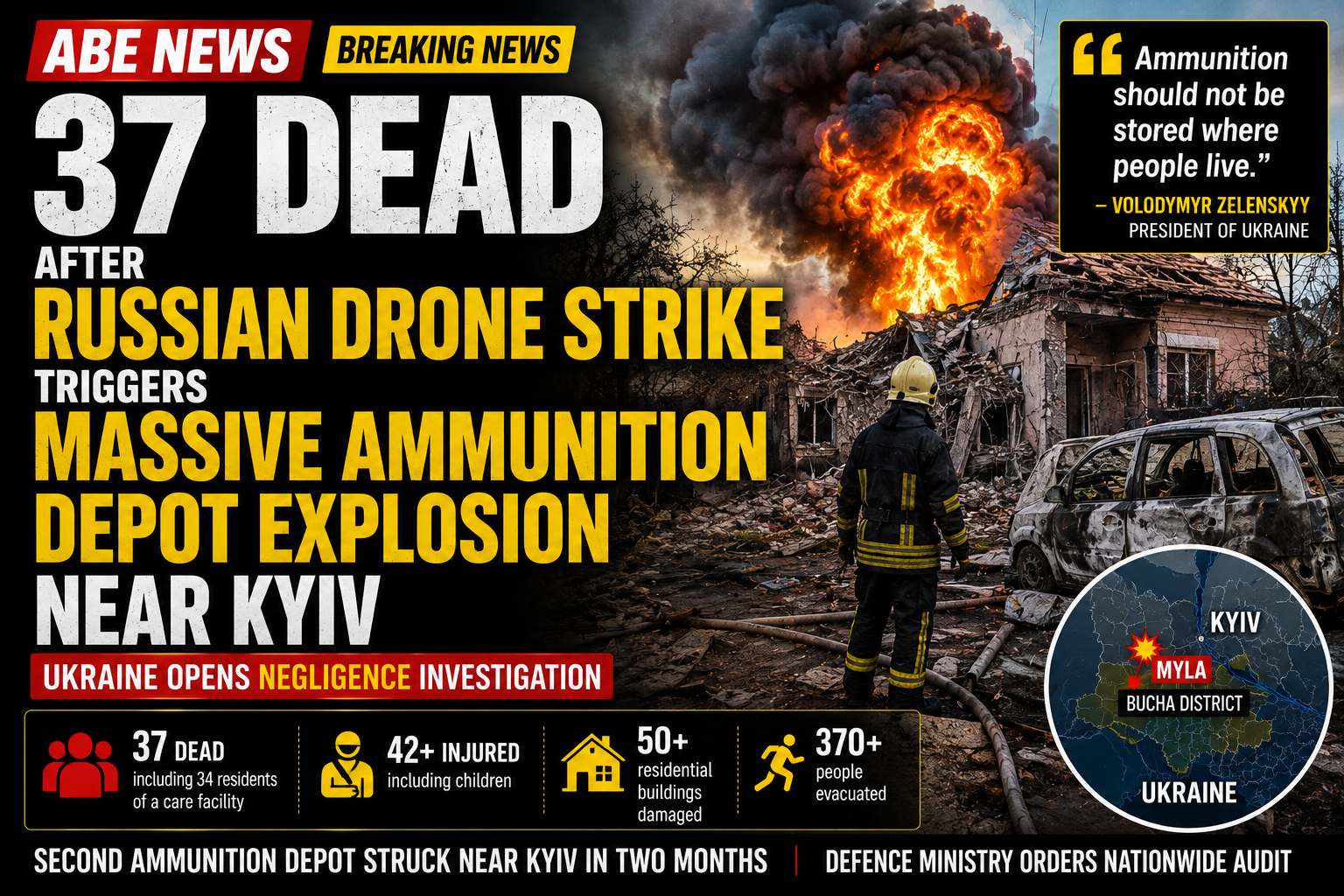
At least 37 people have been killed after a Russian drone struck an ammunition storage facility near Kyiv, triggering enormous secondary explosions that tore through surrounding homes and a care facility in one of Ukraine’s deadliest attacks of 2026.
The strike hit the village of Myla in the Bucha district, west of the Ukrainian capital, late Friday. But what began as a Russian attack quickly became something even more catastrophic.
The warehouse contained Ukrainian military ammunition.
Artillery shells, mines, drones and other munitions began detonating after the initial strike, sending fires and explosions through the surrounding area. Dozens of people were injured, more than 370 were evacuated, and residential buildings were badly damaged.
Ukraine is now investigating not only the Russian attack, but also its own officials.
President Volodymyr Zelenskyy has accused those responsible for storing explosives so close to civilians of severe negligence, saying the ammunition should never have been located there.
Criminal proceedings have been opened.
And the tragedy has raised an uncomfortable question inside a country already struggling against an intensifying Russian air campaign:
How did such a dangerous military stockpile end up beside people’s homes?
A DRONE STRIKE — THEN A DEVASTATING CHAIN REACTION
The attack took place as Russia continued a sustained wave of aerial strikes against Kyiv and surrounding regions.
According to Ukrainian officials, a Russian drone struck the storage site in Myla. The initial impact then ignited the ammunition stored inside.
What followed was devastating.
Shells and other explosives began detonating. Huge fires spread beyond the military facility. Homes and other nearby buildings were caught in the blast zone.
The destruction reached a facility caring for elderly people and people with disabilities.
At least 50 residential buildings were damaged, according to regional officials.
The Associated Press reported that local authorities said 34 of those killed were residents of the care facility, underscoring how quickly the military strike became a civilian catastrophe.
More than 370 people were evacuated as emergency crews attempted to control fires and search the damaged area.
At least 42 people were reported injured, including children.
The scale of the destruction has made the Myla attack one of the deadliest incidents to hit Ukraine this year.
ZELENSKYY TURNS HIS ANGER INWARD
Ukraine has spent years condemning Russia for attacks that kill civilians.
This time, however, Zelenskyy also directed unusually strong criticism toward Ukrainian officials.
The president said the first strike hit an ammunition storage location that should not have been situated where it was.
The facility contained shells, mines, drones and other ammunition, according to Zelenskyy.
Ukraine has regulations restricting the storage of ammunition near residential areas.
Those regulations are now at the centre of an investigation.
Zelenskyy said criminal cases had already been opened over suspected official negligence and demanded accountability from those who permitted the storage arrangement.
The Ukrainian Prosecutor General’s Office is examining whether explosives were legally placed and stored at the facility, whether appropriate permits existed and which officials were responsible for the decisions.
Ukraine’s Defence Ministry has also ordered officials responsible for weapons storage to conduct a broader audit of storage locations.
That transforms the Myla disaster into something more complicated than another Russian strike.
Russia launched the attack.
But Ukrainian authorities are now openly acknowledging that decisions made inside Ukraine may have dramatically increased its consequences.
THIS HAS HAPPENED BEFORE
Perhaps the most damaging question for Ukrainian authorities is why lessons were apparently not learned from an earlier disaster.
Myla is the second major strike-related ammunition detonation near Kyiv in roughly two months.
A Russian strike on a storage site in Vyshneve in July also triggered secondary explosions, killing civilians and damaging hundreds of homes.
Ukrainian Prime Minister Serhii Koretskyi has now publicly criticized the repetition.
The government had already seen what could happen when large quantities of ammunition were stored close enough to civilian communities for a successful Russian strike to produce secondary explosions.
Yet another storage facility remained vulnerable.
That has intensified demands for accountability.
In a country fighting a full-scale war, military logistics must operate under extraordinary pressure. Ukraine needs ammunition distributed close enough to forces and transportation networks to remain useful.
But those requirements have to be balanced against civilian safety.
A warehouse containing artillery shells and mines does not become dangerous only when an enemy attacks it.
Its location itself becomes part of the country’s defensive planning.
Russia has now demonstrated twice that finding such a facility can turn one successful strike into a much larger disaster.
THE PEOPLE LIVING NEARBY DIDN’T KNOW
Accounts from Myla reveal another troubling element.
Some residents said they had no idea ammunition was being stored near their homes.
They experienced the consequences only after the explosions began.
That raises questions about how military secrecy should operate when dangerous materials are located near civilian populations.
Ukraine obviously cannot publicly advertise the location of every weapons depot during wartime.
Doing so would provide Russia with targeting information.
But communities also face enormous risks when military assets are placed among them.
The Myla tragedy exposes the brutal tension between those two realities.
Protecting military information can protect a country.
But storing explosives close to civilians can place those same civilians in extraordinary danger if the location is discovered.
A LOCAL LEADER DIED TRYING TO HELP
Among those killed was Taras Didych, the head of the nearby Dmytrivka community.
According to Ukrainian officials, Didych went toward the affected area to help after the attack.
He did not return.
His death has become one of the individual stories emerging from a disaster otherwise described through enormous casualty figures.
Behind the number 37 are residents of a care facility, local families, emergency responses and people whose ordinary Friday night became a battlefield.
Rescue operations continued Saturday as crews searched damaged structures and assisted displaced residents.
Authorities have warned that the consequences of the attack are still being assessed.
RUSSIA’S AIR CAMPAIGN IS INTENSIFYING
The Myla disaster did not occur in isolation.
Kyiv and its surrounding region have endured days of sustained Russian aerial attacks.
Zelenskyy said nine other Ukrainian regions were also targeted overnight, while Kyiv faced what he described as virtually continuous attacks from high-speed drones.
Russia has increasingly used large numbers of drones alongside missiles in an attempt to overwhelm Ukrainian air defences.
Newer high-speed and jet-powered drones create additional difficulties for interception.
The strategy places enormous pressure on Ukrainian defensive systems because even if most incoming weapons are destroyed, only a small number need to penetrate air defences to cause major damage.
And the consequences can become exponentially worse when the target contains ammunition.
The same day as the Myla death toll was being counted, further attacks continued.
A 14-year-old girl was killed in a drone strike in the Boryspil district, according to regional authorities.
In Kyiv itself, officials said a 2-year-old girl was killed by a downed drone.
The capital and surrounding region have effectively been operating under repeated air-raid warnings as Russia attempts to maintain pressure on Ukraine’s largest city.
MOSCOW SAYS IT WAS TARGETING MILITARY INFRASTRUCTURE
Russia has acknowledged attacking the Myla site but presented the operation as a strike against legitimate Ukrainian military infrastructure.
The Russian Defence Ministry said the warehouse contained components and launch boosters for Ukrainian long-range drones.
Moscow also said its forces attacked other military and logistics targets, including infrastructure connected to Ukrainian missile systems.
Those claims have not all been independently verified.
But Ukraine itself has confirmed the most important point about Myla:
The warehouse contained military ammunition.
That distinguishes the incident from cases in which Russia and Ukraine dispute whether a location had any military purpose.
The controversy here is instead about proximity.
Even if the warehouse was a military target, why was ammunition capable of producing such enormous secondary explosions being stored beside civilian buildings?
That is the question Ukraine’s own government is now asking.
THE STORAGE PROBLEM GOES BEYOND ONE WAREHOUSE
Ukraine faces an extremely difficult military logistics challenge.
It is fighting a long war across a vast front while Russia possesses missiles, drones, satellites, reconnaissance systems and intelligence networks capable of searching for military infrastructure far behind the battlefield.
Large centralized ammunition depots offer logistical advantages.
They can also become enormous targets.
Dispersing ammunition across smaller locations can reduce the damage caused by a single successful strike, but it makes logistics more complicated and requires many more secure sites.
Moving storage farther away from population centres can protect civilians, but transportation routes become longer and potentially more vulnerable.
There is no risk-free solution.
But Myla demonstrates what happens when the consequences of a storage decision become catastrophic.
An ammunition depot can turn the surrounding area into an enormous secondary blast zone.
That makes storage policy part of civilian defence.
ACCOUNTABILITY DURING WAR
Ukraine’s decision to publicly investigate its own officials is significant.
Governments fighting wars often restrict information about military failures because revealing weaknesses can assist the enemy and damage morale.
Ukraine itself rarely provides detailed public confirmation of Russian strikes on sensitive military facilities.
But the scale of the Myla disaster has made silence difficult.
When dozens of civilians die and homes are destroyed, the public inevitably wants answers.
The investigation therefore creates a difficult test for Kyiv.
Ukraine must determine whether officials violated safety regulations without exposing sensitive information about its wider military logistics network.
It must also demonstrate that wartime necessity does not place government decisions beyond scrutiny.
That matters not only domestically.
Ukraine remains heavily dependent on military and financial support from international partners.
Those governments expect weapons supplied to Ukraine to be stored and managed responsibly.
A credible investigation could therefore become important both for Ukrainian citizens and for Kyiv’s foreign allies.
THE WAR IS ENTERING ANOTHER DANGEROUS PHASE
The Myla attack also illustrates how the battlefield has changed.
Modern warfare increasingly extends far beyond the front line.
Drones can travel deep into enemy territory.
Missiles can target warehouses hundreds of kilometres away.
Industrial facilities, energy infrastructure, transportation hubs and logistics centres become part of the battlefield.
That means cities and villages once considered relatively distant from ground combat remain exposed.
Ukraine has responded by developing its own long-range drone capabilities, striking Russian refineries, industrial sites and military facilities deep inside Russia.
Both countries are increasingly trying to disrupt the systems that keep the other’s war machine operating.
The result is a widening infrastructure war.
Warehouses matter.
Railways matter.
Ports matter.
Energy facilities matter.
Factories matter.
And increasingly, the civilians living around those facilities bear part of the risk.
WHAT HAPPENS NEXT
The immediate priority in Myla remains rescue, recovery and assistance for people forced from their homes.
But several larger questions will follow.
Ukraine’s criminal investigation will need to determine who authorized ammunition storage at the site and whether regulations were violated.
The Defence Ministry’s nationwide audit could identify other dangerous storage locations before another Russian strike does.
Military commanders may also face pressure to accelerate the dispersal or relocation of ammunition stockpiles located close to residential communities.
At the same time, Ukraine will continue demanding additional air-defence systems from Western allies as Russia expands its drone and missile campaign.
But Myla demonstrates that air defence alone cannot eliminate the danger.
Ukraine also has to reduce what happens when a Russian weapon gets through.
🔴 THE ABE NEWS TAKE
Russia launched the drone that struck Myla.
That fact should not become blurred.
Ukraine is fighting an invading military, and Russia deliberately targets Ukrainian military infrastructure as part of that war.
But another fact is equally important.
Ukraine’s own president says the ammunition stored at Myla should not have been there.
Those two truths can exist simultaneously.
Russia was responsible for the attack.
Ukrainian officials may have been responsible for creating conditions that allowed one successful strike to become an extraordinary civilian catastrophe.
That distinction matters because wars are not won only through bravery on the battlefield.
They are also fought through logistics, planning, discipline and competent government.
If ammunition must be stored, it must be stored intelligently.
If regulations exist to keep explosives away from homes, those regulations cannot become optional simply because the country is at war.
In fact, war makes them more important.
Myla has now paid an unbearable price.
At least 37 people are dead.
Families have lost homes.
A care facility was devastated.
A community leader who went to help was killed.
And Ukraine is being forced to investigate itself while Russian drones continue flying overhead.
The most important question now isn’t only how Russia found the warehouse.
It is why a successful strike on one military facility was capable of destroying so many civilian lives around it.
Ukraine already received a warning in Vyshneve.
Myla cannot become another warning that goes unheeded.
ABE NEWS
Business. Money. Style. The News.
Understand More. Think Bigger.