







ABE MAGAZINE | ABE ORIGINALS
October 17, 2026
Across Africa, governments are borrowing to finance public services, manage debt and maintain economic stability. Yet an increasingly important question is emerging beyond government budgets: what happens to private businesses when the state becomes one of the largest borrowers in the domestic financial system? For entrepreneurs already struggling with expensive credit, the answer may determine whether they expand, hire workers or abandon promising investments. The relationship between public debt and private opportunity is becoming one of Africa’s most consequential economic challenges.
The Competition for Africa’s Limited Capital
A government borrowing money is not inherently a problem. Public financing can support roads, electricity, hospitals, schools and infrastructure that businesses need to operate. When managed effectively, government borrowing can strengthen productivity and create opportunities that private investors would otherwise struggle to finance.
The difficulty emerges when borrowing grows faster than the financial system’s ability to support it. In economies with relatively small banking sectors, governments and businesses frequently depend on the same institutions for funding. Banks must decide whether to lend to a manufacturer expanding production, a logistics company purchasing vehicles or a government issuing treasury securities.
Government debt can appear especially attractive because it may offer predictable returns without the operational risks associated with individual businesses. Consequently, banks can find themselves holding substantial government securities while entrepreneurs encounter expensive loans, demanding collateral requirements or outright rejection.
Economists describe one possible consequence as crowding out: public borrowing absorbs financial resources that might otherwise support private investment.
When Government Debt Becomes the Easier Investment
The shift toward domestic government borrowing has become increasingly important across sub-Saharan Africa. International financing can be expensive, difficult to obtain or exposed to exchange-rate fluctuations, encouraging governments to raise more money within their own economies.
IMF research published in 2026 found that domestic public debt in sub-Saharan Africa had increased substantially over the preceding two decades. The median country issued domestic debt at an average interest rate of 8.8% in 2024, demonstrating that borrowing locally is not necessarily inexpensive.
The effect on businesses extends beyond the amount governments borrow. When treasury securities offer attractive returns, commercial banks may have less incentive to finance smaller enterprises whose prospects are harder to evaluate.
However, the relationship also works in reverse. Banks sometimes accumulate government debt because there are too few sufficiently creditworthy business borrowers. Weak financial records, unreliable infrastructure and limited collateral can make private lending difficult even without excessive government borrowing.
Africa’s financing problem is therefore more complicated than a simple contest between governments and entrepreneurs.
The Small Business Pays a Different Price
For a large corporation, expensive bank financing may delay an investment. For a smaller business, it can prevent expansion altogether.
Consider a hypothetical food-processing company that has secured orders from regional retailers but needs financing to purchase equipment and additional raw materials. If borrowing costs become prohibitive, the company may reject orders, postpone recruitment or remain dependent on inefficient production methods.
A transport operator faces similar decisions when replacing vehicles. An agricultural enterprise may struggle to purchase machinery before the planting season. A manufacturer may abandon plans to supply customers in neighbouring countries.
These examples illustrate how financing constraints can affect economic development beyond individual balance sheets. When productive businesses cannot invest, potential employment, tax revenue and industrial capacity may never materialize.
The consequences are particularly serious where smaller enterprises account for much of everyday commercial activity but lack access to capital markets or alternative financing arrangements.
Kenya Reveals the Policy Dilemma
Kenya offers a timely example of how governments are attempting to manage this tension.
In October, the country’s National Infrastructure Fund began deploying seed capital through purchases of domestic government bonds. The initiative is intended partly to improve banking-system liquidity and encourage more private-sector lending.

Kenya is also seeking financing from international development institutions. On October 16, central bank governor Kamau Thugge explained that concessional external funding could reduce the government’s reliance on domestic borrowing, potentially leaving banks with greater capacity to finance businesses.
The distinction matters. A government does not necessarily need to stop borrowing to improve private access to credit. It may instead change where it borrows, how much it pays and how effectively the borrowed money is invested.
Still, financing reforms require careful execution. Replacing domestic borrowing with foreign obligations can introduce currency and repayment risks, while poorly selected infrastructure projects may generate insufficient economic returns.
Better Financing Requires More Than Less Debt
Reducing pressure on banks is important, but it cannot resolve every obstacle facing African businesses.
Financial institutions also need better information about borrowers, stronger systems for assessing business risk and mechanisms that make lending to smaller enterprises commercially viable.
Credit guarantees, development-finance partnerships and improved business records can help address these barriers. Expanding long-term savings and investment markets could also reduce the dependence of both governments and businesses on conventional bank lending.
Nigeria offers an example of this broader approach. The World Bank Group recently outlined financing and risk-sharing initiatives designed to attract private investment into infrastructure, agriculture and smaller enterprises.
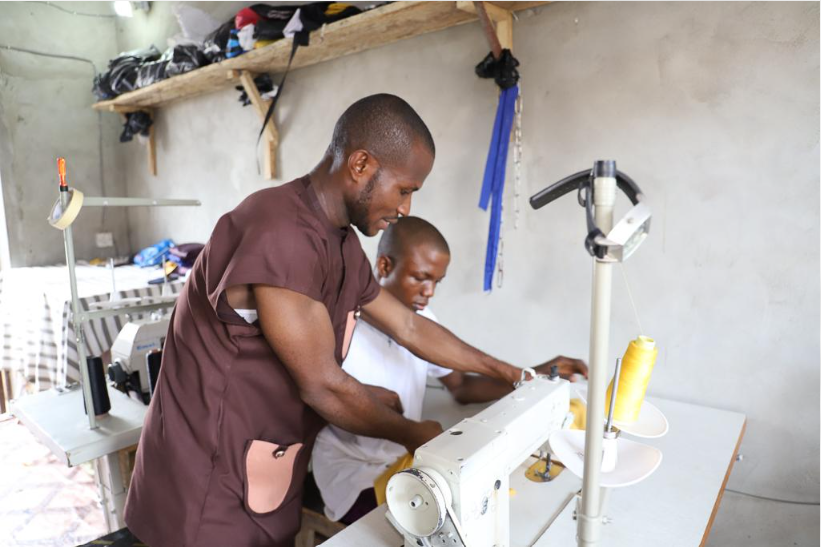
Such programmes demonstrate that public institutions can support private-sector growth when they reduce risks and mobilize additional capital rather than simply competing for the same limited resources.
The objective should not be to eliminate government borrowing, but to ensure that public financing strengthens the conditions under which private enterprise can flourish.
THE ABE TAKE
Africa’s debt debate is often presented through the language of government deficits, repayment schedules and international creditors. Those measures are important, but they do not fully capture the economic consequences of borrowing decisions.
A government may successfully finance its budget while businesses struggle to obtain affordable capital. Equally, reducing public borrowing without addressing weak infrastructure, unreliable institutions or limited credit information may do little to encourage productive investment.
The more meaningful question is whether a country’s financial system can support both responsible public investment and the ambitions of its entrepreneurs.
African governments need sustainable borrowing strategies, deeper financial markets and greater transparency about how public money is used. Banks need incentives and tools to lend responsibly to productive businesses. Entrepreneurs need financing arrangements that recognize commercial potential without ignoring legitimate risks.
Economic development ultimately depends on more than the availability of money. It depends on whether capital reaches activities capable of producing lasting value.
When governments borrow, the consequences should therefore be measured not only in what the state can finance today, but also in what African businesses will be able to build tomorrow.
ABE MAGAZINE
Understand More. Think Bigger.