






ABE NEWS | September 14, 2026
For decades, Canada has enjoyed one of the most valuable economic relationships any country could ask for.
Immediately to its south sits the world’s largest economy.
Canadian oil, cars, lumber, minerals, machinery, electricity and countless other products could cross one of the world’s longest borders into an enormous American market. Businesses built supply chains around that relationship. Governments negotiated trade agreements around it. Entire Canadian industries developed with the assumption that access to the United States would remain the foundation of the country’s economic strategy.
That assumption is becoming considerably less comfortable.
Canada is now locked in a trade confrontation with the United States, its most important commercial partner. Tariffs have exposed just how vulnerable an economy can become when so much of its trade depends on one customer. Prime Minister Mark Carney’s response is not simply to negotiate with Washington.
He wants Canada to find more customers — and substantially more investors.
And this week, he has brought some of the world’s most powerful pools of capital to Toronto to make the pitch.
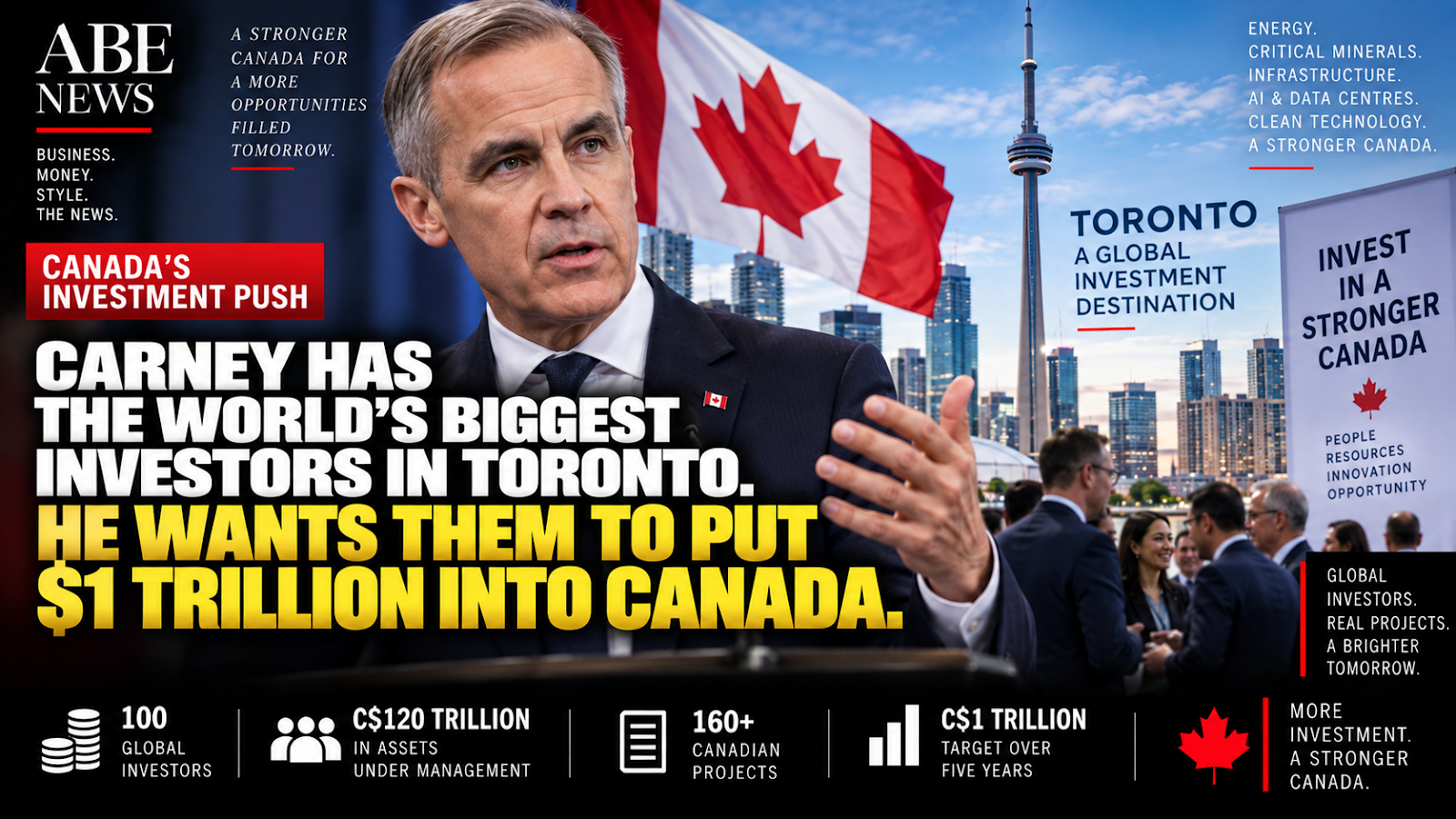
Around 100 global investors are gathering for a two-day summit where they will be introduced to more than 160 potential Canadian projects spanning energy, mining, critical minerals, infrastructure, artificial intelligence, data centres, quantum computing and transportation. The investors represented at the gathering collectively manage more than C$120 trillion in assets.
Among the confirmed attendees are some of global finance’s most influential names, including BlackRock CEO Larry Fink, Blackstone President Jon Gray, Temasek CEO Dilhan Pillay and APG Groep CEO Annette Mosman.
Carney has attached an extraordinary number to the strategy:
C$1 TRILLION
That’s how much investment he wants Canada to attract over the next five years.
The question is whether Canada can actually do it — and, perhaps more importantly, whether bringing enormous amounts of global capital into the country can help Canada become less economically dependent on the United States.
THIS ISN’T REALLY JUST AN INVESTMENT SUMMIT
On paper, the Toronto gathering is essentially a matchmaking exercise.
Canadian companies and governments have projects that need money. Global pension funds, asset managers, private-equity firms, sovereign wealth funds and infrastructure investors have enormous pools of capital that need somewhere to go.
Put the two groups in the same room.
Show them the opportunities.
Try to get deals started.
But the summit is happening at a moment that gives it much greater significance.
Canada’s economic relationship with the United States has deteriorated as Washington imposes tariffs on Canadian products. Carney has responded by trying to deepen commercial relationships with Europe, Asia and the Middle East.
That means attracting foreign investment is becoming part of a much larger Canadian strategy:
diversification.
Canada cannot move away from the United States economically — nor would doing so necessarily make sense.
The two economies are simply too deeply integrated.
But Canada can attempt to make the United States less overwhelmingly important by creating stronger economic relationships elsewhere.
Carney is effectively applying the same principle that multinational corporations are now applying to their supply chains.
Don’t necessarily abandon your largest partner.
Just make sure it isn’t your only serious option.
CARNEY IS SELLING SOMETHING GLOBAL INVESTORS CURRENTLY WANT: STABILITY
Canada isn’t going to beat every country by offering the lowest taxes.
It won’t always have the cheapest labour.
Its regulatory and permitting processes have frequently been criticized for taking too long.
Construction costs can be high.
Large infrastructure projects can take years to approve.
So Carney needs another sales pitch.
One of the strongest is stability.
At a moment when wars, tariffs, political disputes and geopolitical competition are making global investment decisions more complicated, Canada can present itself as a mature democracy with strong institutions, substantial natural resources, sophisticated capital markets and relatively predictable legal protections.
Erik Peterson of Kearney’s Global Business Policy Council described Canada to Reuters as a potential “window of stability” at a particularly important moment for global investors.
That may sound abstract.
For somebody deciding where to put billions of dollars for the next 30 years, it isn’t.
A pension fund financing an electricity grid, mine, data centre or transportation project isn’t simply asking how much money the investment could make next year.
It needs confidence that contracts will remain enforceable, assets will remain secure, regulations will be understandable and the country will remain commercially viable decades into the future.
Canada has a credible argument there.
But stability alone doesn’t produce returns.
Canada still needs investable projects.
THAT’S WHERE THE 160 PROJECTS COME IN
The prospectus being presented to investors contains opportunities at very different stages, ranging from concepts to projects that are much closer to construction.
Some are exactly what one would expect from Canada.
Mining.
Energy.
Infrastructure.
Others point toward the economy Canada wants to build next.
Reuters reports that the investment book includes 96 data centres in development, reflecting Canada’s attempt to capture part of the enormous infrastructure buildout accompanying artificial intelligence and cloud computing.
There is an opportunity to invest in Xanadu’s photonic quantum computer, which is targeted for commercialization around 2029-2030.
Investors are also being shown an Alberta data-centre campus and financing opportunities for a hyperscale AI-focused campus in New Brunswick.
Then there is the Crawford Nickel Project, which is designed to produce lower-carbon nickel that can be used in batteries and green steel.
Infrastructure investors can even consider a proposed high-speed transportation system connecting Calgary and Edmonton, which is seeking roughly C$900 million in financing.
These projects reveal what Carney’s government is trying to accomplish.
This isn’t simply:
“Come buy Canadian companies.”
The ambition is to convince investors that Canada can become a place where the next generation of major industrial assets is actually built.
That distinction matters enormously.
BUYING CANADA ISN’T THE SAME AS BUILDING CANADA
Foreign investment numbers can be deceptive.
Suppose a foreign investment fund spends C$10 billion purchasing an existing Canadian company.
That counts as investment.
But Canada does not necessarily gain a new factory.
It doesn’t necessarily gain a new mine.
It doesn’t necessarily gain new productive capacity.
Ownership changed.
Now imagine the same investor spends C$10 billion constructing a new battery plant, data centre or critical-minerals processing facility.
That can create construction jobs immediately, permanent jobs later, new supplier relationships, additional exports and infrastructure that may operate for decades.
Economists often distinguish this kind of activity as greenfield investment.
And this is where the Carney government’s challenge becomes clearer.
Canada’s foreign direct investment has been relatively resilient. Reuters reports quarterly FDI averaged around C$23 billion during 2024 and 2025, compared with C$16.3 billion in 2023 and C$15 billion in 2022. So far in 2026, the quarterly average is around C$20 billion.
But a significant portion of that capital has come through acquisitions or reinvestment by existing foreign companies.
Greenfield investment — foreign capital financing entirely new factories, warehouses and facilities — has not experienced a major surge since Carney became prime minister.
That’s the number worth watching.
Because if Canada wants to change the structure of its economy, it needs more than investors willing to purchase assets Canada already possesses.
It needs investors willing to create new ones.
C$1 TRILLION IS AN ENORMOUS TARGET
Big numbers can lose their meaning in government announcements.
So consider the scale of Carney’s ambition.
C$1 trillion over five years means roughly C$200 billion in investment per year.
And the summit itself is not expected to produce C$1 trillion worth of signed cheques this week.
Government officials told Reuters that major investments initiated through these discussions could require 12 to 18 months to materialize.
That’s important.
An investment summit can create introductions.
It can improve confidence.
It can put projects in front of decision-makers.
But a C$5 billion mine or C$10 billion energy project doesn’t happen because two executives shook hands at a Toronto hotel.
Investors conduct due diligence.
Financing has to be structured.
Governments issue permits.
Environmental reviews may be required.
Indigenous consultations may be necessary.
Engineering plans need approval.
Commercial agreements have to be negotiated.
Construction costs must make sense.
The summit therefore shouldn’t be judged by how many dramatic announcements appear this week.
The real scorecard comes years later.
CARNEY’S BIGGEST ENEMY MAY BE CANADA’S OWN RED TAPE
Canada possesses resources investors want.
The harder question has often been whether the country can actually build quickly enough.
Major mining, energy and infrastructure projects can spend years navigating regulatory processes before construction begins.
That becomes particularly problematic when Canada is competing with countries willing to approve and build projects faster.
An investor comparing two projects does not simply compare potential returns.
Time matters.
If Project A can begin producing revenue in five years while Project B takes ten years because of permitting delays, the economics can change dramatically.
Carney has therefore tied his investment strategy to reducing regulatory barriers and accelerating major projects.
And today his government added another piece.
Canada’s tax agency will now prioritize requests for advance tax rulings connected to investments worth C$1 billion or more. The measure took effect Monday.
Advance rulings allow an investor to obtain a binding determination about how Canadian tax law will apply to a proposed transaction before committing the money.
That may sound bureaucratic.
For a billion-dollar investment, certainty is valuable.
If a company cannot determine how a transaction will be taxed until after it spends the money, that uncertainty becomes another form of risk.
Canada is effectively telling large investors:
We’ll give you an answer faster.
It is a relatively technical reform, but it points toward the broader problem Carney is trying to solve.
Canada doesn’t merely need opportunities.
It needs to become easier to invest in those opportunities.
CRITICAL MINERALS COULD BE ONE OF CANADA’S STRONGEST CARDS
Canada sits on enormous deposits of minerals that are becoming strategically important to the global economy.
Nickel.
Lithium.
Copper.
Cobalt.
Graphite.
Rare earths.
These materials matter because they sit inside technologies ranging from electric vehicles and batteries to defence systems, power grids and electronics.
The geopolitical importance has increased as Western governments attempt to reduce their dependence on Chinese mineral processing and supply chains.
That creates an opportunity for Canada.
It possesses resources.
It has close relationships with the United States and Europe.
It can market its mining sector as operating under relatively strong environmental and legal standards.
The Crawford Nickel Project being presented at the Toronto summit is a good example of what this strategy could look like.
But possessing minerals underground isn’t the same as having an industry.
Mines require enormous capital.
Processing facilities are expensive.
Roads and electricity infrastructure may need to be built.
Projects can take years before producing their first tonne.
If Canada wants to become a critical-minerals power, it needs investors willing to finance that long period before revenue arrives.
That is exactly the kind of capital Carney is courting.
THEN THERE IS ENERGY
Canada is already one of the world’s major energy producers.
But geography has historically pushed much of that energy toward one customer:
the United States.
The current trade confrontation is forcing Canada to think more aggressively about what happens if it can sell more energy elsewhere.
That could mean additional pipelines, LNG infrastructure, electricity connections and export terminals capable of reaching Europe and Asia.
Carney is simultaneously pursuing a closer strategic relationship with the European Union. On Sunday, he said Canada is seeking a “unique alliance” with the bloc rather than EU membership, with strategic areas under discussion including energy, artificial intelligence, defence and critical minerals.
That connects directly to the investment summit.
Canada cannot diversify trade simply by signing agreements.
It needs physical infrastructure capable of moving goods to different markets.
A mine in northern Canada does little for European supply-chain security if the mineral cannot be processed and transported economically.
An enormous natural-gas reserve doesn’t diversify Canada’s customers if export infrastructure cannot get the gas onto ships.
Trade diversification therefore requires investment.
Investment requires projects.
Projects require approvals.
And approvals require political execution.
That chain is why the C$1 trillion target is about much more than finance.
AI COULD TURN CANADA’S ELECTRICITY INTO A TECHNOLOGY ADVANTAGE
The inclusion of dozens of data-centre projects is particularly interesting.
Artificial intelligence is transforming electricity into a strategic technology input.
Training and running large AI systems requires huge quantities of computing power, and computing power requires enormous amounts of electricity.
That means countries capable of supplying reliable power at competitive prices may gain an advantage in attracting AI infrastructure.
Canada possesses significant hydroelectric capacity alongside nuclear power, natural gas and other energy resources.
It also has cold regions that can potentially reduce some data-centre cooling requirements.
Combine that with proximity to the United States, political stability and a developed technology workforce, and Canada has a credible pitch.
But once again, opportunity doesn’t guarantee investment.
Data centres require transmission infrastructure.
They need land.
They need reliable electricity contracts.
Communities and governments increasingly question how much power massive AI facilities should consume.
The countries that solve those problems fastest may capture a disproportionate share of the AI infrastructure boom.
Canada wants to be one of them.
CANADA’S OWN BANKS ARE PUTTING MONEY ON THE TABLE
Foreign investors aren’t the only institutions being asked to participate.
Canadian financial companies have announced substantial commitments of their own.
Royal Bank of Canada has pledged C$1.4 billion for technology companies.
Bank of Montreal has committed up to C$70 billion toward critical economic sectors.
CIBC plans C$2 billion for defence businesses.
Sun Life has committed C$5 billion toward infrastructure.
Those commitments matter because domestic capital can help validate the investment thesis Canada is selling abroad.
It’s easier to tell a Singaporean sovereign wealth fund or American asset manager that Canada is an exceptional investment opportunity when Canadian financial institutions are willing to make large commitments themselves.
There is also evidence that international financial firms expect more activity.
JPMorgan has been expanding its Canadian equities operation, increasing its senior presence as it positions itself for potentially greater inbound investment. The bank’s Canadian workforce has grown by roughly 50% over five years, while its local revenue has nearly doubled.
Banks don’t make every expansion correctly.
But they generally hire investment professionals because they expect transactions.
CARNEY’S PERSONAL NETWORK IS PART OF THE STRATEGY
There is another unusual element to this summit.
Carney isn’t approaching global finance as an outsider.
Before entering politics, he governed two G7 central banks — the Bank of Canada and the Bank of England — and earlier worked at Goldman Sachs.
That career gave him relationships across global finance.
Reuters notes that several attendees at the Toronto summit come from Carney’s personal network.
That can matter.
Countries often possess investment agencies, glossy prospectuses and government officials tasked with attracting capital.
But personal access to the people who control some of the world’s largest pools of money can shorten the distance between a project and the person capable of financing it.
Carney appears to be trying to convert part of his financial career into a national economic asset.
The ultimate test is whether relationships produce capital.
SAUDI ARABIA, CHINA AND INDIA SHOW HOW MUCH THE STRATEGY HAS CHANGED
Perhaps one of the clearest signs of Canada’s new economic direction is who Carney is willing to do business with.
His government has worked to repair relations with India and China, while Carney has publicly welcomed Saudi investors to the Toronto summit.
That marks a more commercially driven approach to foreign relations.
Canada is essentially confronting a world in which economic alliances are becoming more fluid.
The United States remains indispensable.
Europe is becoming more important.
India offers enormous long-term growth.
China remains one of the world’s largest economies.
Gulf states control vast pools of investment capital.
If Canada wants hundreds of billions of dollars for infrastructure, energy and industrial projects, it cannot rely exclusively on domestic money or one foreign partner.
The strategy requires engaging with several.
That can create uncomfortable political questions.
But it also reflects economic reality.
Capital is global.
Canada wants more of it.
BUT FOREIGN MONEY ISN’T AUTOMATICALLY GOOD MONEY
There is an important issue Canada should not ignore in the rush to attract investment.
Not every foreign investment produces the same national benefit.
If an overseas fund finances a new mine, hires Canadian workers, builds infrastructure and creates export capacity, the economic impact can be substantial.
If a foreign investor simply purchases a Canadian company, extracts profits and eventually sells it, the benefits can be more complicated.
Strategic assets create another question.
How much foreign ownership should Canada accept in critical minerals?
Energy infrastructure?
Artificial intelligence?
Defence companies?
Telecommunications?
Data centres?
Those are not arguments against foreign investment.
They are arguments for distinguishing between capital and control.
Canada needs money to build.
But it also needs to decide which assets it considers strategically important enough to protect.
The larger the investment push becomes, the more important that distinction will be.
THERE IS ALSO THE QUESTION OF WHO ACTUALLY BENEFITS
Politicians frequently celebrate investment using giant numbers.
C$5 billion.
C$20 billion.
C$1 trillion.
But ordinary Canadians will eventually judge the strategy differently.
Does it create good jobs?
Does it raise productivity?
Does it increase wages?
Does it produce infrastructure people actually use?
Does it generate tax revenue?
Does it make housing, energy or transportation better?
Does it create Canadian companies capable of competing globally?
Or does Canada simply become an attractive place for international capital to own assets?
Those are very different outcomes.
Canada has struggled for years with weak productivity growth compared with the United States.
Attracting investment can help solve that problem if the money finances better technology, machinery, infrastructure and businesses.
Capital makes workers more productive when it gives them better tools.
Productivity creates the economic capacity for higher wages and living standards.
That should ultimately be the point of the C$1 trillion target.
Not simply making the investment statistic larger.
Making the Canadian economy stronger.
THE U.S. TRADE WAR MAY HAVE CREATED THE URGENCY CANADA NEEDED
There is an irony at the centre of this story.
Canada’s extraordinary access to the United States has been an enormous economic advantage.
It may also have reduced the urgency to diversify.
When your neighbour is the world’s largest economy and buys enormous quantities of what you produce, building relationships thousands of kilometres away can seem less necessary.
Tariffs change that calculation.
Suddenly, dependence becomes visible.
Canada doesn’t need to replace the United States.
That would be neither realistic nor desirable.
But the country can ask whether too much of its economic future depends on decisions made in Washington.
Carney appears to have decided the answer is yes.
And rather than responding solely with retaliatory tariffs or political speeches, he is attempting something more structural:
give global capital more reasons to build in Canada.
🔴 THE ABE NEWS TAKE
C$1 trillion is the number that will capture attention.
But it isn’t the most important part of this story.
The real question is whether Canada can transform itself from a country with enormous economic potential into a country that actually builds at enormous scale.
Canada already has many of the ingredients investors want.
Energy.
Critical minerals.
Land.
Political stability.
Strong institutions.
An educated workforce.
Access to the United States.
Relationships with Europe.
A sophisticated banking system.
Growing technology expertise.
The problem has rarely been convincing people that Canada possesses valuable things.
The problem is turning those advantages into mines, power lines, data centres, factories, transportation systems and globally competitive businesses quickly enough.
That is why the greenfield investment number matters more than the headline FDI number.
Canada does not simply need the world to buy Canada.
It needs the world to build in Canada.
And if Carney wants C$1 trillion, the government must understand something every entrepreneur eventually learns:
Capital follows opportunity, but it also follows execution.
Larry Fink can visit Toronto.
Blackstone can examine the prospectus.
Temasek can study the projects.
Pension funds can sit across the table from Canadian executives.
But eventually those investors will ask the questions that determine whether billions of dollars actually move:
How long will approval take?
What will the return be?
Can the project actually get built?
Will the rules remain predictable?
Can Canada move faster than the alternatives?
If the answers are convincing, the U.S. trade confrontation could unintentionally become the event that pushes Canada toward a more diversified and ambitious economic model.
If they aren’t, C$1 trillion will remain an impressive target attached to an investment summit.
The difference between those outcomes will not be decided in Toronto this week.
It will be decided over the next five years — in mines that open, factories that get built, power lines that connect, data centres that switch on, businesses that scale and investment commitments that turn into actual Canadian assets.
The world has the money.
Carney has brought the people controlling a remarkable amount of it into the room.
Now Canada has to prove it can build something worth investing in.
ABE NEWS
Business. Money. Style. The News.
Understand More. Think Bigger.