






ABE NEWS | September 14, 2026
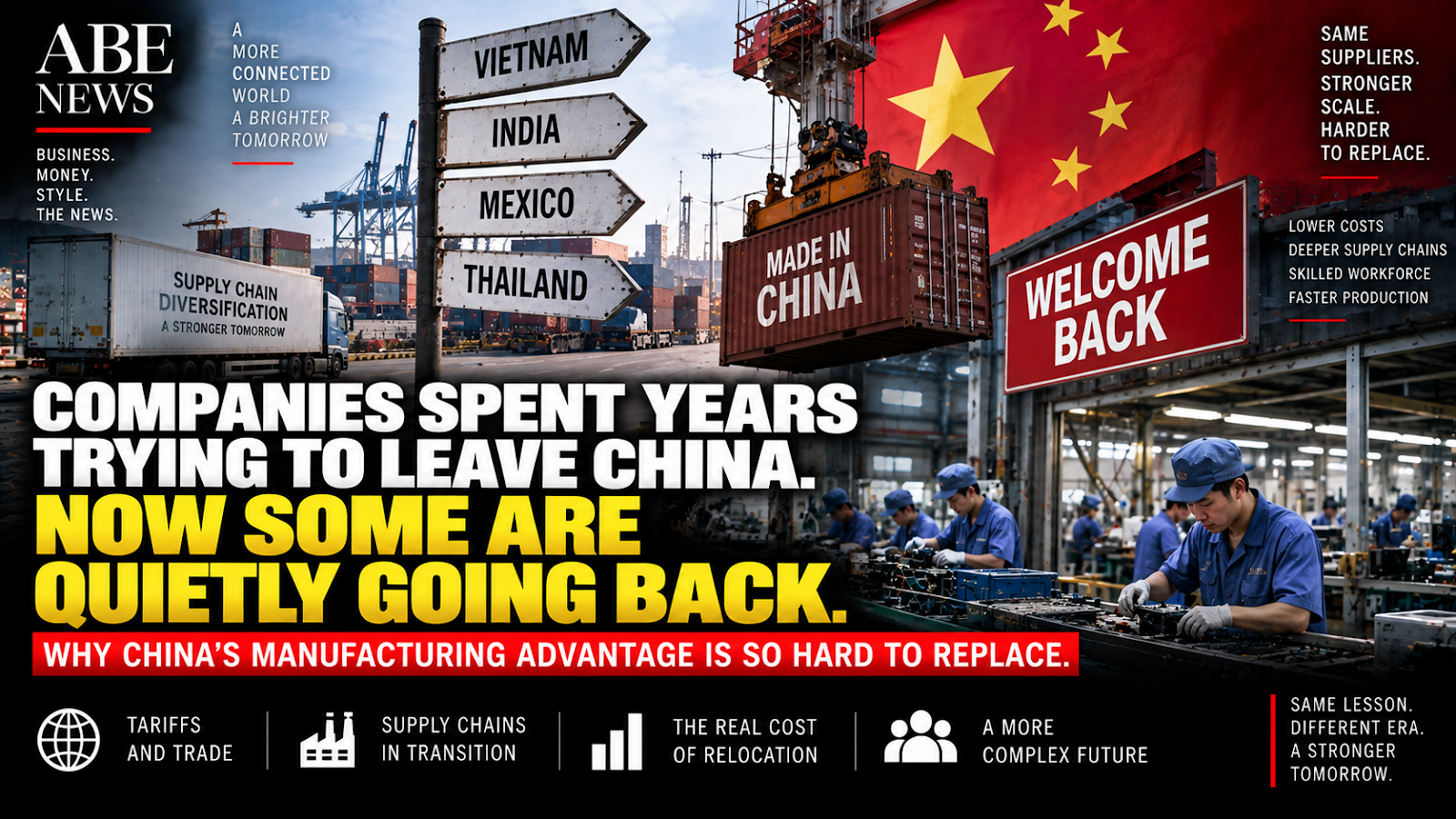
For years, one of the biggest strategic conversations inside global business could be summarized in three words:
Get out of China.
Not completely, perhaps. But reduce the dependence.
American tariffs made Chinese imports more expensive. The pandemic demonstrated how dangerous it could be to depend heavily on one country. Rising tensions between Washington and Beijing made executives worry about what would happen if the relationship deteriorated further. Governments began encouraging companies to manufacture closer to home or in countries considered politically safer.
Vietnam became one of the biggest beneficiaries. India promised an enormous workforce and rapidly expanding domestic market. Thailand, Indonesia and other Southeast Asian economies attracted manufacturers looking for alternatives. Mexico offered something particularly valuable to companies selling into the United States: proximity.
The strategy became known as “China+1.”
Keep some production in China, but establish another manufacturing base elsewhere so the company is no longer dependent on a single country.
Billions of dollars followed that idea.
Factories were built. Suppliers relocated. Production lines moved. Companies spent years attempting to create manufacturing networks that would be less exposed to Chinese tariffs and geopolitical risk.
Now, some businesses are discovering something they underestimated.
Leaving China can be easier than replacing China.
Reuters reported Monday that a number of companies that moved production or sourcing outside China are shifting at least some orders back, after confronting higher costs, unreliable electricity, shortages of skilled workers, weaker supplier networks and other operational difficulties in alternative manufacturing locations.
This doesn’t mean the great supply-chain diversification away from China is suddenly reversing.
Vietnam is not emptying its factories. India is not losing its manufacturing ambitions. Mexico’s position beside the world’s largest consumer economy remains extraordinarily valuable.
Something subtler is happening.
Companies are beginning to discover the difference between a cheap factory and a manufacturing ecosystem.
China spent decades building the second.
And that may be considerably harder to replicate.
THE GREAT CHINA EXIT WAS NEVER JUST ABOUT WAGES
China became the factory of the world partly because labour was inexpensive.
But stopping the explanation there misses what happened next.
Decades of manufacturing created enormous industrial clusters. Suppliers established factories close to other suppliers. Ports expanded. Highways and rail networks connected manufacturing centres with the coast. Technical workers accumulated experience. Companies specializing in moulds, packaging, electronics, plastics, metals, machinery and thousands of other components developed around major production centres.
Over time, China’s advantage stopped being simply:
“Our workers cost less.”
It became:
“Almost everything your factory needs already exists nearby.”
That distinction is enormous.
Imagine an American company producing a relatively ordinary consumer product.
It needs plastic components from one supplier, metal parts from another, packaging from another, electronic components from another and specialized machinery to assemble everything. If the design changes, engineers may need a new mould quickly. If demand suddenly doubles, suppliers need enough capacity to respond.
In a mature Chinese manufacturing cluster, many of those capabilities can exist within the same region.
Move the final assembly line to another country and the company may discover that several of the suppliers it depends upon are still in China.
Now components have to be shipped to the new factory.
The labour may be cheaper.
The supply chain may not be.
SOME COMPANIES ARE LEARNING THAT THE HARD WAY
Reuters documented several examples illustrating how this calculation is changing.
Chinese cookware manufacturer Dawang Metals moved roughly half of its U.S.-bound production to Thailand to reduce exposure to American tariffs. But the company encountered operational problems, including difficulties obtaining equipment and finding appropriately skilled workers.
It is now moving some production back to China.
Another example is particularly revealing because of the company involved.
Target, one of America’s largest retailers, had shifted sourcing for some products away from China. But Reuters reported that the retailer moved orders for certain goods back after encountering manufacturing difficulties elsewhere.
Fast-fashion giant Shein, whose supply chain has long been deeply connected to Chinese manufacturing, also scaled back efforts to source more production from Turkey after encountering difficulties there.
Packaging company DST Pack considered manufacturing in Vietnam, only to conclude that operating there would not provide enough of an advantage once the broader costs were considered.
These companies are not necessarily making ideological statements about China.
They are doing something much more ordinary.
They’re calculating.
And the spreadsheet is producing answers that don’t always match the political narrative.
A LOWER TARIFF DOESN’T GUARANTEE A LOWER COST
This is where the economics becomes particularly interesting.
Suppose a company pays a 25% tariff when importing a product manufactured in China.
Another country faces only a 10% tariff.
Moving production appears obvious.
But tariffs are only one component of the total cost.
What if workers in the alternative location require more training?
What if productivity is lower?
What if electricity fails more frequently?
What if raw materials must still be imported from China?
What if the local factory lacks sophisticated equipment?
What if quality-control failures increase?
What if suppliers require longer lead times?
What if the company has to send Chinese engineers overseas to solve production problems?
What if the alternative factory cannot increase production quickly when demand rises?
Suddenly, that 15-percentage-point tariff advantage begins disappearing.
Businesses don’t ultimately care only about the price written on the factory invoice.
They care about landed cost — what it actually costs to manufacture a product, transport it, clear customs and get it where it needs to go reliably.
Then there is another cost that is harder to measure:
the cost of things going wrong.
That may be where China’s manufacturing advantage is proving particularly durable.
CHINA HAS SOMETHING MONEY CANNOT BUILD OVERNIGHT
A government can approve a new industrial park.
It can build a highway.
It can offer tax incentives.
A multinational corporation can construct a factory.
Those things can happen within several years.
Building an entire industrial ecosystem takes considerably longer.
Workers need experience.
Managers need experience.
Suppliers need customers large enough to justify investing in new capacity.
Those suppliers then attract additional manufacturers because components become easier to obtain.
More manufacturers attract more suppliers.
Universities and technical schools adapt to the labour market.
Logistics networks become increasingly specialized.
Eventually, an ecosystem develops in which each participant makes the others more productive.
China has been doing this at enormous scale for decades.
Reuters reported earlier this year on Agilian Technology, an electronics manufacturer in Dongguan that came under pressure from Western customers to establish production outside China following tariff increases. The experience reinforced the company’s view that China’s combination of suppliers, capabilities and manufacturing infrastructure remained extremely difficult to reproduce elsewhere.
That’s the problem facing companies attempting to diversify.
They aren’t competing with one Chinese factory.
They’re competing with everything surrounding it.
VIETNAM STILL WINS — BUT IT CANNOT BECOME CHINA TOMORROW
None of this means Vietnam’s manufacturing boom has failed.
Vietnam has been one of the biggest beneficiaries of companies diversifying production away from China. Electronics, apparel, furniture and other industries have expanded there, and multinational manufacturers continue investing in the country.
But scale creates constraints.
China has a population of roughly 1.4 billion people. Vietnam’s population is around 100 million.
China possesses enormous industrial regions containing millions of manufacturing workers and highly developed supplier networks. Vietnam can continue expanding manufacturing dramatically without being able to reproduce that scale immediately.
And rapid industrialization creates its own problems.
Industrial land becomes more expensive. Skilled workers become harder to find. Wages rise. Infrastructure comes under pressure.
The very success that makes an alternative manufacturing location attractive can gradually reduce some of the cost advantage that attracted companies in the first place.
That doesn’t make Vietnam a poor manufacturing location.
It means companies may have been unrealistic if they expected another country to become a smaller China simply because they wanted it to.
INDIA HAS SCALE — BUT SCALE ALONE ISN’T ENOUGH
India presents a different proposition.
Unlike Vietnam, India has a population comparable to China’s and one of the world’s largest labour forces. Its government has made manufacturing a national priority, and major companies have expanded production there.
Apple’s supply chain provides perhaps the most prominent example, with suppliers significantly increasing iPhone production in India as Apple diversifies beyond China.
India therefore possesses something few countries can offer simultaneously:
manufacturing potential and a gigantic consumer market.
But manufacturing competitiveness depends on more than population.
Infrastructure, customs procedures, supplier depth, worker training, power reliability, logistics and regulation all influence whether a factory can operate efficiently.
India and China have also maintained a complicated economic relationship. Reuters reported last week that despite improving diplomatic ties, investment and technology flows between the two countries continue to face significant distrust, including restrictions affecting equipment, visas and Chinese companies.
That creates an interesting paradox.
Companies want India to become a larger alternative to China.
But building sophisticated manufacturing capacity in India can sometimes require Chinese machinery, engineers, components or expertise.
The alternative may still depend on the thing it is supposed to replace.
MEXICO HAS THE ADVANTAGE CHINA CAN NEVER REPLICATE
Mexico’s great advantage is geography.
A factory in China may be exceptionally efficient, but it remains thousands of kilometres away from American consumers.
Mexico sits next door.
That can shorten transportation times dramatically and allows manufacturers to build production networks integrated with the United States and Canada.
The nearshoring thesis is therefore powerful: manufacture goods closer to the customers who will ultimately buy them.
Mexico has already attracted enormous automobile, electronics and industrial supply chains for precisely this reason.
But Mexico has its own constraints, including infrastructure bottlenecks, energy limitations, security concerns and long-standing productivity challenges. Reuters Breakingviews noted earlier this year that record trade and foreign investment have not automatically translated into equally strong economic growth, highlighting the difficulty of turning nearshoring investment into broader productivity gains.
Mexico can be extremely attractive without being the correct answer for every product.
That is becoming the broader lesson.
There may be no single replacement for China.
THE CHINESE FACTORY HAS ALSO LEARNED TO ADAPT
There is another reason predictions about China’s manufacturing collapse repeatedly prove premature.
Chinese manufacturers don’t simply sit still while tariffs rise.
They adapt.
Factories reduce margins. Suppliers find new customers. Exporters target Europe, Southeast Asia, Latin America, Africa and the Middle East. Chinese companies establish their own overseas factories. Manufacturers automate production to reduce labour costs.
China ended 2025 with a record $1.2 trillion trade surplus, despite the enormous tariff shock from the United States, partly because exporters expanded aggressively into markets outside America.
That number tells us something important.
Tariffs can change where Chinese goods are sold.
They can change margins.
They can encourage companies to establish factories abroad.
But eliminating China’s manufacturing competitiveness is an entirely different challenge.
The industrial machine adapts.
CHINESE COMPANIES ARE GLOBALIZING TOO
The supply-chain story is often presented as foreign companies leaving China.
But Chinese companies themselves are increasingly building factories abroad.
BYD is a perfect example.
The Chinese electric-vehicle giant said Monday that it intends to manufacture trucks in Europe as it expands its presence there. Executive Vice President Stella Li said BYD ultimately wants vehicles sold in Europe to be produced locally, part of an effort to establish itself increasingly as a European manufacturer rather than merely an exporter from China.
BYD is also developing passenger-car manufacturing in Hungary.
This represents an important evolution.
China’s industrial strength is no longer confined inside China’s borders.
Chinese companies can take their technology, manufacturing expertise and supplier relationships abroad.
Japanese automakers did something similar decades ago.
Toyota and Honda stopped being companies that simply exported Japanese cars to America. They built American factories, hired American workers and developed local supplier networks.
South Korean and European automakers followed similar paths.
Chinese companies increasingly appear interested in doing the same thing.
That means the next phase of globalization may not involve the world manufacturing less with China.
It may involve Chinese manufacturing becoming more global.
TARIFFS HAVE STILL CHANGED BUSINESS PERMANENTLY
None of this means tariffs failed to change corporate behaviour.
They did.
The era in which multinational corporations could build enormous portions of their supply chains around China without seriously considering geopolitical risk is probably over.
Boards now ask questions they rarely asked fifteen years ago.
What happens if tariffs double?
What happens if a shipping route closes?
What happens if Washington restricts another technology?
What happens if China retaliates?
What happens if Taiwan becomes a military crisis?
What happens if our largest supplier suddenly becomes inaccessible?
Those questions have value even if the ultimate answer is to keep substantial manufacturing in China.
Diversification is partly about cost.
It is also insurance.
A company might knowingly accept slightly higher production costs in Vietnam, India or Mexico because maintaining a second manufacturing base reduces the risk of catastrophic disruption.
That means returning some orders to China does not necessarily represent the death of China+1.
It may represent the strategy becoming more sophisticated.
The objective is shifting from:
“Leave China.”
toward:
“Don’t depend entirely on anywhere.”
THAT IS VERY DIFFERENT FROM DECOUPLING
For years, politicians have discussed the possibility of the American and Chinese economies becoming less intertwined.
Businesses increasingly prefer another word:
de-risking.
The difference matters.
Decoupling implies separating two economic systems.
De-risking means maintaining the relationship while reducing the consequences if part of it fails.
A company might manufacture 60% of a product in China, 25% in Vietnam and 15% in Mexico.
China remains the dominant manufacturing location.
But the company now possesses alternatives.
If tariffs change, production can shift.
If a factory closes, another location can increase output.
If transportation becomes disrupted in one region, another route remains available.
This arrangement may cost more than putting 100% of production in whichever factory is cheapest.
But as we argued in Saturday’s ABE Original, resilience has a price — and so does fragility.
The companies returning some production to China aren’t necessarily abandoning resilience.
They may simply be discovering that resilience doesn’t require abandoning efficiency altogether.
THERE IS ALSO A LIMIT TO WHAT POLITICS CAN MAKE COMPANIES DO
Governments can influence business decisions enormously.
Tariffs change prices.
Subsidies can make factories economically viable.
Export restrictions can make certain transactions impossible.
Regulations can determine which technologies companies may purchase.
But businesses ultimately operate under another pressure:
customers still want affordable products.
If manufacturing in one country raises the cost of a product by 30%, a company has to decide who absorbs that difference.
The manufacturer can accept lower profits.
The retailer can accept lower margins.
Or the consumer can pay more.
None of those options is particularly attractive.
That is why political pressure and economic reality can eventually collide.
Governments may want supply chains moved for strategic reasons.
Companies may discover that consumers are unwilling to pay the full cost of making that happen.
China’s advantage becomes especially powerful at that point because decades of industrial development have made it extraordinarily good at manufacturing large quantities of products quickly and cheaply.
Businesses cannot ignore geopolitics.
But they cannot ignore economics either.
THE REAL WINNERS MAY BE COMPANIES THAT LEARN TO OPERATE IN BOTH WORLDS
The most successful multinational businesses may therefore avoid choosing between globalization and localization entirely.
They will do both.
They may retain large Chinese operations because China’s manufacturing ecosystem remains unmatched in certain industries.
They may establish factories in Vietnam or India to diversify Asian production.
They may manufacture in Mexico for the North American market.
They may produce inside Europe to avoid tariffs and serve European customers more quickly.
Different factories may serve different regions rather than one country producing everything for the entire world.
This is sometimes called regionalization.
And it may become one of the defining business strategies of the next decade.
The global economy doesn’t necessarily become less connected.
It becomes connected differently.
Instead of one enormous supply chain optimized primarily for cost, companies operate several overlapping supply chains optimized for a combination of cost, geography, politics and resilience.
That is more complicated.
It is probably more expensive.
But it may also be much harder to break.
🔴 THE ABE NEWS TAKE
The most important lesson from companies returning production to China is not that the great manufacturing exodus has failed.
It is that China was never just a cheap place to make things.
That misunderstanding shaped much of the early conversation around diversification.
If China’s advantage were simply inexpensive labour, replacing it would be relatively straightforward. Find another country with lower wages, build a factory and move production.
But after decades as the world’s manufacturing centre, China accumulated something far more powerful than cheap workers.
It accumulated industrial knowledge.
Suppliers know how to work together. Engineers know how to solve production problems. Factories can find specialized machinery. Ports can process enormous volumes. Logistics networks connect industrial regions to global markets. Workers have spent years developing skills in particular manufacturing processes.
None of those advantages is impossible to reproduce.
But they take time.
That is why today’s story should not be read as “China won and everybody is going back.”
That would be too simple.
Vietnam will continue manufacturing more.
India will continue industrializing.
Mexico will continue benefiting from its proximity to the United States.
Companies will continue building supply chains outside China because tariffs, geopolitical tensions and lessons from the pandemic have made diversification strategically important.
But the idea that global manufacturing could simply pick itself up from China and reappear somewhere else was always unrealistic.
What companies appear to be learning is more useful:
There is no perfect manufacturing country.
China offers scale and supplier depth but carries geopolitical and tariff risk.
Vietnam offers competitive production but cannot instantly replicate China’s scale.
India offers extraordinary long-term potential but still has infrastructure and supply-chain challenges.
Mexico offers proximity to America but faces its own operational constraints.
The intelligent strategy may therefore be neither staying entirely in China nor leaving entirely.
It is knowing what China remains exceptionally good at, what can realistically move elsewhere, and how much a company is willing to pay to ensure it is never trapped by a single supply chain again.
For decades, businesses built the global economy around one overriding question:
Where can we make this cheapest?
The question now has several additional words:
Where can we make this cheaply, reliably — and still make it if the world changes tomorrow?
China remains difficult to replace because, for a remarkable number of products, it can still answer the first two parts better than almost anywhere else.
The race now is for the rest of the world to catch up.
ABE NEWS
Business. Money. Style. The News.
Understand More. Think Bigger.