







ABE NEWS | September 1, 2026
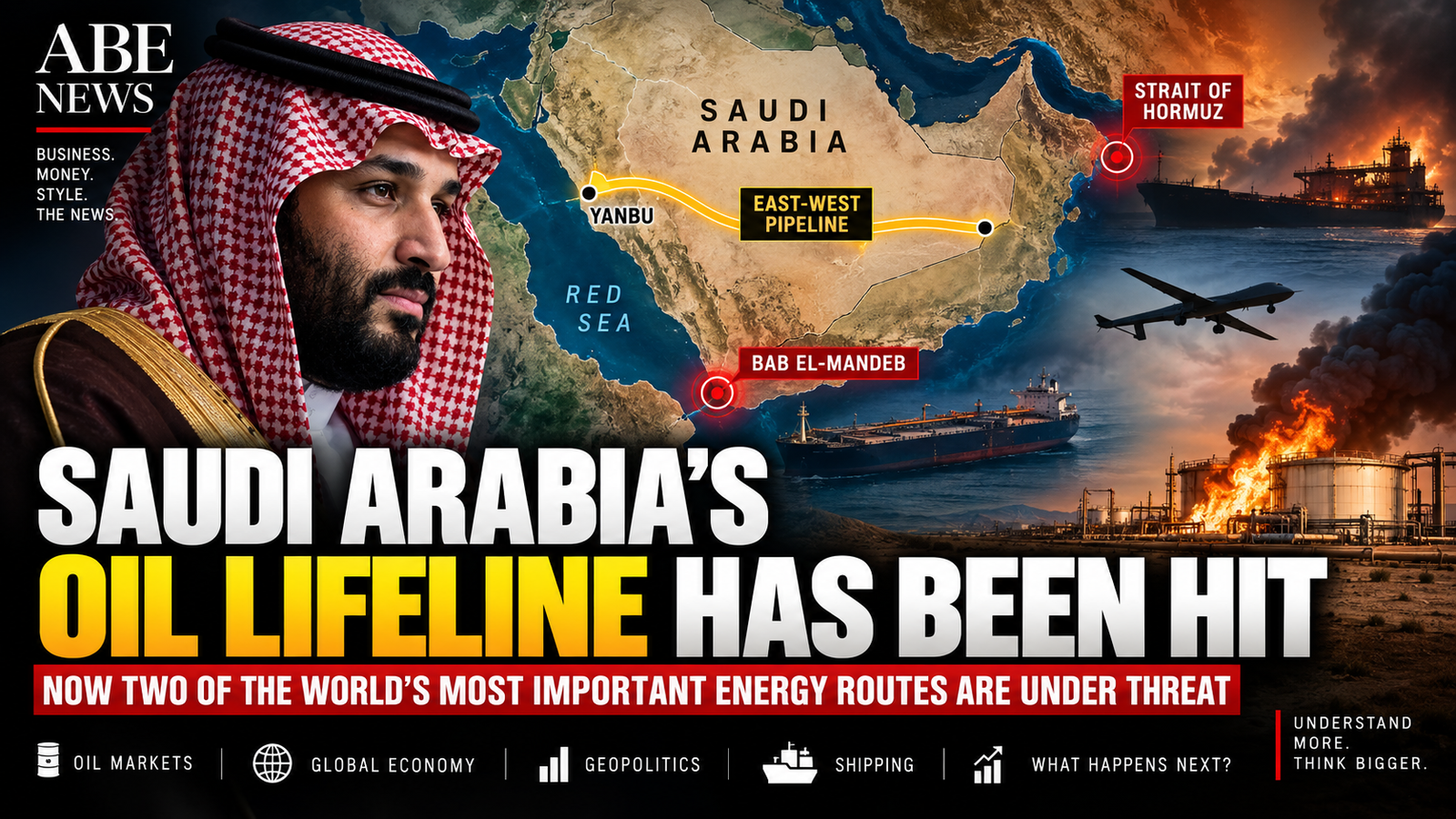
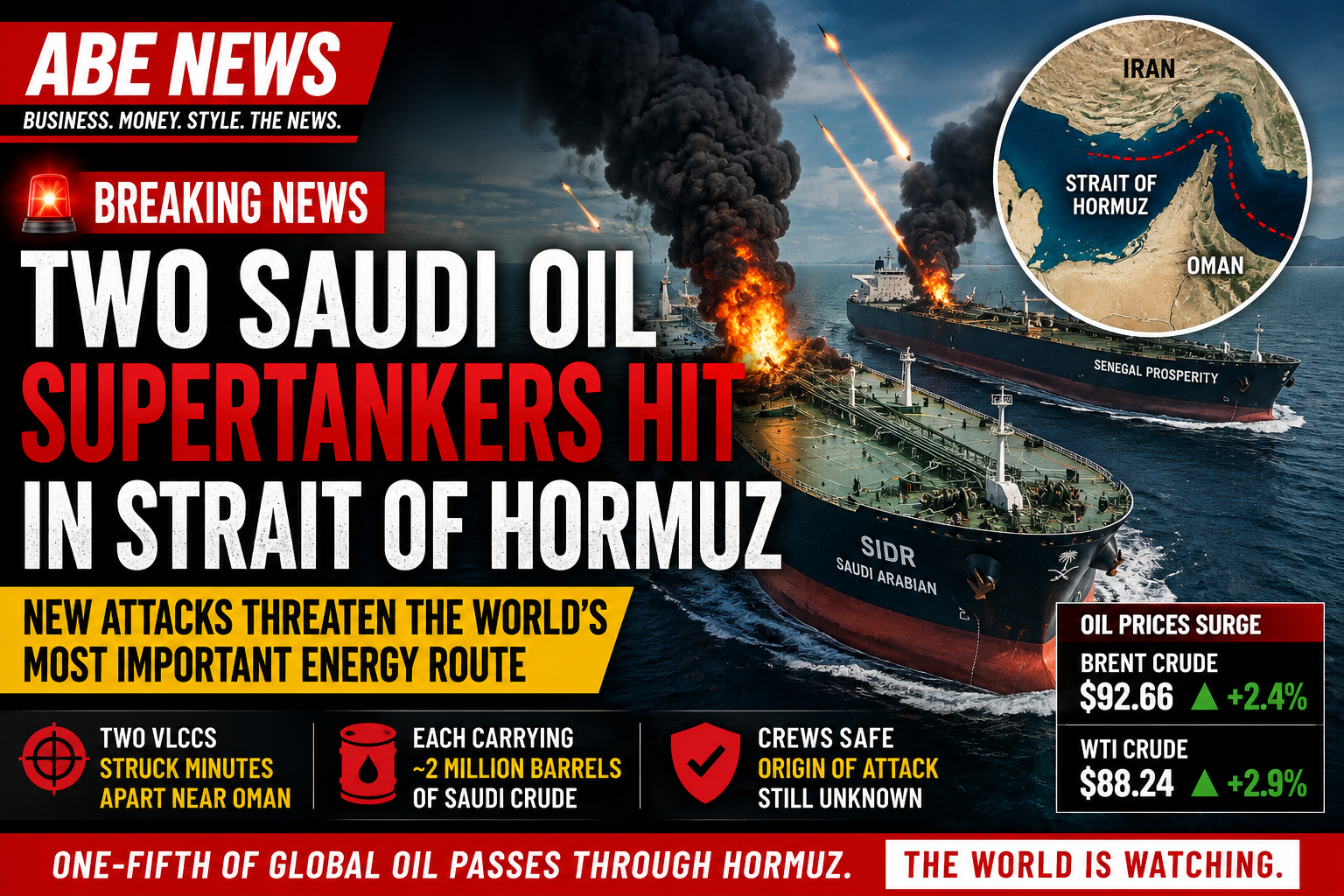
Two enormous oil tankers carrying millions of barrels of Saudi crude have been struck by unknown projectiles while attempting to leave the Persian Gulf through the Strait of Hormuz, marking another dangerous escalation around the waterway that sits at the centre of the world’s energy system.
The attacks happened within minutes of each other late Monday near Oman.
The first vessel, the Saudi Arabian-flagged VLCC Sidr, was struck approximately 16.6 nautical miles northeast of Khasab, Oman. Minutes later, the Liberian-flagged Senegal Prosperity was reportedly hit by three unknown projectiles roughly 17 nautical miles east of Khasab.
Both vessels are very large crude carriers — VLCCs — among the largest oil tankers operating on the world’s oceans.
And both were carrying Saudi oil.
Each tanker had loaded approximately 2 million barrels of crude at Saudi Arabia’s Juaymah terminal last week, according to shipping data cited by Reuters.
Together, that means roughly 4 million barrels of Saudi crude were aboard the two vessels when the attacks occurred.
The crews aboard both ships were reported safe.
But the significance of the attacks extends far beyond the vessels themselves.
They were attempting to pass through the Strait of Hormuz, the narrow maritime chokepoint connecting the Persian Gulf with the Arabian Sea — and one of the most economically important stretches of water on Earth.
Before the current conflict, approximately one-fifth of global oil supplies moved through Hormuz.
Now ships attempting to carry that energy to the rest of the world are being attacked.
And global oil markets are paying attention.
TWO TANKERS. MINUTES APART.
The timing is one of the most troubling elements.
According to maritime-security reporting, the Sidr was struck at approximately 19:52 UTC near Oman.
Only minutes later, the Senegal Prosperity was struck in roughly the same area.
The United Kingdom Maritime Trade Operations agency separately reported that a tanker had been struck by three unidentified projectiles while completing an outbound transit through Hormuz.
The location and timing appeared consistent with the Senegal Prosperity incident.
The near-simultaneous nature of the attacks raises the possibility that this was not a random maritime accident.
But there is an important distinction.
Who fired the projectiles has not been established.
No responsible news organization should turn suspicion into fact.
The region is currently filled with military forces, competing governments, armed groups and extraordinary geopolitical tension.
Until credible evidence identifies the attacker, the correct description is exactly what investigators currently have:
unknown projectiles.
WHY THESE SHIPS MATTER
These weren’t ordinary cargo ships.
A VLCC can transport roughly 2 million barrels of crude oil.
That makes vessels like the Sidr and Senegal Prosperity essential pieces of the global energy system.
Saudi Arabia produces enormous quantities of oil, but producing crude is only half of the business.
The oil has to reach customers.
Tankers carry it to refineries and markets across Asia, Europe and elsewhere.
If the ships cannot safely leave the Persian Gulf, production capacity inside Saudi Arabia, the United Arab Emirates, Iraq, Kuwait and other regional producers becomes far less useful to the global market.
That’s why attacks on tankers can affect oil prices even if no major oilfield has been destroyed.
The infrastructure connecting oil producers with consumers is itself part of the energy supply.
A tanker is infrastructure.
A port is infrastructure.
A pipeline is infrastructure.
And the Strait of Hormuz may be the most important piece of maritime oil infrastructure in the world.
HORMUZ TRAFFIC IS ALREADY COLLAPSING
The attacks come as ordinary commercial traffic through Hormuz has already fallen dramatically.
Preliminary ship-tracking data showed only about five vessels passed through the Strait on Monday.
Four entered.
One exited.
That compares with a recent 10-day average of roughly 14 vessel movements.
And notably, ship-tracking data showed no liquid tankers among Monday’s recorded transits.
Those figures do not include vessels operating with tracking transponders switched off, so they do not provide a complete picture of every ship moving through the waterway.
But the direction is unmistakable.
Traffic through one of the world’s busiest energy corridors has become extraordinarily restricted.
That means the global oil market isn’t merely worrying about a hypothetical closure anymore.
The flow of ships has already been severely disrupted.
SAUDI ARABIA HAD STARTED MOVING OIL AGAIN
That makes the timing especially significant.
Saudi oil shipments from inside the Strait had begun moving again in August.
Saudi Aramco had resumed oil loadings and sales from facilities inside Hormuz as efforts continued to maintain an export route through the crisis.
The two attacked tankers had loaded their cargoes at Juaymah, an important Saudi crude-oil export terminal.
The fact that both were then struck while attempting to leave the Gulf sends an uncomfortable message to every shipping company considering the same journey:
Loading the oil is one thing. Getting it safely through Hormuz is another.
Shipping companies, insurers and tanker owners now have to calculate whether the financial reward of entering the region compensates for the growing physical risk.
If they decide it doesn’t, energy flows can decline even without an official blockade.
THE INSURANCE PROBLEM COULD BECOME ENORMOUS
War risk has a price.
Commercial ships operating through dangerous areas require insurance.
When attacks increase, insurers raise premiums.
In extreme circumstances, insurers can withdraw coverage entirely.
Shipowners then demand higher rates to compensate for the additional danger.
Crews may also become reluctant to operate through conflict zones.
Every additional expense eventually works its way through the global energy chain.
Producer.
Trader.
Tanker.
Insurer.
Refinery.
Distributor.
Consumer.
That means geopolitical risk can eventually appear at an ordinary gasoline station thousands of kilometres away.
A driver in Toronto, London, Johannesburg or Tokyo may never think about a tanker sailing near Oman.
But energy markets do.
OIL IS ALREADY REACTING
Oil prices climbed Tuesday as the attacks combined with renewed U.S.–Iran military tension to increase concerns about supply.
Brent crude moved back above $92 a barrel during Tuesday trading, while U.S. West Texas Intermediate also rose sharply.
The market reaction reflects something larger than the damage to two ships.
Traders are trying to calculate the probability of a much worse scenario.
What if tanker attacks continue?
What if another ship suffers catastrophic damage?
What if crews are killed?
What if Saudi exports are substantially disrupted?
What if military escorts become involved in combat?
What if Iran’s oil infrastructure is attacked?
What if the Strait becomes effectively unusable?
Oil markets don’t wait for those events to happen.
Prices begin incorporating the probability that they might.
THE STRAIT OF HORMUZ IS ALMOST IMPOSSIBLE TO REPLACE
The geography explains why the world cares so much.
Hormuz is the only maritime exit from the Persian Gulf.
Saudi Arabia, Iran, Iraq, Kuwait, Qatar, Bahrain and the United Arab Emirates collectively sit around one of the largest concentrations of oil and natural-gas production on Earth.
Some producers have pipelines capable of bypassing Hormuz.
Saudi Arabia, for example, can move some crude westward toward the Red Sea.
The UAE also has infrastructure allowing some oil to bypass the Strait.
But those alternatives cannot simply replace the enormous volumes historically transported through Hormuz.
The maritime route therefore remains critical.
Before the current conflict, around one-fifth of global oil supply passed through it.
That means disruption inside a relatively narrow stretch of water can influence energy prices across the planet.
THE CRISIS HAS MOVED INTO A NEW PHASE
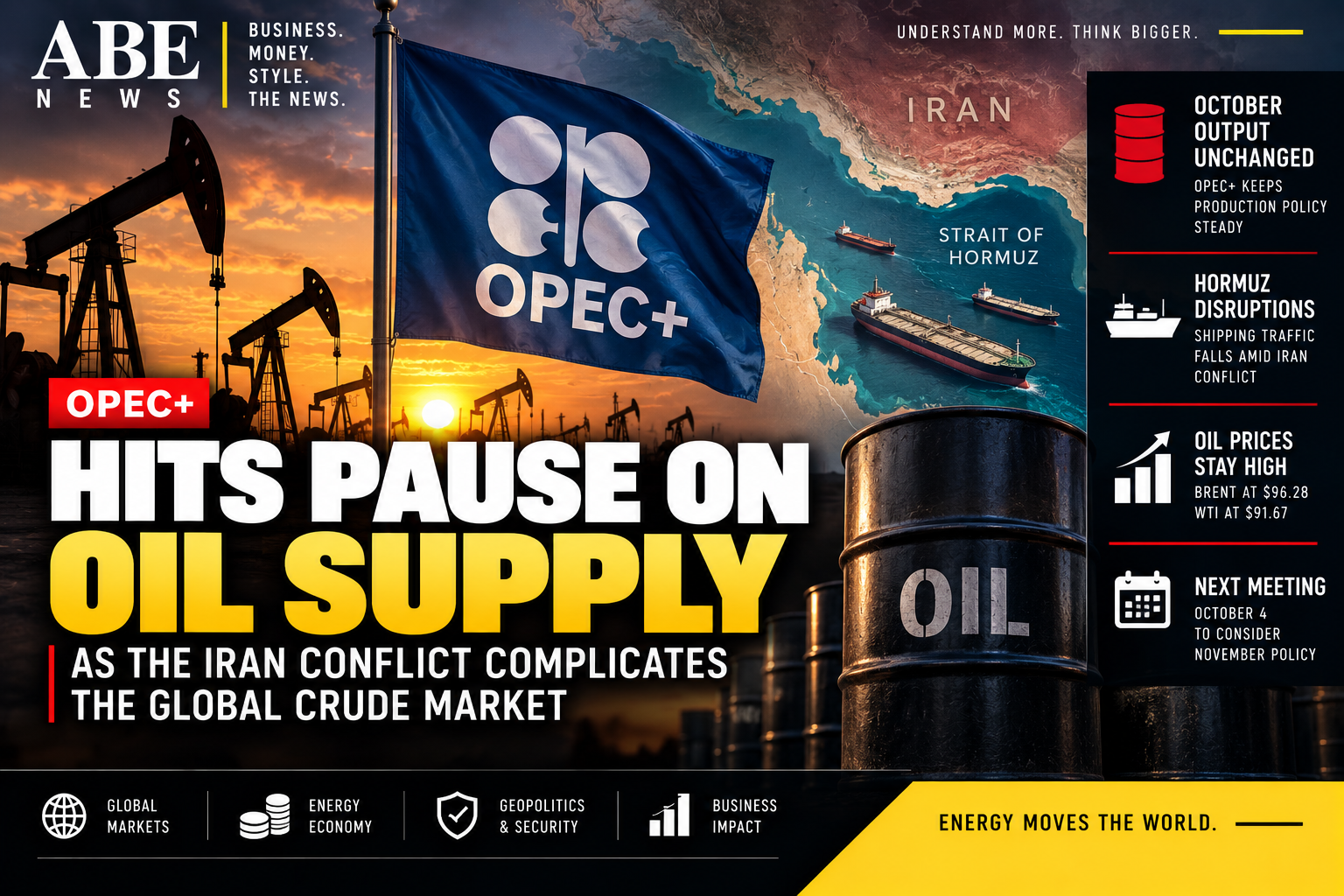
For months, the Hormuz crisis has moved between military confrontation, economic pressure, sanctions, shipping restrictions and diplomatic negotiations.
Qatar and Oman have been among the mediators attempting to produce arrangements that could reopen the waterway more reliably.
Those efforts have not yet produced a durable solution.
Meanwhile, military tension has returned.
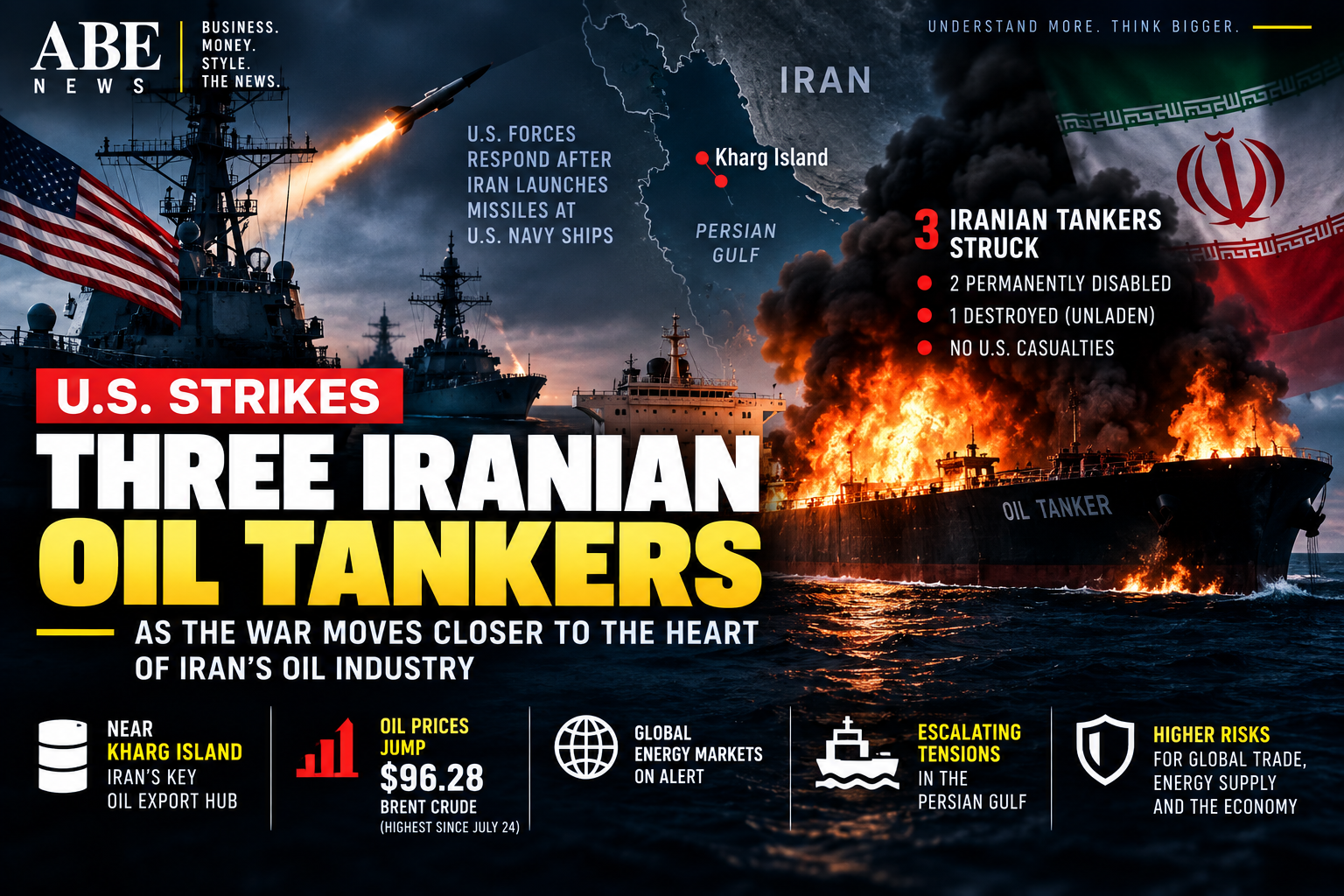
U.S. forces struck Iranian launchers on Larak Island on Sunday after American officials said Iranian Revolutionary Guard forces were preparing rockets carrying sea mines for use in the Strait.
Iran then launched missiles toward U.S.-used military bases in Jordan.
President Donald Trump subsequently threatened further American strikes.
Now commercial tankers carrying Saudi crude have been struck.
Each escalation makes the next diplomatic settlement harder.
And each escalation increases the probability that an accident, misunderstanding or deliberate attack produces something much larger.
SAUDI ARABIA NOW HAS A PARTICULARLY DIFFICULT PROBLEM
Saudi Arabia has enormous economic interests tied to stable oil exports.
Its national transformation strategy requires massive investment.
Infrastructure.
Tourism.
Technology.
Sports.
Entertainment.
New cities.
Industrial development.
Much of that transformation is ultimately supported by the country’s energy wealth.
Saudi Arabia therefore benefits from stability.
It wants its oil to reach customers.
It wants shipping routes to remain open.
And it generally benefits when geopolitical tensions do not become so extreme that they threaten the physical movement of its exports.
Attacks on Saudi-loaded tankers complicate that position.
The kingdom doesn’t necessarily need its own territory to be attacked for its economy to face risk.
Its commercial lifelines can be targeted at sea.
THIS IS ALSO AN ASIA STORY
A large share of Persian Gulf oil travels east.
China.
India.
Japan.
South Korea.
Other Asian economies.
Those countries depend heavily on imported energy.
For them, the Strait of Hormuz isn’t a distant Middle Eastern geopolitical issue.
It is an economic-security issue.
If Gulf oil becomes more expensive or harder to transport, Asian refiners have to compete for alternative barrels.
That can redirect trade flows from Africa, the Americas and elsewhere.
Shipping distances increase.
Freight costs rise.
Refining margins change.
Countries with large oil-import bills can experience currency pressure.
Inflation can rise.
Central banks then face harder decisions.
The consequences can spread remarkably quickly.
FOUR MILLION BARRELS WERE ABOARD THESE TWO SHIPS
The cargo figure helps illustrate the scale.
Approximately 2 million barrels on Sidr.
Approximately 2 million barrels on Senegal Prosperity.
Roughly 4 million barrels combined.
At an oil price around $90 per barrel, the crude itself would represent hundreds of millions of dollars in commodity value.
And that doesn’t include the enormous value of the vessels.
Yet the financial importance of the attacks isn’t really the cargo aboard these two ships.
It’s what happens to every tanker considering whether to follow them.
If 100 ships become more expensive to insure because two ships were attacked, the economic impact multiplies.
If dozens avoid the route, the impact becomes larger again.
If Gulf producers cannot reliably move exports, then the problem becomes global.
THE BIGGEST RISK MAY BE MISCALCULATION
One of the most dangerous characteristics of the current situation is uncertainty.
The attacker has not been publicly identified.
That creates room for accusations.
And accusations can become military decisions.
Governments may interpret incomplete information through the lens of an existing conflict.
A ship is struck.
One side assumes another side was responsible.
A retaliation follows.
The retaliation produces another response.
Soon an incident involving commercial shipping becomes a military escalation involving several countries.
That is why identifying responsibility matters.
It isn’t merely about assigning blame.
It can determine whether the next event is an investigation or an airstrike.
ENERGY MARKETS WILL WATCH EVERY SHIP
For the immediate future, some of the most important information coming out of the Gulf may not arrive from presidential speeches.
It may come from ship-tracking screens.
How many vessels enter Hormuz?
How many leave?
Are VLCCs moving?
Are tankers switching off their transponders?
Are Saudi cargoes reaching international markets?
Are insurers still providing coverage?
Are military escorts increasing?
Are attacks continuing?
Those numbers will tell traders whether the Strait is gradually stabilizing or becoming increasingly unusable.
And the difference between those two outcomes could be worth tens of dollars per barrel.
🔴 THE ABE NEWS TAKE
The Strait of Hormuz crisis has reached another dangerous threshold.
For months, the world has worried about whether the waterway could be closed.
But the more important question now may be simpler:
Even if Hormuz is technically open, will commercial ships consider it safe enough to use?
That distinction matters enormously.
A government doesn’t necessarily need to announce that a waterway is closed.
If tanker operators won’t enter it, insurers won’t cover it and crews won’t sail through it, the economic result begins looking remarkably similar.
That is why the attacks on Sidr and Senegal Prosperity matter.
Two ships were struck.
But every tanker operator in the Gulf saw what happened.
Every insurer saw it.
Every oil trader saw it.
Every major importer saw it.
And every government dependent on Gulf energy saw it.
Approximately four million barrels of Saudi crude were aboard these two vessels.
The crews are reportedly safe.
That is fortunate.
But the next attack may not end the same way.
And until investigators establish responsibility, governments should resist turning assumptions into facts.
The greatest danger in Hormuz is no longer simply that somebody wants to close the Strait.
It is that repeated attacks, retaliation and fear could gradually make one of the world’s most important energy routes commercially impossible to use.
If that happens, the effects won’t stop in the Persian Gulf.
They will travel through oil markets, shipping companies, inflation data, central banks, businesses and eventually household budgets around the world.
The Strait of Hormuz may be only a narrow strip of water.
But right now, an extraordinary share of the global economy is trying to squeeze through it.
And two Saudi-loaded supertankers have just demonstrated how dangerous that journey has become.
ABE NEWS
Business. Money. Style. The News.
Understand More. Think Bigger.