




ABE NEWS | September 1, 2026
South Korea is preparing to make one of the biggest government spending bets in its history — and artificial intelligence sits near the centre of the strategy.
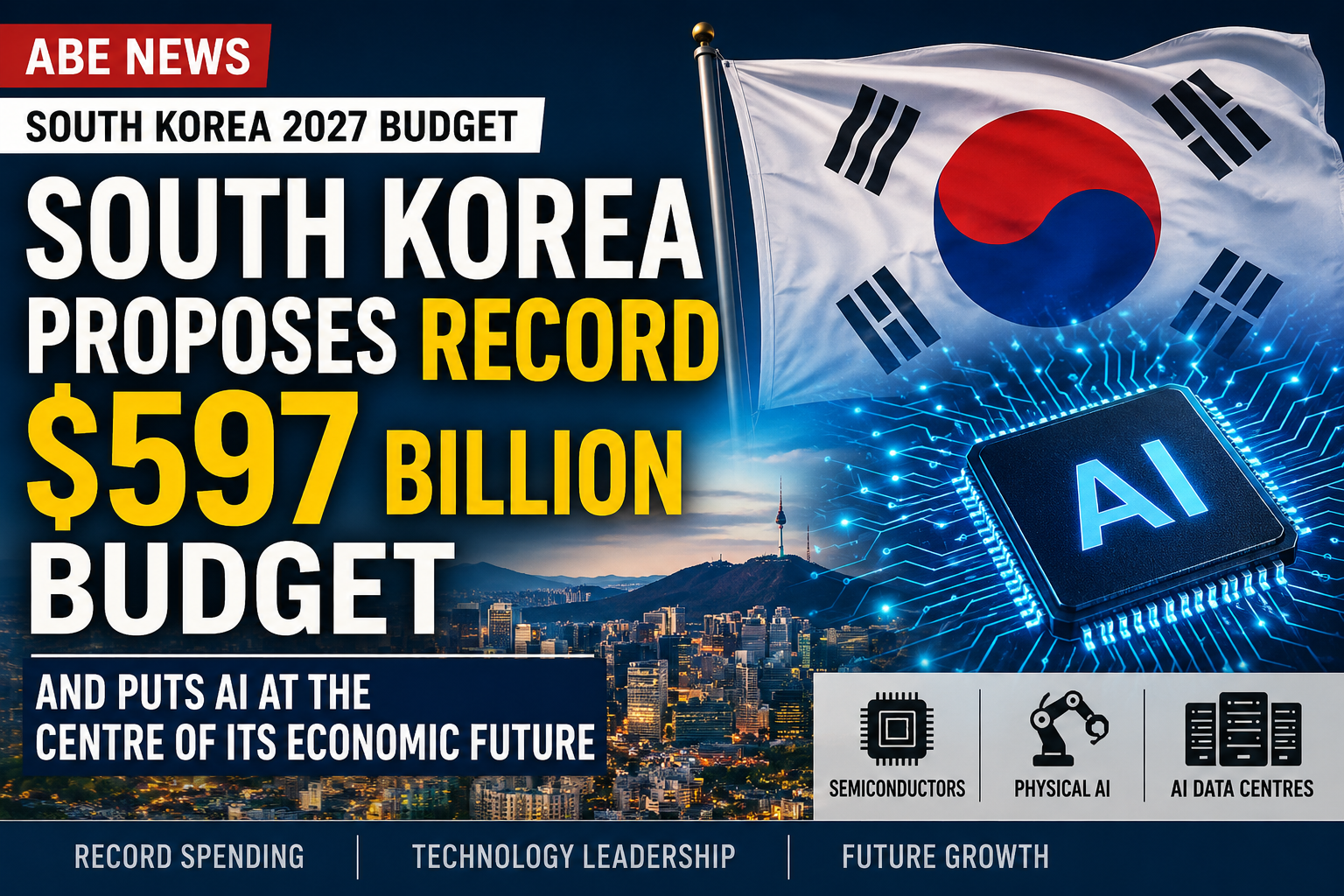
The government of President Lee Jae Myung unveiled a proposed 821 trillion won budget for 2027, worth roughly US$597 billion, representing a 12.8% increase from this year’s spending plan and the largest annual increase on record. The proposal marks a major shift toward expansionary fiscal policy as Seoul attempts to turn the extraordinary semiconductor boom into something much larger: a national technological transformation.
South Korea is already one of the world’s most important technology manufacturing powers. Its companies produce memory chips, displays, batteries, automobiles, smartphones and industrial equipment used across the global economy.
But the government appears to believe that being a major technology producer is no longer enough.
As the United States, China, Europe and other economies race to control artificial intelligence, advanced semiconductors, data centres, robotics and next-generation infrastructure, Seoul is preparing to use public money on an extraordinary scale to ensure South Korea remains near the front.
The country’s booming semiconductor companies are helping finance that ambition.
And that may be the most interesting part of the story.
AI is helping create a semiconductor windfall for South Korea — and South Korea now wants to reinvest part of that windfall into winning the next stage of the AI race.
THE $597 BILLION BET
The proposed 2027 budget would increase total government expenditure from roughly 728 trillion won this year to 820.9 trillion won next year.
South Korea’s government describes the plan as an attempt to reverse declining potential economic growth while confronting longer-term structural problems including an ageing population, a shrinking workforce and regional economic decline.
But technology is one of the defining themes.
The government has identified three major technology projects — semiconductors, physical AI and AI data centres — as strategic priorities and plans 21.3 trillion won in support around those projects, nearly double this year’s level.
That support is intended to go beyond simply funding software companies.
South Korea wants infrastructure.
It wants chips.
It wants computing capacity.
It wants electricity and water infrastructure capable of supporting enormous technology facilities.
It wants industrial complexes.
It wants robotics.
And it wants the human talent required to build and operate the next generation of AI systems.
This is what the global AI race increasingly looks like.
Not merely chatbots.
Not merely software.
Industrial policy.
10,000 GPUs AND A NATIONAL AI AMBITION
Under the proposal, South Korea plans to provide 10,000 graphics processing units, along with data and workers, to support development of a nationally competitive AI foundation model and public AI services.
The government is also proposing approximately 2.6 trillion won for physical-AI demonstration projects and broader support for semiconductor production capacity, core technologies and the surrounding industrial ecosystem.
Physical AI is particularly important.
The next stage of artificial intelligence may increasingly move beyond software running on computers and phones into machines operating in the physical world.
Robots.
Autonomous factories.
Vehicles.
Industrial equipment.
Logistics systems.
Smart infrastructure.
South Korea is unusually well positioned for that transition because it already possesses a huge manufacturing base.
The country is home to major semiconductor companies, automobile manufacturers, battery producers, electronics groups, shipbuilders and industrial companies.
If AI increasingly becomes embedded inside physical products, South Korea doesn’t necessarily have to recreate Silicon Valley.
It can combine AI with industries it already dominates.
That could become an enormous competitive advantage.
SAMSUNG AND SK HYNIX ARE HELPING PAY FOR IT
The financial engine behind this spending surge is equally remarkable.
Global demand for the specialized memory required by AI systems has produced huge profits for South Korean semiconductor manufacturers.
Samsung Electronics and SK hynix are central players in the global memory-chip industry, particularly the high-bandwidth memory technology increasingly required by advanced AI accelerators.
Those profits are now feeding directly into government finances.
South Korea expects total national tax revenue to reach 584.4 trillion won in 2027, with Reuters reporting that corporate tax receipts are projected to more than double to 216.7 trillion won.
In other words, the AI boom is producing extraordinary semiconductor profits.
Those profits produce corporate taxes.
Those taxes give the government more fiscal capacity.
And Seoul now intends to direct part of that capacity back toward AI, semiconductors and future technologies.
It’s a potentially powerful economic loop:
AI demand → chip profits → tax revenue → national technology investment → greater AI competitiveness.
South Korea is effectively attempting to convert today’s semiconductor boom into tomorrow’s industrial advantage.
A NEW 162 TRILLION WON FUTURE FUND
The government also plans to create a massive 162.3 trillion won Future Fund, using what it describes as windfall tax revenue generated partly by structural economic changes such as the semiconductor supercycle.
Rather than allowing all of that unexpected revenue to disappear into ordinary government spending, Seoul wants to reserve a substantial portion for longer-term priorities.
About 45.4 trillion won is expected to be deployed in 2027 across areas including future growth industries, young people, regional development and education and labour initiatives, while remaining resources can provide a buffer against future revenue fluctuations.
That matters because semiconductor cycles can be brutal.
Booms do not last forever.
Chip prices rise.
Capacity expands.
Demand eventually changes.
Profits fall.
Governments that permanently expand spending based on temporary windfalls can eventually find themselves facing enormous deficits when revenue disappears.
South Korea appears to be trying to capture some of today’s extraordinary gains without assuming they will continue indefinitely.
Whether that strategy works will depend heavily on how the money is invested.
THIS ISN’T JUST AN AI BUDGET
Despite the technology headlines, the 821 trillion won proposal is far broader.
South Korea plans 289 trillion won for health, welfare and labour, 110.7 trillion won for education, 73.3 trillion won for defence, 41.2 trillion won for industry, small and medium-sized enterprises and energy, and 39.5 trillion won for research and development.
The government is also increasing support for younger South Koreans across education, employment, entrepreneurship, housing, marriage, childbirth and childcare.
That reflects another existential problem facing the country.
Demographics.
South Korea has one of the world’s most severe population challenges.
Its extremely low birth rate and rapidly ageing population threaten to reduce the future workforce, weaken domestic demand and increase the burden of pensions and healthcare.
Technology therefore isn’t simply being treated as an opportunity.
It is increasingly being treated as a possible response to demographic decline.
If South Korea eventually has fewer workers, those workers will need to become dramatically more productive.
Automation, robotics and artificial intelligence could help make that possible.
SOUTH KOREA ALREADY HAS SOMETHING MOST AI CONTENDERS DON’T
There is another reason Seoul’s strategy deserves attention.
South Korea isn’t starting from zero.
It already sits near the centre of several critical global supply chains.
Samsung Electronics is one of the world’s largest semiconductor manufacturers.
SK hynix has become critically important to the high-bandwidth memory market powering AI accelerators.
South Korean companies are major players in batteries.
Hyundai and Kia are global automobile manufacturers.
The country has enormous shipbuilding capacity.
It has advanced telecommunications infrastructure.
It has sophisticated industrial suppliers.
And it has a highly educated population.
That gives South Korea something many countries pursuing AI strategies lack:
the ability to connect artificial intelligence directly to advanced manufacturing.
The United States dominates much of the AI software and accelerator ecosystem.
China has enormous manufacturing scale and a huge domestic market.
Europe has major industrial capabilities and research institutions.
South Korea’s opportunity is different.
It could become one of the places where advanced AI meets the physical economy.
THE WORLD IS ENTERING AN AI INDUSTRIAL-POLICY ERA
For much of the technology industry’s history, governments largely watched private companies compete.
That model is changing.
Semiconductors are now considered strategic assets.
AI computing capacity is increasingly treated as national infrastructure.
Countries are competing for data centres.
Governments are subsidizing chip factories.
Energy policy is becoming technology policy.
Export controls are determining which countries can access advanced processors.
And governments increasingly worry that dependence on foreign AI infrastructure could become an economic or national-security vulnerability.
South Korea’s budget belongs to this new era.
Seoul isn’t merely asking whether Korean companies can build good AI products.
It’s asking whether the entire country possesses enough computing capacity, semiconductor production, energy infrastructure, research, talent and capital to remain competitive as AI reshapes the global economy.
That is a much bigger question.
BUT $597 BILLION COMES WITH RISKS
There is also a danger in interpreting huge government spending as automatic progress.
Money doesn’t guarantee innovation.
Governments can invest in the wrong technologies.
Projects can become politically protected.
Infrastructure can take too long to build.
Companies can become dependent on subsidies.
And today’s technological winner may not remain tomorrow’s winner.
South Korea also faces an uncomfortable economic contradiction.
The government is preparing a massive fiscal expansion while monetary policy has become tighter.
President Lee said Tuesday that higher interest rates had become unavoidable, while arguing that fiscal policy should protect vulnerable groups and preserve long-term growth potential.
South Korea’s central bank recently raised its benchmark rate to 3%, while concerns remain around inflation, household debt and property prices.
That means one part of the economic system is attempting to cool demand while another prepares to spend aggressively.
Managing that tension will be difficult.
THE SEMICONDUCTOR BOOM COULD ALSO END
South Korea’s enormous revenue projections depend heavily on technology.
That’s both the strength and weakness of the strategy.
Semiconductor profits can fluctuate dramatically.
If global AI investment slows, memory demand weakens or competitors expand supply faster than expected, corporate profits could fall.
That would eventually reduce government tax revenue.
The government therefore has to make sure temporary semiconductor prosperity creates permanent productive assets.
Better infrastructure.
Better research.
Better universities.
More competitive startups.
More efficient factories.
More advanced robotics.
More computing capacity.
If the windfall simply produces larger recurring government expenses, South Korea could eventually regret the expansion.
If it creates new industries, however, the payoff could last decades.
THE NUMBERS ALSO SHOW SOUTH KOREA’S CURRENT MOMENTUM
South Korea’s economic backdrop helps explain why the government feels confident enough to make such an aggressive move.
Exports surged 68.7% year over year in August, reaching approximately $98.26 billion and extending the country’s export expansion to a fifteenth consecutive month, according to government data reported by Reuters.
Imports increased 22.5%, leaving a preliminary monthly trade surplus of approximately $34.75 billion.
Technology demand is a major reason.
That creates a very different economic environment from countries trying to finance AI strategies while their technology industries are struggling.
South Korea is attempting to invest while the machine is already producing cash.
EVEN DEBT COULD FALL RELATIVE TO THE ECONOMY
One of the more surprising aspects of the proposal is that the huge spending increase does not necessarily mean South Korea’s debt burden will rise relative to GDP next year.
The government projects national debt of roughly 1,519.8 trillion won in 2027, up in absolute terms from 2026.
But because revenues and the economy are also expected to grow, debt is projected to decline from 51.6% of GDP in 2026 to 48.3% in 2027.
The government also expects to reduce net sovereign bond issuance.
That is important because financial markets are becoming increasingly sensitive to government borrowing around the world.
Still, projections are projections.
They depend on economic growth and tax revenues arriving roughly as expected.
A global downturn or semiconductor reversal could change the calculation quickly.
SOUTH KOREA IS BETTING THAT AI CAN HELP SOLVE A MUCH BIGGER PROBLEM
Behind the hundreds of billions of dollars and thousands of GPUs lies a deeper challenge.
South Korea needs another growth engine.
The economic model that transformed the country from poverty into one of the world’s major industrial powers was built around manufacturing, exports, education and enormous corporate groups.
That model remains powerful.
But the population is ageing.
The workforce is shrinking.
Productivity growth is difficult.
Competition from China has intensified.
And many traditional industries are being transformed by software and automation.
AI therefore isn’t merely another technology sector for Seoul.
It could become a tool for upgrading almost everything South Korea already does.
Factories.
Cars.
Ships.
Semiconductors.
Healthcare.
Government.
Defence.
Logistics.
Education.
If AI can raise productivity across those sectors, South Korea may be able to continue growing despite demographic decline.
If it cannot, the country’s long-term economic challenge becomes considerably harder.
🔴 THE ABE NEWS TAKE
The most important thing about South Korea’s proposed $597 billion budget isn’t the size of the number.
It’s what the number tells us about where the global AI race is heading.
Artificial intelligence began as a competition between laboratories and technology companies.
It is rapidly becoming a competition between countries.
And countries compete differently.
They build power plants.
They finance infrastructure.
They educate workers.
They subsidize factories.
They fund research.
They establish industrial policy.
They control trade.
They negotiate access to strategic materials.
And increasingly, they decide whether computing infrastructure should be treated almost like roads, ports and electricity grids.
South Korea understands something important:
The countries that capture the greatest economic benefits from AI may not necessarily be the countries that build the most famous chatbot.
They may be the countries that successfully connect AI to the rest of their economy.
South Korea already has semiconductors.
It already has factories.
It already has robotics expertise.
It already has global electronics companies.
It already has automobiles, batteries, shipbuilding and advanced infrastructure.
Now Seoul wants to put artificial intelligence through that entire industrial machine.
And remarkably, the AI boom itself is helping finance the attempt.
Samsung and SK hynix benefit from exploding demand for AI memory.
Their profits strengthen government tax revenues.
The government then wants to recycle part of that windfall into chips, AI infrastructure, physical AI and future technologies.
If it works, South Korea could turn a semiconductor boom into a much broader technological transformation.
If it fails, the country could discover that enormous government spending cannot manufacture innovation on command.
Either way, the message from Seoul is unmistakable.
The AI race is no longer just Silicon Valley versus China’s technology giants.
Governments are entering the arena.
And South Korea has just put hundreds of billions of dollars behind its economic future.
ABE NEWS
Business. Money. Style. The News.
Understand More. Think Bigger.