










By ABE Magazine | November 6, 2026
The first week of November delivered major developments across politics, financial markets and the global economy. The United States voted for a new Congress, technology stocks suffered a sharp sell-off, Canada unveiled a major federal budget, and fresh employment figures complicated the outlook for interest rates.
The events were closely connected. Political changes in Washington raised questions about the future of business regulation, particularly in artificial intelligence. At the same time, investors grew more concerned about the cost of financing technology expansion, while volatile oil prices continued to influence inflation expectations.
For businesses and investors, November 2–6 was a reminder that political decisions, financial markets and economic conditions cannot be viewed in isolation.
1. U.S. Midterm Elections Change the Balance of Power in Washington
The November 3 midterm elections delivered a major shift in American politics, with Democrats winning control of both the House of Representatives and the Senate.
The results represented a substantial change from the Republican-controlled Congress that had supported President Donald Trump’s administration. Democratic victories extended into states and districts that had previously favoured Republicans, reflecting widespread voter concern over living costs, economic policy and the war involving Iran.
For the business community, the immediate significance lies in how the election could affect policymaking over the next two years.
A Democratic-controlled Congress will have greater power to scrutinize the administration, negotiate federal spending and influence legislation. However, the White House will remain under Republican control, creating the possibility of prolonged disagreements over taxation, trade and government spending.
Technology companies face particular uncertainty. Investors are assessing whether the new congressional majority will pursue tighter oversight of artificial intelligence, data centres and other rapidly expanding industries.
The election does not automatically mean that existing business policies will change. New legislation will still depend on negotiations between Congress and the president.
Nevertheless, the results have altered expectations about the direction of American economic policy.
Why it matters: The United States remains central to global finance and international trade. Changes in its legislative priorities can influence investment decisions, corporate planning and financial markets well beyond its borders.
2. Global Technology Stocks Suffer a Sharp Sell-Off
Financial markets reacted sharply to the week’s political developments and growing concerns about artificial intelligence investments.
On Thursday, November 5, the Nasdaq Composite recorded its largest one-day decline in approximately 19 months. The broader sell-off erased trillions of dollars in market value from major American companies and spread to international exchanges.
Technology and semiconductor companies were particularly exposed.
For several years, enthusiasm surrounding artificial intelligence has encouraged enormous investment in computing infrastructure, data centres and advanced chips. Investors have rewarded companies expected to benefit from this expansion, pushing valuations higher.
However, the week’s decline exposed concerns about whether those investments will produce sufficient financial returns.
The U.S. election results added another layer of uncertainty as investors considered the possibility of stricter AI regulation and delays affecting data-centre development.
Markets recovered some ground on Friday, with semiconductor stocks rebounding, but the volatility demonstrated how quickly investor sentiment can change.
The central question is no longer whether artificial intelligence has commercial potential. It is whether the scale and speed of investment can be justified by future earnings.
Why it matters: The technology industry influences pension funds, institutional portfolios, infrastructure spending and global equity markets. A sustained decline in technology valuations could make financing more expensive and affect investment beyond the sector itself.
3. Canada Unveils a Major Budget to Strengthen Investment and Infrastructure
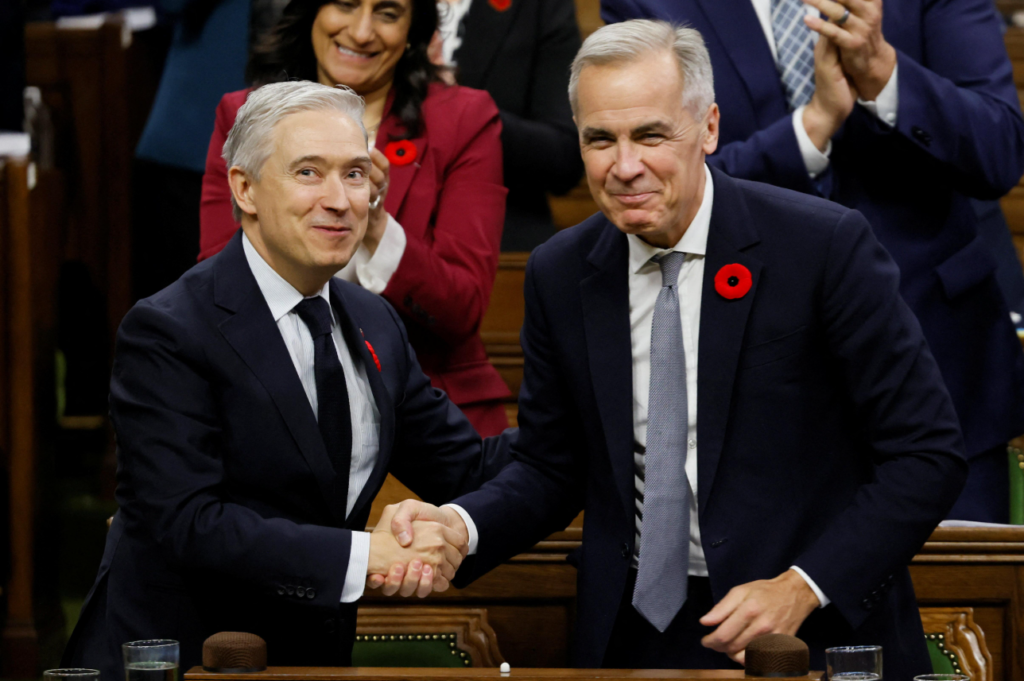
Canada delivered one of the week’s most consequential economic announcements on Thursday, November 5, when Prime Minister Mark Carney’s government presented its second federal budget.
The government proposed using additional revenue generated by higher oil prices to support investment, infrastructure and productivity.
The budget outlined up to C$142.1 billion in spending and tax measures over five years, including incentives intended to attract private investment and strengthen domestic industries.
The strategy also reflects Canada’s efforts to reduce its economic dependence on the United States amid continuing trade tensions.
Infrastructure, energy, housing and business investment featured prominently in the government’s proposals.
Supporters of the approach argue that improving infrastructure and encouraging capital investment could strengthen Canada’s long-term competitiveness. Critics and some economists have raised concerns about debt levels, financing costs and the government’s decision to spend much of its additional fiscal capacity rather than reduce borrowing.
The budget’s effectiveness will ultimately depend on how much private investment it generates and whether the proposed spending produces measurable productivity improvements.
Why it matters: Canada’s economic future depends not only on government expenditure but also on the ability of businesses to invest, expand and compete internationally.
4. Oil Markets Swing as the Iran Conflict Influences Prices
Energy markets experienced another volatile week as investors reassessed the outlook for oil supplies and geopolitical risk.
The continuing conflict involving Iran has created uncertainty around energy production, transportation and international trade.

However, oil prices moved sharply lower during the week as expectations surrounding the conflict changed and traders considered the possibility of improved supply conditions.
Brent crude was on course for its largest weekly percentage decline since 2020, according to Reuters reporting on November 6.
The movement demonstrated that oil prices depend on more than physical supply. Expectations about future disruptions, political negotiations and global demand can cause substantial changes in market prices.
For oil-producing countries and energy companies, falling prices can reduce revenue expectations. For airlines, transportation operators and manufacturers, lower fuel costs can offer relief.
Canada faces a particularly complex situation. Higher oil revenue has strengthened the federal government’s fiscal position, but energy-price volatility makes long-term planning more difficult.
Why it matters: Oil remains a major influence on inflation, transportation costs, government revenue and international trade. Changes in energy prices can quickly affect economic conditions across multiple industries.
5. U.S. Employment Strengthens While Canada’s Labour Market Weakens
Friday’s employment reports revealed contrasting conditions in the two largest North American economies.
The United States added approximately 165,000 jobs in October, exceeding expectations of around 65,000.
The stronger-than-expected result reinforced concerns that the Federal Reserve may need to maintain restrictive monetary policy to control inflation.
For investors, stronger employment can be both encouraging and concerning. It suggests that economic activity remains resilient, but it can also reduce expectations of lower borrowing costs.
Canada’s labour market delivered a different signal.
Employment declined by approximately 4,700 positions in October, while the unemployment rate rose to 6.7%.
The Canadian dollar weakened following the release, reflecting concerns about economic growth and the outlook for monetary policy.
The difference between the two countries highlights the challenges facing Canadian businesses, particularly those exposed to American trade, exchange-rate movements and domestic consumer demand.
Why it matters: Employment influences consumer spending, business confidence, wages and central-bank decisions. Diverging labour-market conditions can also create different interest-rate expectations in Canada and the United States.
6. Silicon Valley Bank Settlement Brings Banking Accountability Back Into Focus
The financial sector also saw a significant legal development on Friday.
Investors reached a US$224.5 million settlement with accounting firm KPMG over litigation connected to the 2023 collapse of Silicon Valley Bank.
Norway’s sovereign wealth fund, which participated in the investor lawsuit, announced the agreement.
KPMG maintained that the settlement did not constitute an admission of wrongdoing and said it stood by its audit work. Proceedings against other defendants continue.
The settlement brought renewed attention to the responsibilities of auditors, corporate governance and financial institutions.
Silicon Valley Bank’s failure demonstrated how interest-rate exposure, concentrated deposits and declining customer confidence can threaten a financial institution.
The latest agreement illustrates how the consequences of a banking collapse can continue long after the original event.
Why it matters: Trust in financial reporting and effective oversight remains essential to investor confidence and the stability of the banking system.
THE NUMBERS THAT DEFINED THE WEEK
| Figure | Development |
|---|---|
| November 3 | U.S. midterm elections changed congressional control |
| Nearly US$3 trillion | Market value erased from S&P 500 companies during Thursday’s technology sell-off |
| C$142.1 billion | Canadian budget spending and tax measures planned over five years |
| 165,000 | U.S. jobs added in October |
| 6.7% | Canada’s October unemployment rate |
| US$224.5 million | KPMG settlement relating to Silicon Valley Bank |
WHAT TO WATCH NEXT WEEK
Attention now turns to whether financial markets can stabilize after the technology sell-off.
Investors will closely monitor the upcoming U.S. inflation report for evidence of whether price pressures are easing or remaining persistent. The figures could influence expectations for the Federal Reserve’s December interest-rate decision.
Technology companies will also face continued scrutiny over the cost of artificial intelligence infrastructure and the sustainability of future earnings.
In Canada, businesses and economists will examine the federal budget’s implications for investment, fiscal sustainability and economic growth.
Meanwhile, developments involving Iran and global energy supplies will remain important for oil prices and inflation expectations.
The next week will help determine whether the recent market volatility represents a temporary adjustment or the beginning of a broader reassessment of economic risks.
THE ABE TAKE
The defining lesson from this week is that political power, economic growth and financial confidence are increasingly interconnected.
The U.S. elections demonstrated how public concerns about living costs and economic policy can reshape the political environment. For businesses, the consequences extend beyond election results to the regulations, fiscal decisions and investment conditions that may follow.
The technology sell-off revealed another important reality: even the most promising industries remain subject to financial discipline. Artificial intelligence may transform the global economy, but investors are beginning to demand stronger evidence that enormous infrastructure investments can generate sustainable returns.
Canada’s federal budget presented a different challenge. The government is attempting to convert additional resource revenue into long-term economic growth, while economists debate whether its fiscal strategy can deliver the expected benefits without creating further debt pressures.
Together, these developments raise an important question for the corporate world: how can businesses pursue growth while remaining resilient to political uncertainty, changing borrowing costs and volatile markets?
The answer will differ across industries, but the underlying principle remains consistent. Long-term success requires more than identifying opportunities. It requires understanding the risks that could undermine them.
This week’s events demonstrated that the most important business decisions are often shaped by developments far beyond the boardroom.
ABE MAGAZINE
Understand More. Think Bigger.