








ABE NEWS | August 29, 2026
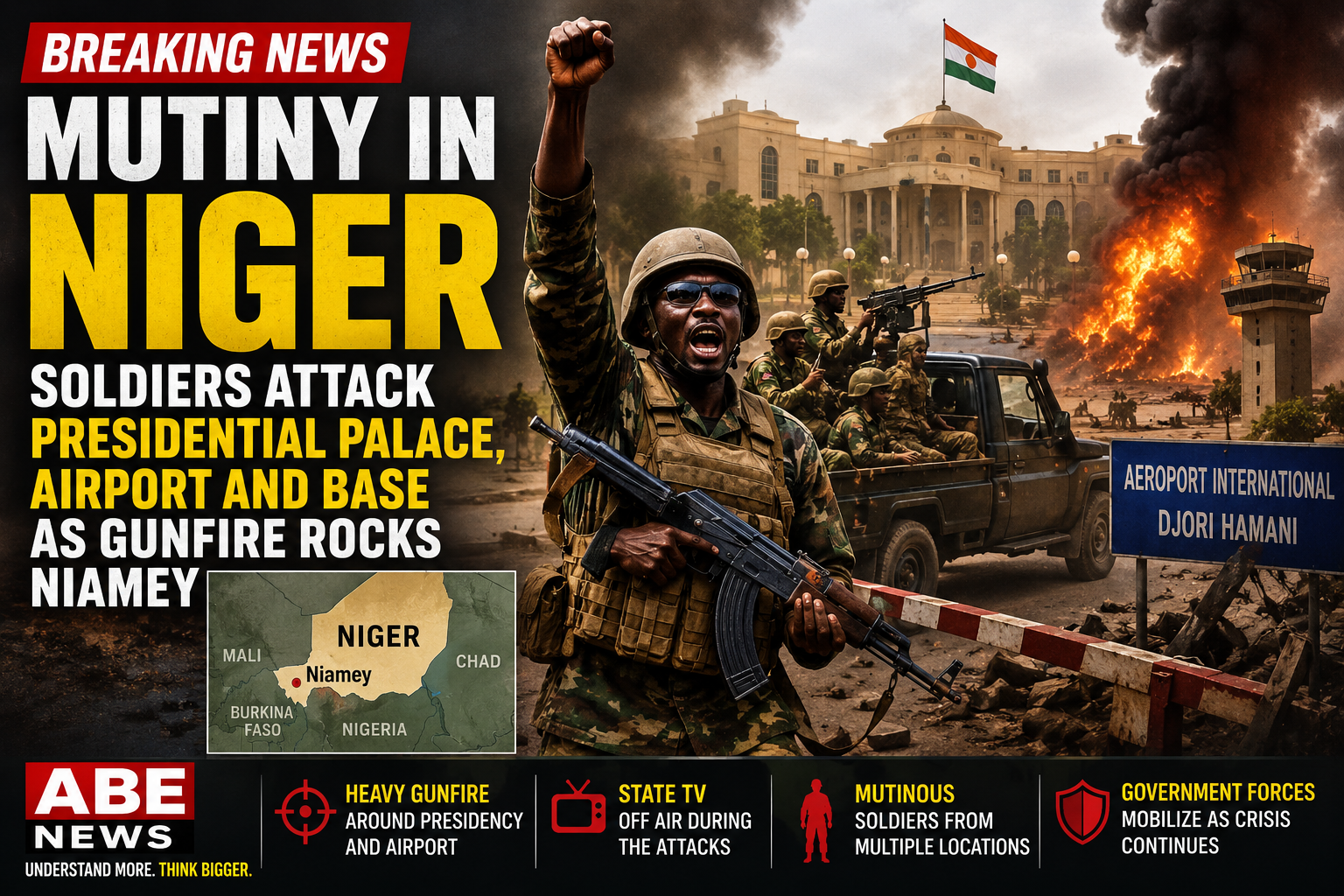
Niger has been plunged into a new political and security crisis after mutinous soldiers launched attacks across the capital, Niamey, targeting some of the most sensitive locations in the country — including the presidential palace, international airport and a major military airbase.
Heavy gunfire and explosions echoed through parts of Niamey for hours early Saturday as security forces battled attackers around the seat of government and Diori Hamani International Airport.
Multiple sources described the assault as involving soldiers rebelling from within Niger’s own armed forces, raising the possibility of a serious internal challenge to the military government that itself seized power in a coup only three years ago.
State television and radio went offline during the unrest.
The government urged the population to remain calm and said security forces were mobilizing.
Reports from the capital indicated that government forces had regained control of some strategic positions, including the important Base 101 military airbase, while security operations continued.
But the situation remained fluid Saturday morning.
And one crucial question had not yet been answered:
Is Niger witnessing a failed military mutiny — or the beginning of another attempt to overthrow the government?
Gunfire Erupts Across Niamey
The unrest began during the night and continued into Saturday morning.
Residents reported sustained bursts of gunfire and powerful explosions in several parts of Niamey.
Two locations quickly emerged as particularly important.
The first was the area surrounding Niger’s presidential palace.
The second was the airport complex, which includes Diori Hamani International Airport and Base 101, one of the country’s strategically important military installations.
Witnesses reported heavy and persistent shooting around the presidency.
At the airport, attackers targeted Base 101 as security forces fought to maintain control.
Four sources cited in reporting on the crisis described the assault as an attack by mutinous soldiers.
The early-morning operation reportedly involved soldiers linked to several locations in southwestern Niger, including Ouallam, Téra and Dosso.
That detail is significant.
It suggests authorities may be confronting something different from the jihadist attacks that have repeatedly struck Niger.
This time, the threat may be coming from within the security establishment itself.
Presidential Guard Confronts Mutineers
The battle around the presidency became one of the most important fronts.
Security reporting indicated that members of the presidential guard repelled soldiers attempting to enter the presidential complex.
That would make the confrontation particularly dangerous for General Abdourahamane Tiani, Niger’s military leader.
The presidential guard is not simply another security unit in Niger’s recent political history.
Tiani himself commanded the presidential guard before leading the military coup that removed elected President Mohamed Bazoum in July 2023.
Three years later, the political order created by that coup is facing another challenge involving armed men and the same centre of power.
At this stage, there is no reliable evidence that Tiani has been removed from office.
There is also no confirmed announcement of a new government.
That distinction matters.
Gunfire around a presidential palace does not automatically mean a coup has succeeded.
But in a country where military intervention has already changed the government once in recent years, an armed rebellion inside the security forces immediately becomes a national political crisis.
State Television Goes Dark
Another worrying development came from Niger’s state media.
State television and radio went offline during the unrest.
Public broadcasting interruptions are closely watched during attempted coups because control of television and radio has historically been used by military plotters to announce the removal of governments.
But a blackout alone does not prove that mutineers captured the broadcaster.
The government was still able to issue a statement urging people to remain calm and warning against the circulation of unverified information.
Later reports indicated that the state television signal was restored after being unavailable for more than an hour.
The competing signals illustrated how confused the situation remained.
Security forces appeared to retain significant control.
But the mutiny was serious enough to disrupt key institutions in the capital.
Base 101 Becomes a Major Battleground
The airport complex is strategically important for another reason.
Alongside the civilian airport sits Base 101, an important military airbase.
Heavy fighting was reported there.
Bana Wagana Ibrahim, a Nigerien official and member of the parliament of the Alliance of Sahel States, said attackers targeted the installation but security forces regained control.
Security sources also said some attackers had been neutralized while others fled, prompting search operations.
Those claims were not immediately independently verified.
The airport area has become a recurring security vulnerability.
It was attacked earlier this year by militants linked to extremist organizations operating across the Sahel.
But Saturday’s violence appears potentially different because multiple sources have identified the attackers as mutinous soldiers.
If confirmed, that would shift the crisis from another jihadist assault toward an internal military confrontation.
Niger Is Already Ruled by Soldiers
The political irony is difficult to ignore.
Niger’s current government exists because of a military coup.
On July 26, 2023, soldiers detained President Mohamed Bazoum and announced that they had removed his government.
Tiani, then commander of the presidential guard, emerged as leader of the new military administration.
The coup triggered an enormous regional confrontation.
The Economic Community of West African States, or ECOWAS, imposed sanctions and threatened military intervention if constitutional government was not restored.
Western governments demanded Bazoum’s release.
But the military government survived.
Tiani consolidated power.
And Niger began dramatically reshaping its foreign relationships.
Niger Turned Away From the West
Before the coup, Niger had been one of the West’s most important security partners in the Sahel.
American and French forces operated in the country as part of counterterrorism efforts against Islamist militant groups.
That relationship collapsed after the military takeover.
France withdrew its troops.
The United States later withdrew forces as well.
Niger strengthened its relationship with Russia and increasingly coordinated with the military governments of neighbouring Mali and Burkina Faso.
The three countries eventually formed the Alliance of Sahel States, commonly known by its French acronym AES.
They also withdrew from ECOWAS.
Their governments argued that Western-backed security strategies had failed and that Sahel countries needed greater control over their own defence and natural resources.
The promise was sovereignty.
The promise was also security.
Three years later, that second promise remains extremely difficult to fulfil.
The Jihadist Threat Never Disappeared
Niger sits inside one of the world’s most dangerous zones for Islamist insurgencies.
Armed groups linked to al-Qaeda and Islamic State operate across parts of Niger, Mali and Burkina Faso.
Military governments in all three countries justified taking power partly by arguing that elected governments had failed to defeat those insurgencies.
Yet violence has continued.
Niger has suffered repeated attacks on soldiers and civilians.
Even Niamey — once relatively insulated from much of the violence affecting rural areas — has experienced attacks this year.
The airport and military base were targeted previously.
Saturday’s mutiny therefore arrives at a dangerous moment.
Niger’s government is simultaneously trying to confront external insurgents and maintain cohesion inside its own armed forces.
If divisions within the military deepen, the country’s ability to fight jihadist groups could weaken further.
Uranium Makes Niger Globally Important
Niger may be one of the world’s poorer countries by income, but what lies beneath its soil gives it enormous strategic importance.
The country is a significant producer of uranium, the fuel used by nuclear power plants.
For decades, French companies played a major role in Niger’s uranium industry.
After the 2023 coup, that relationship deteriorated dramatically.
The military government pushed for greater state control over the country’s mineral resources and became embroiled in a bitter dispute with French nuclear company Orano.
Niger has also reallocated uranium permits previously associated with foreign mining companies to state-backed entities.
The shift has been presented by the government as an assertion of economic sovereignty.
But it has also created uncertainty for foreign investors.
Political instability could deepen that uncertainty.
A serious internal power struggle would raise questions about mining licenses, exports, contracts and the future of foreign investment in the country.
Niger Also Has Oil and Gold
Uranium is only part of the economic story.
Niger possesses significant oil and gold resources as well.
The country has expanded oil production and export infrastructure, including a major pipeline connecting Niger’s oil fields to the Atlantic coast through Benin.
That infrastructure was supposed to help transform Niger’s economy.
But political disputes have repeatedly complicated the project.
Relations between Niger and Benin deteriorated after the 2023 coup.
Border tensions affected trade.
Oil exports became entangled in regional politics.
Now another internal crisis risks adding further uncertainty.
For investors, resource wealth does not automatically equal opportunity.
Political stability determines whether mines operate, pipelines flow, contracts survive and companies can safely deploy capital.
Saturday’s fighting is therefore not merely a political story.
It is also a business and commodities story.
Another Test for the Sahel’s Military Governments
What happens in Niger will be watched closely in Mali and Burkina Faso.
The three military-led countries have increasingly tied their political futures together.
They cooperate on defence.
They have developed common diplomatic positions.
And they have promoted the Alliance of Sahel States as an alternative to the traditional West African regional order.
A major destabilization of Niger would therefore create problems beyond its borders.
If Tiani’s government survives but emerges weakened, questions will grow about internal cohesion within the AES.
If another group of soldiers succeeds in replacing the existing military leadership, it could expose a deeper problem:
Military coups may remove governments quickly.
They do not necessarily create stable political systems afterward.
West Africa Has Seen This Cycle Before
Niger’s crisis is part of a broader pattern.
Over the past several years, West and Central Africa experienced a wave of military coups and attempted coups.
Mali experienced coups in 2020 and 2021.
Burkina Faso suffered two coups during 2022.
Guinea’s military seized power in 2021.
Gabon experienced a coup in 2023.
Niger followed the same year.
Each country has its own circumstances.
But common frustrations frequently appeared:
Weak institutions.
Security failures.
Economic hardship.
Public anger.
Distrust of political elites.
And military officers arguing that extraordinary intervention was necessary to restore order.
The problem is what comes afterward.
Removing a government is much easier than fixing the conditions that made the government unpopular.
What This Means for Ordinary Nigeriens
Behind the military movements and geopolitical calculations are roughly 28 million people.
Niger is one of the youngest countries in the world demographically.
It is also one of the poorest.
Millions of people depend on agriculture.
Climate pressures threaten livelihoods.
Food insecurity remains a serious concern.
Education and healthcare systems face enormous constraints.
And conflict has displaced communities across parts of the country.
Another prolonged political crisis would make those problems harder.
Businesses may delay investment.
Transportation can be disrupted.
Foreign aid becomes more complicated.
Tourism disappears.
Government attention moves away from development and toward survival.
And ordinary families once again face uncertainty over who actually controls the state.
Russia Will Be Watching Closely
Moscow also has significant interests in the outcome.
As Niger’s relationships with France and the United States deteriorated, Russia expanded its influence across the Sahel.
Russian security personnel have operated in the region, while Moscow has sought deeper defence, diplomatic and commercial ties with military-led governments.
Niger became part of that geopolitical realignment.
Any change in leadership could therefore affect more than domestic politics.
A new government could maintain Tiani’s pro-Russian direction.
It could move even closer to Moscow.
Or it could attempt to rebuild relationships with Western governments and neighbouring ECOWAS countries.
That is one reason events in Niamey matter far beyond Niger.
The country has become part of the larger competition for influence in Africa.
What Happens Next
Several questions now determine where this crisis goes.
First: Is Tiani securely in control?
There has been no credible confirmation that his government has fallen.
But the scale of the attack means the strength of his control will be closely examined.
Second: Who exactly organized the mutiny?
Identifying the officers, units and political objectives behind the rebellion will be critical.
Third: How much of the military supports them?
A small group of mutineers can be defeated.
A rebellion spreading across military units is a much more serious threat.
Fourth: Who controls Niamey’s strategic institutions?
The presidential palace, airport, military bases, communications infrastructure and state broadcaster are particularly important.
Fifth: What happens outside the capital?
Coups are not decided only in presidential compounds.
Regional commanders and military units across the country may determine whether the government survives.
Until those questions are answered, claims of victory from either side should be treated cautiously.
🔴 THE ABE NEWS TAKE
Niger’s crisis contains a warning that reaches beyond Niger.
Military governments often come to power with a simple argument:
The previous system failed. We can restore order.
That argument can be powerful when people are frustrated by corruption, insecurity and weak institutions.
But taking control of the presidential palace is not the same as solving those problems.
Niger’s military removed an elected president in 2023.
It expelled or distanced itself from traditional Western partners.
It strengthened relations with Russia.
It asserted greater control over uranium and other natural resources.
It joined neighbouring military governments in building a new regional alliance.
Those were enormous changes.
Yet the country’s fundamental security problem did not disappear.
And now the government may be facing a threat from inside the very institution that brought it to power.
There is a deeper lesson here.
When political power ultimately depends on who controls the guns, every faction with guns eventually understands the same equation.
That creates instability no mineral deposit can solve.
Niger has uranium.
It has oil.
It has gold.
It occupies an important geographic position connecting West and North Africa.
All of those things give the country enormous potential.
But resources become wealth only when institutions are strong enough to turn them into development.
And development becomes difficult when governments can change at gunpoint.
Saturday’s fighting may ultimately end as a failed mutiny.
It may become something much larger.
We do not know yet.
What we do know is that three years after soldiers promised to bring Niger greater security, gunfire is once again being heard around the presidential palace.
For Niger, that is the story that matters most.
ABE NEWS
Business. Money. Style. The News.
Understand More. Think Bigger.