


ABE NEWS | WEDNESDAY, AUGUST 26, 2026
A fight over the future of world football is escalating far beyond the pitch.
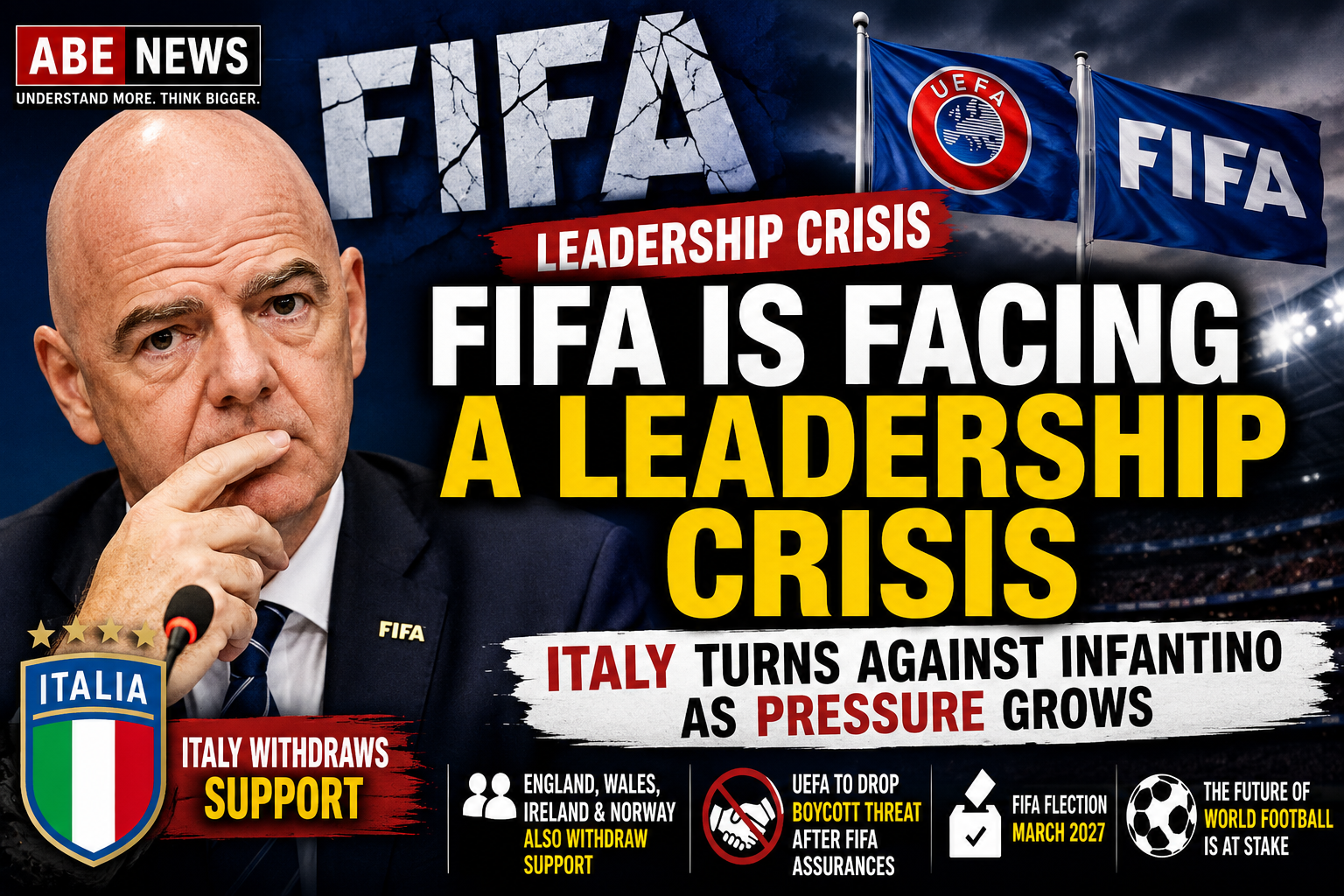
FIFA President Gianni Infantino, once expected to move comfortably toward another term leading the world’s most powerful football organization, is facing an increasingly organized revolt over his leadership. Italy became the latest major football nation Wednesday to withdraw its support for Infantino’s re-election, joining England, Wales and Ireland, while Norway and several other Nordic federations have publicly said they have lost confidence in him. At the same time, three continental confederations representing Europe, Asia, North America, Central America and the Caribbean have put pressure on the FIFA president to step aside.
The immediate crisis was triggered by an extraordinary proposal to sell stakes in some of FIFA’s most valuable competitions, including the World Cup, to private investors. FIFA abandoned that proposal in July following fierce opposition, but the backlash has developed into something much larger than a disagreement over one commercial plan. Critics are now questioning how FIFA is governed, how much authority has accumulated around its president and whether the organization responsible for the world’s biggest sport is making major decisions without sufficient consultation.
UEFA’s 55 member associations had gone as far as agreeing to boycott FIFA competitions over the proposal. That threat is now expected to be withdrawn after FIFA provided assurances that the controversial plan will not return. But the retreat from a boycott should not be mistaken for a reconciliation.
The fight over Infantino himself is continuing.
And with a FIFA presidential election scheduled for March 2027, world football may now be heading toward a leadership battle that looked almost unimaginable only months ago.
The World Cup Became the Centre of the Fight
At the heart of the confrontation is FIFA Forward Enterprises, or FFE, a proposal associated with Infantino that would have opened the door to selling stakes connected with FIFA’s major competitions to private investors.
For football’s governing bodies, the issue touched something much bigger than financing.
The World Cup isn’t simply another sports property. It is FIFA’s crown jewel, one of the most watched sporting events on Earth and the economic engine underpinning much of the organization’s global influence. Commercial rights surrounding the tournament generate enormous revenues from broadcasters, sponsors, licensing and other partnerships.
The idea that private investors could acquire a stake in that ecosystem therefore raised fundamental questions about who should benefit from football’s most valuable competitions and who should have the authority to make decisions about them.
European opposition was particularly intense. UEFA’s 55 member associations ultimately agreed to the extraordinary possibility of boycotting FIFA competitions if their demands were not met. FIFA withdrew the proposal at the end of July, and UEFA subsequently sought assurances that a similar plan would not simply return under another form.
Those assurances have now apparently arrived.
Sources familiar with the discussions told Reuters that UEFA officials are expected to inform their executive committee and member federations that the conditions necessary to lift the boycott have been satisfied.
That solves one problem.
It does not solve FIFA’s leadership crisis.
Italy Just Made the Rebellion Bigger
Italy’s decision matters because this is not a minor football federation protesting from the sidelines.
The Italian Football Federation, or FIGC, formally withdrew its support Wednesday for Infantino’s candidacy in next year’s presidential election, saying its decision reflected concerns over recent initiatives involving FIFA’s governance and international competitions. FIGC President Giovanni Malagò said Italy would continue working alongside UEFA and other European federations in support of a football model based on principles including merit, solidarity, sustainability and the centrality of supporters.
Italy now joins an expanding European opposition movement.
England, Wales and Ireland had already withdrawn support for Infantino earlier this month. Norway has called for him to step down, while Norway, Sweden, Finland, Denmark, Iceland and the Faroe Islands jointly said they had lost confidence in his leadership.
The significance is not merely the number of countries involved.
These are national associations that participate directly in FIFA’s political system and ultimately hold votes in presidential elections.
Infantino’s problem is therefore moving from public criticism toward something potentially much more dangerous:
votes.
This Is No Longer Just a European Revolt
If the rebellion were confined entirely to UEFA, Infantino’s position would be considerably easier to defend. FIFA has 211 member associations, and Europe represents only one part of that electorate.
But Reuters reports that pressure is also coming from the Asian Football Confederation and CONCACAF, which governs football across North America, Central America and the Caribbean. Regional governing bodies have discussed the possibility of a vote of no confidence in Infantino.
That changes the political calculation considerably.
FIFA presidential elections operate on a one-association, one-vote principle. Germany receives one vote. Brazil receives one vote. Canada receives one vote. Cameroon receives one vote. A small football nation can therefore carry the same formal presidential voting power as a country containing one of the world’s wealthiest leagues.
That structure has historically made FIFA politics very different from the economics of football.
European clubs and leagues generate extraordinary commercial wealth, but European federations cannot simply determine FIFA’s leadership on their own. A successful presidential coalition has to reach across continents.
Infantino still retains significant support, particularly among federations in Africa and South America, according to Reuters. He has also sought to appeal directly to individual national associations rather than relying exclusively on relationships with continental confederations.
So the FIFA president is weakened.
He is not necessarily defeated.
Infantino Was Supposed to Have a Much Easier Election
Infantino has led FIFA since 2016 and intends to seek another term next year.
Until the recent controversy, another victory appeared considerably more straightforward. The presidential election will be held in Morocco in March 2027, and FIFA has established November 18 as the deadline for challengers to enter the race.
Now the possibility of a genuine challenger has become much more realistic.
UEFA President Aleksander Čeferin has publicly ruled out running himself, despite becoming one of Infantino’s most prominent critics. But Čeferin has said Infantino should either recognize that he no longer has sufficient support and leave or face an opponent in the March election.
That creates a fascinating political situation.
The opposition does not simply need to criticize Infantino. It needs to find someone capable of building a coalition across football’s very different regions.
A candidate perceived purely as Europe’s choice could struggle to win support from Africa, Asia, South America and smaller football nations that may have different priorities from UEFA’s richest associations.
So removing Infantino and replacing Infantino are two separate problems.
The second could prove considerably harder.
Why UEFA Is Backing Away From the Boycott
A boycott of FIFA competitions would have represented one of the most dramatic institutional ruptures in modern football.
Imagine major European national teams refusing to participate in FIFA tournaments.
The consequences would extend far beyond executives in meeting rooms. Players could lose the opportunity to compete internationally, broadcasters could face disrupted contracts, sponsors could reconsider agreements and fans could lose major tournaments.
The immediate pressure is particularly acute because the FIFA Under-20 Women’s World Cup begins in Poland on September 5. Young players have spent years preparing for an opportunity many may experience only once.
That helps explain why UEFA appears prepared to stand down from the boycott now that FIFA has withdrawn the investment proposal and provided assurances that it will not be revived.
A source familiar with the discussions told Reuters that avoiding harm to young players was an important reason to step away from the boycott, while stressing that pressure for broader changes would continue.
That is an important distinction.
UEFA appears to be separating the tournaments from the leadership dispute.
European teams can continue playing.
The political campaign against Infantino can continue too.
The Argument Is Now About How FIFA Is Governed
European Leagues President Claudius Schaefer sharpened that argument Wednesday, saying Infantino could not have a future at FIFA and arguing that meaningful reform would require another president.
European Leagues represents 53 professional men’s and women’s football leagues, giving Schaefer’s intervention additional weight. His criticism focused heavily on what he described as an increasingly centralized decision-making structure in which major decisions can be made without meaningful consultation with stakeholders who will be affected.
That criticism gets to the heart of the broader dispute.
The World Cup investment proposal may have been the event that triggered the current revolt, but Infantino’s opponents increasingly appear to be making a larger argument: that too much institutional power has accumulated around the FIFA presidency.
If that argument gains support outside Europe, the March election could become a referendum not merely on one individual but on the structure of FIFA itself.
Questions about governance have haunted the organization before. FIFA has spent years trying to rebuild credibility following corruption scandals that shook world football during the previous decade.
That history makes any new argument about transparency, consultation and concentrated presidential authority particularly sensitive.
But Infantino Still Has Powerful Allies
It would be premature to write Infantino’s political obituary.
Some of FIFA’s member federations continue to support him, and his backing outside Europe could be decisive.
Associated Press reports that Morocco, which will co-host the 2030 World Cup and host next year’s FIFA election, remains among the federations supporting Infantino. Qatar, host of the 2022 World Cup, has also backed him. Saudi Arabia, which will host the 2034 tournament, has not publicly endorsed him despite his close political relationships with the kingdom.
Reuters also reports that Infantino retains backing from African and South American confederations.
This illustrates one of the reasons FIFA politics can be difficult to predict from headlines alone.
A collection of famous European football nations withdrawing support creates enormous reputational pressure. But winning a FIFA presidential election requires assembling votes across the entire membership.
If Infantino can maintain strong support in Africa, South America and enough individual associations elsewhere, European opposition alone may not remove him.
The real question is whether the rebellion spreads.
Football Has Become an Enormous Business
There is another reason this leadership battle matters beyond sports politics.
Modern football is a gigantic global business.
World Cups generate billions in commercial revenue. Broadcasting rights are sold around the world. Sponsors attach their brands to tournaments watched by enormous audiences. Host countries spend heavily on infrastructure, while clubs have become increasingly valuable investment assets.
The controversy over potentially selling stakes connected to FIFA competitions therefore sits at the intersection of two competing realities.
Football is culturally treated as something belonging to supporters, national associations and communities.
But elite football is simultaneously a commercial product worth extraordinary amounts of money.
Private capital has already transformed significant parts of the sport. Investment funds and wealthy individuals own clubs, leagues negotiate increasingly valuable media agreements, and sovereign wealth has become a major force in football finance.
FIFA’s abandoned proposal pushed that commercial logic toward one of the few assets even many football executives apparently believed should remain fundamentally under the game’s own control:
the World Cup.
The backlash demonstrates that there may still be limits to how far football’s biggest institutions are willing to commercialize the sport.
The Next Important Date Is November 18
For all the dramatic statements, the leadership fight eventually has to become an election.
Potential challengers have until November 18 to nominate for the FIFA presidency.
That makes the next several months crucial.
If no credible opponent emerges, Infantino could survive even an extraordinary amount of criticism.
If a serious candidate does emerge—particularly one capable of attracting support across Europe, Asia, CONCACAF and portions of Africa or South America—the March vote becomes genuinely competitive.
The opposition also faces a strategic choice.
Does it primarily seek to remove Infantino?
Or does it demand structural reforms to FIFA regardless of who becomes president?
Schaefer has argued that changing the individual is insufficient unless the role itself is reformed.
That may ultimately become the bigger question.
Because replacing a president without changing the system that concentrates authority around the presidency could simply reproduce the same conflict under another name.
🔴 THE ABE NEWS TAKE
The most important development in FIFA’s crisis isn’t that UEFA appears ready to abandon its boycott.
It is that the boycott may be ending while the rebellion continues.
Those are very different things.
FIFA withdrew the controversial World Cup investment proposal. UEFA received assurances that it would not return. Young players preparing for international tournaments no longer need to become casualties of a political battle among football executives.
That is progress.
But Italy’s decision to withdraw support for Infantino on the same day demonstrates that the underlying problem has not disappeared. England, Wales and Ireland have already moved away from him. Nordic federations have lost confidence. UEFA, the AFC and CONCACAF have all applied pressure.
Meanwhile, Infantino still has allies across other regions and controls the advantage of incumbency.
That means world football is entering a political contest with an uncertain outcome.
The World Cup belongs emotionally to billions of supporters. Commercially, it is one of the most valuable properties in global sport. Institutionally, however, it is controlled by an organization whose leadership is now fighting over how that value should be managed and who gets a voice in deciding its future.
That is why this story matters beyond Gianni Infantino.
It asks a much larger question:
Who actually controls world football?
The president?
The 211 national associations?
The continental confederations?
The leagues and clubs that supply the players?
The investors supplying the money?
Or the supporters whose attention makes the entire business valuable in the first place?
FIFA’s abandoned investment plan forced football to confront that question.
Now the answer may determine who runs the organization next.
The boycott may be ending. The battle for FIFA is not.
ABE NEWS
Business. Money. Style. The News.
Understand More. Think Bigger.